 sandwich panel machine
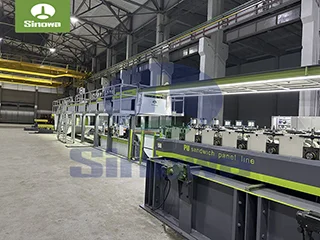
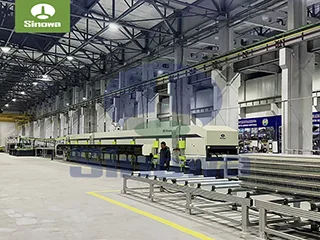
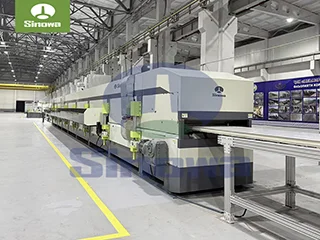
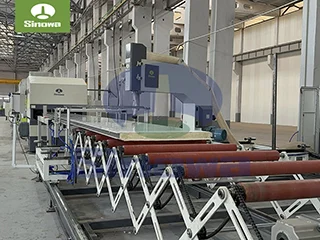
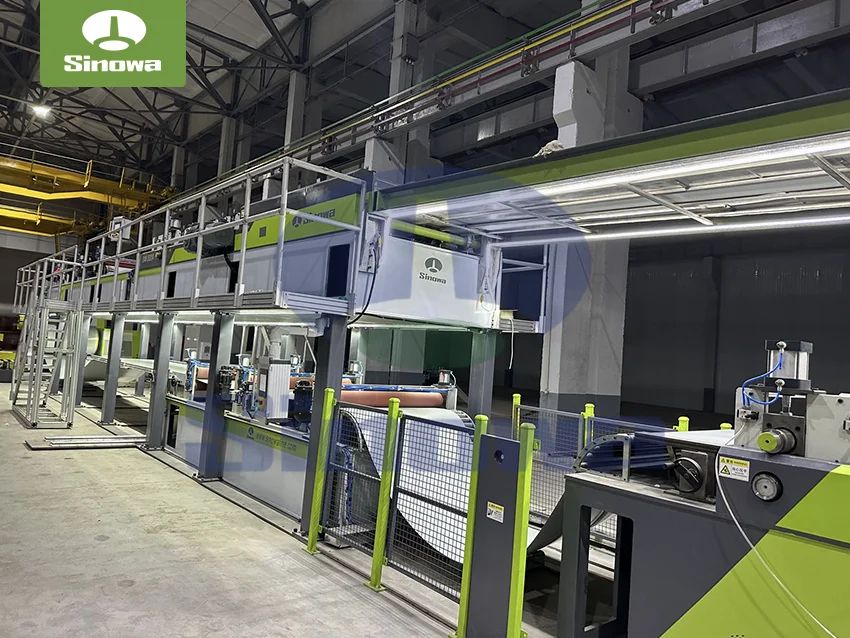
PU sandwich panel equipment for insulation board production is a complex integrated production system composed of multiple functional modules, each of which undertakes specific production tasks and cooperates closely to ensure the smooth progress of the production process. The core components include the uncoiling and feeding system, roll forming system, preheating system, PU foaming and injection system, curing system, cutting system, and automatic stacking and packaging system. Each module is designed with high precision to meet the strict requirements of PU sandwich panel production, from the processing of surface materials to the forming of the core layer, and finally to the finished product cutting and stacking, forming a complete and efficient production chain.
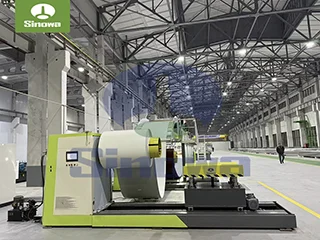
The uncoiling and feeding system is the starting link of PU sandwich panel production, responsible for providing continuous and stable surface material supply for the subsequent process. The surface materials of PU sandwich panels are usually metal coils such as galvanized steel or aluminum, which need to be uncoiled and flattened before entering the next process. The uncoiling part of the system is equipped with a hydraulic lifting device and a centering correction mechanism, which can easily lift and fix the heavy metal coils, and adjust the position of the coils in real time to ensure that the uncoiled metal sheets are kept straight and do not deviate. After uncoiling, the metal sheets pass through a series of guide rollers and flattening devices to eliminate the internal stress generated during the coiling process, making the surface of the sheets flat and smooth, which lays a good foundation for the subsequent roll forming and bonding with the PU core layer. In addition, the feeding system is equipped with a speed-regulating mechanism that can adjust the feeding speed according to the actual production rhythm, ensuring that the feeding speed is perfectly matched with the subsequent roll forming and foaming processes, avoiding material accumulation or shortage, and ensuring the continuity of production.
The roll forming system is a key part that determines the shape and structural strength of the surface of PU sandwich panels. Its main function is to press the flat metal sheets into preset profiles through a series of rolling stands arranged in tandem. Each rolling stand is equipped with a pair of precision-machined rollers, and the shape of the rollers is designed according to the cross-sectional shape of the target sandwich panel. When the metal sheets pass through the rolling stands one by one, they are gradually bent and formed under the pressure of the rollers, and finally form the required profile shape, such as corrugated, trapezoidal, or other special shapes. The roll forming process adopts a progressive forming method, which can avoid excessive stress on the metal sheets caused by one-time forming, ensure the structural stability and surface flatness of the formed sheets, and at the same time improve the wear resistance and service life of the equipment. Some advanced roll forming systems are also equipped with quick-change roller devices, which can quickly replace the rollers of different specifications according to the production needs of different types of sandwich panels, greatly improving the flexibility and adaptability of the production line.
Before the metal sheets enter the foaming process, they need to go through the preheating system for temperature adjustment. The preheating system is mainly composed of a hot air circulation oven or an electric heating roller, and its function is to heat the formed metal sheets to a specific temperature range (usually 40 ~ 60 ℃). This temperature adjustment is crucial for the subsequent PU foaming and bonding process. On the one hand, the appropriate temperature can promote the polymerization reaction of the PU raw materials, ensure that the PU foam forms a uniform and dense cell structure, and improve the thermal insulation performance and mechanical strength of the foam core layer. On the other hand, the preheated metal sheets can enhance the adhesion between the metal surface and the PU foam, making the bonding between the surface layer and the core layer tighter, avoiding delamination during use, and improving the overall quality and service life of the sandwich panels. The preheating system is equipped with a precise temperature control device, which can monitor and adjust the temperature in real time according to the type of metal sheets and the characteristics of the PU raw materials, ensuring the stability of the preheating effect.
The PU foaming and injection system is the core of the entire PU sandwich panel production equipment, which directly determines the performance of the PU core layer. This system mainly includes raw material storage tanks, metering pumps, mixing heads, and injection nozzles. The PU foam raw materials are usually two-component liquids (polyol and isocyanate), which are stored in separate storage tanks and transported to the mixing head through metering pumps. The metering pumps adopt high-precision servo control technology, which can accurately control the flow rate and ratio of the two components to ensure the stability of the foaming reaction. When the raw materials enter the mixing head, they are fully mixed under high pressure (usually 120 ~ 200 bar). The high-pressure mixing method can make the two components react more uniformly, forming a PU foam with a fine and uniform cell structure, which has better thermal insulation performance and mechanical strength compared with low-pressure mixing. After mixing, the foaming liquid is continuously injected between the two formed metal sheets through the injection nozzle. The injection nozzle is designed with a special structure, which can ensure that the foaming liquid is evenly distributed between the two surface layers, avoiding local gaps or excessive accumulation, and laying the foundation for the formation of a uniform core layer.
After the PU foaming liquid is injected between the metal sheets, it needs to go through the curing system to complete the foaming and solidification process. The curing system is usually composed of a double-belt conveyor and a heating and insulation device. The double-belt conveyor is composed of two upper and lower stainless steel belts, which can clamp the sandwich panel blank injected with foaming liquid and move forward at a constant speed. During the movement, the heating and insulation device provides a stable temperature environment for the blank, promoting the expansion and solidification of the PU foam. The temperature and time of the curing process are strictly controlled. If the temperature is too high or too low, or the curing time is insufficient, it will affect the performance of the PU foam, leading to problems such as poor foaming effect, low density, or insufficient strength. The double-belt conveyor can ensure that the sandwich panel blank is subjected to uniform pressure during the curing process, making the surface of the finished panel flat and smooth, and avoiding the occurrence of uneven thickness or surface defects. In addition, the curing system is also equipped with a cooling section. After the PU foam is fully cured, the sandwich panel is cooled to room temperature through the cooling section, which facilitates the subsequent cutting process and improves the dimensional stability of the finished product.
After the sandwich panel is cured and cooled, it enters the cutting system to be cut into finished products of the required length and size. The cutting system usually adopts a band saw or circular saw cutting device, which has the characteristics of high cutting precision and fast cutting speed. The cutting process is controlled by a computer numerical control (CNC) system. The operator only needs to input the required length parameters into the control system, and the system can automatically adjust the cutting position and cutting speed according to the movement speed of the sandwich panel, ensuring that the length of the cut finished product is accurate and the section is flat. Some advanced cutting systems are also equipped with automatic edge trimming devices, which can trim the edges of the sandwich panel while cutting, removing burrs or uneven parts on the edges, improving the appearance quality of the finished product. In addition, the cutting system is also equipped with a dust collection device, which can collect the dust and debris generated during the cutting process, ensuring the cleanliness of the production environment and protecting the health of operators.
The automatic stacking and packaging system is the last link of the production process, responsible for stacking and packaging the cut finished panels. This system is composed of a conveying roller table, a stacking robot, and a packaging machine. The cut finished panels are transported to the stacking area through the conveying roller table. The stacking robot uses visual recognition technology to accurately grasp the panels and stack them according to the preset stacking method. The stacking process is fast and stable, which can avoid collision or damage to the panels. After stacking, the packaged panels are transported to the packaging machine for wrapping and packaging. The packaging material is usually plastic film or waterproof cloth, which can protect the panels from moisture, dust, and damage during transportation and storage. The automatic stacking and packaging system greatly reduces the manual labor intensity, improves the efficiency of stacking and packaging, and ensures the neatness and integrity of the finished products.
Compared with traditional manual or semi-automatic production methods, modern PU sandwich panel equipment has obvious technical advantages, mainly reflected in high production efficiency, stable product quality, strong flexibility, and environmental protection. In terms of production efficiency, the automated continuous production line can realize 24-hour continuous operation, with a production speed much higher than that of manual production. It can complete the processing of surface materials, foaming, curing, cutting, and stacking in one go, greatly shortening the production cycle and improving the output of finished products. In terms of product quality, the equipment adopts precise control systems and advanced production processes, which can accurately control the parameters such as the thickness of the surface layer, the density of the PU foam, and the bonding strength between layers. The finished products produced have uniform dimensions, stable performance, and high consistency, avoiding the quality fluctuations caused by manual operation. In terms of flexibility, the equipment can be adjusted according to the production needs of different types, specifications, and thicknesses of PU sandwich panels. By replacing the rollers of the roll forming system, adjusting the parameters of the foaming system, and modifying the cutting length, it can quickly switch the production type, meeting the diverse market demands. In terms of environmental protection, modern PU sandwich panel equipment usually adopts environmentally friendly foaming agents such as pentane or HFC-141b instead of traditional chlorofluorocarbon (CFC) foaming agents that are harmful to the ozone layer. At the same time, the equipment is equipped with dust collection devices and waste gas treatment systems, which can effectively reduce the emission of dust and harmful gases, meeting the requirements of environmental protection laws and regulations.
The wide application of PU sandwich panel equipment has promoted the development of many industries and brought significant economic and social benefits. In the construction industry, PU sandwich panels produced by this equipment are widely used in the enclosure systems of industrial plants, warehouses, commercial complexes, and prefabricated buildings. Their excellent thermal insulation performance can reduce the energy consumption of buildings, improve the indoor thermal comfort, and help achieve the goal of building energy conservation. In the cold chain logistics industry, PU sandwich panels are important materials for the production of cold storage, refrigerated trucks, and refrigerated containers. The high-quality PU core layer produced by professional equipment has low thermal conductivity and good thermal insulation effect, which can ensure the stability of the internal temperature of the cold storage or refrigerated truck, extend the shelf life of goods, and ensure the safety of the cold chain. In the industrial manufacturing industry, PU sandwich panels are used in the construction of equipment enclosures, clean rooms, and sound insulation walls. Their excellent sound insulation performance and corrosion resistance can provide a good working environment for industrial production. In addition, with the continuous improvement of equipment technology, PU sandwich panels are also gradually applied in special fields such as ship interior partitions, highway sound insulation walls, and pharmaceutical clean rooms, showing a wide application prospect.
The operation and maintenance of PU sandwich panel equipment are crucial to ensuring the long-term stable operation of the production line and the quality of finished products. In terms of operation, operators need to undergo professional training to be familiar with the working principle and operation process of each module of the equipment. Before starting the machine, they should check the status of the equipment, including the tightness of the rollers, the level of raw materials, the accuracy of the control system, and the integrity of the safety protection devices. During the operation process, they should closely monitor the operation parameters of the equipment, such as temperature, pressure, and speed, and deal with abnormal situations in a timely manner. After the operation, they should clean the equipment, especially the mixing head and injection nozzle of the foaming system, to avoid the blockage caused by the solidification of residual raw materials. In terms of maintenance, the equipment needs to be regularly maintained according to the maintenance manual, including lubricating the moving parts, checking the wear of the rollers and cutting tools, calibrating the metering pump and temperature sensor, and replacing the easily damaged parts. Regular maintenance can not only extend the service life of the equipment but also ensure the stability of the equipment performance, reducing the failure rate and maintenance cost.
With the continuous development of science and technology, PU sandwich panel equipment is also moving towards the direction of intelligence, high efficiency, and energy conservation. In the aspect of intelligence, the equipment will be equipped with more advanced sensors and artificial intelligence (AI) control systems, which can realize real-time monitoring and automatic adjustment of the production process. For example, through visual inspection technology, the surface quality and dimensional accuracy of the sandwich panels can be detected online, and the equipment parameters can be automatically adjusted according to the detection results to ensure the quality of the finished products. In the aspect of high efficiency, the research and development of high-speed production lines will be strengthened, and the production speed and output will be further improved by optimizing the structure of the equipment and improving the performance of the components. In the aspect of energy conservation, the equipment will adopt more energy-saving motors and heating devices, and optimize the energy consumption structure to reduce the energy consumption during the production process. At the same time, the recycling and reuse of production waste will be realized, improving the utilization rate of resources and reducing environmental pollution.
In conclusion, PU sandwich panel equipment for insulation board production is an important support for the production of high-performance thermal insulation materials. Its complex and integrated structure, advanced technical level, and excellent performance ensure the quality and efficiency of PU sandwich panel production. With the continuous growth of market demand for energy-saving and environmental protection materials, PU sandwich panel equipment will continue to develop and innovate, bringing new impetus to the development of related industries. At the same time, the rational operation and maintenance of the equipment, as well as the attention to technological upgrading, will help to give full play to the role of the equipment, promote the sustainable development of the thermal insulation material industry, and make greater contributions to global energy conservation and environmental protection causes.
https://www.cnsinowa.com/sandwich-panel-machines/pu-sandwich-panel-equipment-for-insulation-board-production.html