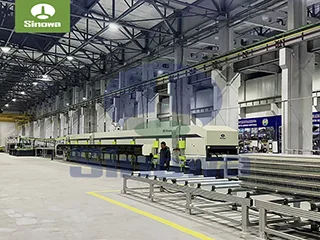
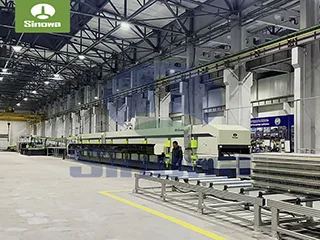
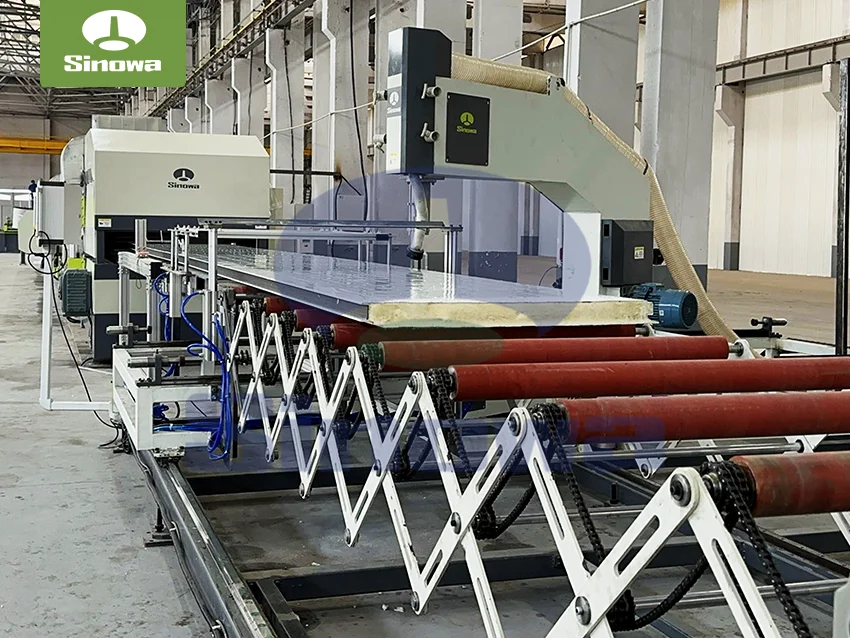
 sandwich panel line
The PU Foam Core Sandwich Panel Line is mainly composed of the following equipment:
Uncoiler: used for unwinding and conveying raw materials, such as steel plates or color steel plates.
Forming machine: Press the raw materials to form the desired sandwich panel shape.
Preheating device: Preheating the raw materials to improve the foaming effect of polyurethane.
Foaming machine: The polyurethane raw materials, curing agent, foaming agent, etc. are mixed in a certain proportion and then injected into the middle of the sandwich board to produce foam through chemical reaction and solidify.
Laminating conveyor: Laminate the upper and lower materials with the foamed polyurethane foam to form a sandwich panel.
Edge trimming device: Trimming the edges of sandwich panels to obtain accurate dimensions.
Cutting machine: Cut the sandwich panel into finished products according to the set length.
In addition, depending on the different configurations of the production line, it may also include unwinding systems, steel plate feeding systems, automatic steel plate docking systems, reinforcement units, corona systems, double track machines and heating systems, n-pentane foaming systems, cutting saws, laminating equipment, cooling equipment, automatic palletizing machines, packaging systems, chemical material storage systems, conveying systems, dust removal and environmental protection equipment, etc.
The working principle of PU Foam Core Sandwich Panel Line is roughly as follows:
After being uncoiled by the unwinding machine, the raw materials are molded into the desired sandwich panel shape by the forming machine.
The preheating device preheats the raw materials.
The foaming machine will mix polyurethane raw materials and inject them into the middle of the sandwich board, generate foam through chemical reaction and solidify it.
The laminating conveyor laminated the upper and lower materials with the foamed polyurethane foam.
Edge trimming device is used to trim the edges of sandwich panels.
The cutting machine cuts the sandwich panel to the set length to form the finished product.
The polyurethane foam sandwich panel has the advantages of efficient heat preservation, corrosion resistance, light weight, thin wall, stable quality, good weather resistance, etc. It is widely used in the external insulation of building exterior walls, central air-conditioning air supply ducts, steel structure wallboards and roof panels and other fields. At the same time, because the production line of polyurethane foam sandwich panels is highly automated and continuous, it is also suitable for large-scale industrial production.
At present, PU Foam Core Sandwich Panel Lines are widely used in the domestic and foreign markets. With the continuous development of the construction industry and the improvement of the requirements for energy conservation and environmental protection, the market demand for polyurethane foam sandwich panels, as a high-quality thermal insulation building material, is also increasing. Therefore, the PU Foam Core Sandwich Panel Line has a broad development prospect, and there will be more technological innovation and upgrading to meet the market demand in the future.
The PU Foam Core Sandwich Panel Line is an efficient, stable and reliable production equipment. Its products have a broad application prospect in the construction field.
PU foam core sandwich panel line is a specialized production system designed to manufacture composite panels with a unique three-layer structure, combining two outer face layers and a central polyurethane (PU) foam core. This integrated production line ensures the seamless bonding of different materials, resulting in panels that possess a combination of structural strength, thermal insulation, and lightweight properties, making them indispensable in various industrial, commercial, and residential applications. The operation of the line involves a series of coordinated processes, from raw material preparation and feeding to foaming, lamination, solidification, and cutting, each step meticulously controlled to maintain consistent quality and performance of the final products. Unlike discontinuous production methods, the continuous operation of these lines enables the mass production of panels with uniform thickness, density, and structural integrity, meeting the diverse needs of different projects.
The structure of a PU foam core sandwich panel line is a sophisticated assembly of functional units, each playing a critical role in the production process. At the core of the line is the foaming system, which is responsible for generating the PU foam core through the reaction of isocyanate and polyol under controlled temperature and pressure conditions. This system typically includes metering pumps, mixing heads, and temperature control units to ensure the precise ratio of raw materials and uniform mixing, which directly affects the quality of the foam core. The metering pumps deliver the raw materials with high accuracy, allowing for adjustments in the mix ratio to produce foams with different densities and properties. The mixing head, often designed to move in multiple directions, ensures thorough blending of the two components, creating a homogeneous foam that bonds tightly with the face layers. Surrounding the foaming system are the face layer processing units, which handle the uncoiling, preheating, and forming of the outer skin materials. These units include decoilers to feed the face materials, preheating devices to optimize the bonding between the face layers and the foam core, and roll forming systems to shape the face materials into corrugated, ribbed, or flat profiles based on application requirements. Additionally, the line is equipped with a lamination conveyor system, usually a double-belt conveyor, which applies uniform pressure to the sandwich structure during the foaming and solidification process, ensuring flat surfaces, even thickness, and no deformation. The final section of the line includes cutting equipment, such as band saws or automatic tracking cross-cutters, which trim the panels to the desired length while maintaining the structural integrity of the core and face layers. The entire line is often controlled by a centralized system that coordinates all processes, ensuring synchronization and precision, with adjustable parameters to accommodate different panel specifications.
The performance of PU foam core sandwich panels produced by these lines is defined by the synergistic effect of their structural components and the precision of the production process. One of the most prominent performance characteristics is excellent thermal insulation, attributed to the closed-cell structure of the PU foam core. The closed-cell configuration minimizes air permeability and prevents moisture absorption, ensuring that the panel’s thermal conductivity remains low and stable over time, significantly reducing heat transfer between the interior and exterior environments. This thermal efficiency makes the panels ideal for applications where energy conservation is a priority, as they can reduce heating and cooling costs in buildings and maintain stable temperatures in specialized facilities. Another key performance attribute is the high strength-to-weight ratio of the panels. The combination of rigid face layers and a lightweight foam core results in a composite material that is both strong enough to withstand structural loads and light enough to reduce the overall weight of the structures they are used in, easing transportation and installation. The face layers, which can be made from various materials such as pre-painted galvanized steel, aluminum, or fiberglass-reinforced plastic (FRP), provide excellent mechanical strength and impact resistance, protecting the foam core from external damage. Additionally, the panels exhibit good moisture resistance and durability, as the closed-cell foam core prevents water infiltration and mold growth, while the face layers offer corrosion resistance and weatherability, ensuring a long service life even in harsh environments. Sound insulation is another notable performance feature, as the PU foam core effectively absorbs sound waves, reducing noise transmission between spaces, making the panels suitable for applications where acoustic comfort is required. Depending on the production parameters, the panels can also be engineered to have flame-retardant properties, minimizing the risk of fire spread and enhancing safety in various settings.
The types of PU foam core sandwich panels produced by these lines are diverse, categorized primarily based on the material of the face layers, the density of the foam core, and the intended application. The choice of face layer material is a key factor in determining the panel’s performance and suitability for specific uses. Steel-faced PU sandwich panels, including pre-painted galvanized steel and galvalume, are widely used due to their high strength, corrosion resistance, and cost-effectiveness. These panels are often used in industrial buildings, warehouses, and exterior walls, where durability and weather resistance are essential. Aluminum-faced panels are lightweight and have excellent corrosion resistance, making them suitable for applications in humid or coastal environments, as well as in transportation vehicles such as RVs and refrigerated trucks. FRP-faced panels offer superior resistance to chemicals, UV radiation, and moisture, along with a smooth, aesthetically pleasing surface, making them ideal for clean rooms, pharmaceutical facilities, and exterior decorative applications. Another category is based on the density of the PU foam core, which can be adjusted during production to balance structural strength and weight. Low-density foam cores are lightweight and offer excellent thermal insulation, suitable for non-structural applications such as interior partitions and decorative panels. Medium-density cores provide a balance of insulation and strength, used in walls and roofs of residential and commercial buildings. High-density cores offer enhanced structural strength, making them suitable for load-bearing applications such as floors and industrial structures. Additionally, there are specialized panels designed for specific applications, such as embedded aluminum tube panels for enhanced structural support, embossed surface panels for improved aesthetics and slip resistance, and panels with customized thicknesses and dimensions to meet unique project requirements. The production line’s flexibility allows for the customization of these panels, ensuring that they can be tailored to the specific needs of different industries and applications.
The applications of PU foam core sandwich panels produced by these lines are extensive, spanning multiple industries and sectors, driven by their versatile performance and ease of installation. In the construction industry, these panels are widely used for exterior walls, roofs, and interior partitions in residential, commercial, and industrial buildings. Their thermal insulation and lightweight properties reduce construction costs and energy consumption, while their quick installation speeds up project timelines. Prefabricated and modular buildings, including portable cabins, on-site offices, and temporary structures, rely heavily on these panels due to their lightweight nature and easy assembly, making them ideal for construction sites, disaster relief efforts, and temporary housing. In the cold chain logistics sector, PU foam core sandwich panels are essential for the construction of cold storage rooms, freezers, refrigerated trucks, and containerized cold boxes. Their excellent thermal insulation properties ensure that low temperatures are maintained consistently, protecting perishable goods such as food, pharmaceuticals, and medical supplies from spoilage. Clean rooms and controlled environments, such as those in the electronics, pharmaceutical, and food processing industries, also utilize these panels due to their smooth, non-porous surfaces and ability to maintain a sealed, hygienic environment, preventing contamination. The industrial sector uses the panels for warehouses, factories, and logistics hubs, where they provide structural stability, thermal insulation, and sound insulation, creating a comfortable and efficient working environment. Agricultural buildings, such as farm warehouses and livestock shelters, use these panels to protect crops, livestock, and equipment from temperature fluctuations, moisture, and pests. In the transportation industry, the panels are used in the manufacturing of RVs, trailers, and ship cabins, where their lightweight and durable properties contribute to fuel efficiency and structural integrity. Additionally, the panels find applications in the electrical industry as insulation materials and in maritime applications as lightweight structural components. The versatility of these panels, combined with the efficiency of the production line, makes them a preferred choice for a wide range of applications, contributing to the advancement of sustainable and efficient construction and manufacturing practices.
The continuous development of PU foam core sandwich panel lines has led to improvements in production efficiency, product quality, and environmental sustainability. Modern lines are equipped with advanced control systems that allow for precise monitoring and adjustment of production parameters, ensuring consistent product quality and reducing waste. The use of environmentally friendly foaming agents, such as cyclopentane, instead of harmful CFCs, has made the production process more eco-friendly, reducing the environmental impact. Additionally, the recyclability of some face materials and the long service life of the panels contribute to their sustainability, making them a more environmentally responsible choice compared to traditional building materials. The flexibility of the production lines also allows for the integration of new materials and technologies, further expanding the range of applications and improving the performance of the panels. As industries continue to prioritize energy efficiency, sustainability, and cost-effectiveness, the demand for PU foam core sandwich panels and the production lines that manufacture them is expected to grow, driving further innovation and development in the field. The ability of these lines to produce high-quality, customized panels that meet the diverse needs of different sectors ensures their continued relevance in modern construction, manufacturing, and transportation industries.
In summary, PU foam core sandwich panel lines are sophisticated production systems that play a crucial role in manufacturing high-performance composite panels. Their well-engineered structure, consisting of foaming, face layer processing, lamination, and cutting units, ensures the production of panels with uniform quality and consistent performance. The panels themselves exhibit excellent thermal insulation, high strength-to-weight ratio, durability, and sound insulation, making them suitable for a wide range of applications. The diversity of panel types, categorized by face material, foam density, and application, allows for customization to meet specific project requirements. From construction and cold chain logistics to industrial and transportation applications, these panels have become an integral part of modern infrastructure and manufacturing. As technology advances, PU foam core sandwich panel lines will continue to evolve, offering more efficient, sustainable, and versatile solutions to meet the growing needs of various industries.
https://www.cnsinowa.com/sandwich-panel-machines/pu-foam-core-sandwich-panel-line.html