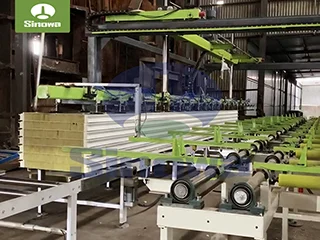
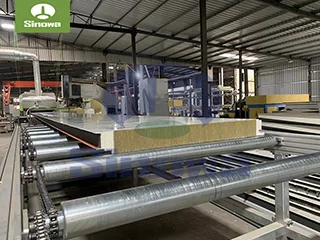
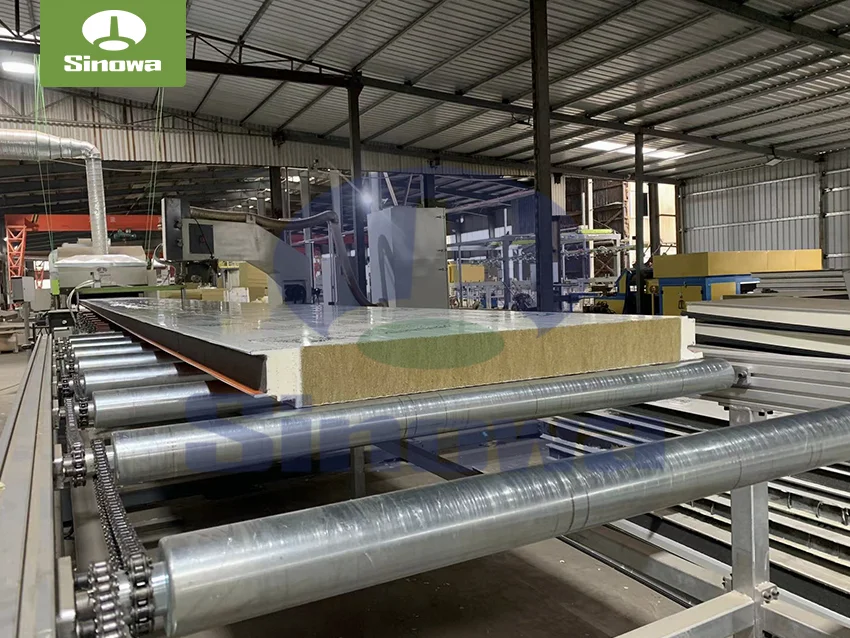
 sandwich panel line
The overall mechanical design of modern color steel rock wool sandwich panel line follows modular integrated layout and high-rigidity structural design concepts, ensuring long-term stable operation under continuous heavy-load working conditions. The whole production system consists of sequentially connected functional modules covering metal sheet unwinding and pretreatment, roller forming, rock wool core material processing and directional arrangement, automatic quantitative gluing, constant temperature and constant pressure composite pressing, stress relief shaping, servo fixed-length cutting, edge trimming and automatic finished product stacking. All modules share unified synchronous transmission signals to guarantee consistent running speed among front-end feeding units, middle composite forming units and rear-end cutting and discharging units, avoiding material accumulation, stretching or dislocation during high-speed continuous production. The main support frame of the entire line adopts thickened integral welded steel structures with post-weld annealing treatment to eliminate internal mechanical stress generated during welding processing. This structural optimization effectively reduces equipment vibration during long-hour continuous operation, prevents dimensional deviation of formed steel sheets and finished composite panels caused by mechanical shaking, and maintains long-term production accuracy stability. Each functional module retains independent adjustable parameters while achieving overall linkage, allowing production staff to independently adjust forming radian, gluing volume, composite pressure, heating temperature and cutting length according to customized production demands without affecting the normal operation of other upstream and downstream units.
The front-end raw material pretreatment section acts as the foundation of the whole production process, handling standardized processing of both upper and lower color steel coil materials and bulk rock wool core materials respectively. For metal surface materials, double-station unwinding devices are equipped to support seamless coil switching without stopping the whole sandwich panel line, eliminating production downtime caused by raw material replacement. After unwinding, curved steel coils pass through multi-group precision leveling roller sets to eliminate internal bending stress and surface concave-convex defects generated during coil storage and transportation. Fully leveled steel sheets then enter continuous roller forming units composed of dozens of profiling rollers arranged in gradient sequence. Through gradual cold bending without high-temperature heating, flat steel sheets are processed into customized plate profiles including flat panels, small corrugated panels and hidden-buckle profiled panels. The cold forming process will not damage the anti-corrosion and weather-resistant coating on the surface of color steel sheets, retaining the original decorative performance and outdoor durability of metal surface layers. Meanwhile, surface cleaning and micro-surface treatment devices are installed between leveling and forming procedures to remove floating dust, oil stains and fine particles attached to the inner side of steel sheets, improving surface tension of metal substrates and laying a solid foundation for subsequent adhesive bonding procedures.
The core material processing and directional laying unit is one of the most distinctive functional parts of rock wool sandwich panel production line, directly determining the fire resistance, compression resistance and overall structural uniformity of final finished panels. Raw rock wool raw materials are delivered into automatic splitting and conveying equipment in whole plate state. The equipment firstly cuts complete rock wool plates into strip-shaped core materials with unified width and thickness matching panel specifications, then adjusts the fiber orientation of rock wool strips through directional turning mechanisms. Different from random horizontal fiber arrangement in traditional production equipment, modern production lines realize vertical arrangement of rock wool fibers between upper and lower steel sheets. This optimized fiber layout maximizes the inherent fireproof performance and vertical compression bearing capacity of rock wool materials, preventing core material collapse and panel surface depression under long-term external pressure. After orientation adjustment, rock wool strips are conveyed to the composite station through synchronous crawler belts, with gapless compact arrangement between adjacent strips to avoid hollow cavities inside sandwich panels. The core material conveying system keeps real-time speed synchronization with steel sheet forming equipment, ensuring that the feeding speed of rock wool core materials perfectly matches the moving speed of upper and lower metal sheets throughout composite procedures, so that metal panels and core materials can complete accurate alignment without offset during continuous operation.
Automatic gluing systems serve as the key process unit deciding interfacial bonding durability and delamination resistance of sandwich panels, replacing inefficient and unstable manual gluing or simple spray gluing methods used in early manufacturing equipment. The system adopts closed high-precision quantitative gluing equipment matched with two-component polymer structural adhesives, realizing uniform glue coating on the inner surfaces of both upper and lower color steel sheets. Built-in flow sensors and intelligent control modules dynamically adjust single-point glue output and overall gluing coverage according to real-time production line running speed and rock wool core material thickness, avoiding insufficient bonding glue leading to local delamination or excessive glue usage causing material waste and panel surface glue overflow. Before formal glue spraying, preheating assemblies properly raise the temperature of steel sheet inner surfaces within a stable range, activating molecular activity of structural adhesives and enhancing permeation effect between adhesives and rock wool fiber gaps. The whole gluing process operates in fully enclosed space, which effectively inhibits volatile substance diffusion generated by adhesives during production, reduces workshop air pollution, and improves overall environmental protection level of panel manufacturing workshops. Reasonable gluing process design enables adhesive layers to form tight microscopic combination structures with both metal substrates and rock wool fibers after curing, resisting interfacial separation caused by long-term temperature difference changes, external wind load and structural vibration in building application scenarios.
Constant temperature and constant pressure composite pressing section is the core core working station of the color steel sandwich panel line, completing integral compounding of upper steel sheet, rock wool core material and lower steel sheet into integrated sandwich panel semi-finished products. After synchronous feeding and accurate alignment, composite materials enter double-crawler composite pressing machines with upper and lower circulating crawler structures. High-strength wear-resistant crawler belts provide uniform vertical pressure across the entire panel width, avoiding local stress concentration and uneven panel thickness caused by point-type pressing modes adopted by ordinary pressing equipment. Distributed heating modules are arranged inside the composite pressing chamber to maintain constant operating temperature throughout the pressing process, cooperating with stable mechanical pressure to accelerate cross-linking curing reaction of coated structural adhesives. The control system independently matches optimal temperature and pressure parameters based on rock wool core material density, overall panel thickness and line running speed, ensuring full curing of adhesives without squeezing deformation of loose rock wool internal fiber structures. After high-pressure constant-temperature compounding, semi-finished panels enter graded slow cooling shaping sections instead of direct natural cooling. Gradual temperature reduction releases internal bonding stress generated during hot pressing process step by step, effectively solving common quality defects such as panel warping, edge bending and surface unevenness caused by rapid temperature change after composite pressing in traditional production processes.
The rear-end cutting, finishing and finished product processing units realize fixed-length sizing and surface finishing of continuously produced long composite panels, meeting unified dimensional requirements for on-site building installation. The rock wool sandwich panel machine adopts full-servo tracking cutting technology instead of traditional fixed-position cutting modes. Cutting tools move synchronously along with running composite panels during cutting actions, achieving static cutting effect on moving plates and guaranteeing ultra-smooth cutting cross-sections without burrs, cracks or fiber tearing. Operators can set arbitrary customized panel lengths through the central control interface to adapt to different wall height and roof span requirements of construction projects. After fixed-length cutting, panels pass through automatic edge trimming devices to trim tiny irregular edges generated during composite and cutting processes, ensuring consistent flatness and sealing performance of panel edges. Well-trimmed finished panels are then transported to automatic stacking platforms, where mechanical grippers complete layered stacking according to set stacking quantities. The whole post-processing process requires no manual carrying or sorting work, reducing labor cost in finished product handling links and avoiding surface scratch damage to color steel panels caused by manual contact.
The centralized intelligent control system runs through every operating link of the whole rockwool board production line, acting as the core command center to realize coordinated operation of all mechanical modules. Equipped with visual human-machine interaction interfaces, the control system supports one-key startup and shutdown of the full line, centralized parameter configuration, real-time operating data monitoring and automatic fault early warning. All process parameters including forming speed, gluing volume, composite temperature, pressing pressure and cutting length can be stored as independent program formulas, allowing operators to switch between different panel specifications with one click for mass production of conventional products, greatly shortening parameter debugging time between production batches. Meanwhile, the system collects real-time operating data of motors, heating modules, transmission rollers and cutting components all day long. Once abnormal current, temperature deviation, transmission speed mismatch or mechanical clamping faults occur, the system will immediately trigger audible and visual alarms and accurately locate fault positions, helping maintenance staff complete rapid troubleshooting and minimize production stop loss. In addition, linkage protection mechanisms are designed inside the control program: if any upstream module stops abnormally, downstream equipment will automatically shut down synchronously to prevent material blockage and mechanical collision failures inside the line.
Compared with semi-automatic segmented production equipment, modern continuous color steel rock wool sandwich panel manufacturing line possess prominent comprehensive advantages in production efficiency, product quality stability, operational cost control and production flexibility. In terms of production efficiency, uninterrupted continuous production mode breaks the efficiency bottleneck of intermittent feeding and pressing of traditional equipment, realizing stable round-the-clock production and greatly improving single-line daily output to satisfy large-scale centralized material procurement demands of prefabricated construction projects. In terms of product quality consistency, full mechanical unified parameter control eliminates quality fluctuation caused by manual operation differences. All finished panels from the same production batch own identical bonding strength, thickness tolerance, surface flatness and core material compactness, reducing after-sales quality risks brought by unqualified panels in building engineering applications. In terms of operational economy, frequency conversion energy-saving motors are adopted for all power transmission components, which automatically adjust power output according to actual production load, cutting invalid energy consumption during equipment idle and low-load operation stages. Integrated dust removal devices equipped at rock wool cutting and splitting positions capture floating fiber dust in real time, improving workshop working environment while reducing raw material dust loss and lowering overall material production cost.
Panels manufactured by this professional production line have excellent comprehensive performance covering mechanical strength, fire resistance, thermal insulation, sound insulation and weather resistance, thus being widely applied in diverse modern building scenarios. For industrial factory buildings, logistics warehouses and large-span steel structure workshops, the sandwich panels serve as wall and roof enclosure materials. The vertically arranged rock wool core materials provide reliable fireproof isolation performance to slow flame spread in case of building fire, while excellent thermal insulation performance reduces air conditioning and ventilation energy consumption of factory buildings throughout the year. For pharmaceutical workshops, food processing plants and electronic dust-free purification workshops, smooth non-dust-accumulating steel surfaces and integral seamless panel structures avoid dust and bacterial attachment, meeting strict internal environmental cleanliness requirements of purification workshops. For low-temperature cold storage buildings and constant-temperature preservation warehouses, the closed fibrous structure of rock wool effectively blocks cold and heat conduction, reducing cooling load of refrigeration systems and lowering long-term operating energy consumption of cold chain buildings. Moreover, these composite panels are also applicable for temporary modular buildings, exhibition venue enclosure structures and noise reduction partition walls of municipal supporting facilities, giving full play to dual advantages of metal surface mechanical durability and multi-functional performance of fibrous core materials.
Looking into future industry development trends, color steel rock wool sandwich panel production line will further evolve toward higher intelligence, higher production precision, stronger multi-scenario adaptability and lower carbon environmental protection. With the deep integration of industrial internet technology, new-generation production lines will support remote data viewing, remote parameter debugging and unmanned automatic production operation, realizing full digital management of the whole manufacturing process from raw material consumption monitoring to finished product output statistics. Online real-time quality detection modules will be added in composite and cutting procedures to automatically detect bonding gaps, panel thickness deviation and surface defects, realizing real-time quality feedback and automatic parameter correction without manual sampling inspection. Meanwhile, production lines will strengthen compatibility with new modified building core materials, adapting to mixed matching production of rock wool with other inorganic thermal insulation materials to develop new composite panels catering to upgraded building energy-saving and fire protection standards. In terms of green manufacturing optimization, follow-up equipment upgrading will further reduce heat energy loss of heating systems and recycle residual heat generated during composite pressing procedures, realizing lower carbon emission of panel manufacturing processes.
In summary, the color steel rock wool sandwich panel continuous production line is a systematic and integrated manufacturing solution tailored for high-performance inorganic fireproof insulation building panels, integrating mechanical transmission technology, intelligent automatic control technology, precise adhesive bonding technology and fibrous material processing technology. It solves multiple long-standing pain points in traditional sandwich panel production including unstable bonding quality, disordered core material fibers, low production efficiency and large labor dependence. Driven by the global upgrading of building safety codes, growing demand for prefabricated buildings and continuous improvement of building energy-saving standards, this type of automatic sandwich panel production line will maintain steady market demand. Continuous technological iteration of mechanical structure and control systems will further improve production efficiency and finished panel performance, providing reliable and efficient equipment support for high-quality, low-carbon and standardized development of global prefabricated building enclosure material manufacturing industry.
https://www.cnsinowa.com/sandwich-panel-machines/color-steel-rock-wool-sandwich-panel-line.html