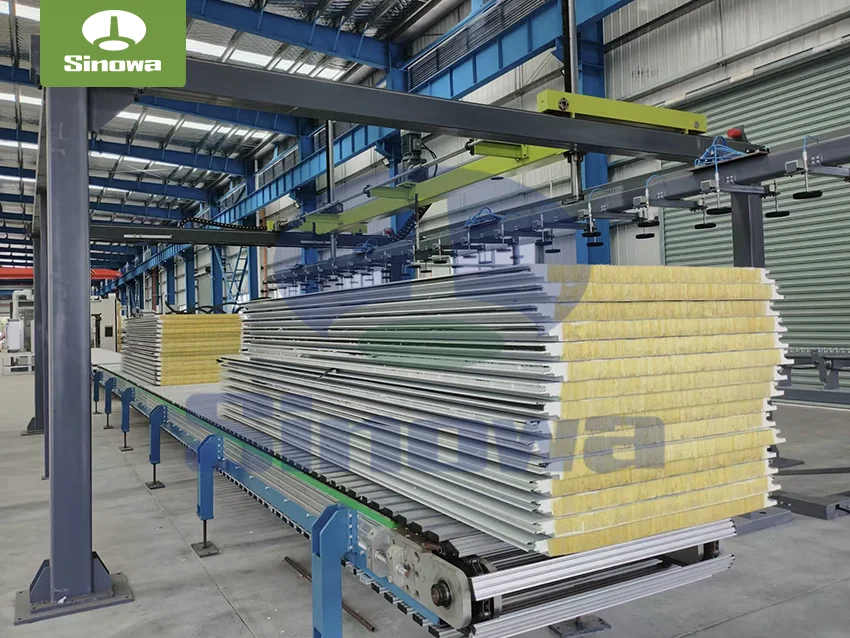
 sandwich panel line
The structure of a rock wool insulation board production line is a sophisticated combination of mechanical components, conveying systems, control units and processing equipment, all of which are integrated to achieve a seamless production flow. The core structure can be divided into several key sections, each with distinct functions that contribute to the overall manufacturing process. The first section is the raw material handling and preparation system, which is responsible for receiving, storing and processing the primary raw materials. The main raw materials used are natural minerals such as basalt, dolomite and slag, which are transported to the production site by trucks and stored in covered silos to prevent contamination and moisture absorption. These raw materials are then fed into enclosed conveyors, weighed accurately and mixed in specific proportions to ensure the desired chemical composition and physical properties of the final product. In addition to the mineral raw materials, auxiliary materials such as binders, dust-proof oils and water repellents are also prepared in this section; the binders are pre-mixed and delivered as non-hazardous materials to avoid on-site chemical mixing, ensuring operational safety and environmental friendliness.
Following the raw material preparation section is the melting system, which is the heart of the production line. This system consists of a high-temperature furnace equipped with heating devices and energy supply units, capable of reaching temperatures exceeding 1450 degrees Celsius—sometimes as high as 2700 degrees Fahrenheit—to fully melt the mixed mineral raw materials. The furnace is heated using energy sources such as coal, natural gas and oxygen, with natural gas delivered via pipelines and used to heat air in both the melting and curing processes, while oxygen is either delivered in tanks or produced on-site from ambient air to enrich the melting furnace and enhance combustion efficiency. A heat recovery system is also integrated into the melting system to recycle waste energy, reducing overall energy consumption and improving the environmental performance of the production line. The melted raw materials, known as melt, are maintained at a stable temperature to ensure they have the appropriate viscosity for the subsequent fiber formation process.
The fiber formation system is the next critical component of the production line, responsible for converting the molten mineral into fine, flexible fibers that form the base of the insulation board. This system primarily includes a high-speed centrifuge and a fiber collection device. The molten melt is poured into the centrifuge, which rotates at extremely high speeds to exert centrifugal force that pulls the melt into thin filamentous fibers. Some advanced production lines use four-axis centrifuges to achieve more uniform and finer fiber formation, simulating the natural process of volcanic eruptions where molten rock is stretched into fibers by air currents. As the fibers are formed, they are sprayed with a controlled amount of binder, dust-proof oil and water repellent to enhance their adhesion, reduce dust generation and improve water resistance. The fibers are then collected by a cotton collector, forming a loose cotton mat that is ready for further processing.
After fiber collection, the production line moves to the forming and curing section, which shapes the loose cotton mat into rigid insulation boards with stable performance. This section includes a pendulum device, a pre-pressing machine and a curing oven. The pendulum device evenly spreads the loose cotton mat in layers, using a pendulum method to stack the fibers in a crosswise manner, which improves the density uniformity and mechanical strength of the final product. Compared to the traditional sedimentation method, the pendulum method results in fibers that are partially vertically distributed, enhancing the compressive strength and interlayer bonding strength of the insulation board. The pre-pressing machine then applies pressure to the layered cotton mat to adjust its thickness and density, ensuring consistency across the board. The pressed cotton mat is then conveyed into a curing oven, where it is heated at a controlled temperature for a specific period to allow the binder to cure and harden. This curing process is critical for stabilizing the structure of the insulation board, ensuring it retains its shape and performance under various environmental conditions. A cooling zone follows the curing oven, where the heated insulation boards are cooled to room temperature to prevent deformation and ensure handling safety.
The final sections of the production line are the cutting, recycling and packaging systems. The cooling insulation boards are conveyed to a cutting machine, which cuts them into specific sizes and dimensions according to customer requirements. The cutting process generates dust, which is captured by a bag filter and transported to an internal recycling system to minimize waste and environmental pollution. The recycling system also processes any defective or non-conforming products, which are crushed into granules and fed back into the fiber formation section for reuse, achieving a closed-loop production process that reduces material waste. After cutting and inspection, the finished insulation boards are stacked, packaged in polyethylene film and palletized for storage and transportation. The packaging process is often automated, using a packing machine to ensure the boards are securely wrapped and protected from damage during transit.
The performance of a rock wool insulation board production line is evaluated based on several key indicators, including production efficiency, product quality stability, energy consumption, environmental friendliness and operational reliability. Production efficiency refers to the output capacity of the line, which is typically measured in tons per year, with modern production lines capable of producing 30,000 to 60,000 tons annually. The efficiency is influenced by the automation level of the line, with fully automated production lines requiring minimal manual intervention and achieving higher output rates. Product quality stability is another critical performance indicator, as it ensures that each insulation board meets the required specifications for density, thickness, thermal conductivity, fire resistance and sound absorption. Advanced production lines are equipped with PLC control systems that monitor and adjust each production link in real-time, ensuring consistent product quality and reducing the rate of defective products.
Energy consumption is an important consideration for the sustainability of the production line, as the melting process requires significant energy input. Modern production lines incorporate energy-saving technologies such as heat recovery systems, efficient combustion devices and optimized furnace designs to reduce energy consumption. The use of pre-milled coal and natural gas as energy sources also helps to improve energy efficiency and reduce emissions. Environmental friendliness is another key performance indicator, with production lines designed to minimize waste and pollution. The internal recycling system reduces material waste, while dust collection devices capture dust generated during cutting and fiber formation, preventing air pollution. The use of non-hazardous binders and auxiliary materials also ensures that the production process does not release harmful chemicals into the environment.
Operational reliability is essential for ensuring continuous production and reducing downtime. High-quality production lines are constructed with durable materials and components that have a long service life, requiring minimal maintenance. The automated control system also includes fault detection and alarm functions, allowing operators to quickly identify and resolve any issues that may arise during production. Additionally, the production line is designed to be flexible, capable of adjusting to different raw material compositions and product specifications, making it adaptable to changing market demands.
The types of rock wool insulation board production lines are primarily classified based on their production capacity, automation level, fiber formation technology and the type of insulation boards they produce. Based on production capacity, production lines can be divided into small-scale, medium-scale and large-scale. Small-scale lines have an annual output of less than 30,000 tons, suitable for small enterprises or regional markets with limited demand. Medium-scale lines have an annual output of 30,000 to 60,000 tons, balancing output and investment costs, and are suitable for most medium-sized enterprises. Large-scale lines have an annual output exceeding 60,000 tons, designed for large-scale production and meeting high-volume market demands.
Based on automation level, production lines can be manual, semi-automated and fully automated. Manual production lines require significant manual intervention in each production link, resulting in lower efficiency and inconsistent product quality, and are gradually being phased out. Semi-automated lines integrate automation in key sections such as melting and fiber formation, while retaining manual operation in cutting and packaging, suitable for enterprises with limited investment capacity. Fully automated lines use advanced PLC control systems to automate the entire production process, from raw material feeding to finished product packaging, achieving high efficiency, stable quality and minimal manual intervention, and are the mainstream choice for modern rock wool insulation board production.
Another classification is based on fiber formation technology, with production lines using either the sedimentation method or the pendulum method. Sedimentation method production lines collect fibers on a conveyor belt in a sedimentation chamber, resulting in fibers that are distributed horizontally. While these lines are simpler in structure and lower in cost, the resulting insulation boards have lower density uniformity and mechanical strength. Pendulum method production lines, on the other hand, use a pendulum device to stack fibers in layers, resulting in better density uniformity and higher mechanical strength, and are widely used in modern production due to their superior product quality.
Production lines can also be classified based on the type of insulation boards they produce, including regular rock wool insulation boards, water-repellent rock wool insulation boards, fire-resistant rock wool insulation boards and sound-absorbing rock wool insulation boards. Regular production lines produce standard insulation boards with basic thermal insulation and fire-resistant properties, suitable for general applications. Water-repellent production lines add additional water repellents during fiber formation, producing boards with enhanced water resistance, suitable for wet environments such as basements and exterior walls. Fire-resistant production lines optimize the raw material ratio and curing process to produce boards with superior fire resistance, capable of withstanding high temperatures for extended periods, suitable for high-risk fire areas. Sound-absorbing production lines adjust the fiber density and structure to enhance sound absorption performance, suitable for applications such as concert halls, factories and residential buildings where noise reduction is required.
The applications of rock wool insulation board production lines are closely linked to the properties of the insulation boards they produce, which are widely used in construction, industrial, automotive, marine and other industries due to their excellent thermal insulation, fire resistance, sound absorption and corrosion resistance. In the construction industry, rock wool insulation boards produced by these lines are one of the most commonly used insulation materials, applied in exterior walls, interior walls, roofs, floors and fire partitions. Exterior wall insulation is a major application, where the boards are installed in the cavity of exterior walls or as part of external facade systems to reduce heat transfer, improve building energy efficiency and maintain a stable indoor temperature. Properly installed exterior wall insulation can reduce energy consumption by up to 70 percent, lowering heating and cooling costs and reducing carbon emissions. Roof insulation uses high-density insulation boards to prevent heat loss through the roof, one of the main areas of heat loss in buildings, while floor insulation improves heat conservation between floors and reduces noise transmission between apartments.
Fire partitions are another important application in the construction industry, as rock wool insulation boards are non-combustible and have excellent fire resistance, capable of slowing down the spread of flames and smoke in the event of a fire. They are used to fill gaps between floor slabs and exterior walls, around conduit pipes and duct openings, and in firewall systems to enhance building fire safety. In residential buildings, commercial buildings such as shopping centers and hospitals, and public facilities such as schools and theaters, rock wool insulation boards play a crucial role in protecting lives and property by providing effective fire protection.
In the industrial sector, rock wool insulation boards produced by these production lines are widely used for thermal insulation and fire protection of industrial equipment, pipelines and workshops. Industrial pipelines that transport high-temperature or low-temperature fluids require effective insulation to reduce energy loss and ensure operational safety, and rock wool insulation boards are ideal for this purpose due to their excellent thermal insulation properties and resistance to high temperatures. Industrial equipment such as boilers, furnaces and steam turbines also use rock wool insulation to reduce heat loss and protect workers from high-temperature burns. In addition, rock wool insulation boards are used in industrial workshops to improve thermal comfort and reduce noise pollution from machinery, creating a better working environment.
The automotive and marine industries also utilize rock wool insulation boards produced by these production lines. In the automotive industry, the boards are used for thermal insulation and sound absorption in vehicle interiors, reducing noise from the engine and external environment and improving passenger comfort. They are also used in automotive firewalls to provide fire protection, preventing the spread of flames from the engine compartment to the passenger compartment. In the marine industry, rock wool insulation boards are used in ship hulls, cabins and engine rooms to provide thermal insulation, fire protection and sound absorption. Due to their resistance to moisture, corrosion and high temperatures, they are suitable for the harsh marine environment, ensuring the safety and comfort of crew and passengers.
Other applications of rock wool insulation boards produced by these production lines include agricultural greenhouses, where they are used to insulate the greenhouse structure, maintaining a stable internal temperature for plant growth and reducing energy consumption for heating. They are also used in cold storage facilities to provide thermal insulation, preventing temperature fluctuations and ensuring the quality of stored goods such as food and pharmaceuticals. In addition, rock wool insulation boards are used in noise control projects, such as road sound barriers and industrial noise reduction systems, due to their excellent sound absorption properties, helping to reduce environmental noise pollution.
In conclusion, the rock wool insulation board production line is a sophisticated and integrated manufacturing system that plays a vital role in producing high-performance insulation materials for various industries. Its structure consists of multiple coordinated sections, from raw material preparation to finished product packaging, each contributing to the efficiency, quality and sustainability of the production process. The performance of the production line is evaluated based on indicators such as production efficiency, product quality stability, energy consumption and environmental friendliness, with modern lines incorporating advanced technologies to optimize these indicators. The types of production lines vary based on production capacity, automation level, fiber formation technology and product type, allowing enterprises to choose the most suitable line for their specific needs. The wide range of applications of the insulation boards produced by these lines, from construction and industrial to automotive and marine, highlights the importance of the production line in promoting energy conservation, fire safety and environmental protection. As industries continue to demand more efficient, sustainable and high-performance insulation solutions, the rock wool insulation board production line will continue to evolve, incorporating new technologies and innovations to meet these changing demands and contribute to a more sustainable future.
https://www.cnsinowa.com/sandwich-panel-machines/rock-wool-insulation-board-production-line.html