sandwich panel machine
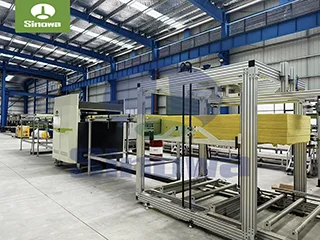
The overall structural design of composite rock wool sandwich panel equipment follows the production logic of raw material pretreatment, core material processing, surface material forming, composite bonding, curing shaping, post-processing cutting, and finished product sorting, with each functional module closely connected and coordinated to form a complete closed-loop production chain. The front-end part of the equipment is equipped with an automatic raw material feeding and pretreatment module, which is responsible for the unreeling, leveling, trimming, and surface cleaning of metal surface materials. In actual operation, coiled metal raw materials are stably output through the automatic unreeling structure, and the subsequent leveling mechanism eliminates the internal stress and surface wrinkles of the metal sheet through multi-group roller calibration, ensuring the flatness and dimensional uniformity of the surface materials before forming. The trimming device can accurately adjust the width of the metal sheet according to production specifications, removing irregular edges generated during raw material rolling to ensure the consistency of the panel width in subsequent composite processing. Meanwhile, the supporting dust removal and surface purification devices can clear fine dust and impurities on the surface of the metal sheet, creating a clean bonding interface for the subsequent adhesive coating process and avoiding quality defects such as virtual bonding and delamination caused by surface impurities.
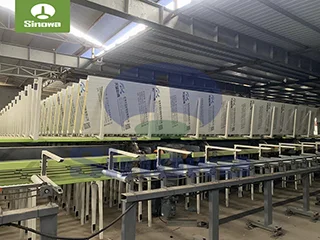
The core material processing module is a unique and key functional part of composite rock wool sandwich panel machine, which is specially optimized for the physical characteristics of rock wool materials such as fibrous structure, low density, and compressibility. Rock wool raw materials are usually supplied in bulk slabs, and this module completes the whole process of lifting, slitting, turning, and shaping of rock wool cores. The lifting device stably transports the whole rock wool slab to the processing station, and the precision slitting structure cuts the rock wool slab into strip cores of different thicknesses according to the preset production standards, realizing flexible adjustment of panel insulation thickness and structural specifications. More importantly, the professional turning device of the equipment can adjust the fiber arrangement direction of the rock wool core to a vertical state, which fundamentally improves the compressive resistance, structural stability, and overall mechanical strength of the finished panel. This targeted processing technology for rock wool fibers makes up for the defect of low structural strength of ordinary horizontally arranged fiber rock wool panels, enabling the produced sandwich panels to withstand greater external pressure and deformation stress in actual use, and significantly improving the service stability of the panels in complex building environments. In addition, the core material conveying and positioning structure can accurately locate the rock wool strip, ensuring that the core material is evenly arranged and free of gaps in the width direction of the panel, avoiding hollow and uneven internal structure of the finished product.
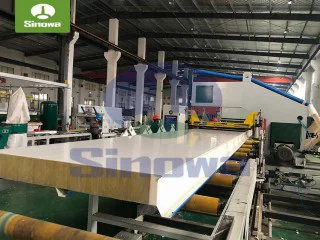
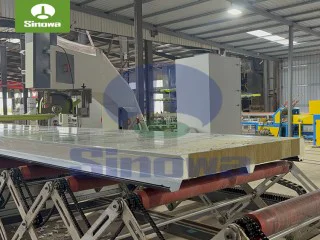
The glue spraying and composite bonding module is the core functional unit that determines the bonding firmness and overall structural performance of the sandwich panel, and its operational precision and parameter control accuracy directly affect the service life and comprehensive performance of the finished product. The equipment is equipped with a uniform automatic glue spraying system, which can evenly coat high-performance special adhesive on the bonding surfaces of metal surface materials and rock wool core materials. The glue spraying system adopts a multi-point distributed spraying design, which can accurately control the glue output per unit area, realizing uniform glue layer thickness, no missing coating, and no glue accumulation. This precise glue application mode ensures that the adhesive can fully infiltrate the fibrous gaps on the surface of rock wool and form a tight bonding layer with the metal surface material, effectively improving the bonding tightness between the core material and the surface material. After the completion of glue spraying, the materials are quickly sent to the constant-temperature pressure composite station through the conveying system. The composite area maintains stable pressure and constant temperature environment, creating the best curing conditions for the adhesive. The stable pressure environment can eliminate the tiny gaps between the core material and the surface material, making the composite structure more compact, while the constant temperature system ensures that the adhesive cures steadily at the optimal temperature, avoiding incomplete curing caused by temperature deviation or glue aging caused by excessive temperature. The matching of pressure, temperature and operating speed in the composite process is precisely calibrated by the system to ensure that each group of composite materials can complete stable bonding in the effective curing time, forming an integrated composite structure with strong integrity.
The curing and shaping module after composite bonding undertakes the key task of stabilizing the structural state of the panel and improving the forming quality. The length of the curing zone of the equipment is scientifically designed according to the production operating speed, which can ensure that the continuously produced long-size composite panels stay in the constant-temperature curing environment for sufficient time to complete the full curing reaction of the internal adhesive. Sufficient curing processing can effectively enhance the structural strength of the composite panel, prevent structural deformation, layer separation and edge warping of the semi-finished panel in the subsequent transportation and cutting process, and lay a foundation for the dimensional stability of the finished product. During the curing process, the equipment adopts a double-belt synchronous conveying structure, which can clamp the upper and lower surfaces of the panel evenly, maintain the flat state of the panel in the high-temperature curing environment, and avoid bending deformation caused by uneven stress or temperature difference. At the same time, the circulating air temperature control system inside the curing zone realizes uniform temperature distribution in the whole working area, ensuring that all parts of the panel can complete the curing reaction synchronously, avoiding the quality difference of local insufficient curing or excessive curing, and greatly improving the overall consistency of batch products.
The post-processing precision cutting and finishing module is the final link to realize the standardized molding of finished panels. The cured long continuous composite panels are stably conveyed to the cutting station by the automatic conveying system, and the high-precision flying saw cutting device completes fixed-length cutting according to the preset dimensional parameters. The cutting system has the characteristics of fast response and high cutting precision, which can complete the cutting operation synchronously in the running state of the panel, realizing non-stop continuous production and effectively improving production efficiency. The cut panel sections have flat and smooth cutting surfaces without burrs, cracks or core material shedding, which meets the fine processing requirements of high-quality building panels. After cutting, the equipment is equipped with automatic edge trimming and cleaning devices to clean the residual adhesive and tiny debris on the edge of the panel, optimize the appearance quality of the product, and ensure the neat and tight fit of the panel in the subsequent installation and assembly process. Finally, the finished panels are automatically sorted and stacked by the stacking device, realizing orderly collection of finished products and reducing manual handling links.
The intelligent control system runs through the whole production process of composite rock wool sandwich panel production line, which is the core guarantee to realize automated, precise and stable production. The system adopts integrated programming control and servo drive technology, which can uniformly regulate and control all functional modules such as feeding, forming, glue spraying, composite pressing, curing and cutting. Operators only need to set the production parameters such as panel thickness, width, length and operating speed through the human-computer interaction interface, and the equipment can automatically complete the whole production process without frequent manual intervention. The built-in parameter self-calibration and real-time monitoring function of the system can track the operating state, temperature, pressure, operating speed and other key data of each module in real time. Once abnormal parameter deviation or equipment operation failure occurs, the system will automatically trigger early warning and protective shutdown, effectively avoiding batch quality problems and equipment failure damage caused by parameter errors. In addition, the control system supports parameter storage and calling, which can quickly switch production specifications according to different production needs, realizing flexible production of diversified panel products and improving the adaptability of the equipment to market demand.
Compared with production equipment of other thermal insulation composite panels, composite rock wool sandwich panel line has prominent targeted advantages in structural design and process configuration, fully adapting to the unique performance characteristics of rock wool core materials. Rock wool materials have excellent fire resistance, thermal insulation and sound absorption performance, but their fibrous structure determines that they have higher requirements for bonding pressure, temperature stability and positioning accuracy in the composite process. This professional equipment solves the processing pain points of rock wool materials through targeted structural optimization, avoiding the problems of loose core material, insufficient bonding strength and easy deformation of finished products in ordinary composite equipment. The integrated continuous production mode greatly shortens the production cycle of a single panel, realizes seamless connection between processes, and effectively improves production efficiency while reducing manual operation errors. At the same time, the closed production environment of the equipment can effectively reduce the dust generated in the rock wool processing process, optimize the on-site production environment, and meet the environmental protection production requirements of modern processing enterprises.
In terms of production quality control, the systematic and standardized operation mode of composite rockwool sandwich panel production line realizes whole-process controllability of product quality. From the pretreatment of raw materials to the finishing of finished products, each process link has precise mechanical parameter control and standardized operation procedures, which avoids the quality fluctuation caused by manual operation differences in traditional production modes. The produced rock wool sandwich panels have stable structural strength, uniform thermal insulation performance, good overall flatness and high dimensional accuracy, and can maintain excellent structural stability and service performance in long-term complex building use environments. The composite panels manufactured by this equipment not only retain the excellent fireproof, thermal insulation, sound insulation and energy-saving characteristics of rock wool materials, but also have higher structural integrity and weather resistance due to precise composite processing, which can adapt to the harsh use environments of industrial workshops, cold storage facilities, clean rooms and special architectural spaces.
With the continuous upgrading of modern construction industry towards energy saving, environmental protection, safety and high efficiency, the market demand for high-performance rock wool sandwich panels is increasing year by year, which also promotes the continuous technological innovation and functional upgrading of composite rock wool sandwich panel equipment. Modern equipment is gradually developing towards higher automation, smarter monitoring, more energy-saving operation and stronger production compatibility. The optimized mechanical transmission structure reduces equipment operation energy consumption and operation noise, and the upgraded intelligent control system realizes more accurate process parameter control and more convenient equipment operation and maintenance. At the same time, the equipment is constantly expanding its production compatibility, which can adapt to the composite production of different types of surface materials and different density rock wool core materials, meeting the diversified product needs of different construction scenarios. As a key core equipment in the production of energy-saving and fireproof building materials, composite rock wool sandwich panel equipment will continue to play an important supporting role in the upgrading of the construction industry, promote the standardized and high-quality development of the building thermal insulation composite panel industry, and provide reliable equipment guarantee for the construction of high-quality, safe and energy-saving modern buildings.
https://www.cnsinowa.com/sandwich-panel-machines/composite-rock-wool-sandwich-panel-equipment.html