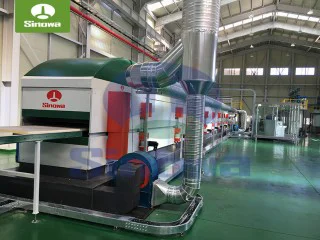
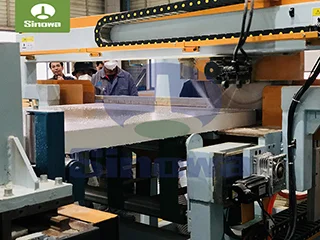
sandwich panel line
The overall structural composition of a standard phenolic sandwich panel production line covers multiple interconnected functional modules, each undertaking independent and collaborative production tasks to form a complete closed-loop manufacturing process. The front-end raw material processing and feeding system serves as the starting point of the entire production process, mainly responsible for the orderly supply and pretreatment of surface materials and core raw materials. For surface facings, including metal sheets, fiber cement boards and decorative composite materials, the system completes automatic uncoiling, leveling and fine trimming through hydraulic and mechanical transmission devices. This process removes surface wrinkles, edge burrs and dimensional deviations generated during raw material storage and transportation, ensuring the flatness and dimensional accuracy of the base materials before lamination. Meanwhile, the phenolic resin raw materials, foaming agents, modifiers and curing agents used for the core layer are stored in independent sealed storage tanks, with professional filtering and metering devices installed to guarantee the purity and proportion accuracy of each raw material component.
The raw material mixing and foaming injection system is the core functional unit that determines the core layer performance of phenolic sandwich panels. Different from common polyurethane foam forming processes, phenolic foam molding requires more precise reaction condition control due to the unique chemical cross-linking characteristics of phenolic resin. The production line adopts a high-precision dynamic mixing structure, which can fully blend liquid phenolic resin with various functional additives and curing agents in an instantaneous and uniform manner. The entire mixing process is carried out in a closed mixing chamber to avoid material waste and environmental pollution caused by raw material splashing. By optimizing the formula matching and material conveying speed, the system can adjust the foaming density and pore structure of phenolic foam flexibly, forming a uniform closed-cell structure inside the core layer. This fine and dense cellular structure lays a solid foundation for the panel’s excellent thermal insulation, sound insulation and pressure resistance, while effectively avoiding common defects such as uneven foam density, local hollowing and inconsistent pore size in traditional manual or semi-automatic production.
Following the material mixing and injection procedure, the continuous lamination and molding system undertakes the key task of compounding surface materials and phenolic foam core layers. The sandwich panel line is equipped with a double-crawler synchronous laminating structure, which realizes the synchronous conveying and precise fitting of upper and lower surface materials. After the evenly mixed phenolic foam liquid is quantitatively injected between the upper and lower base materials, the laminating system applies stable and uniform mechanical pressure through adjustable gap control devices. The gap between the upper and lower crawlers can be finely adjusted according to the required panel thickness, ensuring the overall thickness error of finished panels is controlled within an extremely small range. In the lamination process, the matching of pressing speed and foam reaction speed is accurately calibrated to ensure that the phenolic foam completes foaming expansion and preliminary bonding under constant pressure. This synchronous molding mode enables the surface materials and core foam to form an integrated composite structure without interfacial gaps, greatly improving the overall structural strength and bonding firmness of the sandwich panel.
The intelligent temperature-controlled curing system is an indispensable part of phenolic sandwich panel production, as phenolic resin requires gradual and stable temperature cross-linking reaction to complete full curing and molding. The curing chamber of the sandwich panel machine is divided into multiple independent temperature zones with precise temperature sensing and adjustment components, realizing gradient temperature rise and constant temperature maintenance. Compared with the rapid curing process of other foam materials, phenolic foam curing needs a more gentle temperature change process to prevent thermal shock, which may cause surface cracking, internal stress concentration or incomplete cross-linking reaction. The system can monitor the real-time temperature of each curing zone and the running speed of the plate body through sensors, and automatically adjust heating power and transmission speed according to production parameters. This precise temperature control ensures that the phenolic resin undergoes sufficient chemical cross-linking, forming a stable three-dimensional network structure inside the core layer. Fully cured phenolic foam not only has better dimensional stability and compression resistance, but also gives the panel outstanding fire resistance and high-temperature aging resistance, avoiding performance attenuation in long-term complex service environments.
After completing curing and preliminary shaping, the continuous plate body enters the cooling and shaping stage to eliminate internal stress generated during high-temperature curing. The production line is equipped with a circulating air cooling system, which forms uniform flowing air flow around the continuously moving plate body to realize balanced heat dissipation on the upper and lower surfaces. The gradual cooling mode prevents the plate body from warping, deforming or cracking due to rapid temperature drop. In this process, the internal molecular structure of the phenolic foam is further stabilized, and the bonding force between the core layer and surface materials is further enhanced, ensuring the flatness and structural uniformity of the finished panel. The length of the cooling area and air circulation speed can be adjusted according to different panel thicknesses and production speeds, adapting to diversified production demands while maintaining consistent product quality.
The post-processing system of the PF insulation board production line includes automatic fixed-length cutting, edge trimming and surface finishing modules, realizing precise sizing and shaping of continuous plate bodies. The high-precision cutting device adopts servo drive control, which can accurately cut the continuous molded plate into standard or customized lengths according to preset parameters. The cutting process is stable and efficient, with smooth and flat cutting sections without burrs, chipping or irregular fractures. The supporting edge trimming mechanism can trim the edges of the plate body to ensure consistent overall dimensions and neat edges of each panel, facilitating subsequent installation and assembly. Meanwhile, the surface finishing module can remove tiny residual materials and fine blemishes on the panel surface, improving the surface flatness and appearance quality of finished products. All post-processing procedures are completed automatically in a continuous production state, avoiding secondary damage and dimensional errors caused by manual handling and cutting.
The final stage of the production process is automatic inspection, conveying and stacking. The PF sandwich panel manufacturing line is equipped with online detection components to conduct real-time monitoring of panel thickness, flatness, bonding integrity and surface quality during operation. Unqualified products with dimensional deviations or surface defects will be automatically identified and marked, realizing effective quality screening. Qualified finished panels are stably conveyed to the stacking platform through the transmission system, and the automatic stacking device completes orderly stacking and arrangement according to fixed specifications. This automated post-processing mode not only greatly improves production efficiency and reduces manual labor intensity, but also avoids panel damage and dirt contamination caused by manual contact, ensuring the neatness and integrity of finished products before delivery.
The advanced automated control system runs through the entire operation process of the phenolic panel production line, becoming the core guarantee for stable and high-quality production. The system integrates programmable control, real-time data monitoring and automatic parameter adjustment functions, enabling one-click setting and intelligent operation of all production links including raw material proportioning, foaming injection, lamination pressure, curing temperature and cutting size. All production parameters are displayed in real time on the operating interface, and the system can automatically record production data to facilitate production tracking and quality management. When abnormal parameters such as uneven material proportioning, temperature deviation or transmission jitter occur, the system will trigger real-time early warning and automatic parameter correction, effectively reducing the occurrence of defective products. The highly automated operation mode simplifies production operation procedures, reduces the dependence on skilled workers, and realizes standardized and intelligent management of the production process.
In terms of production process advantages, the continuous production mode of the phenolic insulation board production line achieves seamless connection of all working procedures, eliminating the intermittent waiting time of traditional batch production. The synchronous coordination of mechanical equipment and control systems makes the production speed stable and controllable, which can effectively improve unit time output while ensuring product quality consistency. The optimized foaming formula and closed production process adopt environmentally friendly foaming technologies, which effectively reduce harmful gas generation and energy consumption in the production process, meeting the development requirements of green and low-carbon building material production. In addition, the production line has strong production flexibility, which can adapt to the production of panels with different thicknesses, surface materials and performance parameters by adjusting equipment parameters, meeting the diversified application needs of construction, industrial purification, cold storage insulation and other fields.
The product quality stability brought by the professional sandwich panel production machine is incomparable to traditional production processes. The precisely controlled raw material proportioning system ensures that the chemical composition of each batch of phenolic core materials is uniform, avoiding performance differences caused by manual proportioning errors. The constant-pressure lamination and gradient curing process makes the internal structure of the foam core layer uniform and dense, with stable thermal conductivity, fire resistance and mechanical properties. The integrated molding process enables the surface material and core layer to form a firm composite whole, with no degumming or layering in long-term use, and excellent weather resistance. Panels produced by this production line can maintain stable structural and thermal performance in high temperature, low temperature, humid and other complex environments, with long service life and low later maintenance cost.
With the continuous upgrading of the building material industry's energy-saving and fireproof standards, the application market of phenolic sandwich panels is expanding day by day, and the technical performance requirements for supporting production lines are also constantly improving. Modern phenolic sandwich panel production lines are gradually developing towards higher automation, higher precision, lower energy consumption and stronger intelligence. The optimized mechanical structure design reduces equipment operation friction and energy loss, improving equipment operation efficiency and service life. The upgraded intelligent control system realizes more refined parameter control and remote monitoring functions, further improving production accuracy and management efficiency. At the same time, the modular equipment structure design facilitates daily maintenance, fault detection and equipment upgrading, reducing production downtime and maintenance cost for enterprises.
In practical industrial production applications, the phenolic sandwich panel production line has become key core equipment for promoting the upgrading of fireproof and thermal insulation building materials. It solves the problems of low efficiency, unstable quality and high resource consumption in traditional phenolic panel production, and provides reliable technical and equipment support for large-scale and standardized production of high-performance building insulation materials. The panels produced by the line have prominent comprehensive performance advantages, widely used in building exterior wall insulation, interior partition decoration, industrial plant purification, cold storage thermal insulation and other scenarios. While meeting the market’s demand for high-quality energy-saving and fireproof materials, the production line also promotes the green and high-quality development of the entire building material manufacturing industry, with important practical value and broad market application prospects.
https://www.cnsinowa.com/sandwich-panel-machines/phenolic-sandwich-panel-production-line.html