 sandwich panel line
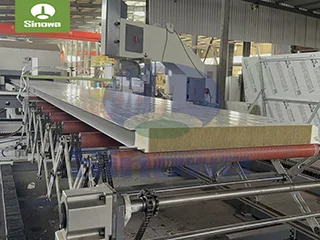
Different from conventional rock wool sandwich panel production equipment that only completes simple lamination of surface plates and core materials, this production line focuses on solving the edge performance bottleneck of composite panels. In traditional production processes, the side edges of rock wool sandwich panels are mostly exposed fiber structures, which are prone to fiber falling, water absorption and moisture penetration during long-term use, and cannot form effective closed protection. The introduction of polyurethane side sealing technology perfectly makes up for this deficiency. Polyurethane materials form a dense, continuous and flexible protective layer on the panel sides through precise foaming and bonding processes, which closely integrates with the internal rock wool core and outer metal surface plates to create an integral closed structure. This structural optimization not only enhances the overall structural stability of the panel but also significantly improves the waterproof, moisture-proof, airtight and sound insulation capabilities of the product, making the finished panels more adaptable to complex building environments.
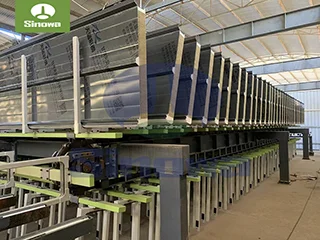
The entire production operation of the PU side sealing rock wool sandwich panel production line follows a continuous and automated process logic, with all links closely connected and coordinated to realize uninterrupted sandwich panel assembly line production from raw material input to finished product output. The whole production process can be divided into multiple core stages including surface plate pretreatment, rock wool core material arrangement, polyurethane foaming and side sealing, composite pressing and curing, fixed-length cutting and post-finishing, and each stage is equipped with professional functional units to ensure process accuracy and production consistency. The system adopts a modular design concept for all functional components, which not only ensures the independent operation of each process link but also realizes synchronous linkage and coordinated operation between various units, avoiding production discontinuity and quality fluctuations caused by separate operation of single processes.
The initial stage of production focuses on the pretreatment and feeding of raw materials, mainly including the leveling and shaping of metal surface plates and the sorting and laying of rock wool core materials. Metal coils used for panel surface layers are transported to the uncoiling unit through automatic conveying devices, and the uncoiling system steadily releases the coil materials at a constant speed to avoid tension deformation and wrinkling of the plates. Subsequently, the plates enter the leveling and trimming unit, where multiple groups of precision rollers perform multi-directional leveling to eliminate internal stress and surface unevenness generated during coil storage and transportation. The trimming device accurately calibrates the plate width to ensure consistent dimensional specifications of the upper and lower surface plates, laying a foundation for subsequent accurate composite molding. Meanwhile, the rock wool core material pretreatment system operates synchronously, completing the sorting, cutting and layered arrangement of rock wool strips. Loose rock wool fibers and residual debris generated during core material processing are collected by supporting dust removal devices, which maintains the cleanliness of the production environment and prevents fiber impurities from affecting the bonding quality of subsequent processes. The rock wool core materials are arranged in a staggered and layered manner according to process requirements, which effectively improves the overall density uniformity and structural compactness of the core layer, avoiding local hollowing or uneven thickness of the finished panels.
The adhesive coating and pre-composite treatment stage is a key link to determine the bonding firmness between the surface plate and the rock wool core layer. After pretreatment, the metal surface plates are evenly coated with high-performance environmental protection adhesive on the inner surfaces through an automatic glue spraying system. The glue spraying equipment adopts a multi-nozzle synchronous spraying design, which can precisely control the glue output and spraying range according to the plate specifications, realizing full coverage and uniform distribution of the adhesive without local glue accumulation or missing coating. The adhesive used has the characteristics of fast curing speed, strong adhesion and good weather resistance, which can form a stable bonding interface between metal plates and rock wool materials. After glue coating, the surface plates and arranged rock wool core materials are initially compounded and positioned by a guiding and fitting device to ensure accurate alignment of the upper and lower plates and the middle core layer, avoiding offset and dislocation during subsequent pressing and curing.
Polyurethane side sealing and integral foaming is the most distinctive core process of this sandwich panel production line, which fundamentally differentiates the finished products from ordinary rock wool sandwich panels. The professional polyurethane foaming and side sealing system accurately measures and mixes polyurethane raw materials according to set process parameters, and the mixed liquid materials are evenly injected into the side gaps of the rock wool core layer through a precise pouring device. Under the set temperature and pressure environment, the polyurethane materials undergo uniform foaming reaction, gradually expand and fill the edge gaps of the panel, and closely bond with the rock wool core and metal surface plates. The whole foaming process is stably controlled by the system to avoid abnormal foaming problems such as excessive expansion, insufficient filling or local voids. After foaming and preliminary shaping, the panel edges form smooth, flat and dense closed protective structures, which completely wrap the exposed rock wool fiber sections. This integral side sealing structure can effectively block the penetration of external water vapor, dust and air, prevent the internal rock wool core from absorbing moisture and mildewing, and avoid fiber falling and scattering during panel installation and use.
The composite pressing and constant-temperature curing stage determines the overall molding quality and structural stability of the sandwich panels. The initially compounded panels with polyurethane side sealing enter the double-belt pressing and curing unit, where continuous and uniform pressure and stable heating temperature are applied to the whole panel. The double-belt pressing structure ensures that the upper and lower surfaces of the panel are stressed evenly, eliminating local bulging, deformation and delamination. The internal temperature of the curing oven is kept within a reasonable process range through a constant-temperature control system, which accelerates the curing reaction of the adhesive and polyurethane foaming materials. During the curing process, the bonding interface between the metal plate and the rock wool core layer is further solidified, and the polyurethane side sealing layer completes complete shaping and structural stabilization, forming an integrated composite structure with high overall compactness. The curing time is intelligently adjusted according to the panel thickness and raw material characteristics to ensure thorough curing of all bonding parts and side sealing structures, avoiding quality problems such as insufficient curing and later delamination.
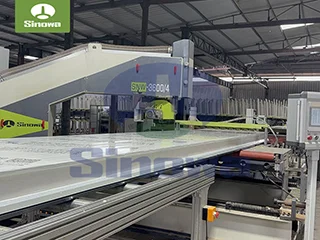
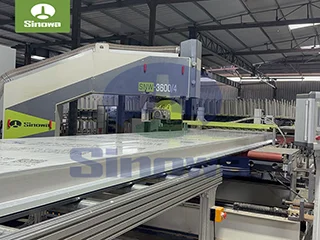
After completing curing and integral molding, the continuous long-strip panels enter the fixed-length cutting and finishing stage. The online cutting system adopts non-stop dynamic cutting technology, which can complete accurate fixed-length cutting of panels in the continuous conveying state of the PU sandwich panel production line, effectively improving production efficiency and avoiding production interruption caused by static cutting. The cutting device has high dimensional accuracy, which can ensure consistent length specifications of each finished panel, and the cutting sections are flat and smooth without burrs or deformation. After cutting, the edge trimming and surface finishing unit performs fine processing on the panel cutting positions and surface edges to remove residual burrs and tiny impurities, further optimizing the appearance quality of the products. At the same time, the system completes real-time detection of panel thickness, flatness and edge sealing integrity during the finishing process, eliminating unqualified products caused by dimensional deviation or incomplete side sealing.
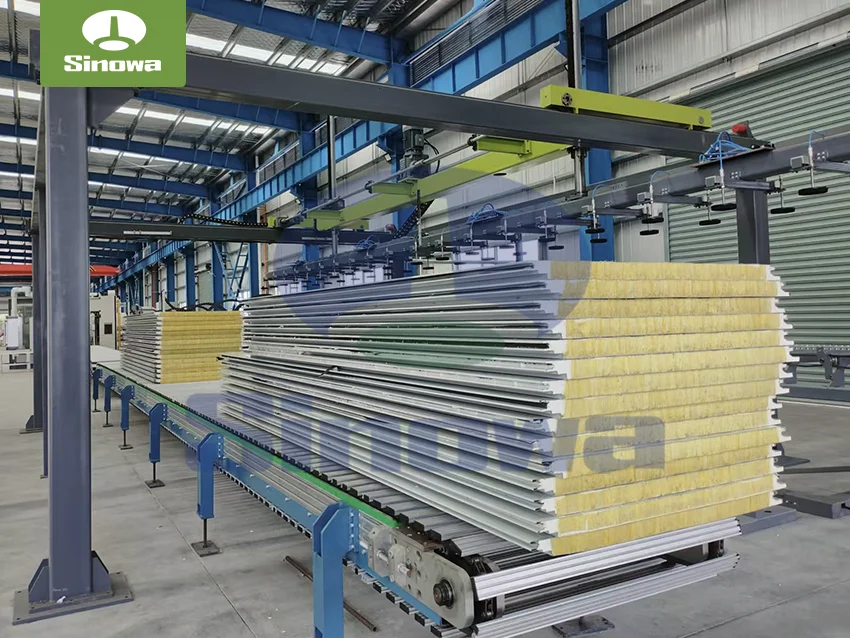
The final stage of production includes automatic stacking and finished product output. The qualified panels after finishing are stably conveyed to the stacking platform through the roller conveying system, and the automatic stacking device neatly stacks the panels according to fixed specifications and quantities. The stacking process maintains uniform spacing and stable placement of panels to avoid surface scratch and edge damage caused by mutual extrusion. The stacked finished products are neatly arranged for subsequent packaging and warehousing, realizing seamless connection from production molding to finished product storage. The whole process from raw material feeding to finished product stacking is completed by automatic equipment, which greatly reduces manual intervention, lowers the error rate caused by manual operation, and ensures the consistency and stability of batch product quality.
In terms of production performance and product quality optimization, the PU side sealing rock wool sandwich panel machine has obvious comprehensive advantages compared with traditional production equipment. Firstly, the integral polyurethane side sealing technology greatly improves the structural tightness of the panels. The closed edge structure avoids the defect of easy water absorption of open rock wool edges, making the panels have better moisture resistance and corrosion resistance, and can maintain stable thermal insulation and mechanical properties in humid and rainy environments for a long time. Secondly, the integrated molding process enhances the overall structural strength of the panels. The polyurethane side sealing layer forms a protective frame on the panel periphery, which cooperates with the internal rock wool core and metal surface plates to improve the bending resistance and compression resistance of the whole panel, reducing the probability of edge deformation and damage during transportation, installation and use.
In terms of production efficiency and operational economy, the highly automated integrated design of the polyurethane sandwich panel production line realizes continuous and uninterrupted batch production. All process links such as feeding, gluing, foaming, pressing, curing and cutting are synchronously linked, which shortens the production cycle of single panels and significantly improves the overall production capacity. The intelligent parameter control system can automatically adjust process parameters according to different raw material specifications and panel production requirements, realizing flexible switching of production specifications and meeting the diversified production needs of different thicknesses and sizes of sandwich panels. In addition, the precise metering and conveying system of raw materials effectively reduces the waste of polyurethane, adhesive and rock wool materials, improves the utilization rate of raw materials, and reduces the comprehensive production cost while ensuring product quality.
In terms of production safety and environmental protection performance, the rock wool sandwich panel line is equipped with perfect auxiliary processing devices. The dust collection system arranged near the rock wool feeding and cutting links can effectively collect floating fiber dust generated during production, keep the production workshop environment clean, and avoid air pollution and worker health hazards caused by fiber diffusion. The closed foaming and curing structure prevents the volatilization of trace harmful substances in the production process, realizing green and environmentally friendly production. At the same time, the automated operation mode reduces the contact frequency between workers and mechanical moving parts and raw materials, effectively reducing the risk of production safety accidents and improving the overall safety level of workshop production.
The finished rock wool sandwich panels produced by this sandwich panel manufacturing line have excellent comprehensive performance, retaining the excellent fire resistance, heat insulation and sound absorption characteristics of high-quality rock wool core materials, while making up for the structural shortcomings of traditional panels through polyurethane side sealing treatment. The products have wide application adaptability and can be widely used in the wall and roof enclosure structures of industrial plants, logistics warehouses, clean workshops, public buildings and other places. The tight side sealing structure ensures that the panels have good air tightness and heat preservation effect after installation, which can effectively reduce the energy consumption of building ventilation and temperature regulation, and improve the overall energy-saving performance of buildings. The stable structural strength and durable anti-aging performance also enable the panels to adapt to different climatic environments, realizing long-term stable use and reducing the frequency of building maintenance and replacement.
With the continuous upgrading of modern building energy-saving and environmental protection requirements, the market demand for high-performance sealed rock wool sandwich panels is increasing day by day, and the PU side sealing rock wool sandwich panel production line has become an important equipment to promote the upgrading of the building material panel manufacturing industry. Its integrated, automated and intelligent production mode changes the extensive production mode of traditional sandwich panel equipment, realizes refined control of each production process, and effectively improves the comprehensive quality level of building composite panels. In the future, with the continuous innovation of building material manufacturing technology, this sandwich panel machinery will further develop towards higher automation intelligence, more flexible production adaptation and more efficient energy-saving production, providing more reliable technical support for the production of high-quality building enclosure materials and promoting the sustainable development of the modern construction industry.
https://www.cnsinowa.com/sandwich-panel-machines/pu-side-sealing-rock-wool-sandwich-panel-production-line.html