 sandwich panel line
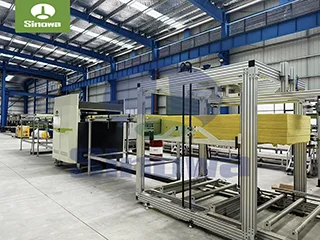
The overall configuration of the rockwool roof sandwich panel production line follows a modular and interconnected design logic, with every functional unit operating in synchronous coordination to realize uninterrupted continuous production. The entire system is composed of multiple core functional modules, covering surface material processing subsystem, rockwool core material pretreatment subsystem, automatic adhesive coating system, composite laminating and pressing unit, thermal curing system, fixed-length cutting unit and finished product conveying and sorting mechanism. All operational procedures are regulated by an intelligent centralized control system, which unifies the speed, temperature, pressure and feeding parameters of each equipment module, effectively reducing manual operation errors and ensuring the stability of the whole production process. The systematic layout not only optimizes production rhythm and improves overall operational efficiency, but also simplifies daily equipment maintenance and routine troubleshooting, laying a foundation for long-term stable industrial production.
Raw material preparation serves as the foundational stage that determines the basic performance and quality consistency of finished roof panels. The core raw materials adopted in the production process are natural volcanic rock-based inorganic raw materials, which are processed into rockwool fibers through high-temperature treatment, while the surface protective materials are metal coil materials with excellent weather resistance and structural strength. Before formal production, all raw materials undergo strict pretreatment procedures. Hard and bulky raw rock materials are crushed and screened to obtain uniform particle sizes, and impurities mixed in raw materials are thoroughly removed to avoid affecting fiber fineness and structural uniformity. Metal coil materials are inspected for surface flatness and thickness uniformity, with surface cleaning procedures implemented to remove dust, oil stains and oxide layers, ensuring reliable bonding strength between surface materials and core insulation layers. The standardized pretreatment process eliminates raw material quality fluctuations, which is crucial for maintaining the overall performance consistency of batch-produced roof panels.
The high-temperature melting and fiber forming process is the key link to shape the thermal insulation and fire-resistant performance of rockwool core materials. Pretreated rock raw materials are quantitatively and continuously sent into a closed high-temperature melting furnace, where the materials are heated to an extreme high temperature state to completely melt into homogeneous liquid melt. The closed furnace body design effectively stabilizes internal temperature and avoids heat loss, ensuring full melting of raw materials and eliminating unmelted particle residues. The high-temperature melt is then transported to a high-speed centrifugal fiber forming device, which relies on powerful centrifugal force to stretch and disperse the liquid melt into ultra-fine inorganic fibers. In the fiber forming process, micro-dose functional auxiliary materials are evenly sprayed onto the newly formed fibers, which can optimize the flexibility and structural cohesion of rockwool fibers, prevent fiber scattering and improve the overall compactness of subsequent core material layers. The whole fiber forming process is precisely controlled in terms of temperature, rotating speed and air volume parameters, ensuring uniform fiber diameter, stable fiber length and no structural defects, which endows the rockwool core with excellent thermal insulation and sound absorption properties.
After fiber forming, the rockwool fibers enter the wool collection and laying forming stage to form continuous and uniform core material blanks. The dispersed rockwool fibers are collected and converged through a negative pressure wool collection system, which gathers disordered fibers into preliminary fiber layers and removes excess floating dust and fine impurities generated in the fiber forming process. Then, the pendulum laying equipment conducts reciprocating uniform laying of the fiber materials, stacking the fibers in a cross and overlapping manner to form rockwool blanks with consistent thickness and uniform density. This cross laying structure effectively enhances the internal structural stability of the core material, avoids local density differences, and prevents the finished panel from deformation or performance attenuation under long-term stress. The thickness of the rockwool blank can be flexibly adjusted according to production demands, enabling the rock wool sandwich panel production line to manufacture roof panels with different insulation thickness specifications to adapt to different building energy-saving and thermal insulation requirements.
While the rockwool core material is being processed, the surface metal materials proceed with synchronous uncoiling and roll forming procedures. The integrated uncoiling device realizes automatic unwinding of metal coils, with a tension control system maintaining stable material conveying speed and uniform tension to avoid material deviation, wrinkling or stretching deformation. The uncoiled flat metal sheets are continuously sent into the roll forming unit composed of multiple groups of precision profiling rollers. Through gradual rolling and shaping of the roller groups, the flat metal plates are processed into special roof panel profiles with rib structures and edge sealing structures. The multi-stage rolling process ensures accurate profile dimension, smooth plate surface and neat edge lines, which not only improves the aesthetic degree of finished panels, but also enhances the overall structural rigidity and on-site assembly convenience of roof panels. The synchronous operation of surface material forming and core material processing greatly shortens the production cycle and realizes high-efficiency continuous compounding.
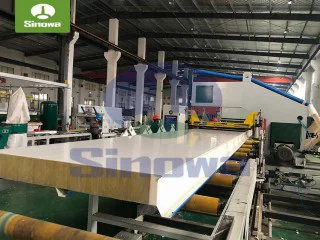
Adhesive coating and composite laminating are critical procedures to integrate the surface metal layer and rockwool core layer into an integral structure. The rock wool sandwich panel line is equipped with an automatic precise adhesive spraying system, which evenly sprays high-performance environmental-friendly adhesive on the inner surface of the formed metal plates. The spraying volume and spraying range are intelligently adjusted according to plate thickness and production speed, ensuring full coverage of the bonding surface without excess adhesive accumulation or local missing coating. Uniform adhesive distribution can maximize the bonding force between the metal surface layer and the inorganic core layer, effectively avoiding delamination, cracking and separation of panels during long-term use. After adhesive coating, the upper and lower metal surface layers and the middle rockwool core layer are accurately aligned and sent into the composite pressing unit. Through constant pressure and uniform pressing treatment, the three-layer structure is closely bonded into an integrated panel blank, and the internal gap of the composite structure is completely eliminated, optimizing the overall compactness and structural stability of the panel.
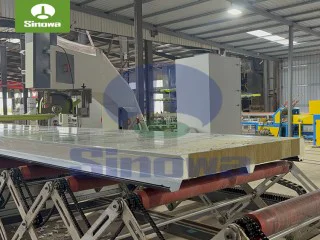
The thermal curing process after composite pressing determines the final bonding strength and structural stability of roof panels. The initially compounded panel blanks are transported into a constant-temperature curing furnace through a synchronous conveying system, where continuous and uniform thermal treatment is carried out. The internal temperature of the curing furnace is distributed evenly without local overheating or temperature dead zones, enabling the adhesive inside the panel to undergo complete cross-linking and curing reaction under stable temperature conditions. This process can fully exert the bonding performance of the adhesive, form a firm and durable bonding layer between the metal layer and rockwool core, and significantly improve the peeling resistance and shear resistance of the composite panel. Meanwhile, the constant-temperature thermal environment can further stabilize the internal fiber structure of the rockwool core, eliminate internal stress generated in the laying and pressing process, and avoid panel warping and deformation after leaving the factory. The curing time and temperature parameters can be dynamically adjusted according to different panel thicknesses and structural requirements to ensure the best curing effect for each product.
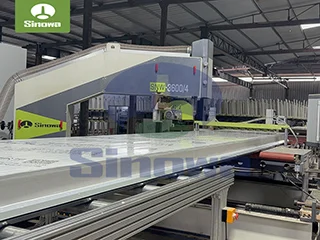
After curing and cooling, the continuous long-strip panel semi-finished products enter the precision fixed-length cutting and edge finishing stage. The rock wool sandwich panel machine is equipped with high-speed synchronous cutting equipment, which can complete fixed-length cutting in real time according to preset dimension parameters without stopping the rock wool board production line, realizing non-stop continuous production. The cutting tool adopts high-hardness wear-resistant materials, ensuring smooth and flat cutting sections without burrs, cracks or fiber falling off. After cutting, the edge trimming device automatically finishes the edges and corners of the panels, trimming redundant materials and optimizing the assembly gap structure of the panel edges, making the on-site splicing and installation of roof panels more accurate and tight. In addition, the equipment can realize flexible switching of cutting dimensions, meeting the customized production requirements of panels with different lengths and widths, and improving the product adaptability to diverse construction scenarios.
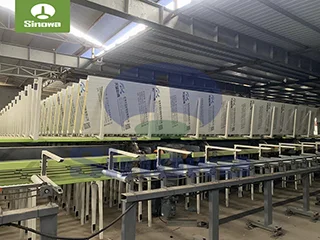
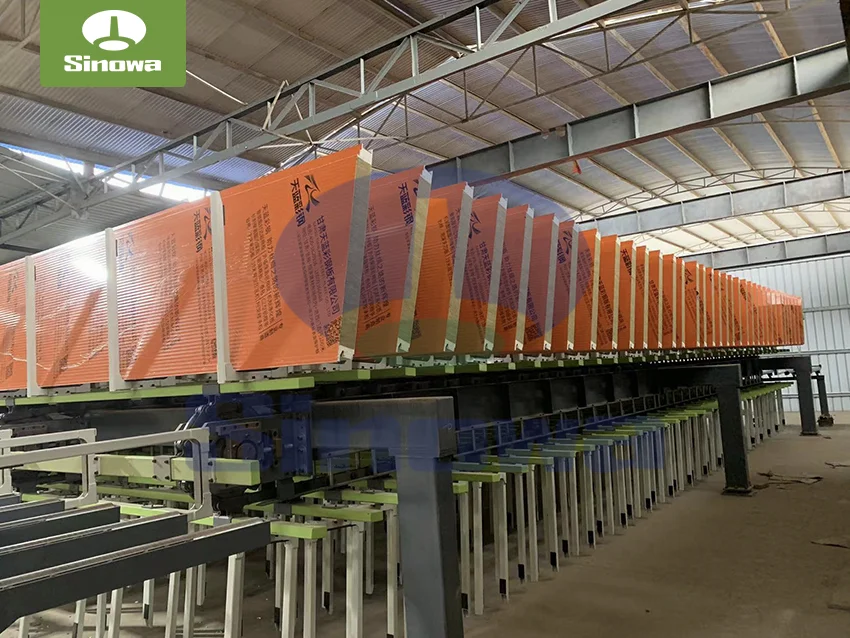
The finished product sorting, conveying and stacking system realizes automatic collection and standardized storage of qualified products. The cut finished roof panels are transported through the low-speed stable conveying platform, and unqualified products with surface defects, dimensional deviations or bonding abnormalities are manually screened out in the conveying process. Qualified products are automatically stacked by the intelligent stacking device in an orderly manner according to fixed specifications, with uniform stacking height and neat arrangement, which is convenient for subsequent packaging, transportation and warehouse storage. The automated post-processing procedure reduces manual handling links, avoids panel surface scratches, deformation and contamination caused by manual operation, and effectively guarantees the appearance quality and structural integrity of finished products.
The intelligent control system running through the whole rockwool board production line is the core guarantee for efficient and stable operation of the equipment. The system adopts integrated programmable control technology, which can uniformly monitor and adjust all links including raw material feeding, melting temperature, fiber forming speed, laying thickness, adhesive spraying volume, pressing pressure, curing temperature and cutting dimensions. Operators can set production parameters through the touch control interface, and the system can automatically realize synchronous matching of the operating speed of each unit. When abnormal parameters such as temperature deviation, material blockage and speed mismatch occur in the production process, the system will automatically trigger early warning prompts and perform adaptive adjustment or emergency shutdown protection, effectively reducing equipment failure rate and product defective rate. Meanwhile, the system can record production data in real time, providing data support for production schedule optimization, equipment maintenance and product quality traceability.
Compared with traditional intermittent production equipment, the fully automated rockwool roof sandwich panel line has prominent advantages in production efficiency, product quality and production cost control. The continuous uninterrupted production mode greatly improves unit time output and shortens the production cycle of single products. The standardized and parameterized production mode avoids quality differences caused by manual operation, making the thermal insulation performance, structural strength, dimensional accuracy and appearance quality of batch-produced panels highly consistent. The closed production environment effectively reduces dust and fiber overflow in the production process, improving the on-site production environment and meeting the requirements of clean and environmentally friendly industrial production. In addition, the modular equipment structure reduces the difficulty of daily maintenance and equipment upgrade, and the intelligent energy-saving design optimizes energy consumption in the production process, realizing low-consumption and high-efficiency production operation.
Roof panels produced by this professional sandwich panel machinery possess excellent comprehensive performance, adapting to the harsh service environment of building roofs. The inorganic rockwool core material has stable physical and chemical properties, with outstanding thermal insulation and heat preservation effects, which can effectively block indoor and outdoor heat transfer, reduce building air conditioning and heating energy consumption, and achieve the effect of energy saving and emission reduction. At the same time, the inorganic fiber structure does not burn or support combustion, providing reliable fire protection performance for building roofs. The compact composite structure and firm bonding layer endow the panels with good wind resistance, pressure resistance and impact resistance, which can adapt to different climatic environments such as strong wind, heavy rain and low temperature. The metal surface layer has good weather resistance and corrosion resistance, which can resist long-term ultraviolet radiation and rain erosion, ensuring a long service life of the roof system. In addition, the panels have excellent sound absorption and noise reduction performance, which can effectively reduce the impact of external noise on the indoor environment and improve the comfort of building use.
In the context of the vigorous development of green buildings and energy-saving buildings worldwide, the application prospect of rockwool roof panels is increasingly broad, and the supporting production line equipment is also constantly optimized and upgraded with the progress of building technology. Modern rock wool roof sandwich panel manufacturing line design pays more attention to intelligent upgrading, energy saving optimization and environmental protection improvement. The optimized material conveying and processing structure further reduces material waste and improves raw material utilization rate. The upgraded temperature control and pressure control system improves the precision of production parameter control, making product performance more stable and reliable. The intelligent fault diagnosis and remote monitoring function realize fine management of production equipment, reduce downtime loss and improve overall production benefits.
As a key equipment in the field of energy-saving building material manufacturing, the rockwool roof panel production line not only realizes large-scale and standardized production of high-performance roof insulation panels, but also promotes the upgrading of the overall manufacturing level of building enclosure materials. Its efficient, stable and environmentally friendly production characteristics meet the dual requirements of modern construction for building safety performance and green energy-saving performance. With the continuous improvement of building energy-saving standards and the continuous expansion of the prefabricated building market, the market demand for high-quality rockwool roof panels will continue to grow, and the sandwich panel production equipment will also develop in the direction of higher intelligence, higher efficiency and more flexible customization, providing more reliable core equipment support for the high-quality development of the construction industry.
https://www.cnsinowa.com/sandwich-panel-machines/rockwool-roof-panel-production-line.html