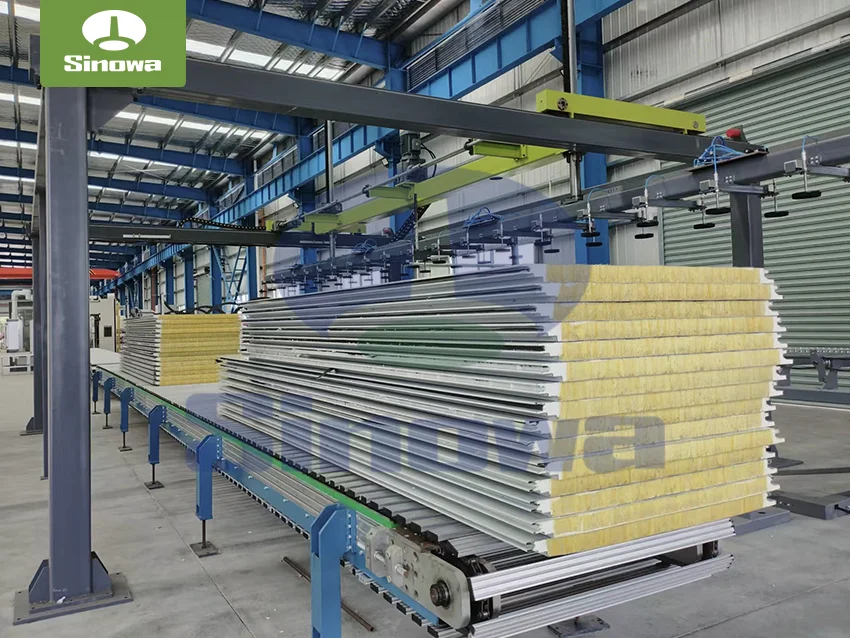
 sandwich panel line
The overall operational logic of the thermal insulation rock wool sandwich panel production line revolves around the perfect combination of thermal insulation core materials and protective surface materials, with the core design concept of maintaining the structural integrity, thermal stability and mechanical durability of finished panels. The entire production process follows a continuous assembly line mode, with each processing unit closely connected and mutually coordinated, avoiding intermediate material handling and repeated positioning errors. At the initial stage of production, the system completes the pretreatment of two key raw materials: metal surface sheets and rock wool core materials. The metal sheets used for panel surface protection are usually rolled metal materials with smooth surfaces and strong compression resistance. Before formal compounding, the raw metal coils need to undergo unwinding, leveling, trimming and surface cleaning treatments. The leveling process eliminates the internal stress and surface wrinkles of the metal sheets generated during coil rolling, ensuring the flatness and dimensional uniformity of subsequent formed panels. The trimming link accurately cuts off the irregular edges of the metal sheets to guarantee the neatness of the final panel edges, while surface cleaning removes dust, oil stains and oxide layers on the material surface, laying a solid foundation for firm bonding between the metal sheet and the rock wool core layer.
As the core functional material of the sandwich panel, rock wool directly determines the thermal insulation, fire resistance and sound absorption performance of the finished product, so the pretreatment of rock wool materials is a key link in the entire thermal insulation board production line operation. High-quality rock wool is made from natural basalt and other volcanic rock raw materials through high-temperature melting and centrifugal fiber forming. In the production line, the loose rock wool fiber materials need to undergo sorting, dense paving and integral shaping treatments. The professional fiber paving system in the equipment can uniformly distribute rock wool fibers in a fixed thickness and density range, avoiding local hollowing, uneven density and fiber agglomeration. This precise paving treatment ensures that each part of the rock wool core layer has consistent thermal conductivity and structural strength, so that the finished panel can maintain stable thermal insulation performance in complex temperature environments. Meanwhile, the production line is equipped with targeted fiber sorting devices to screen out unqualified coarse fibers and impurity particles, further optimizing the internal structure of the rock wool core and improving the overall durability of the panel.
Adhesive coating and composite lamination are the most critical processes that determine the bonding strength and overall structural stability of sandwich panels. The thermal insulation rock wool sandwich panel machine adopts a high-efficiency environmental-friendly polymer adhesive coating system, which can uniformly spray quantitative adhesive on the bonding surfaces of metal sheets and rock wool core materials. Compared with traditional manual gluing and roller gluing processes, the automatic spraying mode realizes ultra-thin and uniform adhesive coverage, effectively avoiding excessive adhesive accumulation, local glue shortage and bubble generation. The adhesive used in the production line has excellent fast-curing characteristics and high bonding activity, which can quickly form a stable adhesive layer at a suitable temperature, tightly combining the rigid metal surface layer and the fibrous rock wool core layer into an integrated structure. In the composite lamination stage, the double-belt laminating equipment applies constant and uniform pressure on the composite materials. The precise pressure control system can adjust the pressing force according to the thickness and density of different panels, ensuring that the internal structure of the panel is compact without crushing the rock wool fiber structure, and balancing the mechanical strength and thermal insulation performance of the product.
Constant-temperature heating and curing is an indispensable link to solidify the composite structure of sandwich panels and stabilize product performance. The curing section of the rock wool board production line is equipped with a closed constant-temperature heating system, which can form a stable and uniform temperature field inside the curing channel. After lamination, the initially compounded panels are continuously transported into the curing equipment through the conveying track, and the internal adhesive completes chemical cross-linking and curing reaction under the set constant temperature condition. The scientific temperature setting and curing time control can maximize the bonding performance of the adhesive, eliminate the risk of degumming and layering of panels in subsequent use, and significantly improve the weather resistance and structural stability of finished products. The whole curing process is completed in a fully enclosed environment, which not only ensures the consistency of curing effect of each batch of products, but also avoids the impact of external temperature and humidity changes on product quality, realizing standardized and intelligent curing processing.
After the curing process is completed, the high-temperature panels enter the automatic cooling and shaping section for temperature reduction and structural stabilization treatment. The rapid and uniform cooling system can gradually reduce the surface and internal temperature of the panels to room temperature, effectively avoiding structural deformation, surface warping and internal stress concentration caused by rapid temperature change. Only after full cooling and shaping can the internal composite structure of the panel reach a completely stable state, ensuring that the dimensional accuracy and flatness of the product meet the design standards. The cooled panels are then sent to the precision cutting unit, where high-speed synchronous tracking cutting equipment performs fixed-length horizontal cutting and edge trimming according to preset production parameters. The intelligent cutting system can flexibly adjust the cutting size according to different production requirements, realizing diversified production of panels of various specifications, and the cutting section is smooth and flat without burrs, which greatly improves the appearance quality and installation adaptability of finished products.
The final stage of the insulation panel production line includes edge sealing, surface protection and automatic stacking, which further optimizes the product performance and facilitates subsequent transportation and storage. The edge sealing process adopts flexible and high-toughness sealing materials to seal the peripheral gaps of the panels, which can effectively prevent external moisture, dust and corrosive substances from entering the internal rock wool core layer, avoid fiber dampness, mildew and performance attenuation, and prolong the service life of the panels. After edge sealing, the equipment completes the pasting of protective films on the panel surface to prevent surface scratches and abrasion during transportation and installation. Finally, the automatic stacking device neatly stacks the qualified finished panels according to fixed specifications, realizing orderly output of finished products and laying a foundation for efficient packaging and warehousing.
In terms of production performance advantages, the thermal insulation rockwool sandwich panel production line has outstanding characteristics of high efficiency, stability and energy saving. The full continuous production mode realizes seamless connection of each process link, greatly shortens the single-piece production cycle and significantly improves the overall production capacity. The whole production process is controlled by an intelligent system, which can automatically adjust production parameters such as feeding speed, glue coating amount, lamination pressure and curing temperature according to different product specifications, realizing adaptive production of diversified products. The automated control mode effectively reduces manual intervention, avoids product quality fluctuations caused by human operation errors, and ensures that the dimensional accuracy, bonding strength and thermal insulation performance of each batch of products remain highly consistent.
In terms of environmental protection and safety production, the rockwool board production line is equipped with professional dust removal and fiber recovery devices in the rock wool processing area. During the fiber paving and shaping process, a small amount of floating loose fibers will be generated, and the dust collection system can timely collect and recover these scattered fibers, which not only keeps the production workshop clean and tidy, avoids fiber diffusion and environmental pollution, but also realizes the reuse of raw materials and reduces production waste. In addition, the adhesive materials used in the production process are low-volatile and environmentally friendly formulas, which will not produce harmful and toxic gases during heating and curing, meeting the environmental protection production requirements of modern building materials manufacturing enterprises. The mechanical operation links are equipped with safety protection structures and linkage control systems, which can automatically stop operation in case of abnormal equipment operation, ensuring the safety and stability of the production process.
The products manufactured by the thermal insulation rock wool sandwich panel manufacturing line have excellent comprehensive performance and wide application value. Relying on the unique fibrous porous structure of rock wool, the finished panels have ultra-low thermal conductivity, which can effectively block heat transfer, achieve excellent heat preservation and heat insulation effects, and greatly reduce the energy consumption of building temperature regulation. At the same time, rock wool materials have excellent fire resistance, which can effectively inhibit the spread of flames and improve the overall fire safety of buildings. In addition, the internal porous structure of rock wool also gives the panels good sound absorption and noise reduction performance, which can effectively reduce the transmission of external noise and create a quiet indoor environment. The composite structure of metal surface layer and rock wool core layer also endows the panels with high mechanical strength, compression resistance and impact resistance, which can adapt to complex outdoor and indoor use environments, and has strong weather resistance, not easy to age, deform and damage in long-term use.
With the continuous development of green building concepts and energy-saving building technologies, the market demand for high-performance thermal insulation and fireproof building panels is increasing year by year, which also promotes the continuous upgrading and optimization of thermal insulation rock wool sandwich panel production line. Modern production lines are gradually developing towards higher intelligence, higher integration and lower energy consumption. The upgraded intelligent control system can realize real-time monitoring and data analysis of the entire production process, automatically record production parameters and product quality data, facilitate production quality traceability and production process optimization. The optimized mechanical structure reduces the energy consumption of equipment operation, improves the utilization rate of raw materials, and further reduces the comprehensive production cost while ensuring product quality.
In practical industrial production and engineering applications, the thermal insulation rock wool sandwich panel production machine has become the core supporting equipment for the production of energy-saving and fireproof building materials. Its stable production performance and flexible production capacity can meet the customized production needs of different industries and different engineering scenarios, including industrial plant enclosure, cold storage thermal insulation, clean workshop construction, public building exterior wall thermal insulation, indoor partition and other fields. The standardized panels produced by the line have the advantages of convenient installation, short construction cycle and good overall forming effect, which can effectively improve the construction efficiency of engineering projects and reduce the difficulty of on-site construction. At the same time, the excellent energy-saving and environmental protection performance of the products can help buildings reduce energy consumption, reduce carbon emissions, and conform to the development trend of low-carbon and energy-saving buildings in the modern construction industry.
In conclusion, the thermal insulation rock wool sandwich panel line is a highly integrated and high-efficiency professional production system combining mechanical manufacturing, material science and intelligent control technology. Through standardized and automated full-process production, it realizes the efficient manufacturing of high-performance thermal insulation rock wool sandwich panels, ensures the stable and reliable quality of finished products, and provides high-quality basic materials for the development of modern green construction industry. With the continuous progress of building material technology and the continuous improvement of building energy-saving standards, this type of insulation sandwich panel machine will continue to play an important role in the field of building thermal insulation material production, and constantly promote the upgrading and iterative development of the building thermal insulation industry with its efficient production capacity, stable product quality and good environmental protection benefits.
https://www.cnsinowa.com/sandwich-panel-machines/thermal-insulation-rock-wool-sandwich-panel-line.html






