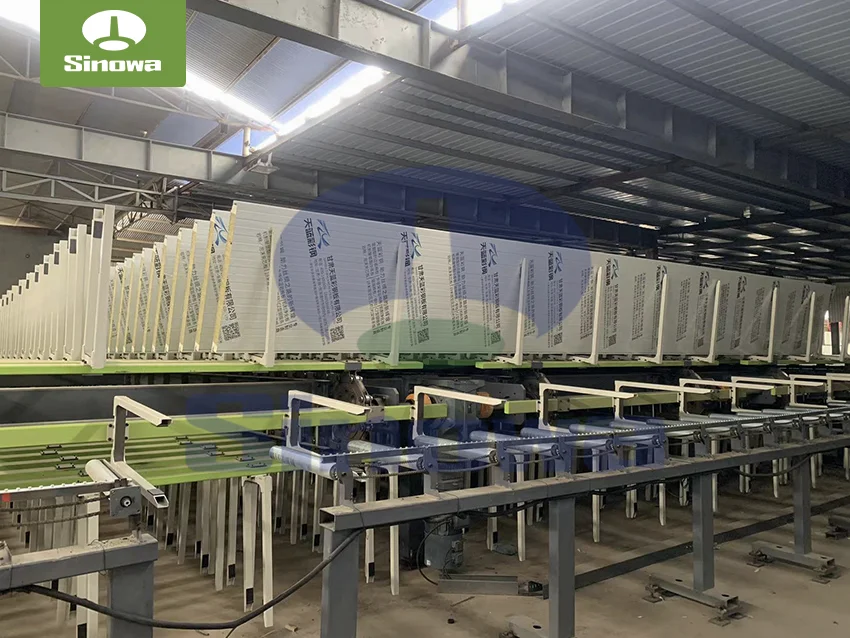
 sandwich panel line
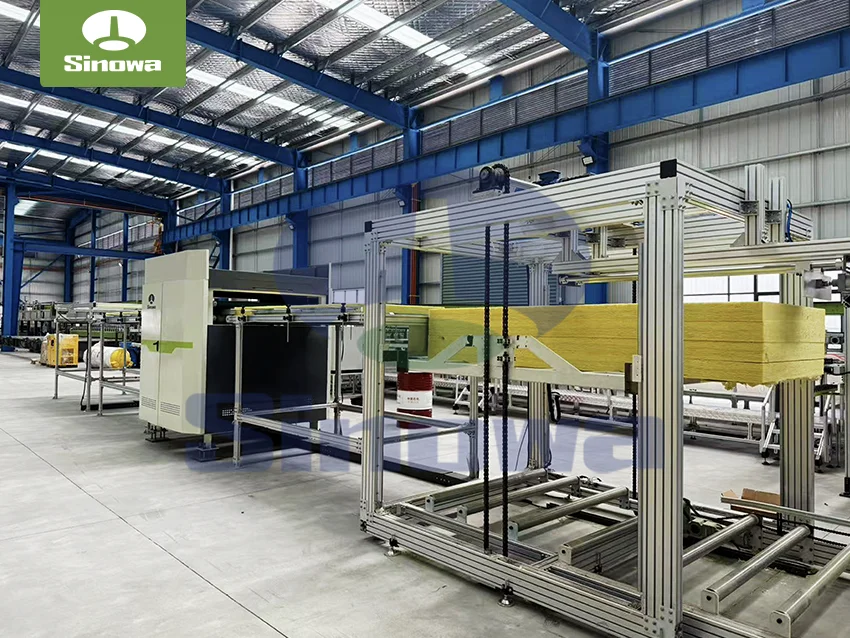
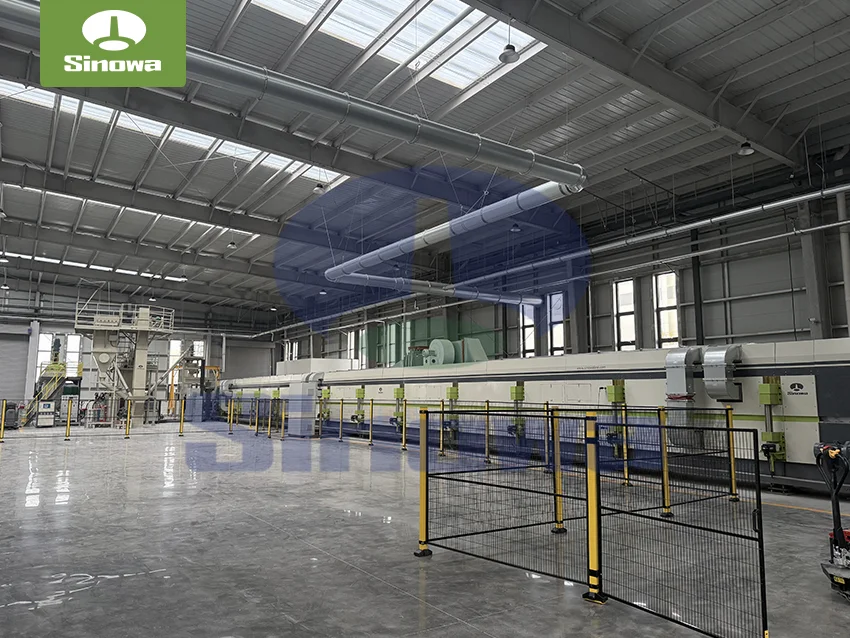
The overall structural design of the automatic composite rock wool board production line adopts modular integrated layout, and all functional units are connected in a linear and continuous operating track to avoid intermediate material transfer interruption and manual intervention gaps existing in segmented production equipment. The whole production system can be divided into six core collaborative modules according to production sequence: raw material automatic feeding and leveling module, surface treatment and adhesive coating module, rock wool core material positioning and laying module, integrated composite pressing and curing module, online cooling and precision cutting module, as well as finished product automatic sorting and stacking module. Supported by a unified central control system, all modules realize synchronous speed matching and parameter linkage operation, so that the whole production process runs continuously without frequent start-stop adjustments, which fundamentally solves the quality fluctuation problem caused by inconsistent operating rhythm of individual equipment in decentralized production lines. Each mechanical component of the rockwool sandwich panel production line is designed with fatigue resistance and running stability targeted at long-duration continuous operation, and key transmission and pressing parts adopt wear-resistant structural materials to reduce daily maintenance frequency and extend the overall service cycle of the whole line.
The initial stage of the whole manufacturing process starts with automatic feeding and leveling of upper and lower surface base plates. Most composite rock wool boards use flat rigid base plates as protective and stress-bearing surface layers, and coiled base plate materials are loaded into automatic uncoiling equipment at the front end of the rock wool sandwich panel production line. Equipped with closed-loop tension regulation devices, the uncoiling unit maintains constant tensile force during the whole unwinding process, effectively preventing common defects such as surface wrinkles, edge warping and local stress concentration caused by uneven unwinding speed. After unwinding, the curved coiled plates are sent to a multi-group roller leveling unit, which eliminates residual bending stress generated during coil storage through multi-directional mechanical calibration, ensuring the flatness of surface plates within an extremely small tolerance range. This precise pretreatment process lays a solid foundation for subsequent adhesive bonding and composite pressing, because uneven surface plates will directly lead to incomplete bonding between surface plates and rock wool core layers, resulting in delamination and peeling of finished products in later use. Parallel to the surface plate feeding system, the rock wool core material automatic conveying system operates synchronously. Bulk rock wool raw materials are firstly sent to an automatic slitting unit, which cuts rock wool into fixed-width core strips matching the size of surface plates according to preset production parameters. Meanwhile, auxiliary shaping rollers compact loose rock wool fibers moderately to avoid excessive fiber shedding while retaining the porous internal structure required for thermal insulation and sound absorption. A centralized dust collection system is arranged around the rock wool cutting and conveying area to capture floating fine fibers in real time, preventing fiber diffusion from polluting other equipment components and the overall workshop operating environment.
Adhesive coating and pre-composite alignment is a pivotal process determining the long-term bonding durability of composite rock wool boards, and also a core link optimized greatly by automatic rockwool board production line compared with manual gluing processes. The production line adopts non-contact precision roller coating and micro-spraying dual adaptive gluing modes, which can switch automatically according to the surface roughness of different base plates. Environmentally friendly polymer adhesive without harmful volatile components is used in the whole process, featuring fast room-temperature curing speed, strong permeability to rock wool porous structures and no corrosive damage to metal or non-metal base plates. The digital metering pump connected to the gluing system realizes real-time quantitative control of adhesive output, avoiding material waste caused by excessive gluing or hidden dangers of insufficient bonding strength caused by uneven gluing gaps. During operation, adhesive is evenly covered on the inner surfaces of upper and lower base plates, and the coating thickness and gluing range are automatically adjusted synchronously with the operating speed of the composite sandwich panel line to match different production rates. After gluing is completed, the upper and lower base plates and the cut rock wool core strips are sent to a visual positioning pre-composite station. High-precision visual sensors identify the edge positions of core materials and base plates in real time, and fine-tune the conveying tracks of each material through servo motors to achieve zero-dislocation lamination of three layers of materials. A group of low-pressure pre-pressing rollers are installed behind the positioning station to discharge residual air between layers gently, making preliminary close contact between the core layer and surface plates and preventing interlayer air bubbles from affecting overall bonding performance before formal high-pressure composite molding.
Continuous composite pressing and constant-temperature curing constitutes the core molding section of the composite sandwich panel production line, which directly decides the overall structural strength, interlayer bonding firmness and dimensional stability of finished composite rock wool boards. This module adopts a long-span double-layer circulating conveyor pressing structure with upper and lower circulating conveyor belts made of high-temperature resistant and non-stick special materials, which can maintain stable surface friction and flatness under long-term pressure and heating working conditions. The system applies uniform surface pressure to the pre-laminated plate blanks, and the pressure value can be adjusted steplessly according to the thickness and density of rock wool core materials. For thick rock wool boards with higher core material thickness, the system automatically increases pressing pressure to ensure tight fitting between layers; for thin-specification products, it reduces pressure moderately to prevent irreversible compression damage to rock wool internal fiber structures and avoid attenuation of thermal insulation performance. Built-in circulating heating modules are distributed evenly inside the pressing section to form a constant-temperature curing environment, accelerating the cross-linking reaction of polymer adhesives and realizing permanent integrated bonding between surface plates and rock wool core layers. Different from intermittent curing equipment, the continuous pressing and curing design matches the linear running speed of the front-end process completely, so plate blanks complete curing synchronously during forward conveying without stopping for static curing, greatly improving continuous production capacity while ensuring consistent curing effect of each batch of products.
After high-pressure composite curing, the integrally molded long strip composite rock wool board enters the online cooling and precision cutting process. The high-temperature plate body coming out of the curing section contains residual internal heat, and direct cutting will lead to thermal shrinkage deformation and uneven cutting notches. Therefore, the rock wool sandwich panel machine is equipped with a forced air cooling section with uniform air volume distribution, which reduces the surface and internal temperature of plates to room temperature evenly through layered circulating air supply. This gradual cooling mode avoids local temperature difference stress inside plates, effectively preventing plate warping, bending and dimensional shrinkage after processing. The cooled continuous plates are then transmitted to a servo-driven fixed-length cutting unit. The cutting system synchronizes real-time running speed of the insulation board production line to achieve dynamic non-stop cutting, eliminating production efficiency loss caused by equipment shutdown in traditional static cutting processes. Operators can set arbitrary cutting length specifications through the central control terminal, and the servo cutting tool realizes micron-level cutting tolerance. Meanwhile, edge trimming devices on both sides remove tiny burrs and uneven fiber residues on plate edges automatically, optimizing the overall appearance and assembly accuracy of finished boards. All cutting waste generated in this process is collected uniformly through a closed recovery pipeline and can be reprocessed into auxiliary thermal insulation filling materials, realizing effective reuse of production waste.
The final link of the production flow is automatic finished product sorting, conveying and stacking. Qualified rock wool boards after cutting and edge trimming are transmitted to a layered stacking platform through a follow-up conveyor. The stacking system adjusts stacking height and spacing automatically according to plate specifications, and places flexible protective gaskets between adjacent boards to prevent surface scratch damage and edge extrusion damage during stacking and later transportation. The whole stacking process requires no manual carrying and arrangement, reducing labor intensity on site while improving the neatness of finished product inventory. The rockwool sandwich panel production machine is also equipped with online real-time quality inspection sensors behind the cutting unit, which conduct real-time non-destructive detection on interlayer bonding tightness, plate flatness and overall thickness of finished boards. Once unqualified products with substandard indicators are detected, the system will automatically push them into an independent unqualified product recovery area without affecting continuous production of subsequent qualified products, realizing online separation of defective products and reducing manual quality inspection workload.
The intelligent central control system acts as the brain of the composite automatic sandwich panel production line, supporting full-process digital operation and intelligent fault early warning. The whole line adopts programmable logic controller as the core control component, matched with an intuitive human-computer interaction touch screen. On-site operators only need to input product parameters including plate thickness, width, length and production speed on the interactive interface, and the system will automatically complete synchronous parameter matching of feeding, gluing, pressing, temperature control and cutting units without repeated debugging of individual equipment. The control system supports real-time data collection and visual display of all operating indicators, including equipment operating current, curing temperature, adhesive consumption, conveying speed and daily production output. All production operation data can be stored automatically for production data statistics, production process optimization and subsequent production traceability. In terms of operation safety and equipment maintenance, the system has built-in multi-dimensional fault self-diagnosis functions. When abnormal conditions such as blocked material conveying, insufficient adhesive supply, overhigh curing temperature and mechanical operation deviation occur in any module, the system will trigger audible and visual alarms instantly, accurately locate the fault position and give corresponding maintenance suggestions, helping staff eliminate hidden risks rapidly and minimize production downtime loss. In addition, the system supports interlocking protection of all mechanical moving parts, and all rotating and pressing structures will stop running immediately once human body approaching signals are detected, greatly improving the intrinsic safety level of the production workshop.
Compared with traditional semi-automatic production modes, the composite sandwich panel machine has comprehensive advantages in production efficiency, product quality stability, human resource cost control and workshop environment management. In terms of production efficiency, continuous uninterrupted operation mode breaks the bottleneck of segmented manual production, and the linear collaborative operation of all modules greatly improves daily single-line output, which can well meet bulk centralized orders from construction projects and building materials distributors. In terms of product quality, full-process digital parameter control avoids random errors caused by manual operation, ensuring consistent physical performance and dimensional accuracy of each batch of composite rock wool boards. The finished products have stable interlayer bonding strength, no delamination after long-term use, and maintain intact thermal insulation and fireproof performance in high-temperature, humid and other harsh service environments. In terms of labor cost optimization, the whole line only needs a small number of on-site management personnel to monitor operating status and conduct daily equipment maintenance, replacing a large number of front-line workers required for material carrying, gluing, cutting and stacking in traditional processes, effectively reducing long-term human resource investment for manufacturers. In terms of on-site environment optimization, the closed dust removal system and adhesive waste gas collection device restrain fiber diffusion and volatile gas emission during production, realizing clean and low-emission workshop production and meeting increasingly stringent industrial environmental management requirements.
From the perspective of full life cycle environmental protection, both the sandwich panel line itself and manufactured composite rock wool boards fit the global green manufacturing and low-carbon building development trends. Rock wool raw materials are processed from natural inorganic mineral raw materials, without adding flammable organic components, and the finished boards will not release toxic smoke or harmful substances when exposed to open fire. During the whole manufacturing process, recyclable treatment is realized for rock wool cutting leftover materials, excess adhesives and edge trimming waste, and almost no solid waste is discharged outwards. The low-VOC adhesive used in the production process reduces air pollution in the production workshop, and the optimized energy-saving driving structure of motors and heating modules cuts down overall energy consumption per unit product. After reaching service life, composite rock wool boards can be disassembled hierarchically, surface base plates can be recycled and reused, and rock wool core materials can be reprocessed into auxiliary thermal insulation fillers, forming a closed-loop resource recycling system. Such environmentally friendly production characteristics make automatic rock wool composite board production lines more competitive in green building material supply chains and low-carbon industrial manufacturing scenarios.
With the continuous upgrading of intelligent manufacturing technology and the deepening of building energy conservation reform, the future development of composite rock wool insulation panel production line will focus on three major directions: deeper intelligent unmanned operation, adaptive multi-specification flexible production and further energy consumption reduction. Firstly, by integrating Internet of Things data transmission and artificial intelligence algorithm analysis technologies, the production line will realize autonomous optimization of process parameters according to raw material quality fluctuations, eliminating manual parameter adjustment completely and achieving full unmanned workshop operation. Secondly, the modular equipment structure will be further optimized to realize rapid switching production of rock wool composite boards with different surface materials, different thicknesses and different structural types without replacing core equipment, improving production flexibility for manufacturers to respond to diversified market demands. Thirdly, waste heat recovery modules will be added to the curing and cooling sections to recycle residual heat generated during production for preheating raw materials, further reducing overall energy consumption of the whole line and lifting the low-carbon manufacturing level of building materials production.
In conclusion, the composite rock wool board automatic production line is a mature and systematic intelligent manufacturing equipment integrating mechanical transmission, material engineering, adhesive technology and digital automatic control technology. It solves multiple pain points of traditional production processes, including low efficiency, unstable quality, high labor cost and poor production environment. While supporting the large-scale supply of high-performance fireproof and thermal insulation building materials for the construction industry, it also promotes the overall upgrading of the rock wool board manufacturing industry from extensive manual production to refined intelligent production. As global requirements for building safety, energy conservation and environmental protection continue to rise, this type of sandwich panel machinery will become standard core equipment for mainstream building materials manufacturers, and play an indispensable supporting role in the popularization of prefabricated green buildings and the realization of industrial dual-carbon goals.
https://www.cnsinowa.com/sandwich-panel-machines/composite-rock-wool-board-automatic-production-line.html