 sandwich panel machine
Before starting the formal production operation, comprehensive pre-production preparation and equipment inspection work must be completed to eliminate potential operational risks and ensure that all equipment modules are in optimal working condition. The first step of preparation is raw material inspection and pretreatment. The main raw materials for rock wool board production are natural mineral materials with stable chemical properties, which need to be screened manually and mechanically to remove impurity particles, large agglomerates, and foreign substances that may affect production quality. After screening, the raw materials are proportioned according to the production process requirements, and uniform mixing is carried out through auxiliary mixing equipment to ensure the consistency of raw material components in each production batch. Uniform raw material components are the basic prerequisite for stable fiber forming and consistent product performance, effectively preventing local performance differences of finished boards caused by uneven raw material mixing.
Subsequently, the overall inspection of the rock wool board production line is carried out, covering mechanical transmission parts, temperature control systems, conveying systems, spraying devices, and cutting execution components. Operators need to check the tightness of each transmission bearing, gear chain, and roller shaft to ensure no loose parts or abnormal friction resistance. The circulating conveying mesh belt and roller table are inspected for deviation, wear, or adhesion of residual materials, and surface cleaning is conducted to avoid affecting the flatness of subsequent fiber laying and plate forming. The temperature control sensing components of the melting and curing equipment are calibrated to ensure accurate real-time monitoring and adjustment of internal temperature during equipment operation. In addition, the air pressure and power supply systems of the entire production line are checked to maintain stable operating power and air pressure output, avoiding sudden parameter fluctuations that may cause production interruptions. After all inspection items are confirmed to be normal, the equipment is started for idle operation for a certain period to observe the running state of each module, check for abnormal noise, vibration, or delayed response of functional components, and formal production can be started only after confirming that the equipment operates stably without abnormalities.
The core link of formal production starts with automatic feeding and high-temperature melting of raw materials. The pretreated and proportioned mineral raw materials are continuously and quantitatively transported to the closed melting furnace through an automatic feeding system. The feeding speed is kept uniform and stable to avoid excessive local material accumulation or insufficient material supply, which may affect the melting effect. The internal temperature of the melting furnace is stably maintained within a fixed high-temperature range through an intelligent temperature control system, which can completely melt the solid mineral raw materials into uniform and smooth molten liquid. During the melting process, the equipment maintains a stable internal airflow environment to ensure sufficient and uniform heating of all raw materials, eliminate unmelted particle residues, and ensure the consistency of the physical state of the molten material. The fully melted liquid raw materials are stably output from the furnace body through a fixed flow channel, laying a solid foundation for subsequent fiber stretching and forming.
The molten raw material liquid enters the high-speed fiber forming system, which is the key process to determine the fineness and uniformity of rock wool fibers. The fiber forming equipment relies on high-speed rotating mechanical structures, which use centrifugal force and high-speed synchronous airflow to stretch the thick molten liquid into ultra-fine and uniform fibrous structures. In this process, the rotating speed of the fiber forming mechanism and the airflow intensity are precisely controlled to ensure that the fiber diameter is kept within a uniform range, avoiding excessive fiber thickness difference that affects the thermal insulation and structural toughness of finished products. At the same time, a quantitative atomized adhesive is evenly sprayed on the surface of the newly formed fibers through a professional spraying device. The adhesive can bond the scattered single fibers into an integral fiber network structure, effectively improving the overall compactness and structural stability of the rock wool board, and preventing fiber shedding and loose structure in subsequent use.
The fiber mixture sprayed with the adhesive is uniformly collected on the circulating conveying mesh belt through the cotton collecting device, and then enters the automatic cotton laying system for uniform distribution and stacking. The pendulum cotton spreading structure operates reciprocally at a stable frequency, paving the disordered fibers layer by layer on the conveying equipment. The thickness and uniformity of the fiber layer are accurately adjusted by controlling the cotton spreading speed and reciprocating frequency. The multi-layer overlapping cotton laying mode can make the internal fiber structure of the rock wool board more three-dimensional and uniform, avoid the problem of uneven local thickness, and enhance the overall structural uniformity of the product. After cotton laying is completed, the preliminary loose fiber blanket is sent to the pre-pressing device for primary compression shaping. The pre-pressing process gently squeezes the loose fiber layer to discharge excess gaps and air inside the fiber blanket, preliminarily fix the overall shape and thickness, and prepare for the subsequent formal curing and pressing process.
The pre-pressed semi-finished fiber blanket is continuously transported to the curing furnace for high-temperature curing and final pressing forming, which is the core process to finalize the product structure and performance. The internal temperature and operating speed of the curing furnace are matched with the production rhythm, so that the adhesive inside the fiber layer can fully react and solidify under constant temperature conditions. In the high-temperature curing environment, the adhesive forms a stable bonding structure between fibers, tightly combining the dispersed fibers into a solid integrated plate structure. At the same time, the double-belt pressing structure inside the curing furnace performs constant-pressure pressing on the fiber blanket, accurately controlling the thickness flatness and overall compactness of the rock wool board. The continuous linear operation mode ensures that each section of the rock wool board is subject to consistent temperature and pressure action, realizing uniform product performance of the whole plate. After curing and pressing, the initial rock wool board has stable structural strength, flat surface, and uniform thickness, and basically forms the finished product shape.
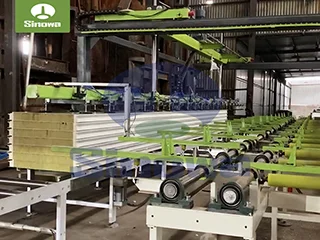
After being discharged from the curing furnace, the high-temperature rock wool board needs to go through a natural cooling and shaping process. The high-temperature board body is transported on the low-speed roller table, and the surface and internal temperature are gradually reduced to room temperature through natural air circulation. The slow cooling mode can effectively avoid internal structural stress caused by rapid temperature change, prevent the finished board from bending, deforming or cracking, and ensure the flatness and structural stability of the product. During the cooling process, operators regularly observe the surface state of the board body to check for abnormal deformation, bulging, or local unevenness, and adjust the operating speed of the front-end process in a timely manner according to the actual situation to eliminate batch quality problems.
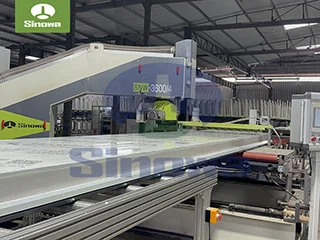
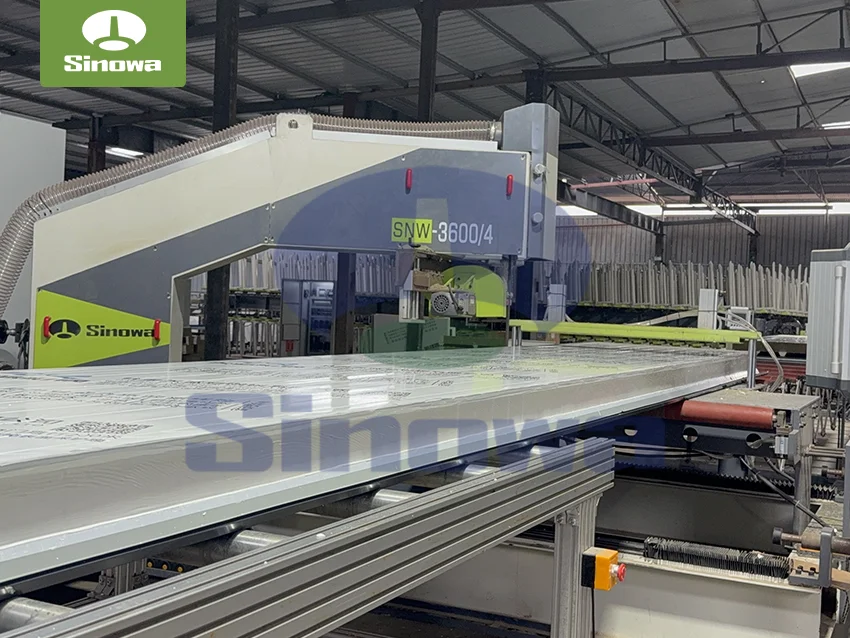
The cooled rock wool board enters the precise cutting and shaping stage, which is an important link to standardize product size and remove redundant parts. The cutting system consists of vertical and horizontal cutting saw discs, which can realize automatic positioning and fixed-size cutting according to the preset production parameters. The edge trimming device first cuts off the loose and irregular residual edges on both sides of the board body to make the two sides of the board flat and neat. Then the transverse cutting mechanism cuts the continuous long strip rock wool board into standard length specifications. The high-speed rotating cutting saw discs ensure smooth and neat cutting sections without burrs, fiber pulling or irregular fractures, which effectively guarantees the dimensional accuracy and appearance quality of finished products. All waste edges and leftover materials generated during the cutting process are automatically collected by the waste recovery device, which can be reprocessed and utilized after centralized treatment, realizing resource recycling and reducing production waste.
After cutting and shaping, the finished rock wool boards are transported to the sorting and stacking area for subsequent finishing operations. The automatic stacking equipment arranges the qualified rock wool boards neatly and layer by layer according to the fixed stacking standard, ensuring flat stacking and consistent spacing between boards, which is convenient for subsequent packaging, transportation and storage. During stacking, the system will automatically screen out individual defective products with unqualified size, deformed appearance or unsmooth surface, and separate them for reprocessing, so as to ensure that all stacked finished products meet the production quality standards. After stacking to the specified height, the finished rock wool board stacks are sorted and arranged manually or mechanically to tidy up the overall shape and eliminate irregular placement.
The final stage of the operation process is finished product packaging and warehouse storage. The neatly stacked rock wool boards are wrapped and sealed by automatic packaging equipment. The packaging operation can effectively protect the surface of the rock wool board, avoid fiber damage, dust adhesion and moisture erosion during transportation and storage, and maintain the good performance and appearance of the product for a long time. The packaged finished products are transported to the finished product warehouse through handling equipment, and classified and stored according to different production batches to facilitate subsequent outgoing management and quality traceability.
In addition to the standardized production operation process, daily operation management and equipment maintenance in the production process are also important parts of the rock wool sandwich panel machine operation specification. During the continuous production process, operators need to conduct real-time monitoring of the operating state of each equipment module, regularly check key process parameters such as melting temperature, curing time, pressing pressure, and conveying speed, and record the production data of each batch. Once parameter deviation or equipment abnormal operation is found, timely fine adjustment and troubleshooting shall be carried out to ensure the continuity and stability of production. After daily production is completed, comprehensive cleaning and maintenance of the equipment shall be carried out, residual fibers and adhesive residues inside the equipment shall be removed, the operating state of transmission parts and precision components shall be checked, and necessary lubrication and maintenance shall be done to ensure that the equipment can maintain stable working performance in long-term continuous operation, extend the service life of the production line, and reduce the failure rate of subsequent production.
The entire operation process of the rock wool sandwich panel production line realizes the whole-process automatic and standardized production from raw material input to finished product output. Each process link is interlocked and restricted with each other, forming a complete and closed production system. Scientific and standardized operation procedures not only improve the production efficiency of rock wool boards and ensure the consistency and stability of product quality but also reduce the probability of manual operation errors and product defects. With the continuous optimization of process technology and equipment performance, the operation process of rock wool board machines is becoming more intelligent and refined, which can better meet the diversified production needs of rock wool board products in different application scenarios and provide reliable technical support for the stable output of high-quality thermal insulation and building protection materials.
https://www.cnsinowa.com/sandwich-panel-machines/operation-process-of-rock-wool-board-machine.html