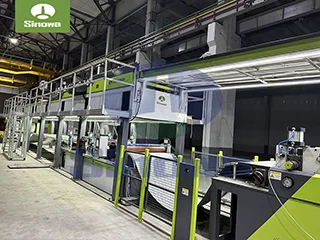
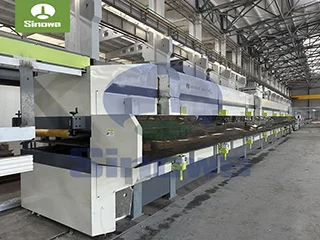
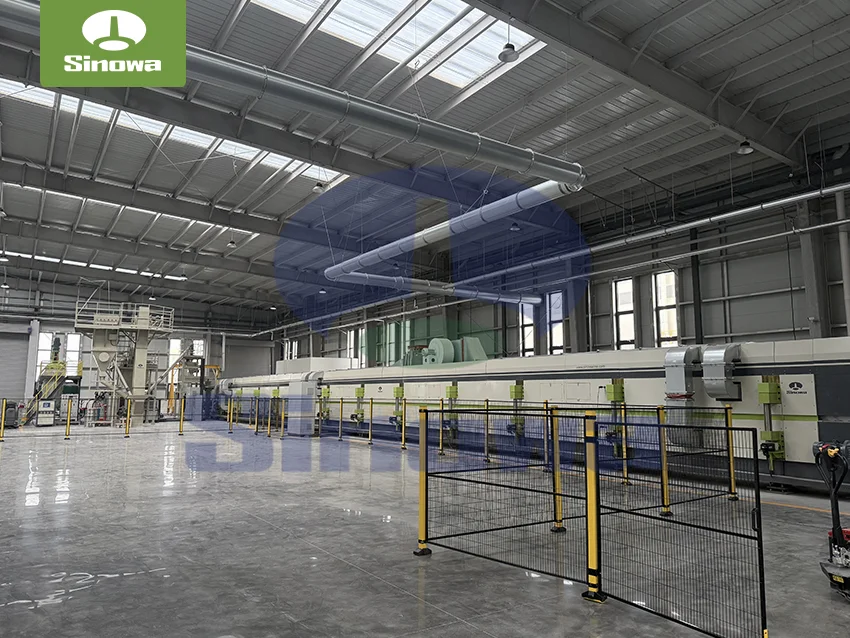
 sandwich panel line
The core operating logic of the continuous PU sandwich panel production line is based on synchronous matching of mechanical operation rhythm and controllable chemical foaming reactions. Polyurethane foam is formed through irreversible cross-linking chemical reactions between two main liquid raw materials, accompanied by physical expansion and pore forming processes. The biggest difficulty in sandwich board manufacturing lies in balancing the foaming speed of liquid polyurethane materials, the moving speed of surface materials on the conveyor line, and the temperature and pressure environment during curing. The continuous production line solves this industry pain point perfectly through overall linkage control of all functional modules. All equipment units run at matched synchronous speeds without waiting or stagnation links in the middle of production. Liquid polyurethane raw materials are quantitatively mixed and evenly sprayed between upper and lower surface materials in real time, expand and foam under stable pressure and temperature environments, and bond closely with surface materials to form an integral composite structure without layered gaps. This in-situ continuous foaming and composite molding mode fundamentally avoids common quality defects of batch-produced sandwich boards, including uneven foam core density, inconsistent pore structure, weak interlayer bonding and irregular board surface warpage, ensuring that every section of finished foam board maintains consistent physical and thermal insulation performance along the whole length.
The complete production flow of the continuous PU sandwich panel line starts from automatic surface material feeding and pretreatment, which lays a decisive foundation for subsequent composite bonding quality. Commonly used surface materials include metal sheet coils and non-metal decorative plates with certain surface hardness and weather resistance. These coiled raw materials are installed on automatic unwinding devices, which release surface materials stably at a constant speed consistent with the overall line operation rhythm. After unwinding, the sheet materials pass through multi-group leveling roller sets to eliminate residual bending stress, surface wrinkles and uneven deformation generated during coil winding and long-term storage. Flat and smooth surface materials can maximize the contact area with polyurethane foam liquid, effectively improving the bonding tightness between core material and surface layers. After leveling, all surface materials enter an independent preheating section with uniform radiation heating. The preheating process removes tiny moisture attached to the surface of plates, activates surface molecular activity of facing materials, and avoids incomplete bonding caused by temperature difference between cold plates and room-temperature foam liquid during composite pressing. The preheating temperature is dynamically adjusted according to different types of surface materials and sandwich panel production line operating speeds, always maintaining the optimal surface activity state required for composite bonding without causing surface thermal damage to plates.
While surface materials complete pretreatment and forward conveying, the polyurethane raw material metering and mixing system operates independently and stably in parallel to supply qualified foaming liquid for the follow-up composite process. This core chemical supply system adopts fully sealed constant-temperature storage tanks to store two basic polyurethane raw materials separately, equipped with low-speed circulating stirring devices inside the tanks to prevent raw material component precipitation and performance attenuation during long-term standby operation. High-precision closed-loop metering pumps deliver two raw materials and matched auxiliary materials including catalysts and foaming aids to the high-pressure mixing head according to fixed dynamic ratios. Intense hydraulic stirring is completed inside the mixing head in an extremely short time to form homogeneous and fully reacted composite foam liquid without local component deviation. The whole metering and mixing process supports real-time parameter adjustment, so manufacturers can change the formula ratio appropriately to produce foam cores with different densities, hardness and thermal conductivity coefficients, adapting to different usage scenarios of sandwich boards. The well-mixed foam liquid is sprayed evenly on the surface of the lower facing plate through a reciprocating mobile spraying nozzle. The nozzle moves horizontally at a uniform speed covering the entire width of the plate, ensuring no liquid accumulation in local areas and no missing spraying gaps, which guarantees uniform thickness of the foam core before pressing.
Continuous laminating pressing and constant-temperature curing are the most critical core links of the polyurethane sandwich panel production line, directly determining the overall structural strength, dimensional stability and service life of finished sandwich boards. After even spraying of polyurethane foam liquid, the upper and lower facing plates are guided into the double-belt continuous pressing unit synchronously. The upper and lower circulating heat-preservation conveyor belts of the unit fit closely with the two sides of the plates, applying continuous and uniform static pressure covering the whole plate width and length. This stable pressure environment restricts the free expansion range of polyurethane foam liquid, makes the foam fill the entire cavity between upper and lower plates completely, and prevents excessive foaming from causing board surface bulging or insufficient foaming leading to internal hollow cavities. The pressing unit is connected with an integrated closed constant-temperature curing channel with gradient temperature control. The internal temperature of the curing channel is divided into three gradual changing zones according to the foaming reaction process: initial reaction heating zone, stable foaming constant-temperature zone and late curing shaping zone. This gradient temperature design matches the whole reaction cycle of polyurethane foam from initial expansion, middle cross-linking polymerization to final solidification and shaping accurately. Under matched pressure and temperature environments, polyurethane liquid completes all chemical cross-linking reactions inside the closed channel, forming a fine and closed-cell foam structure inside the core layer. The integrated composite structure formed in this process realizes molecular-level bonding between foam core and surface plates, making interlayer separation almost impossible under normal external force impact.
After finishing high-temperature curing and preliminary shaping, the continuous long foam board enters the forced cooling and stress relief section to optimize dimensional accuracy and structural stability. The newly cured sandwich board still carries high internal residual temperature and latent stress inside the foam core. If cutting and stacking are carried out directly without cooling, slow natural shrinkage of internal foam will occur in the subsequent placement process, resulting in board length deviation, slight warpage and edge bending. The circulating air cooling system adopted by the PU sandwich panel production line conducts gradual and uniform cooling from both upper and lower sides of the board, reducing the overall board temperature to ambient temperature slowly without sudden temperature drop. Gentle cooling effectively releases internal stress generated during high-temperature pressing and curing, locking the overall size and flatness of the composite board permanently. After cooling treatment, the continuous board passes through automatic edge trimming equipment to cut off irregular unfoamed edges on both sides generated during the spraying and pressing process, ensuring unified width specification and neat edge appearance of all finished boards. Subsequently, high-speed fixed-length cutting equipment cuts the continuous long board into finished products with customized single-board length. The cutting system supports stepless adjustment of length parameters and maintains vertical and smooth cutting sections without foam core collapse or surface plate deformation during high-speed cutting.
The final stage of the whole production process covers online quality inspection, automatic conveying and intelligent stacking. Built-in online detection sensors are arranged along the conveying track after cutting, which monitor key indicators including board thickness, surface flatness, overall length tolerance and interlayer bonding state in real time throughout the production process. Once unqualified products exceeding the set error range are detected, the system will automatically mark the products and isolate them from qualified finished products through a sorting mechanism, avoiding defective products entering the finished product warehouse. Qualified sandwich foam boards are stably transported to the terminal stacking station by buffer conveying rollers, and automated mechanical stacking devices complete layered and orderly stacking according to set stacking height and arrangement modes. The whole production process from raw material feeding to finished product stacking requires only a small number of on-site operators to monitor system operating parameters and conduct routine equipment inspection, realizing truly unattended continuous industrial production and minimizing human interference on product quality.
Compared with traditional intermittent sandwich board production equipment, the PU continuous foam core sandwich panel line has prominent comprehensive advantages in production efficiency, product quality consistency, raw material utilization rate and long-term operation cost. In terms of production efficiency, the continuous non-stop operation mode eliminates all idle time for mold opening, mold closing, material loading and preheating waiting required by batch production. The linkage operation of all modules keeps a stable high production speed for a long time, and the production capacity per unit time is several times that of intermittent equipment. Meanwhile, frequent start and stop of equipment are avoided, reducing mechanical wear and parameter fluctuation caused by equipment restarting. In terms of product quality, unified pressure, temperature and speed parameters run through the whole production process, so every finished board has identical foam cell structure, core density and bonding strength. The dimensional tolerance of finished products is controlled within an extremely small range, which is convenient for on-site seamless assembly of engineering projects. In terms of raw material utilization, high-precision metering pumps achieve accurate quantitative supply of polyurethane raw materials, completely solving raw material waste caused by excessive feeding in manual batching processes. The heat circulation system inside the curing channel recycles waste heat generated during curing, reducing overall energy consumption of equipment operation and realizing energy-saving production.
Finished sandwich foam boards manufactured by this continuous production line own excellent comprehensive performance, supporting wide application scenarios across multiple industries. Relying on closed-cell polyurethane foam core material with ultra-low thermal conductivity, the boards provide outstanding thermal insulation and heat preservation effects, which can effectively block indoor and outdoor heat exchange. Applied to exterior wall and roof enclosure systems of industrial plants, commercial buildings and public facilities, these boards can greatly reduce the power consumption of indoor heating and cooling equipment, helping construction projects achieve overall energy-saving goals. The integral composite structure formed by continuous pressing endows the boards with good mechanical compression resistance, bending resistance and impact resistance, enabling them to withstand wind pressure, snow load and other external loads in outdoor harsh environments without structural damage. In addition, the material has excellent moisture-proof and waterproof performance because of the fully closed internal foam structure, preventing water vapor penetration and internal mildew and corrosion. The lightweight feature of the sandwich board reduces the overall dead load of building main structures, lowering the structural construction cost of projects. Besides building enclosure engineering, these foam boards are also widely used in cold storage and refrigerated warehouse insulation walls, modular integrated houses, transportation vehicle compartment insulation walls and sound insulation partition projects, meeting multi-dimensional performance demands of heat preservation, sound insulation, moisture resistance and structural support.
To maintain long-term stable operation of the continuous PU foam production line and sustain consistent product quality in mass production, standardized daily and periodic equipment maintenance is essential. Daily maintenance mainly includes cleaning residual polyurethane foam attachments on spraying nozzles and conveyor belts every day after shutdown, checking the tightness of all raw material conveying pipelines to prevent liquid leakage, and confirming the sensitivity of temperature and pressure sensors. Regular maintenance conducted every fixed production cycle covers lubrication treatment of all transmission gears and roller sets, calibration of raw material metering accuracy of mixing pumps, overall detection of heating modules inside the curing channel, and inspection of cutting tool wear degree. Timely maintenance can avoid parameter drift, mechanical jamming and local equipment failure during long-time continuous operation, prolong the overall service life of the production line, and keep the production process always in the optimal operating state. Reasonable matching of process parameters is also equally important; production staff need to adjust raw material ratios, curing time and line speed synchronously according to ambient temperature changes and different board thickness requirements, so as to adapt to seasonal environmental changes and customized production needs.
Looking forward to the future development trend of composite board manufacturing equipment, PU continuous sandwich foam panel production line will further develop towards higher intelligence, lower energy consumption and stronger production flexibility. Upgraded intelligent control systems will realize full-process autonomous adaptive adjustment: the system can automatically optimize foaming ratios, curing temperatures and operating speeds according to real-time detected board quality data without manual parameter modification. More optimized mechanical structural designs will reduce operating friction and equipment failure rates, realizing longer uninterrupted running time. Meanwhile, the production line will support switching production of multi-specification and multi-material composite boards more rapidly, realizing free switching between different surface materials and different board thicknesses in a short time without stopping production. Driven by global green manufacturing policies, subsequent technological upgrades will also focus on optimizing foaming auxiliary formulas and thermal circulation systems to further reduce carbon emissions in the production process.
As the global construction industry accelerates transformation towards prefabrication, low carbon and high efficiency, the market demand for high-performance continuous polyurethane sandwich foam boards will keep rising steadily. As the core manufacturing equipment of such green building materials, continuous PU sandwich foam board production lines will continue to promote the upgrading of the whole insulation composite board manufacturing industry. By replacing backward intermittent production processes, this advanced automated production technology improves industrial manufacturing efficiency, unifies finished product quality standards, and provides reliable, cost-effective and eco-friendly material solutions for modern construction, cold chain storage and modular building fields. In the long run, the continuous integration of intelligent control technology and polyurethane foaming manufacturing technology will further release the production potential of such sandwich panel machine, making greater contributions to the development of global green construction and energy-saving industrial manufacturing fields.
https://www.cnsinowa.com/sandwich-panel-machines/pu-continuous-sandwich-foam-board-production-line.html