 sandwich panel machine
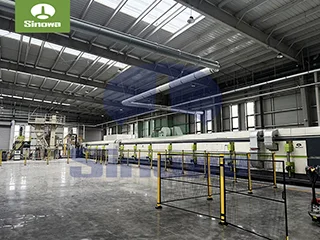
The essential value of wall insulation PU sandwich panel line lies in their ability to realize continuous, integrated and standardized production of composite wall panels. Different from traditional discrete manual or semi-mechanical production modes, modern integrated production lines integrate all independent production procedures into a closed and coherent operating system, effectively avoiding product quality fluctuations caused by manual operation differences and process disconnection. The finished wall panels produced by this equipment take polyurethane foam as the core thermal insulation layer and high-strength surface materials as the outer protective layer, forming a composite structure with lightweight, high thermal resistance, sound insulation and weather resistance. Such structural characteristics make the panels widely applicable in exterior wall insulation, interior partition wall decoration, workshop enclosure walls and other building parts, and the stable operation of the machine is the fundamental guarantee for the consistent excellent performance of each batch of panels.
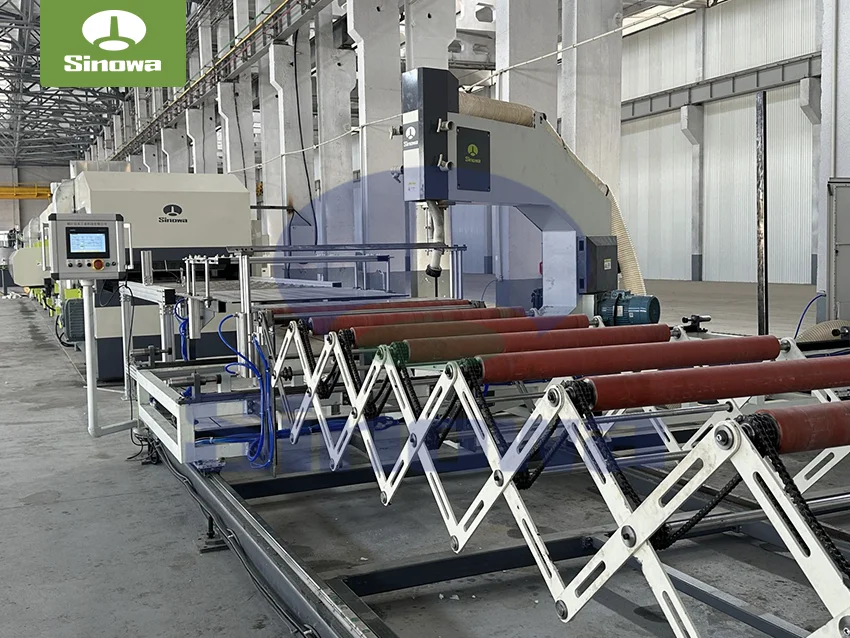
The entire production process of wall insulation PU sandwich panels driven by professional machines follows a rigorous and logical mechanical operation logic, starting from the automatic feeding and pretreatment of raw materials. In the initial production stage, coiled surface materials used for panel outer layers are stably uncoiled through an automatic feeding system, with the whole process maintaining stable tension to avoid material deviation, wrinkling or deformation. The uncoiled surface materials will pass through multi-stage leveling and profiling mechanisms, which use orderly arranged roller sets to perform precise flattening and subtle edge shaping on the materials. This process eliminates internal stress generated during coil winding, ensures the flatness and dimensional regularity of the surface materials, and creates a flat and uniform bonding base for subsequent composite molding. Meanwhile, the polyurethane chemical raw materials required for the core insulation layer are transported to independent temperature-adjustable storage units, where the raw material ratio and storage environment are stably controlled to prevent chemical component failure or performance deviation caused by temperature changes, laying a foundation for uniform foam reaction.
Foam mixing and pouring is the core link that determines the thermal insulation performance and structural uniformity of wall panels, and it is also the most technically sophisticated part of the entire machine system. The polyurethane sandwich panel production line is equipped with a high-pressure dynamic mixing structure, which can accurately meter different polyurethane raw materials according to the set process parameters and send them into the mixing cavity for high-speed stirring and full fusion. The high-pressure mixing mode ensures that each component of the raw materials reacts evenly and fully, avoiding incomplete reaction or local density difference caused by uneven mixing. After uniform mixing, the liquid polyurethane mixture is continuously and evenly poured on the surface of the lower layer of the wall panel surface material through a precision reciprocating pouring device. The pouring system can adjust the pouring range and flow rate in real time according to the designed panel thickness and width, so that the liquid foam can completely cover the surface material without accumulation or missing pouring, ensuring the consistency of the core material thickness of the whole panel.
After the foam pouring is completed, the semi-finished panels enter the lamination and pressure curing stage, which is a key procedure to realize the composite bonding of surface materials and core foam. The polyurethane sandwich panel line is equipped with a double-belt circulating lamination system, which can provide continuous and uniform pressure and constant temperature curing conditions for the panels. Under the stable pressure of the upper and lower belt layers, the liquid polyurethane foam gradually expands, fills the entire closed cavity between the upper and lower surface materials, and closely fits with the inner surface of the surface materials. With the progress of the constant temperature reaction, the polyurethane foam completes curing and forming, and forms a firm integrated bonding structure with the surface materials. The whole lamination and curing process is dynamically adjustable in terms of pressure, temperature and running speed. According to different wall panel thicknesses and material types, the system can match the most suitable curing parameters to ensure that the foam core has uniform internal density, no hollow bubbles or cracking defects, and the bonding interface between the core material and the surface layer is tight and free of degumming, effectively guaranteeing the overall structural strength and long-term service stability of the wall panels.
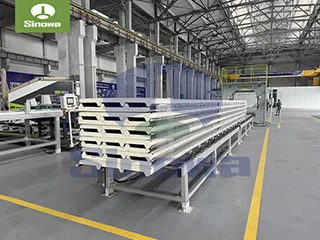
The final stage of the production process is fixed-length cutting and finished product finishing. After full curing and shaping, the continuous long-strip composite panels are transported to the cutting station through a stable conveying system. The automatic cutting unit can identify the set panel length specifications in real time and complete precise fixed-length cutting through high-speed cutting components. The cutting process is stable and neat, without burrs, edge warping or material damage, ensuring the dimensional accuracy and flatness of the end face of the finished wall panels. After cutting, the equipment is equipped with auxiliary finishing mechanisms to simply sort and arrange the finished panels, which is convenient for subsequent stacking, transportation and storage. The whole production process from raw material feeding to finished product output is completed in one go, realizing fully automated continuous production, greatly shortening the production cycle and effectively improving the output efficiency of wall insulation panels.
The superior performance of wall insulation PU sandwich panel production line is reflected in many technical details and production advantages. In terms of production accuracy, the whole machine adopts electronic integrated control logic, and all operation links such as feeding, profiling, pouring, lamination and cutting are controlled by unified program parameters, which can effectively control the dimensional error of finished panels within a very small range. The high production accuracy enables the wall panels to have high assembly compatibility during on-site construction, reducing the gap deviation during installation, improving the overall sealing performance of the wall, and further optimizing the thermal insulation and energy-saving effect of the building envelope. In terms of product performance control, the precise foam mixing and pouring system can stably control the foam density of the core layer, so that the finished panels have excellent low thermal conductivity, effectively blocking the heat transfer inside and outside the building, reducing the energy consumption of building heating and cooling, and meeting the current mainstream building energy-saving standards.
In terms of structural adaptability, professional wall insulation sandwich panel machine supports the production of multi-specification wall panels. By adjusting the operating parameters of the equipment and replacing simple auxiliary molds, it can produce wall panels with different thicknesses, widths and surface shapes, meeting the insulation and enclosure needs of different building types. Whether it is the thin insulation panels required for high-rise residential exterior walls or the thick high-strength insulation panels required for industrial plant walls, the equipment can complete stable production, with strong product coverage and market adaptability. In addition, the equipment has excellent production stability and continuity, and can maintain long-term stable operation in continuous production scenarios, effectively reducing equipment failure rates and production downtime, and creating stable production benefits for manufacturing enterprises.
Compared with traditional wall insulation material production equipment, professional polyurethane sandwich panel machine has obvious comprehensive advantages in energy conservation, environmental protection and product quality stability. In terms of environmental protection production, the closed raw material conveying and mixing system of the equipment can effectively avoid the volatilization and leakage of chemical raw materials during the production process, reduce the generation of production waste gas and waste residue, and realize clean and environmentally friendly production. The polyurethane foam produced by precise proportioning has a high foaming rate and no redundant raw material waste, which improves the utilization rate of production raw materials and reduces the production cost of unit products. In terms of product quality, the integrated mechanical production avoids the quality instability problems such as uneven foam thickness, inconsistent bonding strength and irregular panel size existing in manual and semi-automatic production, making the physical properties of each batch of finished wall panels highly consistent.
The wall insulation panels produced by this professional sandwich panel manufacturing machine have outstanding practical performance in building application. The lightweight composite structure of the panels can effectively reduce the self-weight of the building wall, reduce the load pressure of the building foundation and main structure, and reduce the overall construction cost of the building. At the same time, the compact and closed-cell structure of polyurethane foam gives the panels excellent sound insulation and noise reduction performance, which can effectively isolate the external noise and improve the indoor acoustic environment. In terms of weather resistance, the composite structure formed by tight bonding between the surface material and the PU core layer can resist the erosion of natural environments such as temperature difference change, humidity and wind and rain, avoid aging, peeling and deformation of the wall insulation layer, and ensure the long-term stable operation of the building wall insulation system.
With the continuous advancement of building energy-saving technology and the continuous improvement of environmental protection and energy-saving requirements in the construction industry, the technical upgrading of wall insulation PU sandwich panel machine is also accelerating. Modern equipment is gradually developing towards higher automation intelligence, more precise parameter control and more diversified product adaptation. The optimized mechanical structure and control system can realize real-time monitoring and automatic adjustment of production parameters, automatically identify abnormal conditions in the production process, and carry out early warning and correction, further improving production stability and product yield. At the same time, the upgraded equipment can produce wall panels with better fire resistance, thermal insulation and durability by optimizing the foam reaction process and composite molding technology, adapting to the increasingly stringent building safety and energy-saving specifications.
In the whole industrial chain of building energy-saving materials, wall insulation PU sandwich panel machinery undertake the important task of standardized and large-scale production of high-performance insulation wall panels. Its technical level and production efficiency directly determine the popularization speed and application quality of PU insulation wall systems in the construction industry. As the construction industry continues to move towards greenization, energy conservation and high efficiency, the market demand for high-performance automated PU sandwich panel production equipment will continue to grow. The continuous technological innovation and performance optimization of the equipment will further promote the upgrading of building wall insulation technology, provide more reliable and efficient material support for green building construction, and make important contributions to reducing building energy consumption and promoting the sustainable development of the construction industry.
https://www.cnsinowa.com/sandwich-panel-machines/pu-sandwich-panel-machine-for-wall-insulation.html