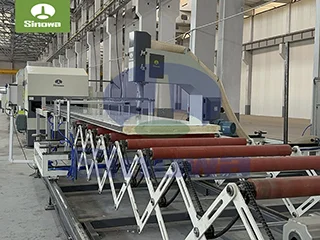
sandwich panel machine
The hydraulic drive system serves as the backbone of PIR sandwich panel production machinery, converting mechanical energy into hydraulic energy to power critical components such as presses, rollers, cutters, and foam injection units. Unlike other drive systems, hydraulic systems utilize a fluid medium—usually high-grade hydraulic oil—to transmit power, offering unique advantages that align with the specific requirements of PIR panel production. One of the key characteristics of hydraulic drive systems is their ability to achieve stepless speed regulation over a wide range, allowing operators to adjust the production speed according to the thickness of the panel, the type of metal facing, and the curing properties of the PIR foam. This flexibility ensures that each stage of the production process, from metal sheet forming to foam curing, can be optimized for maximum efficiency without compromising product quality.
A typical PIR sandwich panel production line with a hydraulic drive system comprises several interconnected components, each powered and controlled by the hydraulic system to perform specialized tasks. The process begins with the uncoiling and preparation of metal facings, which are usually supplied in large coils. Hydraulic uncoilers gently unwind the metal sheets, using controlled torque to prevent damage or deformation to the surface of the facings. The metal sheets then pass through hydraulic leveling units, which apply uniform pressure to flatten the material and eliminate any residual stresses from the coiling process. This step is crucial because uneven metal sheets can lead to poor bonding with the PIR foam core and result in panels with inconsistent thickness or surface irregularities. The hydraulic leveling units use precision cylinders to apply adjustable pressure across the entire width of the metal sheet, ensuring a smooth and flat surface that meets the strict tolerances required for PIR panel production.
After leveling, the metal sheets move to the roll forming section, where hydraulic-driven rollers shape the sheets into the desired profile. Depending on the application, PIR sandwich panels may have trapezoidal, corrugated, or flat profiles, and the hydraulic roll forming system can be adjusted to accommodate different designs. The hydraulic rollers exert consistent pressure on the metal sheets, gradually bending them into shape without causing cracks or weakening the material. The hydraulic drive system’s ability to maintain constant torque and speed ensures that each sheet is formed with identical dimensions, reducing waste and ensuring uniformity across the production batch. Additionally, hydraulic roll forming systems offer quick changeover between different profiles, allowing manufacturers to switch between product types with minimal downtime—a significant advantage in environments where custom orders are common.
Once the metal facings are formed, the next critical stage is the application of adhesive and the injection of PIR foam core. Hydraulic-driven adhesive dispensers ensure the uniform application of adhesive to the inner surface of the metal facings, a key factor in achieving strong bonding between the facings and the foam core. The hydraulic system controls the flow rate and pressure of the adhesive, ensuring that it is spread evenly across the entire surface area—typically at a rate of 200 to 300 grams per square meter—without excess or gaps. Some advanced systems incorporate hydraulic-powered rotating brushes that transfer a portion of the adhesive from the lower facing to the upper facing, further enhancing the bonding strength by ensuring both surfaces are properly coated. This method not only improves adhesion but also optimizes adhesive usage, reducing material waste and production costs.
The PIR foam injection process is another area where hydraulic drive systems play a vital role. The PIR foam is produced by mixing polyol and isocyanate with other additives, and the mixture must be injected between the two metal facings at a precise rate and pressure to ensure uniform expansion and curing. Hydraulic-driven high-pressure foaming machines accurately meter and mix the chemicals, maintaining the correct ratio to produce foam with consistent density and insulation properties. The hydraulic system controls the injection pressure, ensuring that the foam mixture fills the entire gap between the metal facings without creating air pockets or uneven distribution. After injection, the panels move into a hydraulic press or double belt press, where the hydraulic system applies uniform pressure to compress the foam and ensure proper bonding between the core and the facings.
Hydraulic presses are particularly critical in the curing stage of PIR sandwich panel production. These presses use multiple hydraulic cylinders to apply controlled pressure across the entire surface of the panel, ensuring that the foam core expands evenly and adheres firmly to the metal facings. The pressure applied can be adjusted based on the thickness of the panel and the type of foam used, with typical press capacities ranging from moderate to high levels to accommodate different product specifications. The hydraulic system also regulates the temperature of the press plates, which is essential for optimizing the curing time of the PIR foam. By maintaining a consistent temperature—usually between 30 and 40 degrees Celsius—the hydraulic press accelerates the curing process without compromising the foam’s structural integrity or insulation performance. This precise control over pressure and temperature results in panels with uniform density, flat surfaces, and strong structural bonds, meeting the high standards required for industrial and construction applications.
After curing, the PIR sandwich panels move to the cutting section, where hydraulic-driven cutting machines trim the panels to the desired length. These cutting machines use high-speed blades or band saws powered by hydraulic cylinders, ensuring clean, precise cuts without damaging the panel edges. The hydraulic system’s responsiveness allows for quick adjustments to cutting length, enabling the production of panels in various sizes to meet customer requirements. Some advanced systems incorporate hydraulic rotating mechanisms that allow for 180-degree cuts, facilitating the production of shorter panels even at high line speeds. This flexibility enhances production efficiency and reduces waste, as manufacturers can easily adapt to different order specifications without slowing down the entire line.
Beyond the core production stages, hydraulic drive systems contribute to the overall reliability and maintainability of PIR sandwich panel machinery. Hydraulic components are designed for durability, with high-grade steel cylinders, wear-resistant seals, and self-lubricating parts that extend the service life of the equipment. The use of hydraulic oil as a working medium provides natural lubrication to moving parts, reducing friction and minimizing wear and tear. Additionally, hydraulic systems are equipped with safety features such as pressure relief valves, which automatically release excess pressure to prevent damage to the machinery in case of overload. This built-in protection ensures safe operation and reduces the risk of costly breakdowns, minimizing downtime and maintenance costs.
The advantages of hydraulic drive systems in PIR sandwich panel production extend beyond performance and reliability to include energy efficiency and operational flexibility. Hydraulic pumps and motors have a high power-to-weight ratio, making them compact and lightweight compared to electric motors of similar capacity. This compact design allows for more efficient use of floor space in production facilities, a valuable benefit for plants with limited area. Hydraulic systems also offer excellent low-speed stability, with hydraulic motors capable of maintaining consistent speeds at very low revolutions per minute—something that electric motors struggle to achieve. This stability is particularly important in processes such as foam injection and pressing, where precise control at low speeds is essential for product quality.
Another significant advantage of hydraulic drive systems is their ability to integrate with other control systems, such as electronic and pneumatic controls, to create fully automated production lines. By combining hydraulic power with electronic sensors and programmable logic controllers (PLCs), manufacturers can achieve precise control over every stage of the production process. Sensors monitor parameters such as pressure, temperature, and sheet thickness, sending real-time data to the PLC, which adjusts the hydraulic system accordingly to maintain optimal conditions. This closed-loop control system ensures consistent product quality, reduces human error, and allows for remote monitoring and operation of the machinery. Automation also enhances production efficiency, as the line can operate continuously with minimal human intervention, increasing output and reducing labor costs.
The versatility of hydraulic-driven PIR sandwich panel machinery makes it suitable for a wide range of applications. These panels are commonly used in cold storage facilities, where their exceptional thermal insulation properties help maintain consistent temperatures while reducing energy consumption. Industrial buildings, such as factories and warehouses, utilize PIR panels for walls and roofs, benefiting from their structural strength and fire resistance. Prefabricated modular buildings also rely on PIR sandwich panels for quick assembly and energy efficiency, with hydraulic-driven machinery ensuring the panels meet the precise dimensions required for modular construction. Additionally, PIR panels produced with hydraulic machinery are used in commercial buildings, clean rooms, and transportation applications, where quality and performance are critical.
In terms of operational flexibility, hydraulic-driven machinery can accommodate a wide range of panel thicknesses and sizes, from thin panels used for interior partitions to thick, heavy-duty panels for industrial roofing. The hydraulic system’s ability to adjust pressure, speed, and temperature allows manufacturers to produce panels with varying foam densities and metal facing thicknesses, tailoring the product to specific application needs. This flexibility is particularly valuable for small to medium-scale producers who handle custom orders, as it allows them to adapt quickly to changing customer requirements without investing in specialized equipment. For large-scale producers, hydraulic-driven continuous production lines offer high output rates, ensuring they can meet high-volume orders efficiently while maintaining consistent quality.
Maintenance of hydraulic-driven PIR sandwich panel machinery is relatively straightforward, thanks to the standardized design of hydraulic components. Routine maintenance tasks include checking hydraulic oil levels, replacing filters, inspecting seals for leaks, and monitoring pressure and temperature gauges. These tasks can be performed by trained technicians without requiring specialized tools, minimizing downtime and maintenance costs. Additionally, hydraulic systems are less prone to electrical failures compared to electric drive systems, further reducing the risk of unexpected breakdowns. With proper maintenance, hydraulic-driven machinery can operate reliably for many years, providing a long-term return on investment for manufacturers.
While hydraulic drive systems offer numerous advantages, they also require careful consideration of certain factors to ensure optimal performance. The quality of hydraulic oil is critical, as contaminated or low-grade oil can cause damage to components and reduce system efficiency. Regular oil analysis and replacement are essential to maintain the integrity of the hydraulic system. Additionally, proper sealing is important to prevent oil leaks, which can lead to environmental hazards and equipment damage. Manufacturers must also ensure that hydraulic components are properly sized for the application, as undersized or oversized components can reduce efficiency and increase energy consumption. By addressing these factors, manufacturers can maximize the performance and lifespan of their hydraulic-driven PIR sandwich panel machinery.
The future of PIR sandwich panel production machinery is likely to see further advancements in hydraulic drive technology, with a focus on improving energy efficiency and automation. Innovations such as variable displacement pumps, which adjust oil flow based on demand, are already reducing energy consumption in hydraulic systems. Integration with Industry 4.0 technologies, such as IoT sensors and cloud-based monitoring, will enable real-time performance tracking and predictive maintenance, further enhancing reliability and efficiency. Additionally, the development of eco-friendly hydraulic oils will address environmental concerns, making hydraulic-driven machinery even more sustainable. These advancements will continue to solidify the position of hydraulic drive systems as a preferred choice for PIR sandwich panel production, enabling manufacturers to meet the growing demand for high-quality, energy-efficient composite panels.
In conclusion, PIR sandwich panel production machinery equipped with hydraulic drive systems offers a combination of precision, reliability, and flexibility that is unmatched by other drive technologies. From metal sheet preparation and forming to foam injection, curing, and cutting, the hydraulic system provides controlled power and consistent performance at every stage of the production process. This results in high-quality PIR panels with uniform density, strong structural bonds, and excellent insulation properties, suitable for a wide range of industrial and construction applications. The energy efficiency, durability, and ease of maintenance of hydraulic-driven machinery make it a cost-effective choice for manufacturers of all sizes. As the demand for PIR sandwich panels continues to grow, hydraulic drive technology will remain a key enabler of efficient, high-quality production, driving innovation and advancement in the industry.
https://www.cnsinowa.com/sandwich-panel-machines/pir-sandwich-panel-production-machinery-with-hydraulic-drive-system.html