sandwich panel line
The core advantage of PIR sandwich panels lies in their fire-resistant core material, which is a modified polyisocyanurate foam with unique molecular structure. Different from ordinary thermal insulation materials, this core material forms a carbonized fire barrier rapidly when exposed to fire, effectively preventing the spread of flames and reducing the release of harmful smoke and toxic gases. This fire-resistant performance is closely related to the precise formula ratio and strict production control during the manufacturing process. The core material also has excellent thermal insulation properties, with a very low thermal conductivity that can effectively reduce heat transfer, thereby improving the energy efficiency of buildings or industrial facilities. In addition, it exhibits good resistance to corrosion, moisture and aging, ensuring long-term stable performance in various harsh environments. The production of such high-quality core material is the foundation of the entire manufacturing line, and its performance directly determines the quality level of the final PIR sandwich panels.
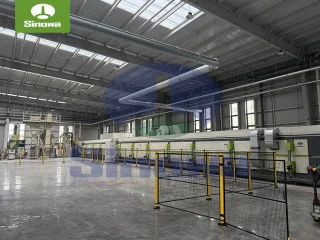
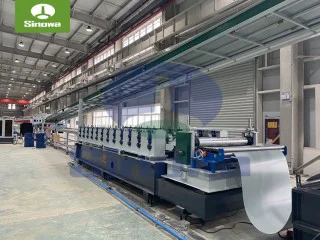
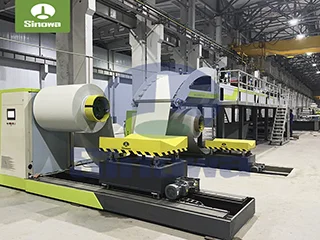
The manufacturing line of PIR sandwich panels with fire-resistant core material is a highly automated production system composed of multiple functional units, and each unit cooperates closely to complete the transformation from raw materials to finished products. The first link in the production process is raw material preparation, which includes the processing of surface panels and the preparation of core material raw materials. The surface panels are usually made of metal sheets, such as color-coated steel plates or galvanized steel plates, which need to go through uncoiling, leveling and profiling processes. The uncoiling machine smoothly unfolds the coiled metal sheets, and the leveling device corrects the deformation caused during transportation and storage to ensure the flatness of the panels. The profiling process shapes the metal sheets into specific structures according to design requirements, which not only enhances the rigidity of the panels but also facilitates the splicing and installation of finished products. For the core material, the main raw materials include polyisocyanate, polyol, flame retardant, foaming agent and other additives. These raw materials need to be strictly inspected for quality before entering the production line to ensure that their chemical composition and performance indicators meet the production requirements. The raw materials are then stored in special tanks with temperature control functions to maintain their stability.
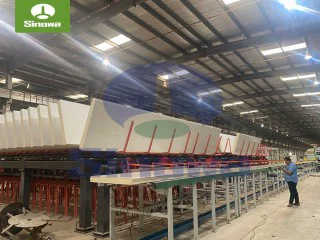
After the raw material preparation is completed, the production enters the key composite forming stage. This stage mainly includes the processes of gluing or foaming, panel lamination and pressing curing. For the production of PIR sandwich panels, there are two common core material filling methods: one is to prefabricate the fire-resistant PIR foam into blocks of specified sizes, and then bond them to the surface panels through adhesives; the other is to inject the mixed liquid raw materials of PIR directly between the two surface panels, and complete the foaming and curing process in the production line. The latter method, known as in-situ foaming, is more widely used in modern large-scale production lines because it can ensure the close combination of the core material and the surface panels, avoiding gaps that may affect thermal insulation and structural strength. In the in-situ foaming process, the liquid raw materials are accurately mixed in a certain proportion through a high-pressure foaming machine, and then evenly injected onto the lower surface panel that has been transported to the designated position. The mixing accuracy of the raw materials is crucial here, as any deviation will affect the foaming effect and fire-resistant performance of the core material. After the raw materials are injected, the upper surface panel is covered on the core material through a lamination device, and the three-layer structure is then sent to a continuous laminating machine or flat press.
The pressing and curing process is a key link to ensure the bonding strength and flatness of the PIR sandwich panels. The three-layer structure composed of upper and lower surface panels and core material is pressed under specific temperature and pressure conditions. The temperature and pressure parameters are set according to the characteristics of the core material and surface panels, and need to be adjusted in real time according to the production speed and environmental changes. The continuous laminating machine with a long track ensures that the sandwich panels are subjected to uniform pressure during the movement process, and the heating system in the machine promotes the full foaming and curing of the PIR core material. This process not only makes the core material closely bonded to the surface panels but also ensures the flatness of the finished product and prevents warping or deformation. The curing time is also strictly controlled; insufficient curing will lead to low bonding strength, while excessive curing will affect the performance of the core material and reduce production efficiency. After the pressing and curing process, the sandwich panels enter the cooling zone to complete the shaping, which further stabilizes the structure and performance of the panels.
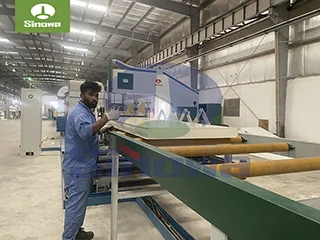
After cooling and shaping, the PIR sandwich panels enter the cutting and finishing stage. This stage includes fixed-length cutting, edge trimming, grooving or punching and other processes. The fixed-length cutting is completed by an automatic cutting machine, which can accurately cut the continuous sandwich panels into specified lengths according to customer orders. The cutting accuracy directly affects the installation efficiency of the finished products, so the cutting machine is usually equipped with a high-precision positioning system. The edge trimming process trims the uneven edges of the cut panels to ensure the neatness of the panel edges and facilitate subsequent splicing. For panels that need to be spliced in a specific way, grooving processing is also required at the ends to form a matching tenon-and-mortise structure, which enhances the tightness of the connection between panels. Some panels also need to be punched according to the installation requirements to facilitate the installation of accessories or the realization of ventilation functions. The cutting and finishing equipment is usually equipped with a dust removal system to reduce the pollution of metal dust and foam debris to the production environment, ensuring the health of workers and the cleanliness of the production site.
Quality inspection runs through the entire production process of the PIR sandwich panel manufacturing line, which is an important guarantee for product performance. In the raw material stage, the chemical composition, particle size, moisture content and other indicators of the core material raw materials are inspected, and the thickness, flatness, coating adhesion and other performance indicators of the surface metal panels are tested. During the composite forming stage, the mixing ratio of the core material raw materials, the foaming speed and the bonding degree between the core material and surface panels are monitored in real time. Special detection equipment is used to check the bonding strength between the core material and surface panels; if the bonding strength is insufficient, the product will be judged as unqualified and removed from the production line. After the cutting and finishing stage, the finished products are inspected for appearance, size accuracy, flatness and fire-resistant performance. The appearance inspection mainly checks for defects such as scratches, bulges or gaps on the panel surface; the size accuracy inspection uses professional measuring tools to verify the length, width and thickness of the panels; the fire-resistant performance is sampled and tested, and the samples are subjected to fire tests to ensure that they can form an effective carbonized fire barrier in case of fire. Only products that pass all quality inspections can enter the packaging and storage stage.
The packaging and storage stage is the last link of the production line, which is designed to protect the finished products during transportation and storage. The qualified PIR sandwich panels are stacked automatically through a stacking machine, and the number of panels in each stack is determined according to the product specifications and transportation requirements. The stacked panels are wrapped with packaging film to prevent moisture, dust and scratches. In order to facilitate transportation and loading and unloading, each stack of panels is usually equipped with loading pads at the bottom. The packaged products are then transported to the warehouse for storage through a conveying system. The warehouse needs to maintain a dry and well-ventilated environment to avoid the influence of moisture on the performance of the panels. At the same time, the products are stored in categories according to specifications and orders to facilitate quick retrieval and delivery.
The PIR sandwich panel manufacturing line with fire-resistant core material has strong adaptability and can produce products of different specifications according to market demand. By adjusting the parameters of the profiling equipment, the surface panels can be formed into different shapes to meet the requirements of different architectural styles. By changing the thickness of the core material and the type of surface panels, the thermal insulation performance, fire-resistant level and mechanical strength of the sandwich panels can be adjusted to adapt to different application scenarios. For example, in the construction of cold storage, PIR sandwich panels with thicker core materials and better thermal insulation performance are required; in the construction of industrial workshops with high fire safety requirements, panels with higher fire-resistant levels are selected. The flexibility of the production line enables it to quickly respond to market changes and meet the personalized needs of customers.
The PIR sandwich panels produced by this manufacturing line have a wide range of application fields, covering industrial buildings, public buildings, commercial buildings and temporary buildings. In industrial buildings, they are widely used as walls and roofs of various workshops, such as machinery manufacturing, electronics, food processing and chemical workshops, which can meet the requirements of production environment and ensure fire safety. In logistics warehouses, especially cold chain warehouses, PIR sandwich panels are an ideal choice due to their excellent thermal insulation and fire-resistant properties, which can ensure the energy efficiency and operational safety of the warehouses. In public and commercial buildings, such as stadiums, exhibition halls, shopping malls, office buildings, schools and hospitals, PIR sandwich panels are used for building partition walls, ceilings or external wall thermal insulation and decoration integrated panels, taking into account aesthetics and safety. In temporary buildings, such as prefabricated houses and construction site temporary rooms, PIR sandwich panels are used as walls and roofs to provide fast office and living spaces, and their fire resistance is crucial to the safety of the construction site. In addition, they are also used in special buildings such as subway vehicles and refrigerated trucks, showing broad application prospects.
The development of the PIR sandwich panel manufacturing line with fire-resistant core material is also closely related to the concept of green and low-carbon development. The fire-resistant PIR core material usually adopts water-blown technology, which does not contain fluorine-containing substances and has no adverse impact on the environment. The production process of the manufacturing line is highly automated, which reduces the consumption of manpower resources and the generation of waste. At the same time, the excellent thermal insulation performance of PIR sandwich panels can reduce the energy consumption of buildings during operation, which is in line with the requirements of energy conservation and emission reduction. In the process of use, the panels do not release harmful substances such as formaldehyde and benzene, which ensures the health of the indoor environment. With the increasing emphasis on environmental protection and energy conservation, the manufacturing line of PIR sandwich panels with fire-resistant core material will be further optimized and upgraded to achieve a more environmentally friendly and efficient production method.
However, the operation of the PIR sandwich panel manufacturing line with fire-resistant core material also faces some challenges. First of all, the initial investment in the production line is relatively large, requiring advanced equipment and professional production workshops, which puts forward higher requirements for the capital strength of enterprises. Secondly, the production process involves chemical raw materials, which requires strict safety management to prevent safety accidents such as leakage or combustion. Enterprises need to establish a complete safety management system and conduct regular training for workers to improve their safety awareness and operational skills. In addition, the quality of raw materials has a great impact on the product performance. Fluctuations in the quality of raw materials from suppliers may lead to unstable product quality, so enterprises need to establish a strict raw material procurement and inspection system to ensure the stability of raw material quality. Finally, the market competition is increasingly fierce. Enterprises need to continuously improve the technical level of the production line, reduce production costs and improve product performance to gain an advantage in the market competition.
In order to meet these challenges and promote the sustainable development of the production line, enterprises need to carry out continuous technological innovation and management optimization. In terms of technology, they can introduce more advanced automation control systems to improve the precision and stability of the production process; develop new core material formulas to further improve the fire-resistant performance and thermal insulation efficiency of the products; and optimize the structure of the production line to improve production efficiency and reduce energy consumption. In terms of management, enterprises can establish a full-process quality management system, realize the traceability of product quality, and timely find and solve problems in the production process; strengthen the training of employees to improve their professional quality and operational skills; and establish long-term cooperative relationships with high-quality raw material suppliers to ensure the stability of raw material supply. In addition, enterprises can also strengthen market research, understand the changing needs of customers, and develop personalized products to meet the diverse needs of the market.
In conclusion, the PIR sandwich panel manufacturing line with fire-resistant core material is an important part of the modern construction material industry, integrating advanced technology, strict quality control and efficient production. The PIR sandwich panels produced by this line have excellent fire-resistant performance, thermal insulation performance and mechanical strength, and are widely used in various fields of construction and industry. With the continuous progress of technology and the increasing emphasis on green and safe development, the manufacturing line will be further optimized and upgraded, and its application prospects will be broader. Enterprises engaged in the production of PIR sandwich panels need to continuously improve their technical level and management capabilities, overcome various challenges, and promote the healthy development of the industry, providing more high-quality and safe materials for the construction of green and low-carbon society.
https://www.cnsinowa.com/sandwich-panel-machines/pir-sandwich-panel-manufacturing-line-with-fire-resistant-core-material.html