 sandwich panel line
The operational logic of the continuous corrugated sandwich panel production line is built on the integration of physical mechanical forming and chemical interface bonding. The entire production process follows a linear and cyclic continuous operation mode, where raw surface materials and core insulation materials undergo sequential processing through multiple functional stations, completing corrugation shaping, surface pretreatment, material compounding, pressure curing, fixed-length cutting, edge trimming, and finished product collection in one uninterrupted flow. Each functional module of the production line operates in synchronous linkage, with operating parameters dynamically matched through intelligent control logic to eliminate production gaps and process errors inherent in traditional batch production. This systematic operation mode not only greatly improves the overall production capacity but also ensures that the structural performance, dimensional accuracy, and surface quality of each batch of panels maintain a highly consistent level, laying a solid foundation for the widespread application of corrugated sandwich panels in complex engineering scenarios.
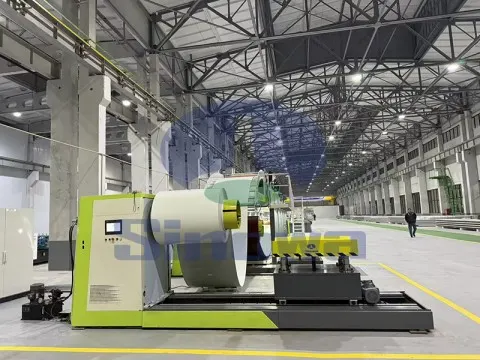
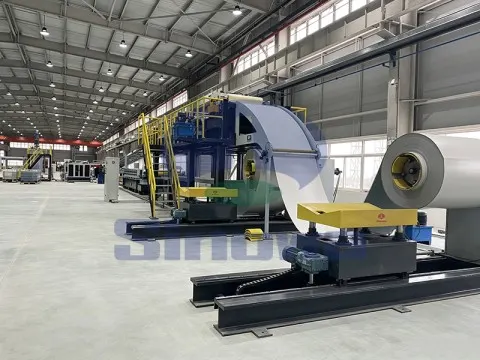
Raw material preparation and feeding constitute the initial link of the entire continuous production process, determining the stability of subsequent processing and the fundamental quality of finished panels. The production line is mainly compatible with metal coil materials as surface layers and various lightweight insulation or structural core materials as the intermediate sandwich layer. The surface metal coils are installed on automatic unwinding devices, which support continuous coil feeding and automatic coil splicing functions. When one coil material is about to be exhausted, the system can complete the docking and connection of the new coil without stopping the line, effectively eliminating production downtime caused by material replacement and ensuring the continuity of the overall production rhythm. This non-stop feeding design is a key feature that distinguishes continuous production lines from discontinuous production equipment, solving the problem of intermittent production efficiency loss in traditional equipment.
After unwinding, the metal surface materials first enter the leveling and cleaning station to eliminate the internal stress and surface defects generated during coil winding and storage. The multi-group roller leveling structure calibrates the flatness of the metal sheet, removing tiny wrinkles, bending deformations, and uneven textures on the material surface. Meanwhile, the automatic cleaning device removes dust, oil stains, and oxide layers attached to the surface, creating a clean and flat bonding base for subsequent gluing and compounding processes. A high-quality surface pretreatment process is crucial for enhancing the bonding strength between the metal surface layer and the core material, as impurities and uneven surfaces will lead to incomplete interface fitting, local debonding, and reduced structural stability of the finished panel in subsequent use. After leveling and cleaning, the metal sheet enters the corrugated forming module, where precision profiled rollers perform continuous cold rolling forming according to preset waveform parameters.
The corrugated forming system is the core functional module that endows the panel with unique structural mechanical properties. Through multi-stage progressive rolling, the flat metal sheet is gradually pressed into a regular corrugated structure with uniform wave height, wave spacing, and arc transition. The progressive forming process avoids the structural damage and stress concentration caused by one-time forced forming, ensuring the structural uniformity and mechanical stability of the corrugated layer. The waveform parameters can be adaptively adjusted according to production requirements, enabling the production of corrugated panels with different structural specifications to meet the load-bearing, shock resistance, and structural rigidity requirements of different application scenarios. The formed corrugated metal sheet maintains continuous and stable conveying without cutting or segmentation in this stage, ensuring the integrity of the subsequent continuous compounding process.
Following the completion of surface layer forming, the continuous sandwich panel production line enters the core material laying and gluing compounding stage, which directly determines the overall thermal insulation, bonding firmness, and structural integration of the sandwich panel. The core material feeding system adopts quantitative continuous feeding technology to uniformly and stably convey the lightweight core material to the middle of the upper and lower metal surface layers. Different core materials have matching feeding and laying processes: flexible core materials are laid in a continuous flat state through roller conveying, while foaming core materials complete proportional mixing, automatic pouring, and uniform spreading through precision metering and mixing systems. The core material can fully fill the corrugated gaps of the surface layer, forming a composite structure with integrated filling and bonding, which significantly improves the overall structural stability and thermal insulation performance of the panel.
The intelligent gluing system works synchronously with core material laying to achieve uniform and efficient interface bonding. The system adopts precision spray coating technology to evenly distribute the adhesive on the fitting surfaces of the upper and lower metal layers and the core material, with accurate control of glue coating amount and coating uniformity. Reasonable glue coating density and thickness can avoid insufficient bonding caused by sparse glue and material waste caused by excessive glue, while ensuring that each fitting interface forms a dense and stable adhesive layer. In the continuous production state, the gluing speed, core material feeding speed, and sheet conveying speed maintain precise dynamic synchronization, preventing offset, dislocation, and uneven bonding between layers, and ensuring that the composite interface of the entire panel is consistent from start to finish.
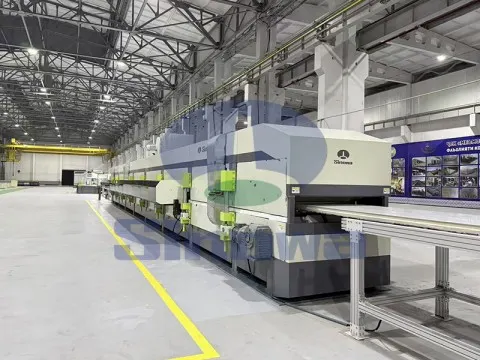
The laminated pressing and curing system is a key link to realize the integral forming of corrugated sandwich panels. The initially compounded multi-layer material enters the constant-pressure laminating conveyor device, where stable and uniform pressing force is applied through upper and lower circulating conveyor belts and pressure roller groups. The pressure parameters are precisely adjusted according to the thickness, core material type, and structural specifications of the panel, ensuring that the metal surface layer and the core material are tightly fitted without gaps or excessive compression deformation. During the continuous pressing process, the material is in a stable linear conveying state, and the adhesive undergoes sufficient chemical reaction and curing molding under constant pressure and appropriate ambient temperature conditions. The integrated design of pressing and curing enables synchronous completion of compound forming and interface curing in the continuous conveying process, eliminating the need for separate standing and curing links in traditional intermittent production, greatly shortening the production cycle and improving production efficiency.
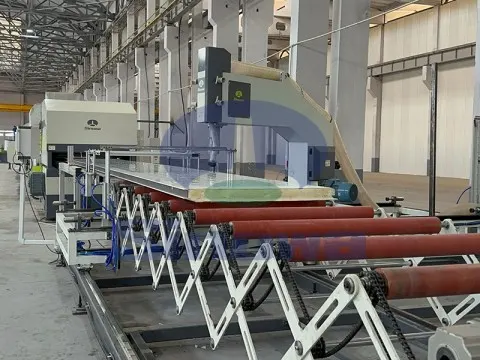
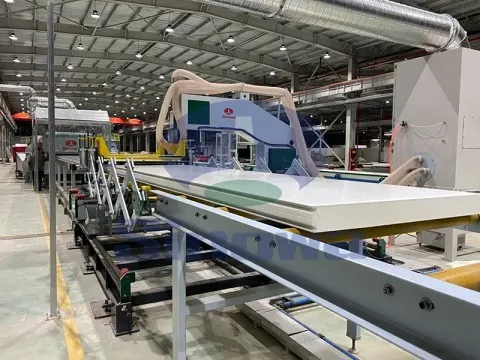
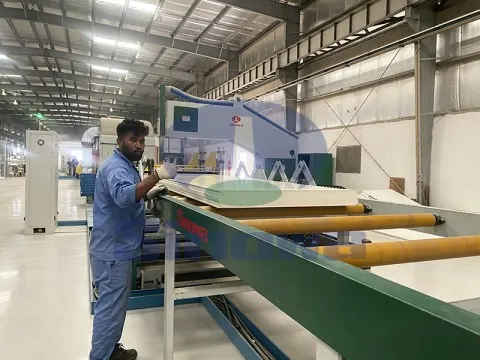
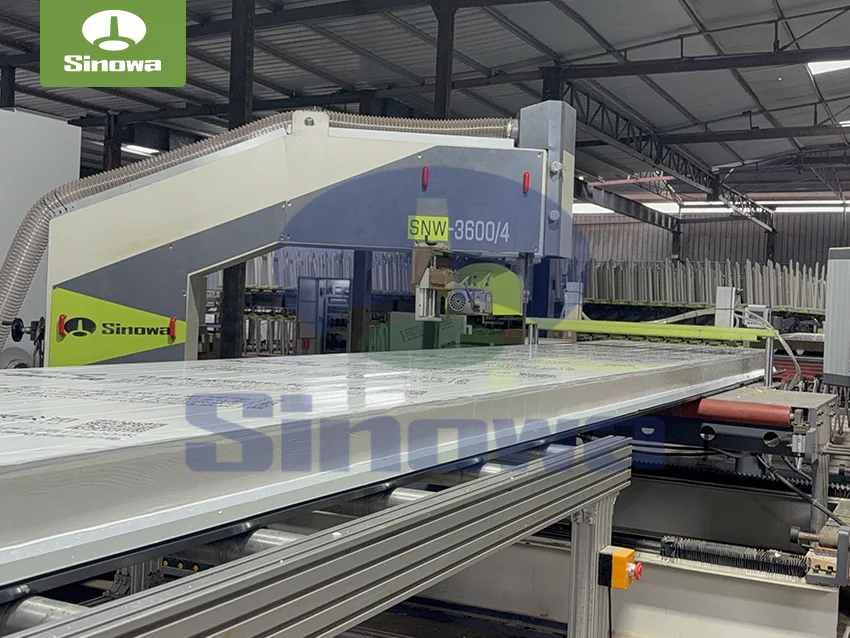
After curing and forming, the continuous integrated panel blank enters the finishing processing stage, including edge trimming, fixed-length cutting, and surface finishing. The edge trimming device automatically cuts off the uneven redundant materials on both sides of the panel to ensure consistent width and neat edge structure of the finished panel, avoiding edge warping, material shedding, and structural defects in subsequent use. The high-precision cutting system adopts servo fixed-length cutting technology, which can flexibly set the cutting length according to production requirements. In the continuous operation state, the cutting action is completed instantaneously without stopping the continuous sandwich panel line, realizing non-stop cutting and continuous output of finished products. The cutting equipment has high dimensional accuracy control capability, which can effectively control the length error of the panel within a tiny range and ensure the dimensional standardization of each finished product.
The final stage of the production process is automatic stacking and finished product output. The processed qualified panels are stably conveyed to the stacking platform through the conveying system, and the automatic stacking device completes orderly arrangement and stacking of the panels according to preset stacking specifications. The intelligent stacking function avoids manual handling errors and surface damage caused by manual operation, maintains the flatness and integrity of the panel surface, and facilitates subsequent packaging, transportation, and storage. The entire process from raw material feeding to finished product stacking is completed in a fully automated continuous cycle, with no redundant intermediate links and minimal manual intervention, realizing streamlined and intelligent production operation.
Compared with traditional discontinuous sandwich panel production equipment, the continuous corrugated sandwich panel production line has comprehensive advantages in production efficiency, product quality, operational cost, and production scalability. In terms of production efficiency, the non-stop continuous operation mode completely eliminates the waiting time for equipment start-stop, material docking, and product transfer in intermittent production. The synchronous linkage operation of each functional module realizes seamless connection of processes, and the single-line production capacity is far higher than that of traditional segmented production equipment, which can fully meet the large-scale production needs of industrial mass orders. For large-scale engineering projects requiring batch supply of panels, this efficient continuous production mode can effectively shorten the production cycle and improve project delivery efficiency.
In terms of product quality stability, the continuous sandwich panel machine adopts unified parameter setting and synchronous operation logic, and all production parameters such as forming pressure, gluing amount, curing time, and cutting size are intelligently controlled in real time. The entire production process is in a closed-loop controllable state, avoiding human operation errors and parameter fluctuations that easily occur in manual and intermittent production. The corrugated structure of the panel formed by continuous rolling has uniform stress distribution, stable bonding performance between layers, and consistent overall structural performance. The finished panels have flat surfaces, neat edges, accurate dimensions, and no local defects such as hollowing, debonding, and deformation, which significantly improves the overall quality grade and service stability of the products.
In terms of operational economy, the highly automated integrated design of the continuous sandwich panel product machinery greatly reduces labor investment. A single production line can realize full-process operation with only a small number of staff for parameter monitoring and equipment maintenance, effectively reducing labor costs in long-term production. At the same time, the precise quantitative control of raw materials such as coils, core materials, and adhesives reduces material waste caused by inaccurate feeding and repeated processing in traditional production. The optimized mechanical transmission structure and energy-saving control system reduce equipment operation energy consumption, and the stable and continuous operation state reduces equipment failure rates and maintenance costs. In the long-term mass production process, the comprehensive production cost per unit of panel is significantly optimized, bringing better economic benefits for manufacturing enterprises.
In terms of product performance diversity and application adaptability, the modular structural design of the continuous corrugated sandwich panel line enables flexible adjustment of production parameters. By adjusting roller forming parameters, core material feeding specifications, gluing process parameters, and cutting dimensions, the production line can manufacture corrugated sandwich panels with different thicknesses, waveforms, core material types, and structural strengths. The produced panels integrate multiple excellent properties including light weight, high strength, thermal insulation, sound insulation, shock resistance, and weather resistance. The corrugated structure enhances the bending resistance and structural rigidity of the panel compared with flat sandwich panels, enabling it to bear larger external loads and adapt to more complex installation and use environments.
The application scenarios of corrugated sandwich panels produced by continuous production lines cover multiple fields of modern industrial construction and civil engineering. In industrial plant construction, such panels are widely used for factory wall enclosures, roof systems, and partition structures. Their light weight reduces the load of building structures, while their excellent thermal insulation and weather resistance can effectively adjust the internal temperature of the factory building, reduce energy consumption for heating and cooling, and adapt to the long-term operation needs of industrial production environments. In cold storage and constant-temperature warehouse engineering, the high-density integrated core material structure provides stable thermal insulation performance, effectively isolating internal and external temperature exchange, reducing the operation energy consumption of refrigeration equipment, and ensuring the constant-temperature storage environment of the warehouse.
In modular prefabricated construction projects, corrugated sandwich panels have become the preferred building envelope material due to their standardized size, convenient installation, and stable performance. The standardized panels produced by continuous manufacturing lines can be quickly assembled and spliced on the construction site, greatly shortening the construction cycle of prefabricated buildings and improving construction efficiency. In temporary engineering facilities such as mobile construction houses and emergency rescue houses, the light weight and high structural strength of the panels facilitate rapid transportation and assembly, while their good wind resistance, shock resistance, and heat preservation performance ensure the safety and comfort of temporary buildings. In addition, the panels are also widely used in agricultural breeding buildings, logistics warehouse enclosures, municipal engineering facilities, and equipment insulation protection structures, with extremely broad market application space.
The production line is equipped with a complete intelligent monitoring and fault self-diagnosis system to ensure the stability and safety of long-term continuous operation. The core control system collects real-time operating data of each module including conveying speed, forming pressure, gluing flow, curing temperature, and cutting accuracy, and compares and analyzes the data with preset standard parameters. When minor parameter deviations occur, the system can automatically adjust and correct to maintain the stability of the production process. Once abnormal conditions such as equipment jitter, material blockage, and parameter overrun occur, the system will trigger timely early warning and protective control, effectively avoiding equipment failure and defective product generation. The real-time data monitoring function also facilitates production staff to grasp the production operation status in real time, realize refined production management, and improve the controllability of the production process.
In terms of equipment operation stability and durability, the continuous corrugated sandwich panel production machine adopts high-strength mechanical structures and optimized transmission design. The key forming and pressure-bearing components are processed with high-precision manufacturing technology, with good wear resistance, pressure resistance, and fatigue resistance, which can adapt to long-term uninterrupted high-intensity operation. The modular assembly structure facilitates daily maintenance and component replacement of the equipment, reducing the difficulty and time cost of equipment maintenance. The overall mechanical matching degree of the production line is high, the operation rhythm is stable, and the vibration and noise generated during operation are effectively controlled, which not only improves the production working environment but also extends the overall service life of the equipment.
With the continuous improvement of global energy-saving and environmental protection requirements and the upgrading of building material performance standards, the continuous corrugated sandwich panel production line is also evolving towards higher intelligence, higher efficiency, and greener production. Modern production lines gradually introduce more refined intelligent control technologies, realizing automatic switching of production parameters for different product specifications, intelligent prediction of equipment maintenance cycles, and real-time statistical analysis of production output and product qualification rate. The upgraded gluing system and core material laying process further improve the uniformity of material compounding and the utilization rate of raw materials, reducing the generation of production waste. The optimized energy-saving transmission structure and variable-frequency speed regulation technology effectively reduce production energy consumption, realizing low-carbon and environmentally friendly production.
The technological progress of continuous sandwich panel production equipment has also driven the continuous upgrading of corrugated sandwich panel product performance. Through the optimized forming process of the production line, the corrugated structure of the panel is more reasonable, the internal stress distribution is more uniform, and the structural stability and load-bearing capacity of the product are further improved. The precise compounding and curing process enhances the interface bonding firmness between layers, effectively avoiding layer separation and peeling during long-term use, and improving the service life and durability of the panel. At the same time, the diversified production capacity of the production line promotes the innovation of panel functional design, enabling the product to meet the differentiated performance requirements of fire resistance, sound absorption, corrosion resistance, and high weather resistance in different engineering scenarios.
In the industrial chain layout of modern building composite materials, the continuous corrugated sandwich panel manufacturing machine plays a vital connecting role. It realizes the efficient transformation from basic raw materials to high-performance finished building materials, provides standardized and high-quality basic materials for the downstream prefabricated construction, industrial enclosure, and energy-saving insulation industries, and supports the standardized and large-scale development of the entire industrial chain. The popularization and application of continuous production technology have changed the backward production mode of low efficiency, low standardization, and high error rate in the traditional sandwich panel industry, promoted the overall upgrading of the industry's production level and product quality, and provided strong technical equipment support for the high-quality development of the building energy-saving material industry.
In practical production and application, the operational advantages of continuous corrugated sandwich panel making machine is further reflected in the consistency of batch products and the stability of long-term production. For manufacturing enterprises undertaking large-scale and long-term orders, the stable and continuous production capacity of the equipment can ensure the consistency of product quality in different batches and different production cycles, avoid product performance differences caused by discontinuous production, and improve customer recognition and market competitiveness of products. At the same time, the flexible production capacity of the equipment can quickly respond to the personalized customization needs of the market, adjust product specifications and structural forms in a timely manner, and meet the diversified market demand.
In conclusion, the continuous corrugated sandwich panel production line as an advanced integrated automated production system, integrates mechanical forming, chemical compounding, intelligent control, and precision finishing technologies, realizing efficient, stable, and standardized continuous manufacturing of corrugated sandwich panels. Its unique non-stop continuous operation mode, high-precision production control, and flexible product adaptation capabilities make it the core equipment for the modernized production of corrugated sandwich panels. With the continuous development of prefabricated construction, green building, and industrial infrastructure construction industries, the market demand for high-performance corrugated sandwich panels will continue to grow, and the continuous corrugated sandwich panel making line will also achieve further technological innovation and performance upgrading, continuously empowering the high-quality development of the building composite material industry and modern construction engineering.
Sinowa is a professional manufacturer of sandwich panel machine in china, we provide diversified and high-performance sandwich panel production lines, including fully automatic continuous PU sandwich panel line and customized special lines to meet mass production and personalized order demands. These sandwich panel lines support processing multiple foam core materials, such as PU, PIR, mineral wool, rock wool and glass wool, covering different insulation and fireproof standards.
Featuring stable operation, high efficiency, energy saving and easy maintenance, our PU sandwich panel line deliver sandwich panels with excellent thermal insulation, fire resistance, sound insulation and lightweight durability. The finished panels are widely applied in industrial workshops, warehouse roofing and wall cladding, cold storage insulation, serving global construction and industrial insulation markets.
https://www.cnsinowa.com/sandwich-panel-machines/continuous-corrugated-sandwich-panel-production-line.html