sandwich panel line
The fundamental value of a qualified polyurethane sandwich panel line supplier lies in the integration and optimization of production equipment to adapt to the inherent production characteristics of polyurethane sandwich panels. Polyurethane sandwich panels are typically composed of upper and lower surface materials and a polyurethane foam core layer, and the bonding compactness, foaming uniformity, and overall flatness of the three layers directly determine the service quality and service life of finished panels. Professional suppliers focus on designing production lines that can realize continuous and automated processing, eliminating the inefficiencies and unstable product quality caused by intermittent manual production. In the overall structural design of the production line, suppliers need to take into account the compatibility of multiple raw materials, including different types of metal surface materials and polyurethane raw materials with varying foaming ratios, ensuring that the production line can maintain stable operating conditions during long-term continuous production. Unlike ordinary mechanical equipment suppliers, polyurethane sandwich panel line suppliers possess in-depth professional knowledge of polyurethane foaming chemistry and composite molding physics, which enables them to adjust equipment parameters according to the physical changes of raw materials in the production process and avoid common production defects such as uneven foaming, delamination between layers, and surface wrinkles of panels.
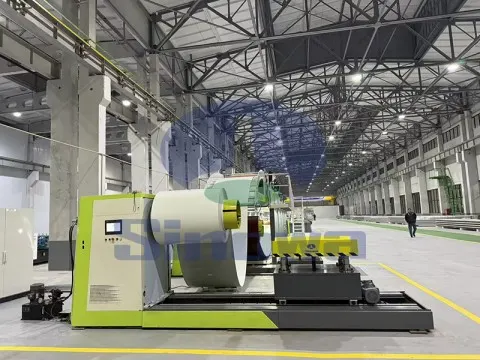
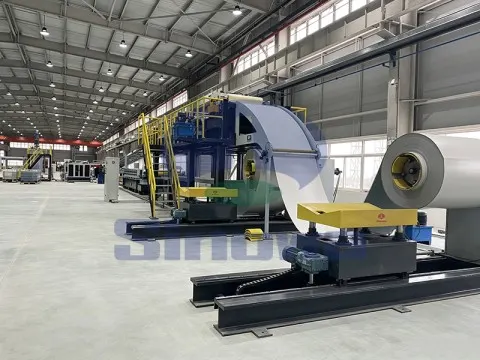
A complete polyurethane sandwich panel production line consists of multiple interconnected functional modules, and professional suppliers carry out hierarchical optimization for each module to ensure the coordination and linkage of the entire production process. The front-end part of the production line is the raw material feeding and pretreatment module, which is responsible for the continuous unwinding, straightening, and surface cleaning of surface materials. During the production process, surface materials are prone to adhering to dust and fine impurities, which will affect the bonding effect with the polyurethane core layer. Therefore, suppliers equip this module with automatic dust removal and surface smoothing structures to keep the surface materials clean and flat before composite processing. After pretreatment, the surface materials are transported to the raw material mixing and pouring module, which is the core functional area of the entire production line. In this module, polyurethane resin raw materials, curing agents, and foaming auxiliaries are accurately transported to the high-speed mixing device through metering components. Professional suppliers adopt precision metering structures to control the proportion of various raw materials, as the proportion deviation will directly affect the foaming density and structural toughness of the polyurethane core layer. The mixed raw materials are evenly coated on the moving bottom surface material through the reciprocating moving distributing structure, laying a foundation for uniform foaming molding.
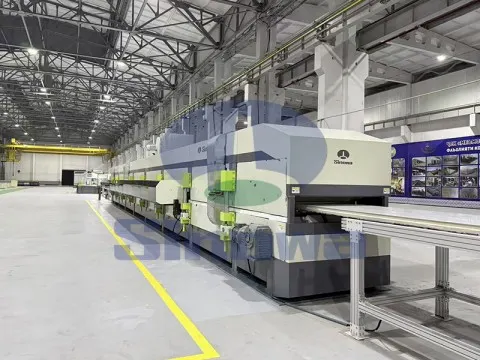
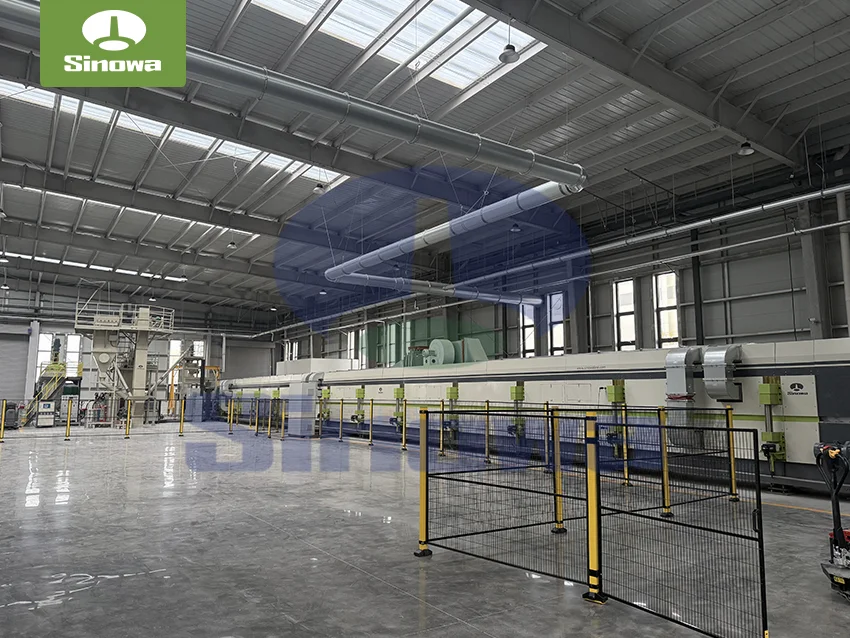
Following the pouring process is the thermoforming and curing module, which determines the structural stability of the composite panels. The mixed polyurethane raw materials undergo foaming reaction between the upper and lower surface materials, and the double-belt pressing structure designed by suppliers can maintain stable pressure and temperature during the foaming process. The internal temperature of the curing area needs to be kept within a reasonable constant range to promote the complete chemical cross-linking reaction of polyurethane components. Appropriate temperature and pressure conditions can make the foam structure dense and uniform, and enhance the bonding strength between the core layer and the surface materials. Without precise temperature and pressure control, the finished panels are likely to have internal voids and insufficient bonding force, which will reduce the thermal insulation effect and structural durability. After thermoforming, the panels enter the trimming and shaping module, where the edge trimming devices on both sides of the production line cut the excess edges of the panels to ensure consistent dimensional accuracy of each finished panel. This processing step eliminates irregular edges generated in the continuous composite process and improves the assembly convenience of panels in subsequent construction applications.
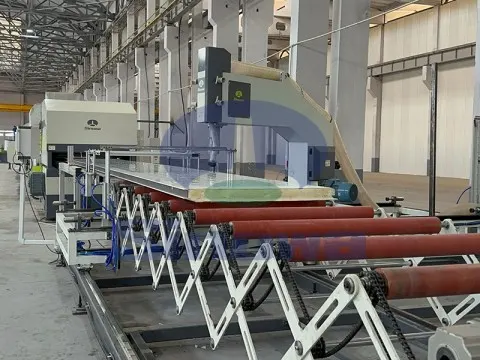
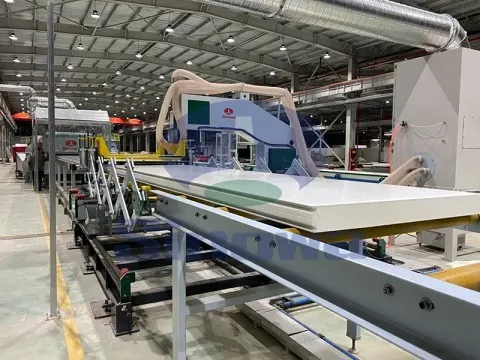
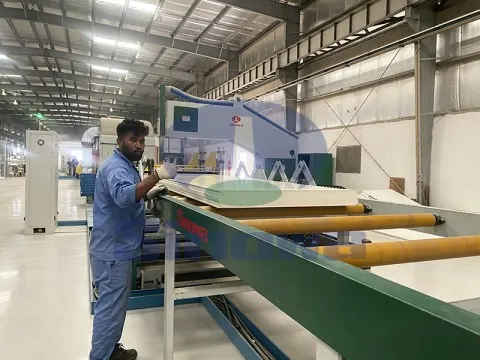
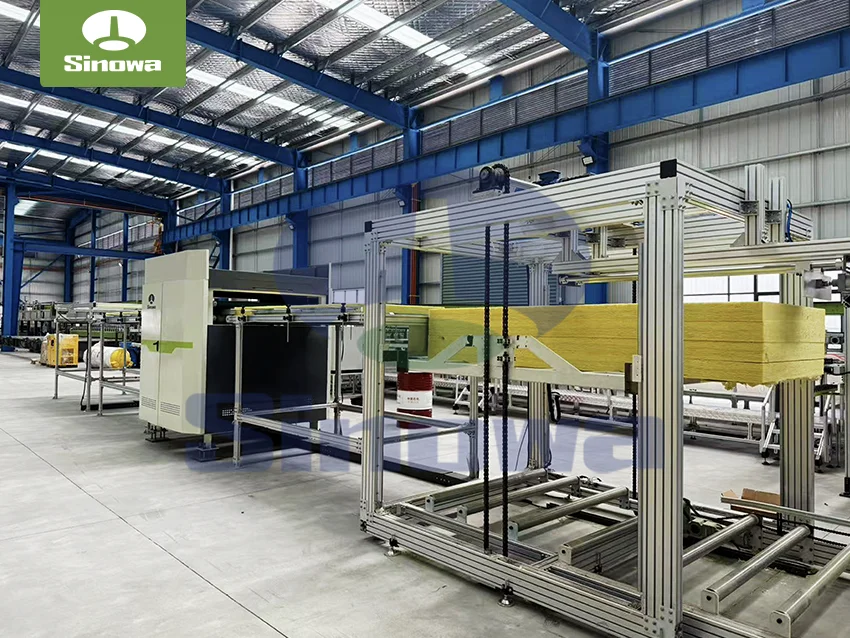
The final part of the production line includes cooling, cutting and stacking modules, which realize the final finishing and standardized collection of finished products. The initially cured panels still retain residual temperature, and the slow cooling structure can avoid structural deformation caused by rapid temperature change. After cooling, the continuous long plates are cut into specified sizes by the fixed-length cutting device, and the intelligent stacking system automatically arranges and stores the finished panels. Professional suppliers optimize the operating speed of each module to form a smooth production rhythm. High-performance production lines can maintain a stable continuous operation speed, balancing production efficiency and product molding quality. In addition, suppliers reserve adjustable space for equipment parameters, allowing manufacturers to modify production specifications according to market demands, such as adjusting the thickness of the polyurethane core layer and the width of finished panels, so as to produce panel products suitable for cold storage insulation, building exterior wall decoration, and industrial enclosure structures.
In addition to mechanical equipment manufacturing, excellent polyurethane sandwich panel line suppliers focus on the rationality of equipment energy consumption and operational cost control. In the current industrial environment that emphasizes energy conservation and efficient production, suppliers optimize the internal heating circulation system and power transmission structure of the production line to reduce invalid energy consumption during equipment operation. The improved heating circulation mode can evenly distribute heat in the curing area, avoiding local overheating and energy waste, while the optimized transmission components reduce mechanical friction loss and extend the service life of wearing parts. At the same time, suppliers select high-quality raw materials for equipment manufacturing, using wear-resistant and corrosion-resistant metal structures to adapt to the humid and chemically volatile production environment of polyurethane foaming. This material selection strategy reduces the frequency of equipment maintenance and replacement of vulnerable parts, effectively lowering the long-term operational cost for panel manufacturers. For different production scales, suppliers can also provide differentiated equipment configuration schemes. Compact production lines are suitable for small and medium-sized processing plants with limited site space, while large-scale integrated production lines meet the high-yield production needs of large industrial manufacturers.
The technical service capability of suppliers is another key dimension to measure their comprehensive strength, and it runs through the whole cycle of equipment selection, installation, operation, and maintenance. Professional suppliers provide personalized scheme design services for customers. Before equipment production, they communicate with customers in depth to confirm production site conditions, raw material types, and product orientation, so as to adjust the equipment layout and functional configuration. In the equipment delivery and installation stage, the technical team completes assembly, debugging, and production line linkage testing to ensure that all modules operate in coordination and reach the preset production indicators. After the equipment is put into use, suppliers provide systematic operation training for the customer's production personnel, including daily operation specifications, parameter adjustment methods, and simple fault diagnosis skills. Polyurethane sandwich panel production lines involve complex chemical reaction processes and mechanical transmission structures, and standardized operation can effectively avoid equipment failure and product quality problems. In terms of after-sales maintenance, suppliers establish a complete feedback mechanism to respond to equipment operation abnormalities in a timely manner, provide remote technical guidance and on-site maintenance services, and minimize the production stagnation time caused by equipment failures.
With the continuous upgrading of industrial manufacturing technology, polyurethane sandwich panel line suppliers are constantly carrying out technological iteration and functional innovation to adapt to the changing market demands. In terms of intelligent manufacturing, suppliers introduce automatic sensing and control components to realize real-time monitoring of production parameters such as raw material proportion, curing temperature, and transmission speed. The intelligent control system can record production data throughout the process, helping manufacturers analyze production efficiency and product quality changes, and provide data support for production optimization. In terms of product diversification adaptation, the upgraded production line can realize the composite processing of multi-type core materials, matching with different surface materials to produce composite panels with fire resistance, sound insulation, and high weather resistance. Some optimized production structures can also realize one-time molding of special-shaped panels, enriching the application scenarios of finished products. In addition, suppliers pay attention to environmental protection optimization of production processes, improving the raw material mixing and sealing structure to reduce the volatilization of chemical substances during production, and making the production process conform to modern environmental protection production standards.
In the international industrial market, polyurethane sandwich panel line suppliers need to adapt to the differentiated production demands of different regions. In areas with rapid infrastructure construction, customers tend to choose high-efficiency and large-capacity production lines to meet the large-scale demand for building insulation panels; in regions with strict environmental protection requirements, customers pay more attention to the environmental protection performance and low-emission design of production lines; for small processing enterprises in emerging markets, suppliers provide cost-effective simplified configuration schemes to lower the entry threshold of panel production. Excellent suppliers have flexible production adjustment capabilities, which can modify equipment details according to regional raw material characteristics and usage habits, ensuring that the equipment can maintain stable operation in different geographical environments. At the same time, suppliers summarize the common problems in the actual production process of global customers, and continuously optimize equipment structures to reduce universal production defects, forming mature and reliable industrial manufacturing solutions.
For panel manufacturers, selecting a suitable polyurethane sandwich panel line supplier is crucial to long-term production and development. Manufacturers need to focus on the overall matching degree between equipment and their own production demands, rather than blindly pursuing complex functions. It is necessary to inspect the structural stability, parameter adjustment flexibility, and energy consumption performance of the production line, and evaluate the supplier's technical accumulation and after-sales service capabilities. A reliable supplier can not only provide high-quality mechanical equipment, but also assist manufacturers in optimizing production processes, improving product yield, and reducing comprehensive production costs. With the continuous growth of demand for energy-saving building materials in the global construction industry, the market scale of polyurethane sandwich panels will continue to expand, which puts forward higher requirements for the technical level and service quality of production line suppliers.
Looking ahead, polyurethane sandwich panel production line suppliers will continue to develop towards intelligence, energy conservation, and high integration. The deep integration of automation technology and mechanical equipment will further reduce manual intervention in the production process and improve production consistency; the application of new energy-saving materials and optimized thermal circulation structures will continuously reduce the energy consumption level of equipment; the modular design of production lines will make equipment transportation, installation, and maintenance more convenient. In addition, suppliers will strengthen the research and development of adaptive technology for new environmental protection raw materials, to meet the increasingly stringent environmental protection regulations in various regions. As an important supporting link in the composite material industry, polyurethane sandwich panel line suppliers will keep pace with the development of the times, continuously polish technical strength, improve service systems, and provide stable and efficient production equipment solutions for the global sandwich panel manufacturing industry, so as to promote the sustainable development of the entire industrial chain.
Sinowa is a professional manufacturer of sandwich panel machine in china, we provide diversified and high-performance sandwich panel production lines, including fully automatic continuous PU sandwich panel line and customized special lines to meet mass production and personalized order demands. These sandwich panel lines support processing multiple foam core materials, such as PU, PIR, mineral wool, rock wool and glass wool, covering different insulation and fireproof standards.
Featuring stable operation, high efficiency, energy saving and easy maintenance, our PU sandwich panel line deliver sandwich panels with excellent thermal insulation, fire resistance, sound insulation and lightweight durability. The finished panels are widely applied in industrial workshops, warehouse roofing and wall cladding, cold storage insulation, serving global construction and industrial insulation markets.
https://www.cnsinowa.com/sandwich-panel-machines/polyurethane-sandwich-panel-line-supplier.html