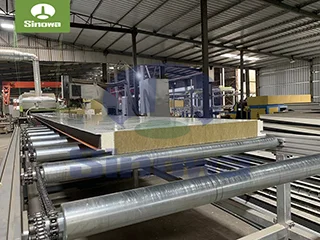
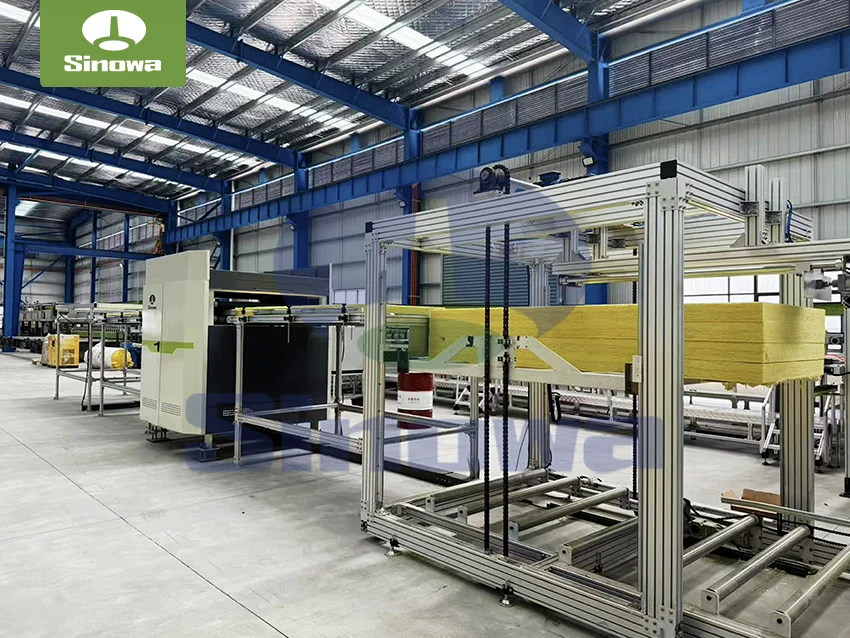
 sandwich panel line
Different from ordinary rock wool sandwich panel production line used for common factory workshops and public building enclosures, cold room rock wool sandwich panel line adopts targeted process adjustment in every production link according to the extreme operating environment of cold rooms. Cold storage interiors maintain long-term low temperature and high humidity, with frequent temperature differences between indoor cold environment and outdoor normal atmospheric temperature, which puts forward stricter requirements for panel bonding firmness, core material hydrophobicity, overall structural tightness and anti-delamination performance of finished panels. Ordinary sandwich panel production line only focus on basic compound molding and surface flatness, while cold room special production lines optimize glue coating parameters, pressing temperature and pressure matching mode, rock wool fiber arrangement direction and post-production cooling shaping procedures in a targeted manner, solving common pain points of cold room panels such as glue failure caused by long-term low temperature erosion, core material water absorption leading to decreased insulation effect, and plate seam cold bridge heat conduction. All process parameter settings of the whole production line are centered on improving the long-term service stability of panels in high humidity and large temperature difference scenarios, rather than simply pursuing production speed and output volume.
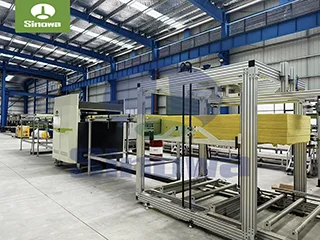
The full continuous production workflow of a complete cold room rockwool sandwich panel line runs in closed-loop synchronous linkage without manual intervention in the intermediate process, starting from metal coil raw material feeding and ending with automatic stacking and conveying of finished panels. The first working section is the automatic uncoiling and surface pretreatment unit for upper and lower metal base plates. Raw metal coils are placed on dual-station uncoiling racks, which support non-stop coil switching to avoid production line shutdown caused by raw material replacement. After uncoiling, the metal plates first pass through multi-group leveling rollers to eliminate internal stress generated during coil winding and remove surface tiny depressions and bending deformations, ensuring the flatness of base plates before subsequent forming and gluing. Following leveling is surface cleaning and micro-roughness treatment, a unique pretreatment procedure reserved for cold room panel production. Fine dust, oil stains and oxide layers attached to metal plate surfaces will severely reduce the bonding force between metal plates and adhesive under long-term humid and low-temperature conditions; therefore, the rockwool board production line is equipped with automatic dust removal equipment and surface micro-etching devices to improve surface tension of metal plates. This subtle pretreatment process effectively prevents edge warping and interlayer delamination of finished panels after long-term use in cold rooms, greatly extending the overall service life of enclosure structures.
After surface pretreatment, upper and lower metal plates enter independent roll forming units respectively. According to cold room installation design requirements, metal plates can be rolled into hidden buckle type, flat type or trapezoidal rib structures. Hidden buckle profile is the most widely adopted solution for cold room wall and roof panels, as its seamless splicing structure effectively blocks cold bridge penetration at plate joints and reduces cold air leakage inside cold storage. All forming rollers adopt synchronous servo driving control, realizing consistent feeding speed of upper and lower plates and avoiding dislocation during subsequent composite pressing. Meanwhile, the forming unit supports stepless adjustment of plate width and profile depth, enabling one production line to meet the processing demands of cold room wall panels, roof panels and corner special-shaped panels without replacing massive molds, improving overall production flexibility for diversified cold storage engineering orders.
The core material feeding and directional arrangement section is one of the most critical differentiated designs of cold room dedicated production lines compared with ordinary sandwich panel equipment. Rock wool core materials have inherent fiber direction characteristics, and disorderly stacked rock wool will lead to uneven overall insulation performance and inconsistent compressive strength of finished panels. For cold room panels requiring stable heat insulation all year round, the rockwool sandwich panel production line is equipped with automatic rock wool splitting, flipping and directional paving equipment. Bulk rock wool raw materials are divided into uniform strip structures through longitudinal and transverse cutting devices, then flipped by a special turnover mechanism to make internal rock wool fibers arranged vertically perpendicular to the metal plate surface. This vertical fiber arrangement mode enhances the overall compression resistance of panels, prevents core material collapse under long-term dead load of cold room roof panels, and maintains stable thermal insulation coefficient without attenuation in long-term low-temperature environments. In addition, the core material feeding system is matched with online hydrophobic agent spraying equipment, which uniformly coats the surface of rock wool strips. This treatment solves the defect that porous rock wool is easy to absorb moisture in cold and humid cold storage internal environment, avoids increased thermal conductivity caused by water absorption of core materials, and permanently locks the insulation performance of rock wool core layers.
Subsequently, the rock wool sandwich panel machine enters the high-precision automatic gluing composite section, which determines the interlayer bonding reliability of finished cold room panels. The whole line adopts full-surface uniform spraying gluing mode instead of traditional partial point gluing or linear gluing. The intelligent glue supply system realizes real-time linkage between glue output and plate operating speed, automatically adjusting glue coating amount according to plate thickness, production speed and ambient temperature. The adhesive selected for cold room panel production has excellent low-temperature resistance and anti-aging properties, which will not become brittle or lose bonding activity under long-term zero and sub-zero temperature environments. The glue spraying area is equipped with closed recovery structures to collect redundant adhesive, reducing raw material waste while avoiding volatile material diffusion in the production workshop. After synchronous gluing of lower metal plate, rock wool core material and upper metal plate, three layers of materials are accurately aligned through positioning correction rollers to eliminate horizontal and longitudinal dislocation, laying a foundation for integrated composite molding.
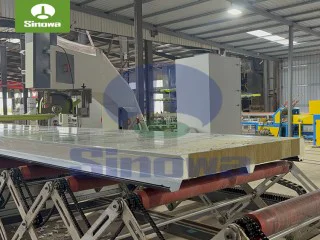
The continuous double-belt heating pressing unit is the core functional section for integrated molding of sandwich panels. Different from normal-temperature pressing of common building panels, cold room panel production adopts segmented constant-temperature heating and constant-pressure integrated pressing process. The pressing area is divided into three independent temperature control zones: preheating zone, constant-temperature curing zone and slow cooling buffer zone. The preheating zone raises the overall temperature of composite plates moderately to activate adhesive molecular activity; the middle constant-temperature zone maintains stable heating temperature to accelerate full curing of adhesive between layers; the buffer zone avoids sharp temperature difference inside panels before leaving the pressing unit. Meanwhile, the system maintains uniform static pressure on the whole plate surface throughout the pressing process, preventing local glue shortage, bubbles and core material compression deformation. Exhaust structures are arranged on both sides of the pressing belt to completely discharge residual air between metal plates and rock wool core materials. Residual air bubbles left inside panels will condense into water droplets in cold room low-temperature environment, destroying composite structures and reducing insulation effect, so full defoaming treatment in the pressing process is indispensable for cold room special panels.
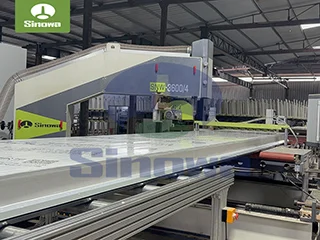
After completing heating curing and integrated composite molding, continuous long-size whole plates are transmitted to the fixed-length precision cutting unit. Driven by synchronous tracking cutting technology, the cutting tool runs synchronously with moving plates without stopping the whole rockwool insulation board production line, realizing uninterrupted continuous cutting and improving overall production efficiency. The cutting system supports arbitrary setting of finished plate length according to actual cold storage engineering installation demands, with ultra-small cutting dimensional error to ensure seamless assembly on construction sites. The cutting section is equipped with automatic edge trimming and burr removing devices to polish plate cutting sections, ensuring tight splicing between panels during cold room construction and reducing cold air leakage from plate end faces. Immediately after cutting, panels enter the forced air cooling shaping section. Newly molded panels carry residual curing heat, and direct stacking without cooling will cause internal stress release leading to plate bending and deformation. The circulating air cooling system conducts uniform and slow cooling on upper and lower surfaces of panels to release internal stress completely, ensuring long-term dimensional stability of finished panels in alternating temperature environments.
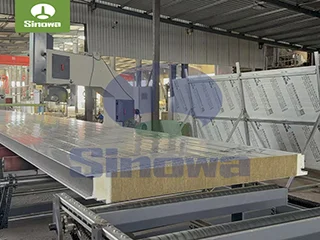
The final part of the rock wool board production line includes online visual inspection, automatic glue cleaning and intelligent stacking and conveying systems. High-definition visual detection cameras arranged above the conveying line conduct full-surface non-destructive inspection on finished panels in real time, automatically identifying surface scratches, glue missing areas, core material deviation and other appearance and internal composite defects, and automatically eliminating unqualified products without manual screening. The automatic cleaning device wipes residual overflow adhesive on panel edges to keep panel edges neat and tidy. Qualified finished panels are orderly stacked by servo-driven stacking manipulators, which can adjust stacking height and spacing according to panel thickness, avoiding surface extrusion damage during stacking. The whole process from raw material feeding to finished product warehousing realizes full automatic unmanned operation, only requiring a small number of staff to monitor overall operating parameters on the central control touch screen.
Compared with semi-automatic panel production equipment and ordinary continuous production lines, cold room dedicated rockwool sandwich panel making machine has prominent comprehensive production advantages adapting to cold chain construction needs. Firstly, the overall product performance consistency is significantly improved. Manual participation in semi-automatic lines easily causes uneven glue amount, inconsistent core material thickness and unstable pressing pressure, leading to large performance differences between different batches of panels. The full-link synchronous control system of professional production lines locks all key process parameters, ensuring unified thermal insulation strength, bonding performance and dimensional accuracy of each finished panel. Secondly, the sandwich panel machine has strong environmental adaptability for finished products. All process optimization designs target high humidity and large temperature difference working conditions of cold rooms, making panels resistant to low-temperature aging, moisture erosion and structural delamination, reducing later maintenance frequency of cold room enclosure structures. Thirdly, integrated continuous production greatly shortens the overall production cycle. One-piece molding eliminates intermediate turnover and waiting links between separate processes, effectively improving unit-time output and meeting centralized panel supply demands for large-scale cold storage construction projects.
Standardized daily operation and regular maintenance are essential to maintain long-term efficient and stable operation of cold room rock wool sandwich panel manufacturing line and keep finished product quality stable for a long time. Before daily startup, operators need to conduct full-circuit inspection of mechanical transmission components, sensor detection modules, glue supply pipelines and temperature and pressure control systems to check for pipeline blockage, sensor deviation and roller wear. Formal production can only start after parameter calibration is completed. During continuous operation, the central control system monitors real-time data including plate feeding speed, heating zone temperature, pressing pressure, glue spraying flow and core material feeding thickness synchronously, and the system automatically adjusts matching parameters once parameter deviation occurs to avoid batch unqualified products. For daily maintenance, workers need to clean residual rock wool fibers and waste adhesive inside the equipment every day to prevent accumulated impurities from affecting plate surface quality and transmission smoothness. Regular weekly maintenance focuses on calibrating cutting precision and forming profile size; monthly maintenance checks wear degree of pressing belts and forming rollers to replace vulnerable parts in a timely manner. Reasonable maintenance plans can effectively reduce equipment failure rate, extend the whole service life of the sandwich panel machinery, and avoid production shutdown losses caused by sudden equipment faults.
Looking ahead, cold room rock wool sandwich panel production machine will further integrate digital and intelligent manufacturing technologies to adapt to the upgrading trend of global high-standard cold chain construction. The next-generation production lines will be equipped with full-process digital twin systems, building virtual simulation models consistent with physical production lines. Engineers can simulate production parameter adjustment, new product trial production and equipment fault prediction in the virtual model without affecting actual production progress, realizing pre-judgment and early warning of potential equipment faults. In terms of energy saving and green production, follow-up optimized production lines will adopt waste heat recovery devices to recycle residual heat generated by the heating pressing section for preheating metal raw materials, reducing overall energy consumption of equipment operation. Meanwhile, more environmentally friendly low-carbon adhesive formulas and closed-loop material circulation systems will be popularized to reduce production carbon emissions and realize greener panel manufacturing process. In terms of production flexibility, future equipment will support faster switching of panel specifications and profiles, realizing seamless switching between ultra-thin cold room partition panels and ultra-thick roof load-bearing panels, better adapting to personalized and customized cold storage construction demands.
In conclusion, cold room rock wool sandwich panel line is professional customized intelligent production equipment tailored for the special operating environment of cold chain cold storage projects. Every process link from raw material pretreatment, core material directional arrangement, low-temperature resistant glue composite, segmented heating pressing to post-production stress relief cooling is optimized for long-term low-temperature and high-humidity working scenarios. With the continuous growth of global cold chain logistics, medical low-temperature storage and fresh food distribution center construction demands, high-performance rock wool sandwich panels will occupy a larger share in cold room enclosure material markets, and matched professional panel production lines will become core supporting equipment for the cold chain building material manufacturing industry. Through continuous technological iteration in automation control, green energy saving and digital simulation, such sandwich panel manufacturing machine will further improve production efficiency, optimize finished panel performance, reduce overall manufacturing costs, and provide more reliable, durable and energy-saving building material solutions for global cold storage infrastructure construction.
https://www.cnsinowa.com/sandwich-panel-machines/cold-room-rock-wool-sandwich-panel-line.html