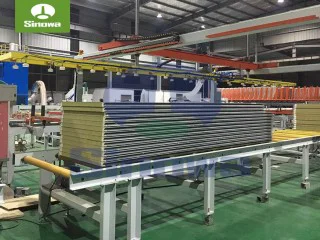
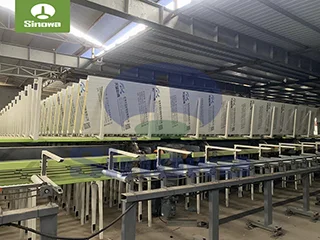
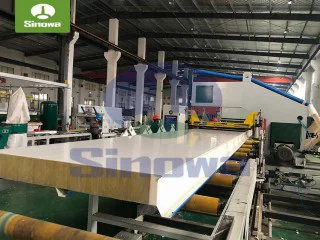
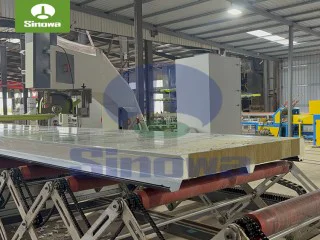
sandwich panel line
At the core of the production process lies the careful selection and preparation of raw materials, which directly influence the quality and functionality of the final panels. The primary components include the rockwool core and the outer facing materials, typically metal sheets with protective coatings. Rockwool, a mineral fiber derived from natural stone, is chosen for its inherent non-combustible properties, high melting point exceeding 1000 ºC, and excellent thermal and acoustic insulation capabilities. It contains no harmful substances such as asbestos, CFCs, HCFCs, or HFCs, aligning with modern sustainability and environmental protection standards. The rockwool core is available in various forms, including slabs and lamellas, each processed to specific densities—usually between 105 and 120 kg/m³—to suit different application requirements. The outer metal sheets, often pre-painted or coated for corrosion resistance, are selected based on the intended use of the panels, with thickness and material composition adjusted to provide structural rigidity while maintaining lightweight characteristics.
The production line begins with the decoiling of the outer facing materials, a process that requires precise control to avoid wrinkling or deformation. Decoiling systems are equipped with tension control mechanisms that ensure the metal sheets are fed into the line smoothly and evenly. This initial stage is critical, as any irregularities in the facing materials can propagate through subsequent processes, affecting the final panel’s flatness and structural integrity. After decoiling, the metal sheets pass through a series of roll forming stations, where they are shaped into the desired profile using advanced roll forming technology. Digital servo systems and frequency conversion vector technology enable precise adjustment of the forming rollers, allowing for customization of panel dimensions—including length, width, and thickness—to meet diverse project specifications. The forming process is designed to create sharp, consistent edges and corners, with fillet radii often controlled between 1.2 and 1.5 mm to enhance both aesthetics and functionality, particularly in applications requiring dust resistance.
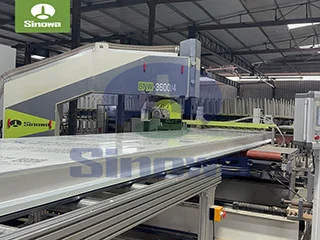
Concurrent with the processing of the outer facings, the rockwool core undergoes preparation to ensure optimal integration with the metal sheets. The rockwool is cut to the required size using high-precision cutting equipment, which may include three-axis vertical cutting systems for thickness adjustment ranging from 30 mm to 200 mm, and servo-driven reciprocating cutters for length and width customization. This precision cutting minimizes material waste and ensures that the core fits perfectly within the formed metal facings, eliminating gaps that could reduce thermal insulation performance or structural stability. In some configurations, the rockwool core is treated with adhesive sprays on both upper and lower surfaces to facilitate bonding with the metal sheets. The adhesive application process is fully automated, with spray nozzles controlled by computer systems to deliver a uniform layer of adhesive, ensuring strong and consistent bonding across the entire panel surface.
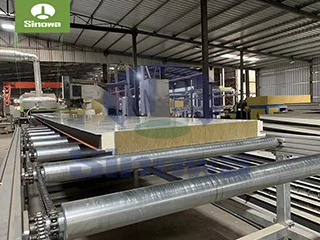
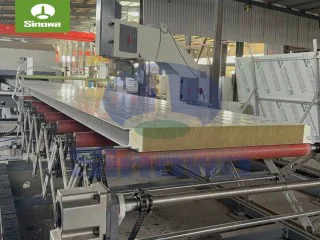
The composite assembly stage is where the prepared outer facings and rockwool core are combined to form the sandwich panel. This stage relies on a combination of mechanical pressure and thermal curing to ensure proper adhesion and dimensional stability. The assembled components pass through a double belt system, where upper and lower belts apply consistent pressure to bond the layers together. These belts are typically constructed from alloy steel plates for durability and heat resistance, with hot air circulation systems used to maintain precise temperatures between 45 and 70 ºC—adjustable with a tolerance of ±3 ºC. The temperature control is critical for curing the adhesive and ensuring that the panel maintains its shape and structural integrity over time. Unlike conventional systems that use heat transfer oil and U-shaped pipes, which can cause uneven heating and surface marks, the hot air circulation design ensures uniform heating and a smooth panel surface.
Advanced control systems are the backbone of high precision production lines, enabling seamless integration of all processing stages and real-time monitoring of key parameters. These systems utilize computer integrated control technology, combining numerical control servo, frequency conversion vector, and hydraulic control to achieve centralized management and decentralized control. This architecture minimizes the impact of single-point failures on the entire line, enhancing operational reliability and safety. Operators interact with the system through an intuitive human-machine interface, where they can input production parameters such as panel dimensions, speed, and temperature. Once configured, the line operates autonomously, with automated adjustments made to maintain precision and efficiency. Remote interactive communication capabilities further enhance usability, allowing for off-site monitoring and troubleshooting, which reduces downtime and improves overall productivity.
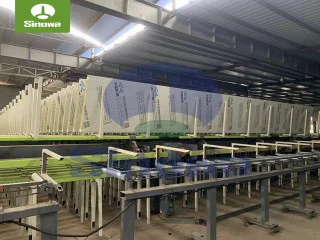
Efficiency is a defining feature of high precision rockwool sandwich panel production lines, with continuous operation designed to maximize output while minimizing resource consumption. Production speeds typically range from 3 to 8 meters per minute, adjustable based on panel thickness and material characteristics, with annual production capacities reaching up to 850,000 square meters when operating 250 to 300 working days per year. The high degree of automation reduces labor requirements significantly, with most lines requiring only 5 to 13 operators to manage the entire process—from raw material feeding to final packaging. This not only lowers labor costs but also reduces the risk of human error, ensuring consistent product quality. Energy efficiency is another key advantage, with modern lines consuming up to 40% less energy than conventional equipment. Features such as optimized heating systems, variable frequency drives, and waste reduction technologies contribute to this efficiency, aligning with sustainability goals and reducing operational costs.
Quality control is embedded throughout the production process, with real-time monitoring and inspection ensuring that each panel meets the required standards. Dimensional accuracy is maintained through precision cutting and forming systems, with automated measurements taken at multiple stages to detect and correct any deviations. The bonding strength between the rockwool core and metal facings is tested regularly, ensuring that the panels can withstand mechanical stress, temperature fluctuations, and moisture exposure. Additionally, the non-combustible nature of the rockwool core is verified to ensure compliance with fire safety requirements, with panels capable of providing fire resistance for up to 240 minutes depending on thickness and structure. The absence of toxic fumes during combustion further enhances safety, making these panels suitable for use in commercial, industrial, and public buildings.
The versatility of high precision production lines allows for the manufacture of a wide range of rockwool sandwich panels tailored to specific applications. These panels are widely used in exterior walls, roofs, and partitions of commercial and industrial buildings, as well as in fire isolation belts and structural insulation integration systems. Specialized panels can be produced for high-temperature environments such as industrial furnaces, drying tunnels, and heat treatment systems, leveraging the rockwool core’s ability to withstand temperatures exceeding 650 ºC. In cleanroom applications, panels with small forming fillets and smooth surfaces are manufactured to prevent dust accumulation, making them ideal for pharmaceutical, food processing, and electronic manufacturing facilities. The ability to produce custom dimensions and profiles ensures that the panels can be adapted to unique architectural designs and project requirements, expanding their applicability across various sectors.
Sustainability is a key consideration in the design and operation of modern high precision production lines. The use of rockwool, a natural and recyclable material, reduces the environmental impact of the panels, while energy-efficient technologies minimize carbon emissions during manufacturing. Waste reduction measures, such as precision cutting and material optimization, further enhance sustainability by reducing the amount of raw material discarded. Additionally, the long service life of rockwool sandwich panels—due to their durability, corrosion resistance, and dimensional stability—reduces the need for frequent replacement, lowering the lifecycle environmental impact. These sustainability features align with global green building initiatives, making rockwool sandwich panels a preferred choice for environmentally conscious projects.
Maintenance and reliability are critical factors in ensuring the long-term performance of high precision production lines. The modular design of these lines facilitates easy installation, maintenance, and component replacement, with core components designed for interchangeability and quick repair. Routine maintenance tasks, such as belt inspection, lubrication, and control system calibration, can be performed with minimal downtime, thanks to the line’s decentralized control architecture and accessible components. Low operating noise and dust-free operation further enhance the working environment for operators, reducing the risk of workplace hazards and improving overall operational safety. These design features contribute to the line’s overall reliability, ensuring consistent production and minimizing unexpected downtime.
In conclusion, high precision rockwool sandwich panel production lines represent a significant advancement in composite material manufacturing, combining advanced automation, precision engineering, and sustainability to meet the evolving needs of the construction and industrial sectors. These lines deliver consistent, high-quality panels with exceptional fire safety, thermal insulation, and acoustic performance, while optimizing efficiency and reducing environmental impact. The integration of digital control systems, efficient heating technologies, and modular design ensures that the lines are versatile, reliable, and easy to operate, making them a valuable asset for manufacturers seeking to enhance productivity and product quality. As demand for sustainable, high-performance building materials continues to grow, high precision rockwool sandwich panel production lines will play an increasingly important role in shaping the future of construction and industrial manufacturing, enabling the creation of safer, more efficient, and environmentally friendly buildings and facilities.
https://www.cnsinowa.com/sandwich-panel-machines/high-precision-rockwool-sandwich-panel-production-line.html