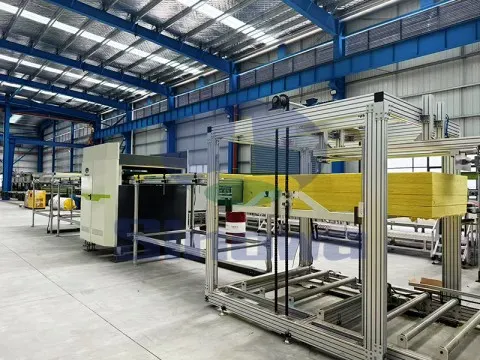
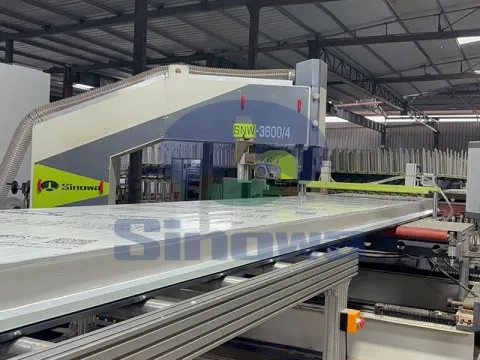
sandwich panel line
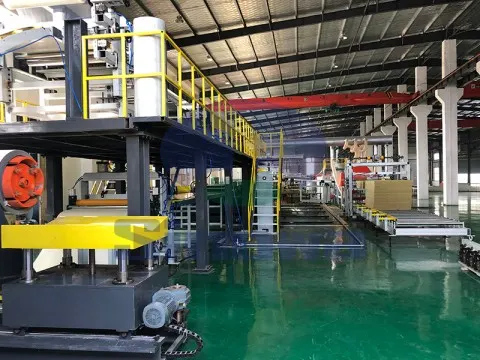
The overall structural composition of the continuous rock wool sandwich panel production line follows a sequential production logic, with each functional module closely connected to form an inseparable production chain. Every component in the system is optimized for mechanical coordination and transmission matching to ensure the smooth transfer of raw materials between different processing stages without manual intervention. The front-end part of the production line is dominated by raw material feeding devices, which are responsible for the orderly input of metal surface materials and rock wool core materials. The metal sheet feeding unit is equipped with multi-group unwinding structures, which can store coiled metal raw materials and achieve steady and uniform discharging through frequency conversion speed regulation. This speed regulation mode effectively avoids material stretching and deformation caused by uneven discharging tension, laying a foundation for the flatness consistency of the finished panel surface. Meanwhile, the feeding mechanism is fitted with an anti-winding correction structure to automatically adjust the material deviation during the transmission process, ensuring that the metal sheet always maintains a linear conveying track and reducing the dimensional deviation of subsequent forming processes.
Following the metal sheet feeding unit is the surface shaping and pressing mechanism, which undertakes the preliminary molding processing of flat metal sheets. Inside this mechanism, multiple sets of precision pressing rollers are arranged in an orderly gradient manner. The roller gap and pressing angle can be adjusted according to the preset panel specifications, enabling the metal sheet to complete surface rib pressing, edge folding and groove opening molding through gradual extrusion. The mechanical design of gradient pressing avoids the structural damage and internal stress concentration of metal materials caused by one-time heavy pressure processing. In addition, the pressing mechanism is equipped with a flexible trimming structure to polish the raw edges of the metal sheet, removing burrs and irregular gaps generated during raw material slitting. This processing step optimizes the surface smoothness and edge regularity of the metal sheet, which not only improves the aesthetic appearance of the finished product but also enhances the tightness of the subsequent bonding between the metal sheet and the rock wool core material.
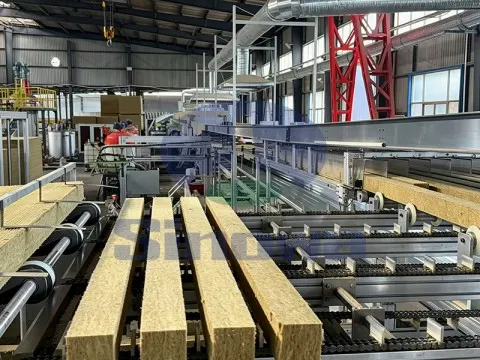
The rock wool core material feeding and laying system is a key functional module that distinguishes the continuous rockwool sandwich panel production line from other composite panel production equipment. Different from the manual feeding and intermittent laying mode of traditional production lines, this automated system adopts a pendulum cotton laying technology to realize uniform and three-dimensional stacking of rock wool fibers. The rock wool raw materials are transported to the settling chamber through the conveying equipment, and the pendulum mechanism continuously swings horizontally to spread the fibrous rock wool raw materials evenly on the bearing base. This laying method changes the single-plane fiber distribution state of the traditional sedimentation process, forming a three-dimensional cross distribution structure of rock wool fibers. The optimized fiber distribution significantly improves the compression resistance, tensile strength and internal structural uniformity of the rock wool core layer. During the laying process, the system can automatically adjust the cotton laying density and stacking thickness according to the production parameters, precisely controlling the thermal insulation performance and mechanical strength of the finished sandwich panel to meet the usage requirements of different application scenarios.
The gluing and bonding module located in the middle section of the sandwich panel production line determines the interlayer bonding stability and overall structural firmness of the sandwich panel. This module adopts an automatic quantitative gluing technology, with high-precision glue injection devices evenly distributed on both the upper and lower sides of the rock wool core material. The glue spraying volume and spraying range can be intelligently adjusted according to the panel thickness and production speed, ensuring that the adhesive is evenly covered on the bonding interface without excessive glue accumulation or local glue shortage. Before gluing, the surface of the metal sheet and rock wool core material will undergo dust removal and electrostatic treatment to eliminate tiny impurities and static attachments on the contact surface. This pretreatment effectively enhances the adsorption force between the adhesive and the base material, improving the bonding durability of the interlayer structure. The selected adhesive materials have excellent temperature resistance and aging resistance, which can maintain stable bonding performance in complex temperature and humidity environments and prevent interlayer peeling and cracking of the sandwich panel during long-term service.
After the gluing process, the semi-finished composite materials enter the constant temperature heating and composite pressing area. This area is equipped with a fully enclosed heating furnace and a multi-layer pressing roller group, which jointly complete the curing and composite shaping of the sandwich panel. The internal temperature of the heating furnace presents a gradient distribution state, realizing low-temperature preheating, medium-temperature curing and high-temperature shaping of the composite materials in sequence. The gradient heating mode avoids the quality defects such as bubble generation and adhesive deterioration caused by instantaneous high-temperature baking. The internal circulating air system of the furnace body ensures uniform temperature distribution in the heating space, so that every part of the panel can obtain consistent curing conditions. The pressing roller group applies continuous and uniform mechanical pressure to the composite materials during the heating process. The pressure value is precisely controlled within a reasonable range to ensure the tight fitting between the metal sheet and the rock wool core material without crushing the internal fiber structure of rock wool. The cooperation of constant temperature heating and constant pressure pressing makes the adhesive solidify rapidly and stably, forming an integrated composite structure with high interlayer bonding strength.
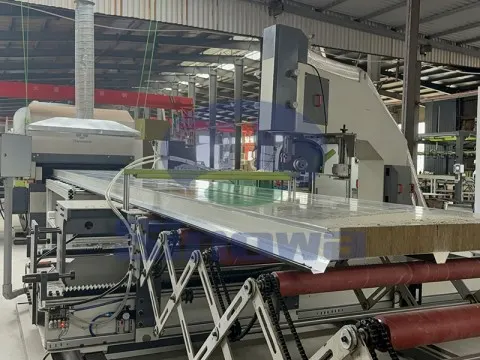
The post-processing section of the sandwich panel line includes fixed-length cutting, edge finishing, flaw detection and automatic stacking equipment, which completes the final shaping and sorting of finished products. The fixed-length cutting device adopts high-speed servo cutting technology, with the cutting accuracy controlled within a tiny error range. The system can set arbitrary cutting length parameters according to production requirements, and automatically complete positioning and cutting in the continuous conveying state, without stopping the production line to ensure uninterrupted production rhythm. The cutting tool is made of wear-resistant alloy materials, which can maintain smooth cutting edges for a long time and avoid metal burrs and rock wool fiber scattering at the cutting section. After cutting, the edge finishing mechanism carries out secondary trimming and chamfering on the panel edges to eliminate sharp corners and irregular cuts, further optimizing the appearance quality and assembly convenience of the finished panel.
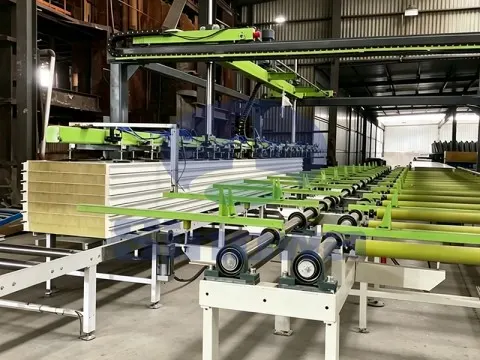
The built-in flaw detection system of the continuous sandwich panel production line conducts real-time online inspection on the processed panels. Through optical sensing and pressure sensing components, the system automatically identifies surface scratches, interlayer empty gaps, uneven glue coating and dimensional deviation defects. Once unqualified products are detected, the system will mark them automatically and transmit the screening signal to the sorting device. The unqualified products will be isolated from the qualified product conveying line to prevent defective products from entering the finished product stacking link. The automatic stacking device adopts a double-station alternating operation structure. While one station completes stacking and shaping, the other station receives incoming materials, realizing non-intermittent stacking operation. The internal alignment device of the stacking equipment can correct the placement position of the panels in real time, ensuring that the stacked panels are neatly arranged with consistent gaps, which is convenient for subsequent packaging, transportation and storage.
In terms of power and control system configuration, the continuous rock wool sandwich panel line adopts a programmable logic control mode matched with a touch-sensitive human-computer interaction interface. All production parameters including conveying speed, heating temperature, pressing pressure, cotton laying density and cutting size can be set and adjusted on the touch screen. The control system has an intelligent memory function, which can store the parameter formulas of different specifications of panels, realizing rapid switching between production modes and shortening the parameter debugging time during product replacement. The whole production line is driven by variable frequency motors, which can dynamically adjust the operating power according to the production load. This energy-saving driving mode effectively reduces the idle energy consumption of the equipment and lowers the overall operating cost of the production line. In addition, the system is equipped with a complete safety protection logic. When abnormal conditions such as material blockage, equipment overheating and circuit failure occur, the control system will trigger an automatic alarm and stop operation to avoid equipment damage and production safety accidents.
The continuous production mode adopted by the equipment brings significant technical advantages compared with the traditional discontinuous rock wool sandwich panel machine. In terms of production efficiency, the optimized mechanical transmission structure and synchronous cooperation of various functional modules enable the production line to maintain a stable operating speed within a reasonable interval. The one-time composite molding process eliminates multiple intermediate handling and transferring links of semi-finished products, greatly reducing the time consumption of a single panel production cycle. In terms of product quality stability, the automated and intelligent processing mode reduces the interference of human factors in the production process. All processing links are implemented according to fixed parameter standards, realizing consistent control of panel density, thickness, bonding strength and surface flatness. The product quality fluctuation range is extremely small, which is far better than the manual-assisted intermittent production mode.
In terms of material utilization rate, the precise feeding and metering system of the continuous sandwich panel line accurately controls the consumption of metal sheets, rock wool raw materials and adhesives. The intelligent cutting and trimming mechanism minimizes the generation of leftover materials. The excess rock wool fibers and metal scraps generated during the production process can be recycled and reused through the supporting recovery device, effectively reducing the waste of raw materials. From the perspective of production environment optimization, the production line is equipped with a closed dust removal and noise reduction structure. The fiber dust generated during rock wool processing is collected by the centralized dust removal system to avoid air pollution in the production workshop. The silent transmission structure and shock absorption base of the mechanical components reduce the operating noise of the equipment, improving the working environment of the production workshop and meeting the environmental protection requirements of modern industrial production.
The rock wool sandwich panels produced by this continuous production line have excellent comprehensive performance, adapting to diverse complex application scenarios. Relying on the inherent fibrous porous structure of rock wool materials, the finished panels have outstanding thermal insulation and heat preservation performance, which can effectively block the heat transfer between spaces and reduce the energy consumption of building temperature regulation. At the same time, rock wool belongs to inorganic non-combustible materials, and the integrated composite structure formed by continuous pressing and curing further enhances the fire resistance limit of the panels, which can delay the spread of flames in case of fire accidents and improve the safety of building structures. In terms of sound insulation performance, the internal staggered fiber structure of rock wool can absorb and isolate sound waves, reducing noise transmission and creating a quiet indoor environment.
In terms of mechanical performance, the three-dimensional fiber distribution structure optimized by the pendulum cotton laying process improves the compression resistance and bending resistance of the core material. The metal outer sheet provides stable surface protection and tensile strength, enabling the sandwich panel to withstand external mechanical impact and structural pressure during installation and use. In addition, through the strict control of the gluing and curing process in the continuous production line, the interlayer bonding force of the panel is significantly enhanced. The finished product can maintain stable structural performance under extreme weather conditions such as high temperature, low temperature and humidity alternation, without interlayer separation and deformation. The smooth metal surface also has good waterproof, anti-corrosion and anti-aging capabilities, adapting to long-term outdoor exposure usage environments.
This type of continuous sandwich panel production line has strong production flexibility and can complete the production of panels with different specifications through simple parameter adjustment and component debugging. By changing the rolling gap of the pressing roller group, the production line can manufacture metal panels with different surface groove shapes and rib structures. Adjusting the cotton laying thickness and pressing pressure can produce rock wool sandwich panels with different core layer densities and overall thicknesses to meet the thermal insulation strength requirements of different building envelopes. The flexible production capability enables a single production line to cover multiple product types, reducing the equipment procurement cost for manufacturing enterprises and improving the comprehensive utilization rate of production equipment. The simplified mold replacement and parameter debugging process also shorten the product switching cycle, enabling enterprises to quickly respond to the differentiated customization needs of the market.
In the daily operation and maintenance of the continuous rock wool sandwich panel production line, standardized management procedures are required to ensure the long-term stable operation of the equipment. The daily maintenance work focuses on the inspection of transmission components, including regularly checking the tightness of the conveyor belt, the lubrication state of the pressing roller bearing and the wear degree of the cutting tool. Timely cleaning of the residual rock wool fibers and adhesive dirt on the equipment surface can prevent the accumulation of impurities from affecting the transmission accuracy and processing effect. The heating furnace and glue supply system need regular sealing inspection to avoid heat loss and glue liquid leakage. The electrical control part should keep the circuit dry and clean, and regularly detect the sensitivity of sensors and the stability of the control program to ensure the normal execution of intelligent control commands.
In terms of medium and long-term maintenance, the vulnerable parts such as rolling molds and cutting blades need to be inspected regularly for wear and replaced in time when the wear degree exceeds the standard, so as to avoid affecting the processing accuracy of the panels. The internal circulating air pipeline of the heating furnace should be cleaned periodically to prevent dust accumulation from blocking the air duct and affecting the uniform distribution of temperature. The hydraulic and pneumatic components of the pressing and cutting mechanism need to replace the internal lubricating oil and hydraulic fluid regularly to maintain stable power output. Scientific maintenance measures can effectively extend the service life of the production line, reduce the failure rate of equipment operation, and avoid production interruption and economic losses caused by equipment faults.
From the perspective of industrial development trend, with the continuous improvement of global building energy conservation and environmental protection standards, the market demand for high-performance rock wool sandwich panels continues to grow, which also puts forward higher technical requirements for continuous production lines. The future development direction of this type of production equipment focuses on intelligent upgrading, energy conservation optimization and green production. On the basis of the existing automatic control system, the equipment will be embedded with remote monitoring and data analysis functions. The production background can collect and sort out the operating data of the production line in real time, analyze the equipment operation state and product quality changes, and realize predictive maintenance of equipment and intelligent optimization of production parameters.
In terms of energy-saving optimization, the continuous rock wool sandwich panel line will adopt more efficient heating circulation technology and regenerative heat utilization structure to reduce heat loss in the curing process. The optimized motor driving logic and transmission structure can further reduce the power consumption of unit products. In terms of green production, the dust removal and waste recovery system will be further upgraded to realize the full recycling of production waste, reduce the discharge of production pollutants, and meet the increasingly stringent industrial environmental protection standards. At the same time, the production line will strengthen the adaptive design of diversified raw materials, which can be compatible with rock wool raw materials of different purity and density, reducing the raw material procurement threshold for enterprises.
In the application market layout, the continuous rock wool sandwich panel manufacturing line provides reliable equipment support for the popularization and application of energy-saving composite building materials. The panels produced by the equipment are widely used in the construction of industrial plants, cold storage warehouses, public exhibition halls, temporary engineering buildings and special fireproof insulation projects. With the acceleration of urban industrial construction and the continuous improvement of building safety standards, the market demand for fireproof, thermal insulation and durable rock wool sandwich panels will continue to expand, which will drive the continuous technological iteration and performance upgrading of supporting continuous production lines.
In conclusion, the continuous rock wool sandwich panel production line integrates advanced mechanical manufacturing, intelligent control and material processing technologies. Through the integrated design of multiple functional modules, it realizes efficient, stable and green batch production of rock wool sandwich panels. The equipment has prominent advantages in production efficiency, product quality, material utilization rate and production flexibility, and can meet the diversified production needs of modern building material processing enterprises. With the continuous progress of industrial manufacturing technology and the upgrading of market demand, this type of production line will continue to optimize its structural performance and intelligent level, providing more reliable technical support for the high-quality development of the building thermal insulation composite material industry, and making important contributions to the realization of energy-saving and environmentally friendly development goals in the construction field.
Sinowa is a professional manufacturer of sandwich panel machine in china, we provide diversified and high-performance sandwich panel production lines, including fully automatic continuous PU sandwich panel line and customized special lines to meet mass production and personalized order demands. These sandwich panel lines support processing multiple foam core materials, such as PU, PIR, mineral wool, rock wool and glass wool, covering different insulation and fireproof standards.
Featuring stable operation, high efficiency, energy saving and easy maintenance, our PU sandwich panel line deliver sandwich panels with excellent thermal insulation, fire resistance, sound insulation and lightweight durability. The finished panels are widely applied in industrial workshops, warehouse roofing and wall cladding, cold storage insulation, serving global construction and industrial insulation markets.
https://www.cnsinowa.com/sandwich-panel-machines/continuous-rock-wool-sandwich-panel-production-line.html