 sandwich panel line
The fundamental structural composition of an automatic continuous sandwich panel production line follows a sequential production logic, with each functional module closely interconnected to form an uninterrupted production chain. The entire system can be divided into multiple core functional units based on production procedures, including raw material pretreatment unit, surface layer feeding unit, core material metering and conveying unit, continuous composite forming unit, heating curing unit, precise cutting unit, post-processing shaping unit, and automatic stacking unit. Every functional unit is equipped with independent transmission and regulation components, and all units maintain synchronous operating rhythms under the unified scheduling of the central control system. This integrated structural design eliminates production gaps between different processing links, realizing genuine continuous production. In terms of mechanical configuration, the main frame of the production line adopts high-rigidity steel structures to resist mechanical vibration generated during long-term high-speed operation, ensuring the overall stability of the equipment. The transmission components use wear-resistant and high-temperature-resistant alloy materials, which can adapt to long-duration continuous operation and reduce the frequency of component replacement caused by mechanical wear. The internal space layout of the production line strictly follows the material flow direction, optimizing the transmission path of raw materials and semi-finished products to minimize material transfer resistance and improve overall production fluency.
Raw material pretreatment constitutes the initial and foundational link in the entire production workflow, directly determining the bonding quality and surface flatness of finished sandwich panels. This processing stage covers the pretreatment of both surface layer materials and core layer raw materials. For common metal surface materials, the pretreatment process includes surface dedusting, oil removal, and surface texture optimization. Specialized dust removal equipment is installed at the front end of the feeding mechanism to remove fine dust and particulate impurities attached to the surface of the coiled raw materials, preventing foreign particles from affecting the bonding tightness between the surface layer and the core material. The oil removal process eliminates residual lubricants formed during metal rolling, improving the surface roughness of the surface material and enhancing the adhesion of composite interfaces. For non-metal surface materials such as color-coated plates and fiber-reinforced plates, the pretreatment process also includes surface smoothing and edge trimming to eliminate burrs and irregular textures on the material edges. In terms of core material pretreatment, different treatment methods are adopted according to the characteristics of raw materials. For foamed core materials, raw material components are accurately metered and fully stirred to ensure uniform mixing of foaming agents, base materials, and auxiliary additives. For inorganic fibrous core materials, loosening and impurity removal treatments are carried out to optimize the internal fiber structure and avoid agglomeration defects. All pretreatment parameters are automatically regulated by sensing devices, which monitor material surface conditions and mixing uniformity in real time to dynamically adjust processing parameters and maintain consistent raw material quality.
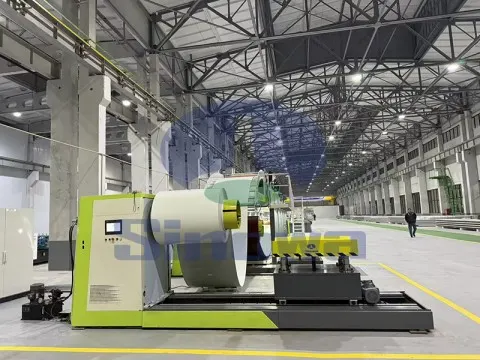
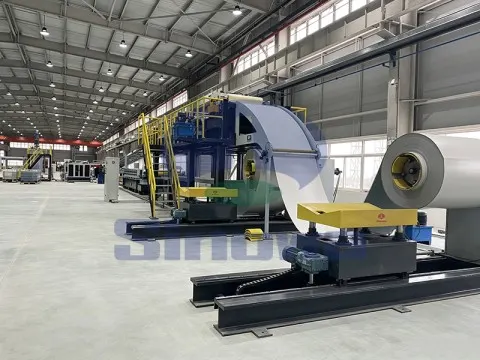
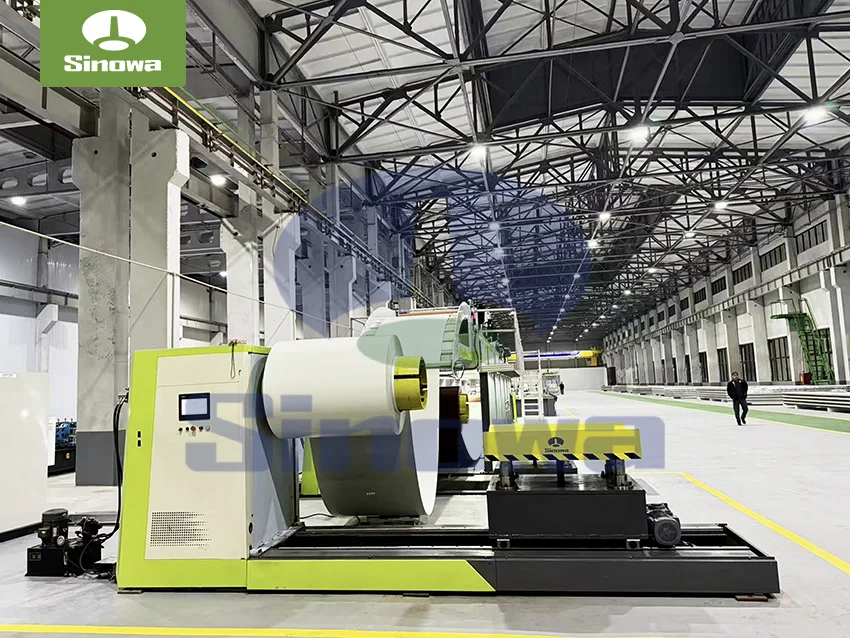
The surface layer feeding system undertakes the task of stable and continuous supply of panel surface materials, possessing precise tension control and material deviation correction functions. Most feeding modules are designed with multi-station unwinding structures, which can simultaneously place multiple rolls of surface raw materials to realize automatic roll switching and avoid production interruptions caused by raw material replacement. The tension control system adopts closed-loop intelligent regulation. High-sensitivity tension sensors are installed at the material transmission path to monitor the stretching force of surface materials in real time. When tension fluctuations occur due to material roll diameter changes or transmission speed adjustments, the system automatically adjusts the operating speed of the unwinding motor to keep the material tension within a stable range. This function effectively prevents surface material deformation, wrinkling, and stretching damage during high-speed transmission. Equipped with an automatic deviation correction mechanism, the feeding system can identify minor lateral offset of materials through optical sensing components. The correction execution components rapidly adjust the placement angle of the material roll to ensure that the surface materials are always transmitted along the predetermined track. In addition, the feeding system is integrated with a material preheating module, which appropriately increases the temperature of surface materials within a safe range. This preheating treatment can enhance the surface activity of materials, further improving the bonding firmness between the surface layer and the core material in the subsequent composite process.
Core material metering and conveying is a key link to ensure the consistent internal structure of sandwich panels, requiring extremely high precision in raw material ratio and conveying volume. For chemical foaming core materials, the metering system uses high-precision flow monitoring components to quantitatively transport liquid and powdery raw materials to the mixing chamber. The internal stirring structure of the mixing chamber adopts multi-layer spiral stirring blades, which can realize rapid and uniform mixing of multi-component raw materials. The stirring speed and mixing time are dynamically adjusted according to the preset material formula to ensure that the foaming raw materials achieve the optimal reaction state. After mixing, the raw materials are evenly sprayed on the surface of the bottom surface material through a pressure-type spraying pipeline. The spraying width and thickness are accurately controlled by adjustable nozzle components to match the production specifications of target panels. For rigid bulk core materials and fibrous core materials, the conveying system adopts sealed quantitative feeding equipment. The internal spiral conveying structure stably transports core materials to the composite station, and the material distribution mechanism evenly spreads the core materials on the surface layer to avoid local hollowing or uneven thickness. All metering data is recorded in real time by the central control system, forming traceable production data to provide parameter support for subsequent quality inspection and formula optimization.
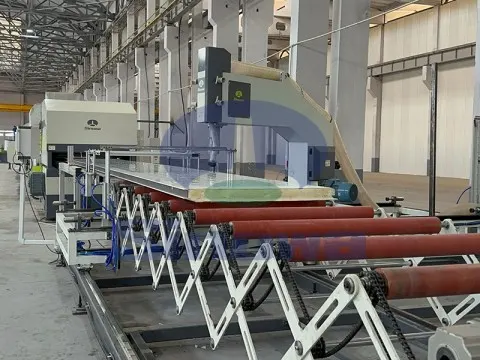
Continuous composite forming serves as the core processing stage of the entire production line, completing the tight lamination of the upper surface layer, core material, and lower surface layer. The composite forming area is equipped with multi-group pressure roller sets arranged in an orderly manner. These pressure rollers are made of high-precision polished alloy materials with smooth surfaces to prevent scratching the surface of composite panels. The pressure of each group of pressure rollers can be independently adjusted according to the hardness and thickness of different raw materials. During the composite process, the upper and lower surface materials gradually fit with the intermediate core material under the action of steady mechanical pressure. The layered materials eliminate internal air gaps through gradual pressurization, realizing seamless bonding between layers. For thermosetting composite processes, the composite area is equipped with closed thermal insulation structures to maintain a constant forming temperature environment. Moderate temperature assistance can accelerate the preliminary curing reaction of adhesive components and foaming materials, enhancing the initial bonding strength of composite layers. The transmission speed of the composite forming area is synchronized with the upstream feeding speed, ensuring that the material combination process maintains a stable linear velocity. This synchronous operation mode avoids structural defects such as material layer dislocation and core material accumulation caused by speed differences, ensuring the dimensional accuracy and structural uniformity of semi-finished panels.
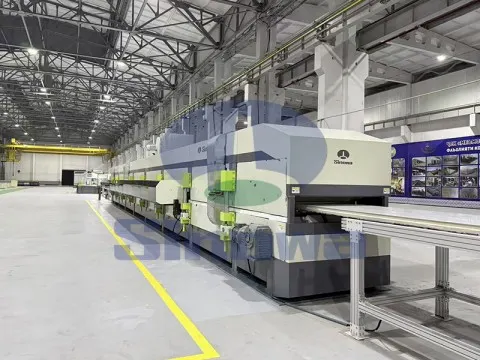
Heating and curing processing is an essential procedure to stabilize the internal structure of sandwich panels and enhance overall mechanical properties. The curing section adopts an extended closed heating tunnel structure, and the internal space is divided into multiple independent temperature control areas. Each temperature control area is equipped with heating components and temperature sensing detectors, which can independently set and maintain heating temperatures. The segmented temperature control design conforms to the gradual curing reaction law of composite materials. In the early stage of curing, a medium-temperature environment is adopted to promote the slow reaction of internal materials and avoid internal stress concentration caused by rapid temperature rise. In the middle stage, the temperature is appropriately increased to accelerate the curing and molding of the core material, improving the interlayer bonding strength. In the later stage, constant temperature maintenance is carried out to stabilize the internal molecular structure of the panel and eliminate residual stress generated during processing. The internal circulating air system of the heating tunnel realizes uniform heat distribution, avoiding local overheating or insufficient heating of panels. Meanwhile, the ventilation system reasonably discharges trace gas generated during material curing to maintain a safe and stable production environment. After continuous heating and curing, the physical properties of the sandwich panel tend to be stable, with significantly improved compression resistance, bending resistance, and interlayer peeling resistance.
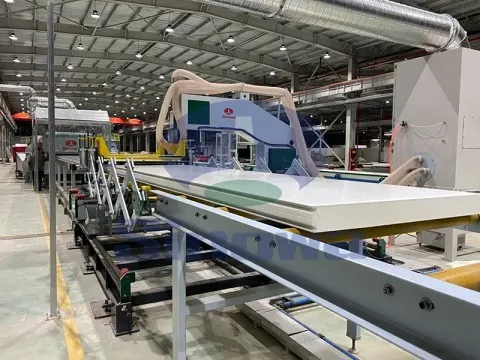
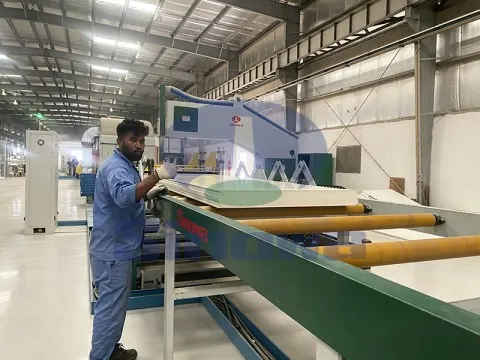
Precision cutting and shaping processes realize the fixed-size processing of continuous semi-finished panels to meet diverse application specification requirements. The cutting unit is installed at the rear end of the curing tunnel, adopting a non-stop dynamic cutting mode. This working mode eliminates the need to halt the production line during cutting, ensuring the continuity of the overall production process. Equipped with high-speed alloy cutting blades, the cutting mechanism can complete flat cutting of panel sections in an instant. The blade operation speed is intelligently matched with the panel transmission speed to ensure smooth and burr-free cutting sections. The cutting length and width are preset through the central control system, and the system automatically adjusts the cutting interval and cutting position according to production orders. Before cutting, the positioning sensing component accurately identifies the edge position of the panel to correct minor transmission deviations and guarantee the dimensional tolerance of finished products. After cutting, the edge shaping mechanism carries out fine processing on the panel edges, trimming redundant leftover materials and smoothing sharp edges. For panels requiring special grooving and edge folding processes, the reserved shaping station can complete one-time forming of edge structures, simplifying subsequent construction and installation procedures.
The post-processing and automatic stacking system realizes the final finishing and orderly collection of finished panels. After cutting and shaping, qualified panels are transported to the surface treatment station. For panels with surface protection requirements, the automatic film covering mechanism evenly pastes protective films on the surface to prevent surface scratches and corrosion during transportation and storage. The surface cleaning device removes residual dust and processing debris on the panel surface to improve the appearance quality of finished products. The stacked part adopts a mechanical arm stacking structure with adjustable stacking height and arrangement mode. The mechanical arm accurately grabs single panels through stable clamping components and places them in an orderly manner on the material storage platform. The stacking system is equipped with a position correction function to ensure neat stacking of panels without inclination and displacement. When the stacking quantity reaches the preset standard, the system automatically sends out a material replacement reminder to facilitate staff to complete material transfer. In addition, the post-processing module integrates a simple quality detection function. Through optical scanning and pressure sensing components, it preliminarily screens panels with surface defects, unqualified thickness, and insufficient bonding strength to reduce the outflow rate of defective products.
The intelligent automatic control system acts as the brain of the automatic sandwich panel production line, realizing centralized scheduling and precise regulation of all functional units. The system adopts a modular programming structure, with an intuitive human-computer interaction interface. Production personnel can complete parameter setting, equipment debugging, and operation monitoring through simple touch operations. The internal logic program establishes a synchronous linkage mechanism for all mechanical units. When a certain link has parameter fluctuations such as material supply interruption and temperature deviation, the system automatically adjusts the operating parameters of upstream and downstream equipment to maintain the overall production balance. A large number of high-precision sensors are distributed at key positions of the production line, including temperature sensors, pressure sensors, speed sensors, and thickness detection sensors. These sensors collect real-time operating data of the equipment and transmit it to the data processing terminal. The terminal analyzes and compares the collected data with preset standard parameters. Once abnormal data is found, the system triggers an automatic alarm mechanism and marks the abnormal position to facilitate maintenance personnel to quickly troubleshoot. The control system also has an automatic data storage function, which records daily production output, parameter changes, and equipment operation status, providing data support for production management and equipment maintenance.
In terms of material adaptability, the continuous sandwich panel line has strong compatibility and can be compatible with multiple types of surface layer and core layer materials. In terms of surface layer materials, it can adapt to metal materials such as color steel plates, galvanized steel plates, and aluminum alloy plates, as well as non-metal materials such as fiber cement plates, plastic composite plates, and decorative insulated plates. Different surface materials only need to adjust feeding tension, preheating temperature, and composite pressure parameters to complete adaptive production. In terms of core layer materials, the production line is compatible with organic foaming materials such as polyurethane and polystyrene, as well as inorganic thermal insulation materials such as rock wool, glass wool, and lightweight concrete. For core materials with different densities and hardness, the metering feeding speed and curing temperature curve can be optimized to ensure the forming quality of composite panels. This wide material compatibility enables a single production line to meet the diversified production needs of multiple types of sandwich panels, reducing the equipment procurement cost for production enterprises and improving the comprehensive utilization rate of production equipment.
Compared with traditional intermittent production equipment, the automatic sandwich panel line has prominent technical and production advantages in multiple dimensions. In terms of production efficiency, the continuous operation mode eliminates frequent equipment start-stop processes and intermediate material transfer links, greatly shortening the single-panel production cycle. The synchronous cooperation of all modules realizes uninterrupted output of finished products, and the unit-time production capacity is several times that of traditional equipment. In terms of product quality, the intelligent parameter regulation system ensures the consistency of raw material ratio, composite pressure, and curing temperature. The mechanical precise processing mode effectively reduces manual operation errors, making the thickness, flatness, and bonding strength of each batch of panels maintain a high uniformity. In terms of production cost, the highly automated operation reduces the number of on-site operators. A single production line can complete full-process production with only a small number of management personnel, lowering labor input costs. The precise metering system reduces raw material waste, and the optimized mechanical structure reduces energy consumption during equipment operation, realizing energy-saving and cost-reducing production. In terms of operation stability, the high-rigidity mechanical structure and intelligent fault detection system reduce equipment failure probability, and the continuous stable operation time of the equipment is significantly prolonged, meeting the requirements of long-term industrial production.
Sandwich panels produced by automatic continuous production lines are widely used in multiple industrial and civil construction fields relying on excellent comprehensive performance. In the industrial building field, such panels are commonly used for the enclosure structures of factory buildings, warehouses, and logistics storage centers. Their lightweight characteristics reduce the load-bearing pressure of building structures, while excellent thermal insulation performance lowers the internal temperature regulation energy consumption of buildings. In the field of cold chain construction, low-temperature resistant sandwich panels serve as the wall and top plates of cold storage, maintaining stable internal low-temperature environments and reducing cold air loss. In the temporary building industry, prefabricated activity rooms assembled with sandwich panels have the advantages of convenient installation and short construction cycle, which are suitable for emergency construction and temporary office scenarios. In addition, such panels are also applied in special scenarios such as clean workshops, agricultural greenhouses, and transportation vehicle carriage manufacturing. With the continuous upgrading of building energy conservation and environmental protection standards, the application scope of high-quality continuous production sandwich panels is still expanding, bringing broader market development space for production equipment.
In terms of daily operation and maintenance, the automatic continuous sandwich panel production machine is designed with humanized maintenance logic to reduce the difficulty of equipment management. The key transmission and processing components adopt an open detachable structure, which is convenient for daily cleaning and component replacement. The lubrication system automatically quantitatively injects lubricating oil into rotating and friction parts to reduce mechanical wear and extend component service life. The heat dissipation structure is optimized for high-temperature operation parts such as the heating tunnel and motor components to avoid equipment aging caused by long-term high-temperature accumulation. The system has a self-diagnosis function for common faults, which can accurately locate abnormal parts such as motor failure, sensor deviation, and pipeline blockage, and display fault codes and troubleshooting suggestions on the control interface. Daily maintenance only needs to complete surface cleaning, parameter calibration, and component inspection in accordance with standardized procedures, without professional and complex maintenance technology. The simple maintenance mode reduces the technical threshold and maintenance cost for enterprise equipment management.
With the continuous progress of industrial manufacturing technology and the improvement of environmental protection production requirements, the automatic continuous sandwich panel machine is constantly evolving towards intelligence, energy conservation, and environmental protection. In terms of intelligent upgrading, the production line is gradually integrated with Internet of Things technology to realize remote monitoring and remote debugging of equipment. Production managers can view real-time operating data of the equipment through mobile terminals and complete parameter adjustment without arriving at the production site. In terms of energy-saving optimization, new heating structures and frequency conversion transmission components are adopted to reduce invalid energy consumption during equipment operation. The waste heat generated in the curing process is recycled and reused for raw material preheating, improving energy utilization efficiency. In terms of environmental protection improvement, the production line is equipped with sealed dust removal and waste gas treatment devices to effectively filter harmful substances generated in the production process and meet industrial environmental protection emission standards. In addition, the equipment is developing in the direction of modular combination, and enterprises can freely assemble functional modules according to production demands to realize flexible switching of multiple production processes.
In conclusion, the automatic continuous sandwich panel production line, as a highly integrated and intelligent modern manufacturing system, integrates raw material processing, composite forming, curing shaping, and finished product collection into one continuous production process. Its reasonable mechanical structure, precise intelligent control, and excellent production stability make it a core piece of equipment in the composite building material industry. By virtue of high production efficiency, stable product quality, and low comprehensive operating cost, the production line not only meets the large-scale production demand of sandwich panel manufacturers but also guarantees the application performance of finished products in diversified construction scenarios. With the continuous development of building industrialization and energy-saving environmental protection industries, the market demand for high-quality sandwich panels will continue to grow, which will further promote the technological iteration and performance upgrading of continuous production lines. In the future, such automated production equipment will play a more important role in the construction material manufacturing industry, providing reliable technical support for the high-quality development of the global construction engineering field.
Sinowa is a professional manufacturer of sandwich panel machine in china, we provide diversified and high-performance sandwich panel production lines, including fully automatic continuous PU sandwich panel line and customized special lines to meet mass production and personalized order demands. These sandwich panel lines support processing multiple foam core materials, such as PU, PIR, mineral wool, rock wool and glass wool, covering different insulation and fireproof standards.
Featuring stable operation, high efficiency, energy saving and easy maintenance, our PU sandwich panel line deliver sandwich panels with excellent thermal insulation, fire resistance, sound insulation and lightweight durability. The finished panels are widely applied in industrial workshops, warehouse roofing and wall cladding, cold storage insulation, serving global construction and industrial insulation markets.
https://www.cnsinowa.com/sandwich-panel-machines/automatic-continuous-sandwich-panel-production-line.html