PU Sandwich Panel Production Line Vibration Reduction And Noise Control Scheme
Sep 21, 2026
A targeted vibration reduction and noise control scheme for PU sandwich panel production lines. It analyzes core vibration and noise sources in production processes, designs multi-dimensional physical optimization and structural improvement measures, and adopts systematic control methods to lower equipment operation vibration and working noise effectively.
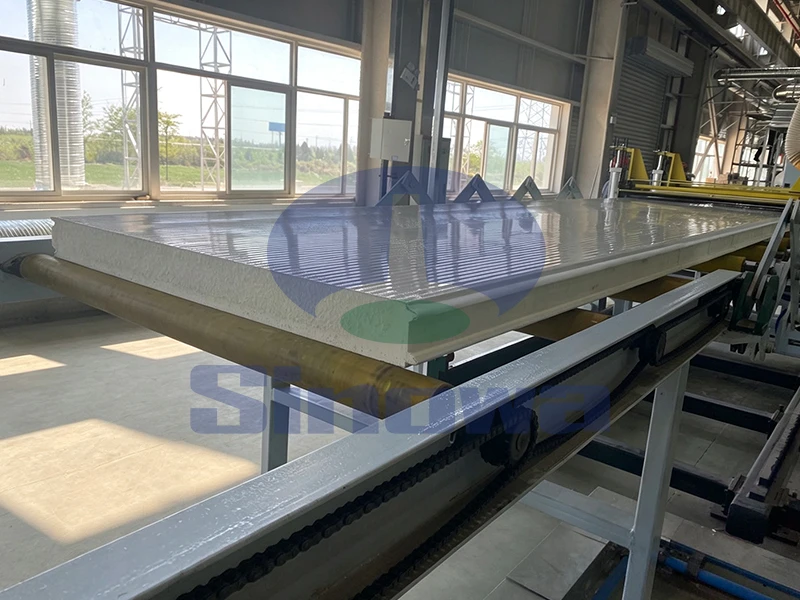
PU sandwich panel production lines involve continuous mechanical operation, material extrusion, high-speed cutting and composite molding processes, which generate persistent vibration and noise during daily operation. The main vibration sources concentrate on high-speed rotating equipment including feeding rollers, extrusion hosts and cutting devices. Long-term high-frequency vibration not only causes loose connection and structural wear of production equipment components, shortening the service life of mechanical parts, but also leads to unstable production precision, resulting in uneven panel thickness and inconsistent composite bonding effect of finished PU sandwich panels. Meanwhile, vibration will trigger resonance of workshop floors and auxiliary facilities, amplifying the vibration effect in the entire production area and forming cyclic structural vibration interference. In terms of noise generation, the collision noise between mechanical operating parts, the friction noise during PU material extrusion and molding, and the airflow noise generated by cooling and ventilation auxiliary systems constitute the main noise sources of the production line. These superimposed noises form a continuous high-decibel noise environment in the workshop, which affects the working comfort and physical health of on-site operators for a long time. In addition, unregulated vibration and noise will interfere with the normal operation precision of precision auxiliary testing equipment, reduce the overall stability of the production system, and indirectly affect the qualification rate and batch consistency of PU sandwich panel products. Therefore, targeted vibration source suppression and noise absorption and isolation treatment are essential for standardized and stable production of the production line.
Source vibration reduction treatment is the core link of the whole control scheme, focusing on optimizing the structural operation state of key vibrating equipment to eliminate vibration from the origin. For the rotating and operating equipment of the PU sandwich panel production line such as main extruders, traction rollers and cutting machines, professional dynamic balance calibration is carried out regularly to correct the unbalanced deviation of rotating parts caused by long-term operation and material abrasion, so as to reduce high-frequency vibration generated by eccentric rotation. For the connection parts of all mechanical components, high-strength damping gaskets and anti-loosening fasteners are added to replace the traditional hard connection mode. This structural improvement can effectively buffer the instantaneous vibration impact generated during equipment start-up, operation and shutdown, and avoid vibration transmission caused by component gap friction and loose joints. In view of the reciprocating vibration of the cutting mechanism in the cutting process, a customized flexible limit damping structure is installed at the operating stroke of the equipment. The structure can adapt to the reciprocating operation track of the cutting tool, absorb the residual vibration kinetic energy after cutting, and prevent the vibration from being transmitted to the equipment body and the workshop foundation. Moreover, the equipment installation foundation is optimized by laying multi-layer composite damping materials between the equipment base and the workshop ground, which isolates the direct vibration transmission path from the equipment to the building structure and avoids the formation of large-area resonance in the workshop. Through all-round source vibration reduction optimization, the basic vibration amplitude of key production equipment can be significantly reduced, laying a foundation for subsequent noise control.
On the basis of source vibration reduction, vibration transmission isolation optimization is implemented to block the secondary diffusion of residual vibration of the production line. The vibration generated by the operation of PU sandwich panel production equipment will be transmitted along the equipment support, ground and connecting pipelines, forming secondary vibration interference in different areas of the workshop. To solve this problem, the scheme adopts partitioned vibration isolation design for the whole production line. Independent vibration isolation bases are built for high-vibration equipment units such as extrusion molding units and fixed-length cutting units, which are separated from the workshop ground and other low-vibration equipment areas to avoid cross vibration interference between different production sections. For the material conveying pipelines and air supply and exhaust pipelines matched with the production line, flexible damping connecting pieces are used at the pipeline joints and fixed supports. This improvement can buffer the vibration generated by fluid flow and equipment linkage operation, prevent the vibration from being transmitted along the pipeline network, and reduce the vibration resonance of pipeline accessories. In addition, the overall structural rigidity of the production line support frame is optimized by reinforcing the weak support parts and adding auxiliary stabilizing structures, which reduces the self-vibration probability of the frame caused by long-term load operation. The hierarchical vibration isolation measures form a multi-barrier vibration suppression system from equipment interior, connection structure to workshop space, effectively weaken the residual vibration of the production line, and eliminate the adverse effects of structural vibration on production operation and workshop environment.
Aiming at the diversified noise sources of the PU sandwich panel production line, targeted noise absorption and noise reduction treatments are carried out for different production links. The mechanical friction and impact noise generated by the operation of transmission gears, bearings and roller sets belongs to medium and high-frequency discrete noise, which has strong penetrating power. For this kind of noise, high-efficiency sound-absorbing composite materials are pasted on the inner wall of the equipment shell and the protective cover of the transmission mechanism. These porous sound-absorbing materials can effectively capture and consume high-frequency noise energy, reduce noise reflection and diffusion inside the equipment. For the continuous airflow noise generated by the cooling system and exhaust system of the production line, silencing components with gradient sound absorption structure are installed at the air inlet and outlet of the ventilation equipment. The gradient structure can gradually consume airflow noise energy, avoid turbulent airflow noise caused by rapid air pressure change, and significantly reduce the radiation noise of the ventilation system. In view of the instantaneous impact noise generated by panel cutting and molding lamination, a closed local sound insulation cover is set up at the operating station of the cutting and laminating equipment. The sound insulation cover adopts a composite structure of sound insulation plate and sound-absorbing cotton, which can isolate the instantaneous high-decibel noise in a small range and prevent it from spreading to the whole workshop. Meanwhile, the gaps of equipment operation joints are sealed with flexible sound insulation strips to reduce noise leakage, realizing point-to-point precise noise reduction for key noise sources.
Overall workshop sound insulation and noise optimization is supplemented to further improve the comprehensive noise control effect of the production line. The superposition of residual noise of multiple equipment units in the workshop will form continuous background noise, so it is necessary to carry out overall acoustic optimization of the production workshop space. The interior wall and top of the production area are paved with large-area flame-retardant sound-absorbing decorative materials, which can absorb the reflected noise in the space, reduce indoor noise reverberation, and avoid the continuous amplification of noise caused by multiple reflections between walls and ground. Isolation sound insulation partitions are set between the production operation area and the staff working area, which effectively block the noise transmission from the production core area to the rest area and improve the environmental comfort of the staff activity space. In addition, the layout of the production line is reasonably optimized, and the high-noise equipment units are centrally arranged to form relatively independent noise control areas, which avoids the scattered distribution of noise sources leading to full-shop noise diffusion. The auxiliary equipment such as power distribution cabinets and water pumps that produce auxiliary noise are placed in independent closed spaces to isolate auxiliary noise sources. Through the combination of local precise noise reduction and overall space sound insulation, the workshop noise environment is comprehensively improved, and the noise control effect of the whole production line is guaranteed.
Daily maintenance and dynamic optimization management mechanism is formulated to ensure the long-term stable operation of vibration reduction and noise control effects. Vibration and noise problems of PU sandwich panel production lines are prone to rebound with equipment aging and long-term operation, so standardized daily maintenance is essential. Regular inspection and maintenance of damping and noise reduction accessories are carried out, including checking the aging degree of damping gaskets, sound-absorbing materials and flexible connecting pieces, and replacing failed accessories in a timely manner to maintain the original vibration isolation and sound absorption performance. The operating state of key equipment is monitored dynamically, and the vibration amplitude and noise value of each production link are recorded regularly. Once abnormal vibration or excessive local noise is found, targeted troubleshooting and structural optimization adjustment will be carried out immediately. Meanwhile, standardized operation specifications for equipment operators are formulated to avoid equipment vibration and noise increase caused by irregular operation, overload operation and improper parameter adjustment. Regular professional training for maintenance personnel is arranged to improve their ability of vibration and noise fault judgment and optimization adjustment. The combination of hardware optimization and software management realizes the long-term and stable effect of vibration reduction and noise control of the production line, ensures the stable and high-quality operation of PU sandwich panel production, and creates a safer and more comfortable production working environment.
Main Products
-

Continuous PU Sandwich Panel Production Line
This continuous PU sandwich panel production line is an integrated automatic equipment. It covers uncoiling, forming, foaming, curing and cutting processes. With automatic raw material proportioning and precise temperature & pressure control, PIR sandwich panel production line continuously composites panels with double skins. Polyurethane sandwich panel production line stably produces steel and aluminum sandwich panels. Featuring high automation, the line makes fireproof and thermal-insulation panels for building enclosure and cold storage. -

Rock Wool Sandwich Panel Production Line
Continuous rockwool sandwich panel production line is an automatic integrated production equipment, consisting of uncoiling, forming, gluing and compounding, heating curing, fixed-length cutting, automatic stacking and other modules. The mineral wool sandwich panel production line continuously conveys color steel plates and rock wool core materials to automatically complete lamination and curing, which can produce fireproof and thermal insulation sandwich panels. Featuring high automation degree and stable operation, this production line is suitable for mass production of panels used for building walls, roofs and other scenarios. -

Phenolic Insulation Board Production Line
This integrated automatic production line continuously manufactures PU and phenolic insulation boards. The insulation board production line covers raw material proportioning, high-pressure foaming, laminating, curing and fixed-length cutting. Featuring high automation and stable molding, the insulation panel production line supports various surface materials. PU boards offer excellent thermal insulation, while phenolic boards have superior fire resistance. These products are widely used in construction, cold chain, ventilation ducts and other thermal insulation fields.
Other FAQs
- Production Efficiency Improvement Measures Of Sandwich Panel Production Line
- Production Line Operation Steps For Continuous PU Sandwich Panel Molding
- Sandwich Panel Production Line Adaptation For Different Metal Facing Materials
- Price Composition Of Complete PU Sandwich Panel Production Line
- Operator Professional Training Content For PU Sandwich Panel Line
Related Articles
- PIR Sandwich Panel Production Line With Automatic Thickness Adjustment
- How To Use PU Sandwich Panel Machine
- Automatic and Continuous PU Sandwich Panel Manufacturing Line For Wall And Roof Panels
- PU Sandwich Panel Making Machinery For Custom Size Composite Panel Production
- Clean Room Sandwich Panel Production Line