Anti-corrosion Treatment Standard For PU Sandwich Panel Equipment
Sep 17, 2026
Anti-corrosion treatment for PU sandwich panel production equipment is essential to stabilize production efficiency and extend mechanical service life.
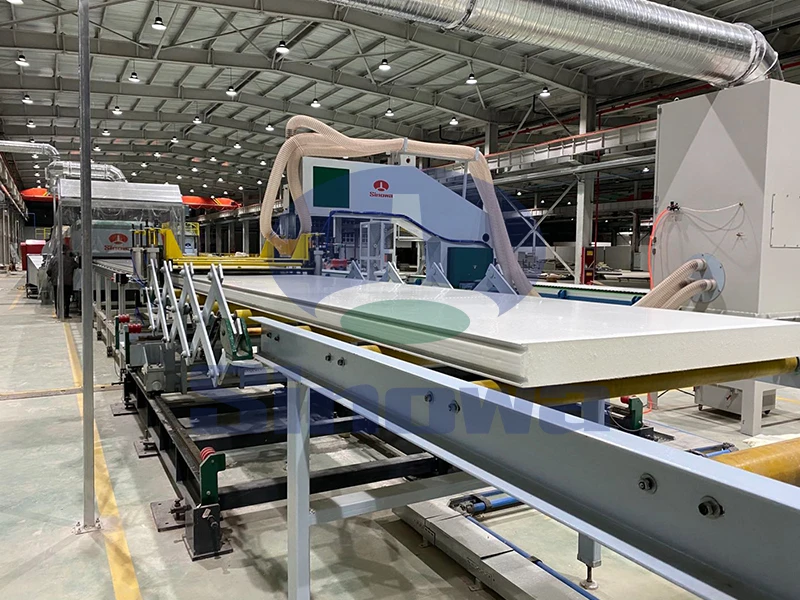
PU sandwich panel production equipment operates in long-term complex environments featuring high humidity, chemical volatilization and frequent mechanical friction, making targeted anti-corrosion treatment a core part of equipment lifecycle management. The production process involves polyurethane foam raw materials, chemical additives and frequent water cleaning operations, which easily cause oxidative corrosion, chemical erosion and surface rust on metal components of the equipment. Without standardized anti-corrosion treatment, key parts such as feeding rollers, laminating frames and transmission structures are prone to surface peeling, metal aging and structural deformation, which will not only reduce the precision of panel molding and affect the flatness and bonding performance of finished PU sandwich panels, but also increase equipment failure rate and maintenance costs in daily production. Scientific anti-corrosion treatment runs through the whole process of equipment use, from pre-production surface pretreatment to in-service protective reinforcement, and focuses on adapting to the unique corrosive factors of PU panel production. Different from conventional mechanical anti-corrosion methods, it needs to balance corrosion resistance, mechanical wear resistance and production compatibility, ensuring that anti-corrosion layers do not affect the bonding effect of PU materials and the normal operation of automated production processes, so as to maintain long-term stable operation of production lines.
Surface pretreatment constitutes the foundational link of anti-corrosion treatment for PU sandwich panel equipment, directly determining the adhesion durability and overall effect of subsequent protective layers. Before implementing formal anti-corrosion coating and modification, all metal working surfaces, transmission components and equipment frames need comprehensive impurity removal and surface optimization treatment. The first step is degreasing and decontamination, which removes surface oil stains, dust, residual PU foam debris and adhesive impurities accumulated during equipment operation. These pollutants will form isolation layers on metal surfaces, leading to hollowing and peeling of anti-corrosion coatings in the later stage. Physical cleaning methods such as high-pressure air blowing and mechanical polishing can be matched with mild alkaline cleaning agents to thoroughly clean component surfaces, followed by natural drying or constant-temperature drying to ensure no residual moisture. After cleaning, surface rust removal and oxidation layer polishing are carried out to eliminate floating rust and passivated oxide layers on metal surfaces, making the metal base present a uniform and smooth state. For precision parts with high operational accuracy requirements, fine polishing is adopted to avoid dimensional deviation caused by excessive grinding. This standardized pretreatment process eliminates hidden dangers of poor coating adhesion, laying a solid foundation for the stability of subsequent anti-corrosion treatment and effectively improving the overall corrosion resistance of equipment components.
Functional anti-corrosion coating treatment is the core measure to improve the environmental adaptability of PU sandwich panel equipment, with targeted coating selection and standardized coating processes as the key. According to the different working areas and stress conditions of equipment components, differentiated coating schemes are formulated to adapt to the production characteristics of PU sandwich panels. For frequently operated transmission parts, roller surfaces and molding contact components, wear-resistant and chemical-resistant composite coatings are selected, which can resist the micro-corrosion caused by long-term contact with PU raw material volatiles and withstand continuous mechanical friction and extrusion. For equipment frames, support structures and external exposed parts, weather-resistant anti-corrosion coatings are adopted to cope with environmental humidity and air oxidation corrosion in the production workshop. The coating construction strictly follows layered operation specifications, including primer coating, intermediate coating and topcoat finishing. The primer enhances the bonding force between the metal base and the protective layer and plays a basic anti-rust role; the intermediate coating increases the thickness and compactness of the protective layer to block external corrosive media; the topcoat provides wear resistance, stain resistance and anti-aging protection. Each coating procedure needs to be carried out after the previous layer is completely cured, and the coating thickness is controlled uniformly to avoid local thin coating or accumulation, so as to ensure the continuous and effective anti-corrosion protection of the equipment surface.
Localized anti-corrosion reinforcement for vulnerable components is an indispensable part of the overall treatment standard, as partial key parts of PU sandwich panel equipment are more susceptible to corrosion damage due to special working conditions. Equipment gaps, welding joints, bolt connection parts and material contact areas are typical corrosion-prone positions, where dust, moisture and residual chemical materials are easy to accumulate and form local corrosive environments that accelerate metal aging. For welding seams and gap positions, after surface cleaning and rust removal, special gap sealant and anti-corrosion putty are used for filling and sealing to block the entry of corrosive media and avoid crevice corrosion caused by long-term material accumulation. For fasteners such as bolts and screws that are frequently disassembled and stressed, integral anti-corrosion immersion treatment is adopted, and auxiliary protective grease is applied during assembly to enhance friction corrosion resistance and oxidation resistance. For the material bearing and feeding parts that are in long-term contact with PU foam and metal sheets, local thickened coating treatment is implemented, and flexible anti-corrosion protective layers are added to avoid coating damage and corrosion exposure caused by frequent material friction and impact. This targeted local reinforcement makes up for the weakness of uniform coating protection, realizes full-coverage anti-corrosion protection of the equipment, and reduces local failure risks caused by partial corrosion.
Environmental adaptation management in the production operation process is an important guarantee to maintain the long-term effect of equipment anti-corrosion treatment. The anti-corrosion performance of PU sandwich panel equipment is not only determined by post-treatment processes, but also closely related to the daily operation environment and production management methods. The production workshop needs to maintain stable humidity and ventilation conditions to reduce the accumulation of humid air and chemical volatile gas. Excessive workshop humidity will accelerate the oxidation and hydrolysis of equipment protective layers, while long-term accumulation of PU raw material volatiles will cause slow chemical corrosion on metal surfaces and coatings. Timely ventilation and exhaust can effectively dilute corrosive gas and reduce the contact time between equipment and harmful media. In daily production, standardized operation procedures should be implemented to avoid long-term retention of residual PU materials, cleaning wastewater and industrial dust on equipment surfaces. After daily production is completed, surface cleaning and dry maintenance of key equipment parts are required to remove residual corrosive substances. In addition, equipment operation load should be reasonably controlled to avoid long-term overloaded operation causing structural deformation and coating cracking, which would damage the integrity of the anti-corrosion protective layer and lead to secondary corrosion of the metal base.
Regular inspection, maintenance and secondary anti-corrosion repair form a closed-loop guarantee system for equipment anti-corrosion treatment, ensuring the continuous and stable performance of equipment anti-corrosion capacity in the full lifecycle. With the extension of equipment operation time, the surface anti-corrosion layer will inevitably have minor wear, aging, color fading and local peeling under the combined action of mechanical friction, chemical erosion and environmental changes. Regular targeted inspection and maintenance can timely discover potential corrosion hazards and avoid small-area damage expanding into large-scale equipment aging and failure. Daily routine inspections focus on checking the surface integrity of vulnerable parts such as transmission rollers, welding seams and contact parts, observing whether there is coating peeling, rust spots and discoloration. Regular comprehensive maintenance is carried out on a periodic basis, including deep cleaning of equipment gaps, detection of coating thickness and compactness, and evaluation of metal base corrosion status. For minor coating wear and local rust spots, partial polishing and secondary coating repair are implemented in a timely manner; for aging and failed protective layers in large areas, old coatings are completely removed and re-standardized anti-corrosion pretreatment and coating construction are carried out. Perfect post-maintenance anti-corrosion management can effectively extend the service life of equipment anti-corrosion layers, maintain the long-term operational stability of PU sandwich panel production equipment, and reduce comprehensive production and maintenance costs.
https://www.cnsinowa.com/faqs/anti-corrosion-treatment-standard-for-pu-sandwich-panel-equipment.html
Main Products
-

Continuous PU Sandwich Panel Production Line
This continuous PU sandwich panel production line is an integrated automatic equipment. It covers uncoiling, forming, foaming, curing and cutting processes. With automatic raw material proportioning and precise temperature & pressure control, PIR sandwich panel production line continuously composites panels with double skins. Polyurethane sandwich panel production line stably produces steel and aluminum sandwich panels. Featuring high automation, the line makes fireproof and thermal-insulation panels for building enclosure and cold storage. -

Rock Wool Sandwich Panel Production Line
Continuous rockwool sandwich panel production line is an automatic integrated production equipment, consisting of uncoiling, forming, gluing and compounding, heating curing, fixed-length cutting, automatic stacking and other modules. The mineral wool sandwich panel production line continuously conveys color steel plates and rock wool core materials to automatically complete lamination and curing, which can produce fireproof and thermal insulation sandwich panels. Featuring high automation degree and stable operation, this production line is suitable for mass production of panels used for building walls, roofs and other scenarios. -

Phenolic Insulation Board Production Line
This integrated automatic production line continuously manufactures PU and phenolic insulation boards. The insulation board production line covers raw material proportioning, high-pressure foaming, laminating, curing and fixed-length cutting. Featuring high automation and stable molding, the insulation panel production line supports various surface materials. PU boards offer excellent thermal insulation, while phenolic boards have superior fire resistance. These products are widely used in construction, cold chain, ventilation ducts and other thermal insulation fields.
Other FAQs
- Energy Consumption Standard Of Automatic PU Sandwich Panel Production Equipment
- Troubleshooting For Sandwich Panel Production Line Frequent Shutdown Failure
- Noise Reduction Measures For PU Sandwich Panel Production Equipment
- Difference Between PUR And PIR Sandwich Panel Production Lines
- Sandwich Panel Production Line Startup And Shutdown Standard Operating Procedures