sandwich panel line
To understand the significance of a dedicated PU sandwich panel production line for air-conditioning ducts, it is essential to first grasp the unique structural composition of PU sandwich panels designed for this purpose. Unlike conventional single-layer duct materials, these panels feature a three-layer sandwich structure: a rigid, closed-cell PU foam core sandwiched between two protective outer facing layers, most commonly embossed aluminum foil or thin galvanized metal sheets. The PU foam core acts as the primary insulation layer, boasting ultra-low thermal conductivity that minimizes heat gain or loss during air transmission, a key factor in reducing the energy consumption of HVAC systems. The outer facings, on the other hand, provide mechanical strength, moisture resistance, and corrosion protection, preventing air leakage, water vapor penetration, and surface damage that could compromise duct performance over time. This integrated structure eliminates the need for separate insulation installation on-site, streamlining duct construction and reducing labor input, while also ensuring consistent insulation performance that is difficult to achieve with manual on-site fabrication. A specialized manufacturing line is indispensable to replicate this precise structure at scale, maintaining uniformity in core density, bonding strength, and panel dimensions throughout production.
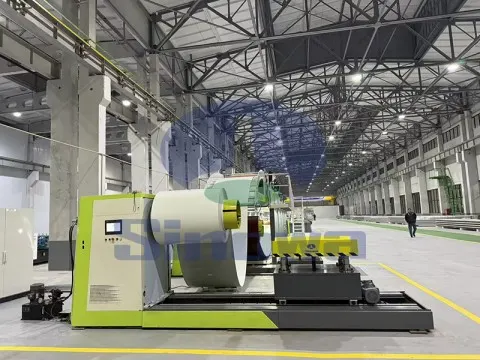
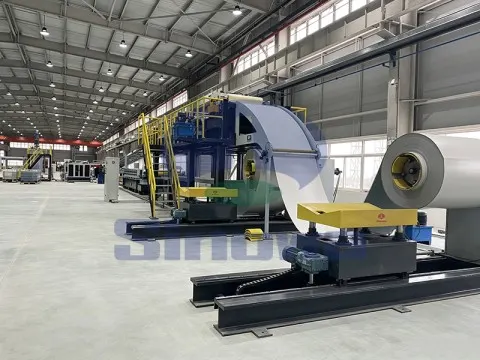
The operational workflow of a PU sandwich panel manufacturing line for air-conditioning ducts is a seamless, continuous process that combines raw material preparation, foam formation, lamination, curing, sizing, and finishing, with each stage optimized to uphold product quality and production efficiency. The process commences with the unwinding and pre-treatment of the outer facing materials, which are typically supplied in large coiled rolls to support continuous production. Automated decoiler systems feed the facing materials into the line, with precision leveling and surface cleaning stations removing any dust, oil, or irregularities to ensure optimal adhesion between the facings and the PU foam core. For metallic facings, gentle pre-heating may be applied to enhance the bonding reaction, while non-metallic facings undergo surface profiling to create a micro-textured surface that reinforces the bond with the foam. This initial pre-treatment stage is critical, as any defects in the facing materials or inadequate surface preparation can lead to delamination, weak spots, or inconsistent insulation in the final panels, directly impacting their suitability for air-conditioning duct use.
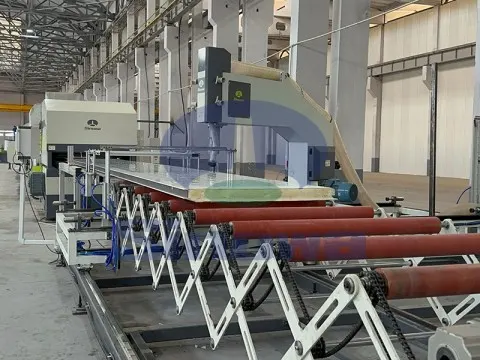
Following facing pre-treatment, the line moves to the core stage: PU foam mixing, injection, and in-situ foaming. This phase demands extreme precision, as the quality of the PU foam core hinges on the accurate proportioning and thorough mixing of the two primary raw materials—polyol and isocyanate—along with specialized additives such as catalysts, blowing agents, flame retardants, and cross-linking agents. Modern production lines are equipped with high-pressure metering and mixing systems that deliver these components in exact ratios, eliminating human error and ensuring the foam achieves the desired density, closed-cell rate, and mechanical properties. The mixed liquid PU compound is continuously and evenly injected onto the lower facing material as it moves along the production line, with a controlled distribution mechanism preventing uneven application that could cause thickness variations or weak points in the core. Simultaneously, the upper facing material is guided into place above the injected PU mixture, forming a temporary sandwich assembly that proceeds to the laminating and curing section.
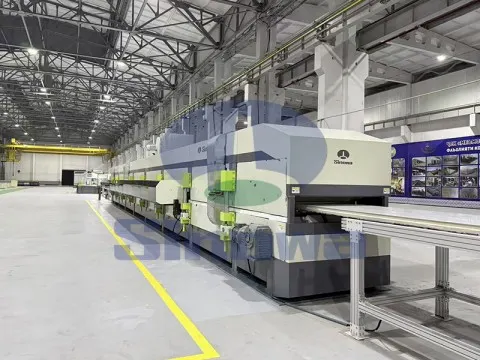
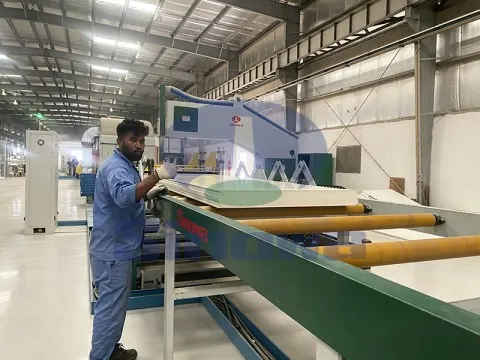
The laminating and curing section is where the PU foam undergoes expansion, solidification, and bonding with the outer facings, transforming the liquid mixture into a rigid, integrated sandwich panel. The assembly passes through a double-track conveyor system with adjustable pressure and temperature settings, which applies consistent, gentle pressure to keep the facings aligned and the foam core uniformly distributed as it expands. The controlled temperature environment accelerates the chemical curing reaction of the PU foam, ensuring it solidifies fully without forming voids, cracks, or uneven cell structures. The speed of the conveyor is calibrated to match the curing rate of the foam, striking a balance between production efficiency and complete curing—rushing this stage can result in under-cured foam with reduced insulation and strength, while excessive slowdowns hinder overall output. As the panel exits the curing zone, it has developed a stable, rigid structure with a strong bond between the core and facings, ready for the subsequent sizing and finishing processes.
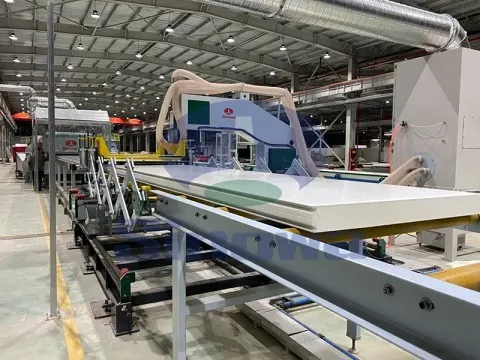
Once cured, the continuous PU sandwich panel moves through precision cutting and trimming stations that customize the panel to the standard dimensions required for air-conditioning duct fabrication. Automated cutting equipment, guided by digital control systems, cuts the continuous panel into fixed lengths and widths, with clean, burr-free edges that facilitate seamless on-site assembly and connection of duct sections. Some production lines also incorporate optional finishing processes, such as edge sealing, surface embossing refinement, or protective film lamination, to further enhance the panel’s durability and ease of handling. After cutting and finishing, the finished panels are automatically stacked, sorted, and prepared for storage or transportation, with minimal manual intervention reducing the risk of damage and improving workflow efficiency. This end-to-end automation not only boosts production capacity but also ensures that every panel leaving the line adheres to consistent dimensional tolerances, a critical requirement for precise duct fitting and airtight performance.
A defining feature of high-quality PU sandwich panel manufacturing lines for air-conditioning ducts is their robust quality control and process monitoring systems, which are embedded throughout every stage of production to mitigate defects and maintain consistent performance. Real-time sensors and monitoring devices track key parameters, including facing material tension, PU component mixing ratios, foam injection volume, curing temperature and pressure, conveyor speed, and panel thickness. Any deviation from preset parameters triggers immediate alerts, allowing operators to make timely adjustments before defective panels are produced. Additionally, random sampling and testing are conducted regularly to assess core properties such as thermal conductivity, density, compressive strength, and bonding strength between the core and facings, as well as panel flatness and dimensional accuracy. These rigorous control measures ensure that the panels meet the functional requirements of air-conditioning ducts, including reliable thermal insulation, airtightness, resistance to deformation, and longevity in diverse operating environments, from temperature-controlled commercial buildings to industrial facilities with harsh air quality conditions.
Beyond the production process itself, the design of a PU sandwich panel line for air-conditioning ducts is optimized to address the unique needs of the HVAC industry, offering flexibility, adaptability, and operational efficiency. The lines are engineered to accommodate different types and thicknesses of outer facing materials, as well as varying PU foam core densities and panel thicknesses, allowing manufacturers to produce customized panels for different duct sizes, insulation requirements, and application scenarios. For instance, thinner panels with moderate insulation may be used for residential HVAC ducts, while thicker, higher-density panels are suited for large-scale commercial or industrial ducts that demand superior thermal performance and structural rigidity. The modular design of the production line also enables easy maintenance, component upgrades, and workflow adjustments, ensuring long-term operational reliability and the ability to adapt to evolving industry standards and market demands. Furthermore, modern lines prioritize energy efficiency and environmental sustainability, utilizing eco-friendly blowing agents in PU foam production and optimizing energy consumption for heating, mixing, and curing processes, aligning with the global push for green manufacturing in the construction and HVAC sectors.
The adoption of specialized PU sandwich panel manufacturing lines has revolutionized air-conditioning duct production, addressing longstanding limitations of traditional duct materials and fabrication methods. Conventional sheet metal ducts, for example, require extensive on-site insulation, sealing, and labor, leading to longer construction cycles, higher costs, and inconsistent insulation quality. Fiberglass duct boards, while lightweight, are prone to moisture absorption, dust accumulation, and reduced insulation performance over time. In contrast, PU sandwich panels produced via dedicated lines offer a unified solution that combines insulation, structural support, and airtightness in a single, lightweight panel, reducing on-site installation time by a significant margin and minimizing the risk of performance inconsistencies. The closed-cell structure of the PU foam core also resists moisture and mold growth, a critical advantage for maintaining indoor air quality and extending the service life of the duct system, while the lightweight nature of the panels reduces transportation and handling costs, as well as the structural load on buildings.
In commercial buildings such as office towers, shopping malls, and hospitals, where HVAC systems operate continuously and energy efficiency is a top priority, PU sandwich panels from dedicated production lines deliver tangible benefits. The superior thermal insulation reduces the load on air conditioning and heating units, lowering long-term energy expenses and reducing carbon emissions. The airtight construction minimizes air leakage, ensuring that conditioned air reaches its intended destination without waste, while the smooth, non-porous surface of the outer facings prevents dust and debris buildup, simplifying duct maintenance and preserving indoor air quality. In industrial settings, where ducts may transport air with varying temperatures or mild contaminants, the durable outer facings and rigid PU core withstand daily wear and tear, maintaining structural integrity and insulation performance even under demanding operating conditions. For residential HVAC systems, the lightweight, easy-to-install panels streamline construction, making efficient thermal insulation more accessible and affordable for homeowners.
Looking ahead, the evolution of PU sandwich panel manufacturing lines for air-conditioning ducts is poised to align with broader advancements in HVAC technology and sustainable building practices. As global energy efficiency regulations become stricter and demand for low-carbon building materials rises, production lines will continue to integrate smarter automation, digital monitoring, and eco-friendly material processing technologies. Innovations in PU foam formulation will further enhance insulation performance, fire resistance, and environmental compatibility, while advancements in facing material technology will improve durability and corrosion resistance. The integration of digital twin technology and artificial intelligence will also enable predictive maintenance of production lines, minimizing downtime and optimizing production efficiency, while customized production capabilities will expand to meet the growing demand for bespoke duct solutions in complex building designs.
In conclusion, the PU sandwich panel manufacturing line for air-conditioning ducts is a cornerstone of modern HVAC infrastructure, merging precision engineering, automated processing, and material innovation to produce high-performance duct materials that redefine energy efficiency, durability, and ease of installation. From the meticulous pre-treatment of facing materials to the controlled foaming, curing, and finishing processes, every aspect of the production line is engineered to deliver consistent, high-quality panels that meet the diverse needs of residential, commercial, and industrial HVAC systems. By eliminating the inefficiencies of traditional duct fabrication, reducing energy consumption, and enhancing the longevity and performance of air-conditioning ducts, these specialized production lines play a vital role in advancing sustainable building practices and shaping the future of the global HVAC industry. As the demand for efficient, eco-friendly climate control solutions continues to grow, the role of PU sandwich panel manufacturing lines will only become more central, driving innovation and excellence in air-conditioning duct technology for years to come.
Sinowa is a professional manufacturer of sandwich panel machine in china, we provide diversified and high-performance sandwich panel production lines, including fully automatic continuous PU sandwich panel line and customized special lines to meet mass production and personalized order demands. These sandwich panel lines support processing multiple foam core materials, such as PU, PIR, mineral wool, rock wool and glass wool, covering different insulation and fireproof standards.
Featuring stable operation, high efficiency, energy saving and easy maintenance, our PU sandwich panel line deliver sandwich panels with excellent thermal insulation, fire resistance, sound insulation and lightweight durability. The finished panels are widely applied in industrial workshops, warehouse roofing and wall cladding, cold storage insulation, serving global construction and industrial insulation markets.
https://www.cnsinowa.com/sandwich-panel-machines/pu-sandwich-panel-manufacturing-line-for-air-conditioning-duct.html