Difference Between Continuous And Discontinuous PU Sandwich Panel Production Lines
Sep 17, 2026
Continuous and discontinuous PU sandwich panel production lines are two mainstream manufacturing modes with distinct operational logics. They differ greatly in production flow, automation level, output capacity, product flexibility and production cost, suiting varied manufacturing scales and customized production demands in the building material industry.
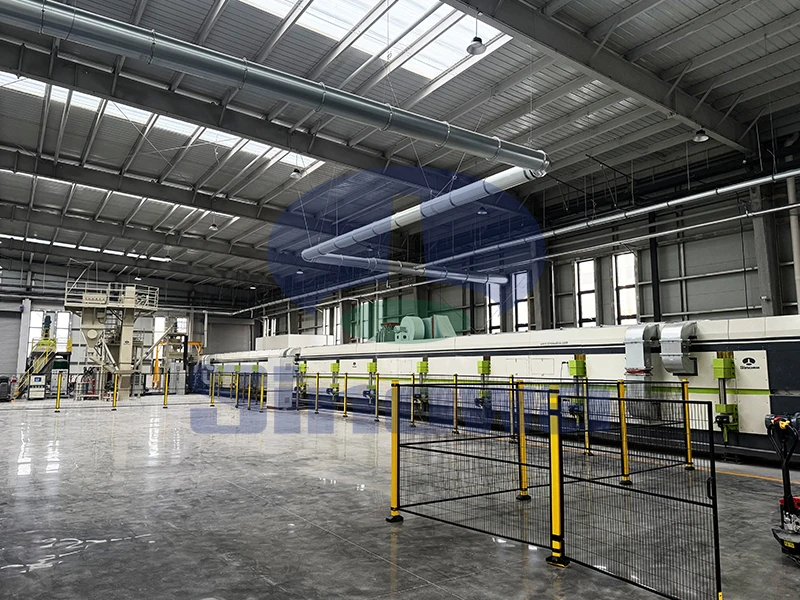
The core distinction between continuous and discontinuous PU sandwich panel production lines lies in their fundamental operational workflows and production rhythm mechanisms. Continuous production lines adopt a fully integrated, uninterrupted assembly line structure that connects every manufacturing procedure into a seamless whole. From raw material decoiling, surface pretreatment, high-pressure PU raw material pouring, foam curing and composite molding to fixed-length cutting and finished product stacking, all processes operate synchronously with coordinated mechanical linkage. The surface materials move steadily along the conveyor system throughout production, eliminating frequent equipment startup, shutdown and debugging intervals. In contrast, discontinuous production lines follow a batch-based intermittent working mode, dividing the complete production process into multiple independent segmented steps. Each production link is operated relatively separately, with panels processed one batch at a time. After completing foaming and pressing for one batch of panels, the equipment needs to pause for mold adjustment, material replacement and finished product removal before starting the next production cycle, forming obvious intermittent production gaps throughout operation.
Automation and labor dependence levels further widen the gap between the two types of production lines. Continuous production lines feature high-degree full-process automation, realizing unmanned operation for core production links. The entire production process from raw material feeding to finished product output is controlled by integrated intelligent systems, with precise mechanical equipment completing material conveying, PU material metering and pouring, constant-temperature curing and fixed-size cutting. Only a small number of staff are required to conduct real-time equipment monitoring and occasional fault handling, minimizing manual intervention links. This automated operation effectively avoids human-induced errors and maintains stable production continuity. Discontinuous production lines rely heavily on manual auxiliary operations despite partial mechanical assistance. Multiple links including material positioning, mold assembly, batch feeding and finished product demolding require manual participation and adjustment. The segmented production mode makes it impossible to achieve fully synchronous automated operation, leading to higher labor dependence. The frequent manual operations not only increase labor input but also make product quality and production efficiency susceptible to operational proficiency and human factors.
Production efficiency and output capacity represent the most intuitive practical differences between the two production systems. Benefiting from uninterrupted streamlined operation, continuous production lines deliver extremely high unit-time output. There is no idle time caused by equipment switching, mold replacement or batch interval waiting, and the stable operating speed enables long-term continuous mass production of standard PU sandwich panels. This mode is highly suitable for large-batch, standardized order production and can sustain long-hour continuous operation to meet large-scale market demand. Discontinuous production lines have far lower overall production efficiency due to inherent intermittent working characteristics. Each production cycle includes non-production time such as equipment standby, mold adjustment and material arrangement, which occupies a large proportion of the total production duration. Although the single-panel processing quality can be refined, the batch-based operation limits daily output. This efficiency trait makes discontinuous lines incapable of undertaking large-scale centralized orders, restricting them to small-batch production scenarios.
Product customization flexibility and applicable production scenarios vary significantly between continuous and discontinuous PU sandwich panel lines. Continuous production lines are optimized for standardized, unified-specification panel production, with fixed mechanical parameters and operating procedures. Once the production parameters are set, the line maintains consistent panel thickness, foam density and overall dimensions during long-term operation, ensuring excellent product consistency. However, the integrated mechanical structure makes parameter adjustment and mold replacement cumbersome and time-consuming, resulting in poor flexibility for customized products. Discontinuous production lines excel in personalized and customized production. Their independent batch processing structure allows flexible adjustment of production parameters, mold specifications and processing techniques for each batch. Manufacturers can freely switch panel thickness, length, surface material types and foam formulas according to diverse order requirements, easily adapting to special-specification panels, thickened panels and personalized customized orders that continuous lines cannot efficiently produce.
Product quality stability and finished product performance consistency show obvious differentiation under the two production modes. Continuous production lines adopt precise unified metering systems and constant-temperature integral curing environments. The PU raw material mixing ratio, pouring volume and curing temperature are precisely controlled by intelligent systems without manual deviation, ensuring uniform foam density, stable bonding strength between core materials and surface layers, and consistent overall flatness of each panel. The continuous molding process avoids splicing gaps and structural inconsistencies between batches, achieving high overall product uniformity. For discontinuous production lines, batch independent processing leads to subtle differences in processing conditions for each panel. Manual auxiliary operation links may cause slight deviations in material feeding and parameter adjustment, and the intermittent curing environment also leads to minor differences in foam molding effects among different batches. Although single-panel quality can meet basic usage requirements, the overall batch consistency is inferior to that of continuously produced panels.
Long-term operational cost and resource utilization efficiency form another key difference between the two production lines. Continuous production lines feature high resource utilization due to closed-loop automated production and precise raw material metering. The synchronous operation of each link eliminates raw material waste caused by repeated debugging and intermittent feeding, and the stable production rhythm reduces equipment wear and energy consumption per unit product. Despite higher early-stage equipment configuration investment, the long-term mass production mode effectively averages operational costs and improves overall economic benefits. Discontinuous production lines have lower initial equipment investment and simpler site configuration requirements, lowering the threshold for early production launch. Nevertheless, intermittent operation leads to higher comprehensive energy consumption due to frequent equipment startup and shutdown. Dispersed manual operation and segmented material feeding also cause inevitable raw material residue and waste. Additionally, higher long-term labor costs and lower single-unit output make the overall operational economic efficiency weaker than continuous lines in long-term large-scale production scenarios.
Main Products
-

Continuous PU Sandwich Panel Production Line
This continuous PU sandwich panel production line is an integrated automatic equipment. It covers uncoiling, forming, foaming, curing and cutting processes. With automatic raw material proportioning and precise temperature & pressure control, PIR sandwich panel production line continuously composites panels with double skins. Polyurethane sandwich panel production line stably produces steel and aluminum sandwich panels. Featuring high automation, the line makes fireproof and thermal-insulation panels for building enclosure and cold storage. -

Rock Wool Sandwich Panel Production Line
Continuous rockwool sandwich panel production line is an automatic integrated production equipment, consisting of uncoiling, forming, gluing and compounding, heating curing, fixed-length cutting, automatic stacking and other modules. The mineral wool sandwich panel production line continuously conveys color steel plates and rock wool core materials to automatically complete lamination and curing, which can produce fireproof and thermal insulation sandwich panels. Featuring high automation degree and stable operation, this production line is suitable for mass production of panels used for building walls, roofs and other scenarios. -

Phenolic Insulation Board Production Line
This integrated automatic production line continuously manufactures PU and phenolic insulation boards. The insulation board production line covers raw material proportioning, high-pressure foaming, laminating, curing and fixed-length cutting. Featuring high automation and stable molding, the insulation panel production line supports various surface materials. PU boards offer excellent thermal insulation, while phenolic boards have superior fire resistance. These products are widely used in construction, cold chain, ventilation ducts and other thermal insulation fields.
Other FAQs
- Daily Maintenance Items Of Polyurethane Sandwich Panel Production Line
- Production Efficiency Improvement Measures Of Sandwich Panel Production Line
- Production Line Operation Steps For Continuous PU Sandwich Panel Molding
- Price Composition Of Complete PU Sandwich Panel Production Line
- Energy Consumption Standard Of Automatic PU Sandwich Panel Production Equipment