Polyurethane Sandwich Panel Production Equipment Lubrication Maintenance Standard
Sep 21, 2026
Proper lubrication maintenance is the core foundation for stable operation of polyurethane sandwich panel production equipment. Systematic lubrication maintenance norms for the equipment, covering core purposes, key parts, operation procedures, cycle management, oil product selection, fault prevention and daily optimization to extend equipment service life and ensure production continuity.
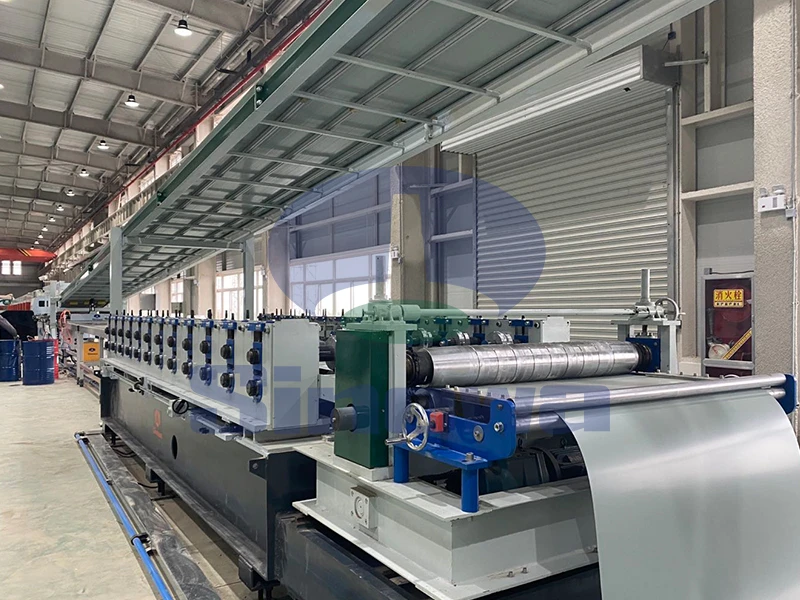
Scientific lubrication maintenance serves as the fundamental guarantee to eliminate mechanical friction loss and maintain the long-term stable operation of polyurethane sandwich panel production equipment. In the continuous production process of sandwich panels, core mechanical components such as transmission shafts, bearings, gear sets and roller systems operate at high frequency and bear continuous mechanical load, and dry friction or insufficient lubrication will directly cause component wear, increased operating resistance and abnormal equipment vibration. Effective lubrication can form a uniform protective oil film on the surface of mechanical moving parts, isolating direct metal-to-metal contact, reducing friction resistance and heat generation during operation. Meanwhile, lubricating oil can also play a auxiliary role in cleaning tiny metal debris and dust generated by mechanical operation, avoiding particle accumulation that causes component jamming and operation deviation. Regular and standardized lubrication maintenance can effectively reduce the failure rate of key equipment parts, avoid unplanned production shutdowns caused by mechanical faults, and maintain consistent production efficiency and product processing accuracy in long-term batch production. It also slows down the aging speed of mechanical components, reduces the frequency of component replacement and overall equipment maintenance costs, and lays a stable mechanical foundation for standardized and continuous polyurethane sandwich panel production.
The lubrication maintenance of polyurethane sandwich panel production equipment needs to focus on multiple key operating parts that are prone to friction and loss, and targeted maintenance measures should be formulated according to the operating characteristics of different components. The transmission system including driving gears, sprockets and conveyor chains is the power transmission core of the entire production line, which runs continuously for a long time and is extremely susceptible to wear and tooth surface deformation due to frequent meshing. These parts require continuous lubrication to ensure smooth power transmission and avoid power loss caused by friction resistance. The bearing components of the rolling system, including the bearings of forming rollers, leveling rollers and traction rollers, bear radial and axial loads during the operation of the sandwich panel molding process, and insufficient lubrication will lead to bearing heating, noise and even stuck rotation, affecting the flatness and molding quality of the panel. In addition, the sliding guide rails of the cutting device, the rotating joints of the foaming injection system and the moving parts of the pressing equipment are also key lubrication positions. These precision parts have high matching accuracy, and slight friction damage will affect the overall operation precision of the equipment. In daily maintenance, staff need to classify and mark all key lubrication parts, regularly check the lubrication state of each position, and avoid missing lubrication or uneven oil supply of individual parts to ensure the overall coordinated operation of the equipment.
Standardized lubrication operation procedures are essential to ensure the implementation effect of equipment maintenance, and all lubrication work must follow standardized and orderly operation steps to avoid irregular operation causing equipment hidden dangers. Before carrying out any lubrication maintenance work, the equipment must be completely shut down and cut off the power supply, and it is necessary to wait for all operating components to completely stop running and the equipment temperature to drop to a safe range, so as to prevent scalding accidents and avoid lubricating oil failure caused by high-temperature instantaneous volatilization. After confirming the safety state of the equipment, the maintenance staff first needs to clean the surface of the lubrication parts, wipe off floating dust, residual oil dirt and accumulated debris with professional cleaning tools, and ensure that the oil filling ports and friction surfaces are clean and unobstructed, preventing impurities from mixing into the lubricating layer to affect the oil film quality. Then, according to the structural characteristics of different parts, quantitative and fixed-point oil injection or oil filling operation is carried out. For closed transmission parts such as gearboxes, sealed oil injection is adopted to avoid oil leakage and dust invasion; for open moving parts such as guide rails and chains, uniform oil brushing and dripping are used to ensure full coverage of the friction surface. After the lubrication operation is completed, the excess residual oil on the equipment surface needs to be cleaned in time to prevent the adhesion of dust and impurities, and a trial run of the equipment is carried out after maintenance to check whether the operation is smooth and whether there is abnormal noise or oil leakage, so as to confirm the lubrication effect meets the operational requirements.
Reasonable lubrication cycle management is the key to maintain the long-term stable lubrication state of polyurethane sandwich panel production equipment, and differentiated cycle plans need to be formulated according to equipment operating intensity, operating environment and component loss degree. For the core high-frequency operating parts such as main transmission gears, traction roller bearings and conveyor chains, which run continuously with large load and fast loss, short-cycle regular lubrication is required, and daily visual inspection and weekly quantitative oil supplement should be implemented to ensure the continuous effectiveness of the lubricating oil film. For medium-loss parts such as cutting guide rails and auxiliary transmission components, a monthly lubrication maintenance cycle can be adopted, with thorough oil cleaning and re-lubrication to eliminate aged and deteriorated lubricating oil. For low-frequency operating parts and static connection moving parts with small friction loss, a quarterly maintenance cycle is sufficient to meet the equipment operation needs. In addition, the lubrication cycle needs to be dynamically adjusted according to the actual production situation. When the equipment operates continuously for a long time with high load or the production environment has large dust and humidity, the lubrication and maintenance frequency should be appropriately increased to cope with accelerated component loss and easy oil deterioration. A complete maintenance record ledger should be established to record each lubrication time, maintenance parts, oil product type and operation state, forming a standardized cycle management mechanism to avoid random maintenance and missed maintenance.
The correct selection of lubricating oil products directly determines the lubrication effect and equipment protection quality, and the matching oil products must be selected according to the working conditions and structural characteristics of different equipment components. High-load transmission parts such as gear sets and heavy-duty bearings are suitable for high-viscosity lubricating oil with strong wear resistance and pressure resistance, which can form a thick and stable oil film under high load operation, effectively resist friction impact and avoid oil film rupture caused by excessive load. For precision moving parts such as cutting guide rails and foaming system rotating joints with high operation precision requirements, low-viscosity, high-fluidity and clean lubricating oil should be selected. This type of oil product has good permeability, can fully cover tiny friction gaps, and will not produce sticky dirt that affects the precision movement of components. For equipment parts operating in high-temperature environments for a long time, high-temperature resistant lubricating grease with stable chemical properties is required to prevent oil product volatilization, oxidation and deterioration under high temperature, which leads to lubrication failure. It is strictly forbidden to mix different types of lubricating oil and grease in the maintenance process, so as to avoid chemical reactions between different oil products causing oil deterioration, precipitation of impurities and corrosion of mechanical parts. Meanwhile, unused lubricating oil needs to be stored in a sealed and dry environment to avoid moisture, dust and oxidative deterioration, ensuring the purity and effectiveness of the oil product used for equipment maintenance.
Daily lubrication fault prevention and continuous maintenance optimization can effectively reduce equipment mechanical faults and prolong the overall service life of polyurethane sandwich panel production equipment. In daily production and maintenance, staff need to always observe the operating state of the equipment, and judge the lubrication state of key parts through equipment operating noise, operating temperature and operation smoothness. Abnormal noise, excessive local temperature rise and unsmooth transmission operation are typical signs of insufficient lubrication or oil product failure, and targeted inspection and maintenance should be carried out immediately once found. Regularly carry out thorough cleaning and oil replacement for the equipment lubrication system, completely discharge the aged and deteriorated lubricating oil, clean the oil circuit and oil storage cavity, and refill with new qualified oil products to avoid long-term accumulation of waste oil and impurities causing component corrosion and oil circuit blockage. In addition, maintenance personnel should continuously summarize maintenance experience according to equipment operation conditions, optimize lubrication cycles and oil product matching schemes according to seasonal changes and production load changes, and improve the refinement level of lubrication maintenance. Standardized and optimized lubrication maintenance work can effectively reduce mechanical wear and equipment failure rate, ensure the long-term high-efficiency and stable operation of polyurethane sandwich panel production equipment, and provide reliable mechanical support for stable product quality and continuous production operation.
Main Products
-

Continuous PU Sandwich Panel Production Line
This continuous PU sandwich panel production line is an integrated automatic equipment. It covers uncoiling, forming, foaming, curing and cutting processes. With automatic raw material proportioning and precise temperature & pressure control, PIR sandwich panel production line continuously composites panels with double skins. Polyurethane sandwich panel production line stably produces steel and aluminum sandwich panels. Featuring high automation, the line makes fireproof and thermal-insulation panels for building enclosure and cold storage. -

Rock Wool Sandwich Panel Production Line
Continuous rockwool sandwich panel production line is an automatic integrated production equipment, consisting of uncoiling, forming, gluing and compounding, heating curing, fixed-length cutting, automatic stacking and other modules. The mineral wool sandwich panel production line continuously conveys color steel plates and rock wool core materials to automatically complete lamination and curing, which can produce fireproof and thermal insulation sandwich panels. Featuring high automation degree and stable operation, this production line is suitable for mass production of panels used for building walls, roofs and other scenarios. -

Phenolic Insulation Board Production Line
This integrated automatic production line continuously manufactures PU and phenolic insulation boards. The insulation board production line covers raw material proportioning, high-pressure foaming, laminating, curing and fixed-length cutting. Featuring high automation and stable molding, the insulation panel production line supports various surface materials. PU boards offer excellent thermal insulation, while phenolic boards have superior fire resistance. These products are widely used in construction, cold chain, ventilation ducts and other thermal insulation fields.
Other FAQs
- Polyurethane Sandwich Panel Production Line Start-up Pre-inspection Complete Items
- Noise Reduction Measures For PU Sandwich Panel Production Equipment
- Difference Between PUR And PIR Sandwich Panel Production Lines
- Polyurethane Sandwich Panel Production Line Fault Alarm System Debugging Method
- Sandwich Panel Production Line Startup And Shutdown Standard Operating Procedures