Troubleshooting For Sandwich Panel Production Line Frequent Shutdown Failure
Sep 17, 2026
Frequent unplanned shutdowns of sandwich panel production lines severely reduce manufacturing efficiency and cause unnecessary production losses.
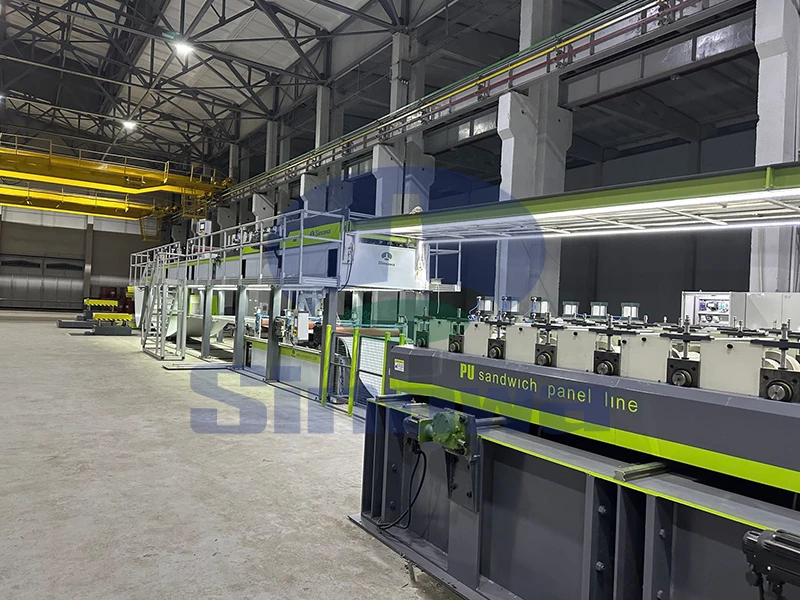
Unplanned frequent shutdowns are one of the most prevalent and disruptive faults in sandwich panel production operations, as they break continuous production rhythms, lower overall equipment effectiveness, and lead to increased material waste and labor idleness. Unlike occasional shutdowns caused by routine maintenance or manual parameter adjustment, recurrent sudden stops usually stem from latent equipment defects, unstable operating conditions or unreasonable production matching, rather than accidental operational errors. In actual production scenarios, many workshops simply restart the equipment after shutdowns without thorough cause investigation, which leads to repeated fault recurrence and gradually aggravates equipment wear and production instability. To fundamentally resolve this problem, it is essential to conduct systematic fault sorting and targeted inspection starting from the core operating links of the sandwich panel production line, including feeding, forming, gluing, pressing and cutting processes. Each functional module of the production line is interconnected and interactive, so a tiny abnormal state in a single link may trigger the line’s automatic protection shutdown mechanism, resulting in overall production suspension. Therefore, targeted troubleshooting must cover the entire production flow rather than focusing on a single faulty component, so as to eliminate hidden dangers comprehensively.
Mechanical operation abnormalities are the primary cause of frequent shutdowns in sandwich panel production lines, accounting for most recurrent sudden stop faults in daily production. The production line involves a large number of rotating, transmission and positioning mechanical components, including conveyor rollers, drive chains, gear sets, pressing rollers and cutting execution structures, all of which bear continuous load during long-term operation. After prolonged running, these components are prone to wear, gap deviation and lubrication failure, which will cause unsmooth transmission and abnormal mechanical resistance. For instance, insufficient lubrication of drive chains will lead to increased friction and jamming during operation, triggering the line’s overload protection program and causing automatic shutdown. Similarly, worn conveyor roller bearings or deformed roller surfaces will result in uneven material conveying speed, causing material deviation and stuck faults in the forming and pressing links. In addition, loose mechanical fasteners caused by long-term vibration will lead to component displacement and inaccurate positioning, making the equipment unable to complete standard production actions and activating self-protection shutdown. Most mechanical hidden faults develop gradually, with subtle abnormal noise and slight speed fluctuation in the early stage, which are easily ignored by operators. Regular disassembly inspection, component calibration and lubrication maintenance are the key measures to eliminate mechanical shutdown faults and maintain stable mechanical operation of the production line.
Electrical control system failures are another critical factor leading to frequent shutdowns of sandwich panel production lines, featuring sudden occurrence and difficult hidden danger investigation. The entire production line is controlled by an integrated electrical system, including core control modules, sensor components, frequency converters, contactors and circuit wiring, which jointly regulate the speed, coordination and operation logic of each production link. In the long-term high-load production environment, electrical components are susceptible to temperature rise, dust accumulation and voltage fluctuation, resulting in unstable operating performance. A large amount of dust and fiber debris generated during sandwich panel production will adhere to the surface of sensors and circuit interfaces, causing signal delay, signal distortion or intermittent signal loss. Since the production line’s automatic operation relies on real-time sensor feedback signals, abnormal signal transmission will cause the control system to misjudge the operating state and trigger emergency shutdown protection. Moreover, aging internal circuits and loose wiring terminals will lead to poor circuit contact and intermittent power supply instability, causing sudden equipment shutdown during high-speed operation. Frequency converter overload and parameter drift after long-term operation will also disrupt the motor speed matching of each link, resulting in program mismatch and automatic line shutdown. Regular dust cleaning of electrical cabinets, calibration of sensor sensitivity, inspection of circuit firmness and detection of component aging are essential to reduce electrical-induced frequent shutdowns.
Unstable raw material quality and abnormal feeding conditions easily induce frequent shutdown faults of sandwich panel production lines, which are often overlooked in daily fault troubleshooting. The continuous production of sandwich panels requires stable matching of core materials and surface materials, and material specifications, flatness and feeding continuity directly affect the smooth progress of forming and pressing processes. When raw materials have uneven thickness, irregular edges, excessive hardness fluctuation or local deformation, they will encounter resistance during automatic feeding and conveying, causing material jamming in the feeding channel and forming area. Once the material jamming occurs, the production line’s anti-jamming protection mechanism will be immediately activated to stop operation, avoiding equipment structural damage. In addition, inconsistent material feeding tension caused by unadjusted feeding equipment will lead to material deviation and superposition errors in the continuous production process, making the subsequent pressing and cutting procedures unable to be carried out normally and triggering repeated shutdowns. Unreasonable material stacking and irregular manual feeding operations will also disrupt the automatic feeding rhythm of the production line, resulting in frequent start-stop cycles. Standardizing raw material incoming inspection, optimizing feeding equipment parameters and unifying feeding operation standards can effectively avoid shutdown faults caused by material and feeding abnormalities.
Unreasonable operational parameter setting and non-standard manual operation are important human factors leading to recurrent shutdowns of sandwich panel production lines. The automated production line has strict matching requirements for operating parameters such as operating speed, pressing pressure, gluing volume and heating temperature, and parameter coordination directly determines production stability. In actual production, operators often adjust parameters arbitrarily according to superficial production experience without combining real-time production conditions, resulting in mismatched parameters between adjacent production links. For example, excessive production speed will make the gluing and pressing links unable to complete process actions in place, causing unqualified product forming and triggering the line’s abnormal process shutdown program; excessive pressing pressure will increase mechanical load and activate overload protection. Meanwhile, irregular manual operations such as untimely material supplement, random equipment intervention and incomplete pre-production inspection will disrupt the automatic operation logic of the production line. Long-term non-standard operation will not only cause frequent shutdowns but also accelerate equipment aging and expand faulty component damage. Establishing standardized parameter adjustment procedures, strengthening operator professional training and implementing full pre-production inspection can effectively reduce human-induced shutdown failures.
Scientific daily maintenance and dynamic fault early warning are the fundamental guarantees to solve frequent shutdown faults and achieve long-term stable operation of sandwich panel production lines. Most frequent shutdown faults are caused by accumulated minor abnormalities and unprocessed hidden dangers rather than sudden major failures, so establishing a complete daily maintenance system can effectively block fault accumulation. Enterprises need to formulate targeted maintenance plans for mechanical transmission parts, electrical control systems, feeding systems and process execution links, implementing regular cleaning, lubrication, calibration and aging component replacement. On this basis, operators should be trained to master real-time abnormal state identification skills, paying attention to subtle changes in equipment noise, operating speed, signal feedback and material conveying state during production, so as to discover and eliminate hidden dangers in the early stage of fault development. In addition, it is necessary to establish fault record files, record each shutdown time, phenomenon and processing method, summarize recurring fault rules, and carry out targeted equipment optimization and parameter adjustment. Through the combination of standardized daily maintenance, real-time state monitoring and fault data summary, the frequent shutdown problem of sandwich panel production lines can be completely solved, improving production continuity, stability and overall production efficiency.
Main Products
-

Continuous PU Sandwich Panel Production Line
This continuous PU sandwich panel production line is an integrated automatic equipment. It covers uncoiling, forming, foaming, curing and cutting processes. With automatic raw material proportioning and precise temperature & pressure control, PIR sandwich panel production line continuously composites panels with double skins. Polyurethane sandwich panel production line stably produces steel and aluminum sandwich panels. Featuring high automation, the line makes fireproof and thermal-insulation panels for building enclosure and cold storage. -

Rock Wool Sandwich Panel Production Line
Continuous rockwool sandwich panel production line is an automatic integrated production equipment, consisting of uncoiling, forming, gluing and compounding, heating curing, fixed-length cutting, automatic stacking and other modules. The mineral wool sandwich panel production line continuously conveys color steel plates and rock wool core materials to automatically complete lamination and curing, which can produce fireproof and thermal insulation sandwich panels. Featuring high automation degree and stable operation, this production line is suitable for mass production of panels used for building walls, roofs and other scenarios. -

Phenolic Insulation Board Production Line
This integrated automatic production line continuously manufactures PU and phenolic insulation boards. The insulation board production line covers raw material proportioning, high-pressure foaming, laminating, curing and fixed-length cutting. Featuring high automation and stable molding, the insulation panel production line supports various surface materials. PU boards offer excellent thermal insulation, while phenolic boards have superior fire resistance. These products are widely used in construction, cold chain, ventilation ducts and other thermal insulation fields.
Other FAQs
- Difference Between Continuous And Discontinuous PU Sandwich Panel Production Lines
- Daily Maintenance Items Of Polyurethane Sandwich Panel Production Line
- Production Efficiency Improvement Measures Of Sandwich Panel Production Line
- Production Line Operation Steps For Continuous PU Sandwich Panel Molding
- Price Composition Of Complete PU Sandwich Panel Production Line