 sandwich panel line
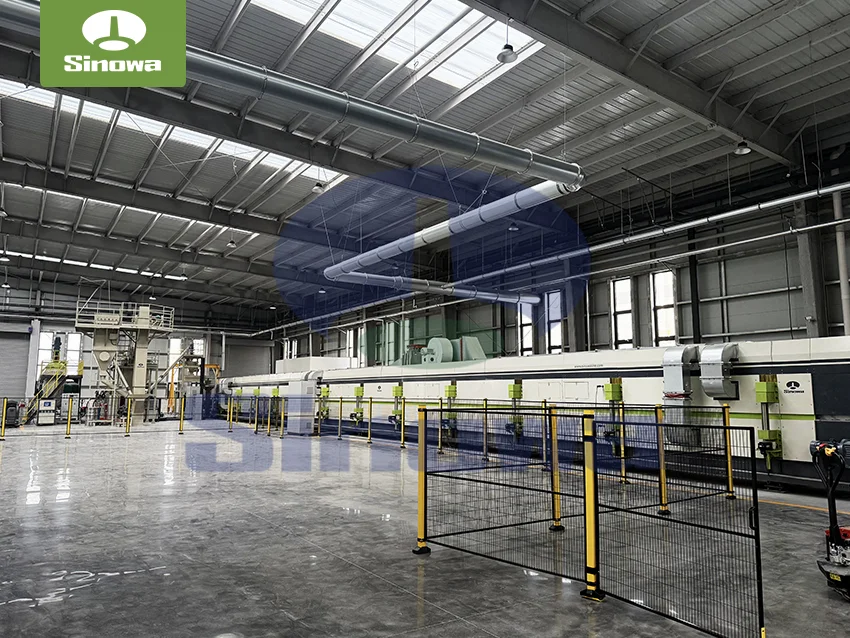
The overall structural layout of a fully automatic continuous PU sandwich panel line follows a linear production logic, with each functional module closely connected in sequence to form an integrated closed-loop production system. Every component in the production line is designed with precise mechanical coordination to ensure the synchronization of material transmission, chemical reaction, and mechanical processing. The upstream section of the production line mainly undertakes the raw material feeding and pretreatment work, including the surface material unwinding mechanism, surface treatment assembly, and raw material metering and mixing unit. The midstream section is the core functional area responsible for foaming, composite molding, and constant-temperature curing, which determines the internal structure and physical performance of the finished sandwich panels. The downstream section completes the final processing links such as fixed-length cutting, edge trimming, and finished product conveying, realizing the standardized output of qualified panels. All functional modules are coordinated by a centralized control system, which can dynamically adjust operating parameters according to production requirements and material characteristics, avoiding performance fluctuations caused by manual operation errors. The compact and reasonable structural arrangement not only saves factory space but also shortens the material transmission path, effectively reducing energy consumption and material loss during the production process.
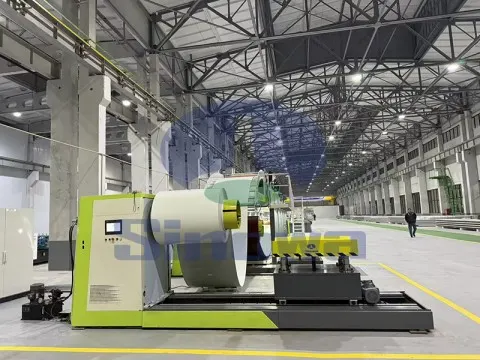
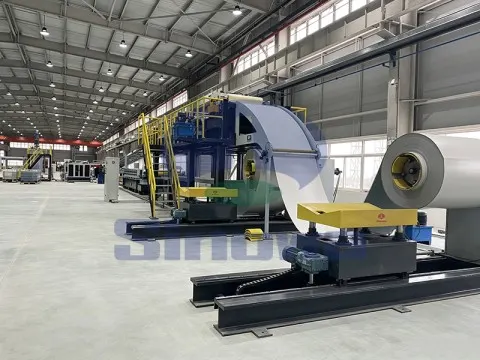
The surface material unwinding system serves as the starting terminal of the automatic sandwich panel production line, undertaking the task of continuously and stably supplying upper and lower surface materials for sandwich panels. This system is composed of multiple sets of unwinding racks, tension adjustment components, and deviation correction devices. Different types of coiled surface materials can be installed on the unwinding racks, and the mechanical clamping structure ensures the firm fixation of material coils to prevent material deviation during high-speed transmission. The tension adjustment component adopts a mechanical induction structure to monitor the tightness of surface materials in real time. When the material transmission resistance changes slightly, the component can automatically adjust the unwinding speed to maintain constant tension, effectively avoiding material wrinkling, stretching, and fracture problems. The deviation correction device uses sensor induction technology to identify the offset state of surface materials during transmission. Once lateral deviation is detected, the mechanical adjustment mechanism will make fine corrections to ensure that the surface materials are always transmitted along the preset track. In actual production, this system can realize non-stop coil replacement through the alternate working mode of double unwinding racks, which eliminates the production shutdown time caused by raw material replacement and further improves the continuous production capacity of the entire line. Before entering the composite molding area, the surface materials will also pass through a dust removal and flattening unit to remove surface impurities and smooth out subtle folds, providing a clean and flat base for subsequent foaming and bonding processes.
The raw material metering and mixing unit is the core device that controls the foaming quality of polyurethane core materials, directly affecting the density, uniformity, and thermal insulation performance of the sandwich panel interlayer. Polyurethane foaming raw materials are composed of multiple chemical components, and the precise proportion of each component is the key to ensuring stable foaming reactions. This unit is equipped with high-precision metering pumps and flow monitoring sensors, which can quantitatively transport different chemical raw materials to the mixing chamber according to the preset ratio. The internal structure of the mixing chamber adopts a spiral stirring design, which can realize rapid and uniform mixing of multi-component raw materials. The high-speed shear force generated during the stirring process makes the chemical components fully fused, avoiding local concentration differences that may cause uneven foaming. In order to adapt to different production environments and product requirements, the mixing unit is equipped with an independent temperature regulation structure. It can adjust the raw material temperature within a reasonable range to ensure that the chemical reaction rate of polyurethane foaming remains stable under different ambient temperatures. All metering parameters and mixing working states are fed back to the centralized control terminal in real time, and the system can automatically fine-tune the material delivery flow according to the foaming state, so as to maintain the consistency of the core material density of each batch of panels.
The foaming and composite molding area is the central functional section of the continuous sandwich panel line, where the liquid polyurethane raw materials complete the conversion from liquid state to foam solid state and realize the composite bonding with upper and lower surface materials. After being evenly mixed, the liquid polyurethane raw materials are evenly coated on the continuously moving lower surface material through a quantitative spraying mechanism. The spraying mechanism adopts a wide-range uniform spraying design, which can control the spraying thickness and coverage area accurately according to the preset interlayer thickness parameters. With the gradual advancement of the transmission track, the liquid raw materials begin to undergo chemical foaming reactions, and the volume expands steadily to form a porous foam structure. During the foaming process, the upper surface material is gradually covered on the surface of the unconsolidated polyurethane foam through a laminating roller group. The gap between the upper and lower roller groups is precisely calibrated to match the preset thickness of the sandwich panel. The mechanical pressure generated by the roller group makes the surface materials closely fit with the foam core material, eliminating internal gaps and ensuring the integrity of the composite structure. The closed molding cavity in this area can isolate external air flow and maintain a stable reaction environment, preventing the foaming quality from being affected by external temperature and air flow changes. The slow and uniform transmission speed of the track provides sufficient time for the foaming reaction, so that the internal bubble structure of the polyurethane core material is fine and uniform, laying a foundation for the excellent thermal insulation and mechanical properties of the finished panel.
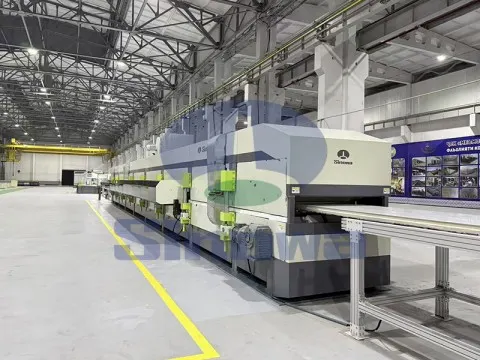
The constant-temperature curing tunnel is an indispensable functional module for stabilizing the structural performance of PU sandwich panels. After completing the composite molding, the preliminary shaped panels need to pass through the internal space of the curing tunnel to complete the final chemical curing and structural hardening. The interior of the curing tunnel is divided into multiple independent temperature control areas, and each area is equipped with a heating device and a temperature sensor. According to the curing characteristics of polyurethane materials, the system sets a gradient temperature rise and constant temperature maintenance mode. The low-temperature area at the entrance accelerates the preliminary solidification of the foam surface, the middle constant-temperature area promotes the complete cross-linking reaction of internal chemical molecules, and the slow cooling area at the exit relieves the internal stress of the panels. This segmented temperature control method avoids the quality defects such as internal cracking and surface deformation caused by excessive temperature difference. The sealed tunnel structure reduces heat loss, which not only ensures the curing effect but also improves energy utilization efficiency. During the curing process, the transmission track keeps running at a constant speed to ensure that each panel stays in each temperature area for the same time, realizing the consistency of curing degree. After curing, the bonding strength between the surface material and the core material is significantly improved, and the overall structural stability of the panel is enhanced, which can effectively resist external extrusion and bending deformation in subsequent use.
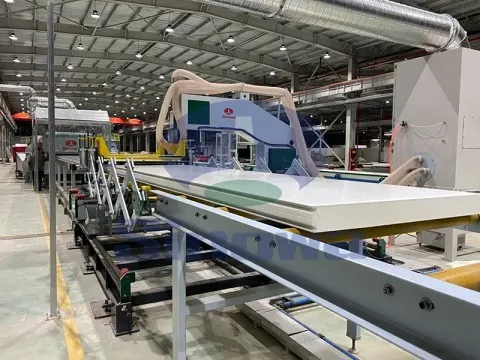
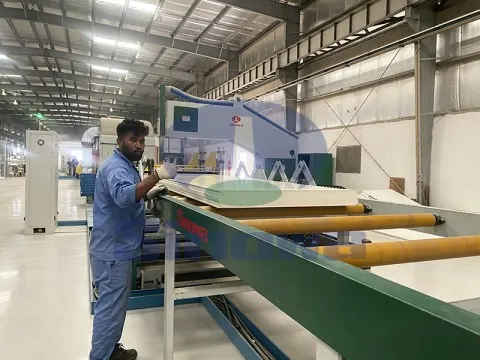
The fixed-length cutting and edge trimming system undertakes the finishing processing work of cured sandwich panels, realizing the standardized sizing and smooth edge treatment of finished products. This system is equipped with high-precision induction positioning sensors and high-speed cutting execution components. When the continuously transmitted panels reach the preset length, the sensor sends a trigger signal, and the cutting tool completes the transverse cutting action in an instant. The cutting tool adopts a wear-resistant alloy structure, which can keep the cutting edge flat and smooth for a long time without burrs and cracks. In order to meet the dimensional accuracy requirements of industrial production, the system supports arbitrary setting of cutting length within the applicable range, and the error of finished product length is controlled within a tiny fluctuation range. After cutting, the panels will enter the edge trimming process. The trimming device polishes and cuts the four edges of the panels to remove residual foam and uneven edge materials generated during the molding process. For panels with special edge sealing requirements, the system can also complete simple edge wrapping and shaping operations to enhance the edge sealing tightness of the panels. All cutting and trimming actions are automatically completed by mechanical equipment without manual auxiliary operation, which not only improves processing efficiency but also ensures the uniformity of panel size and appearance quality.
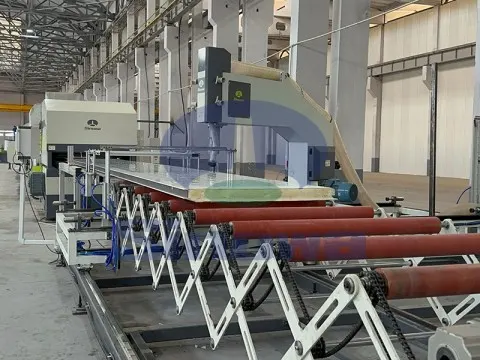
The finished product conveying and stacking system is located at the terminal of the continuous sandwich panel production line, responsible for the orderly transportation, temporary storage, and automatic stacking of processed qualified panels. The conveying mechanism adopts a roller transmission structure with stable operation, which can smoothly transport the cut panels to the stacking area. The surface of the conveying roller is treated with anti-slip and wear resistance to prevent the surface of the panels from being scratched during transportation. The automatic stacking device is equipped with a mechanical grabbing structure, which can adjust the grabbing position and clamping force according to the size and weight of the panels. It neatly stacks the panels on the storage platform in a fixed arrangement, avoiding chaotic accumulation and panel collision damage. The system is integrated with an automatic counting function, which can record the number of finished products in real time and synchronize the data to the control terminal, facilitating production quantity statistics and inventory management. In addition, the terminal is equipped with a simple quality inspection identification component, which can preliminarily screen out individual panels with obvious surface defects and size deviations, reducing the proportion of defective products entering the storage link. The integrated design of conveying and stacking realizes the seamless connection of the final link of production, further improving the automation level of the entire production line.
The intelligent centralized control system is the brain of the fully automatic continuous PU sandwich panel production line, responsible for the unified scheduling and parameter regulation of all functional modules. The system takes the programmable logic controller as the core control component, and is equipped with an intuitive human-computer interaction interface. Operators can complete the setting of production parameters such as panel thickness, raw material ratio, transmission speed, and curing temperature through the touch operation interface. The system is embedded with a real-time data acquisition module, which can continuously collect operating data including motor speed, material flow, cavity temperature, and transmission tension. All collected data is presented on the interaction interface in the form of digital values and dynamic curves, making the production state transparent and controllable. In the normal production process, the system maintains an automatic operation state, and dynamically adjusts the operating parameters of each module according to the real-time production feedback to ensure the coordination and consistency of the overall operation. When abnormal conditions such as material blockage, parameter deviation, and equipment failure occur, the system will automatically trigger an early warning mechanism, pop up fault prompt information on the interface, and perform emergency shutdown operations for abnormal modules to avoid equipment damage and mass production of defective products. In addition, the system has a data storage function, which can record the production parameter data of each production batch, providing data support for subsequent production optimization and quality traceability.
The fully automatic continuous PU sandwich panel machine has outstanding material compatibility and can adapt to a variety of surface materials and polyurethane raw material formulas to meet the differentiated production needs of different application scenarios. In terms of surface materials, the production line can process metal color steel coils, inorganic non-metallic plates, and composite fiber plates. Different surface materials have different physical characteristics such as surface smoothness and hardness, and the production line can adapt to the transmission and processing requirements of various materials through the automatic adjustment of tension parameters and lamination pressure. In terms of core material raw materials, by adjusting the chemical ratio of polyurethane components, the density, porosity, and thermal conductivity of the foam core material can be changed, so as to produce sandwich panels with different thermal insulation grades and mechanical strength. For panels used in special environments such as high humidity and corrosion resistance, the production line can also be matched with modified polyurethane raw materials to enhance the moisture resistance and chemical stability of the core material. The wide material compatibility enables a single production line to complete the production of multiple types of sandwich panels, reducing the equipment procurement cost of manufacturing enterprises and improving the utilization rate of production equipment.
Compared with semi-automatic and intermittent production equipment, the fully automatic PU sandwich panel line has obvious comprehensive advantages in production efficiency, product quality, and production cost. In terms of production efficiency, the continuous non-stop production mode eliminates the waiting time for material replacement and equipment reset. The linear synchronous operation of each functional module makes the production rhythm stable and efficient, and the daily output is several times that of intermittent production equipment. In terms of product quality, the intelligent parameter control system realizes precise control of every link from raw material mixing to finished product molding. The consistent production environment and mechanical processing standards make the thickness, density, and bonding strength of each panel highly uniform, with low product defect rate. In terms of production cost, the high degree of automation reduces the number of on-site operators, saving labor input costs. The precise metering system avoids excessive waste of chemical raw materials, and the sealed production structure reduces raw material loss caused by external pollution. In addition, the integrated structural design reduces the failure probability of equipment operation, lowers the maintenance frequency and maintenance cost of the production line, and brings long-term economic benefits to production enterprises.
The finished sandwich panels produced by this continuous polyurethane sandwich panel production line have excellent comprehensive physical and chemical properties, covering multiple performance advantages such as light weight, thermal insulation, sound insulation, and weather resistance. The internal closed-cell porous structure of the polyurethane core material gives the panel extremely low thermal conductivity, which can effectively block heat transfer and achieve excellent thermal insulation and heat preservation effects. The composite structure formed by the tight bonding between the surface material and the core material enhances the overall mechanical strength of the panel. The panel can bear a certain external load without deformation and damage, and has good compression resistance and bending resistance. The dense closed-cell structure can isolate moisture penetration, making the panel have excellent moisture-proof and waterproof performance, and it can maintain stable performance in high-humidity environments for a long time. At the same time, the polyurethane core material has good sound absorption and noise reduction capabilities, which can weaken the transmission of external noise and improve the internal environmental comfort of buildings and equipment. In terms of weather resistance, the optimized polyurethane formula and composite structure can resist the aging effects of ultraviolet rays and temperature changes, and the service life of the panel is significantly prolonged.
Relying on superior product performance and standardized production quality, PU sandwich panels produced by fully automatic continuous production lines are widely used in multiple industrial and civil fields. In the construction industry, such panels are used for the enclosure structures of prefabricated buildings, cold storage buildings, and industrial workshops. Their lightweight characteristics reduce the bearing pressure of building foundations, and the efficient thermal insulation performance meets the energy-saving requirements of buildings. In the transportation industry, they can be used for the inner lining of refrigerated transport vehicles and insulated containers, providing a stable low-temperature storage environment for transported goods. In the field of industrial purification, the smooth and dust-free surface of the panels meets the production environment requirements of pharmaceutical, food, and electronic processing workshops, realizing dust-free and sterile space construction. In addition, the panels can also be applied to agricultural breeding buildings, outdoor temporary facilities, and other scenarios, providing thermal insulation and structural protection for different usage environments. With the continuous expansion of the application scope of energy-saving composite materials, the market demand for high-quality PU sandwich panels is constantly rising, which further promotes the popularization and application of continuous automatic production lines.
In terms of daily operation and maintenance, the fully automatic continuous polyurethane sandwich panel line adopts a humanized structural design to reduce the difficulty of equipment management. The key transmission parts of the production line are equipped with sealed lubrication structures, which can reduce the friction loss between mechanical parts and extend the service life of wearing parts. The detachable modular structure facilitates the daily cleaning and replacement of vulnerable components. Operators can quickly disassemble and clean the material spraying cavity and cutting tool components to avoid material residue affecting subsequent production quality. The intelligent monitoring system can record the operating status of each component in real time, judge the aging degree and wear state of parts through data changes, and remind maintenance personnel to carry out regular maintenance and replacement. The production line is also equipped with a perfect safety protection structure. The closed protective cover is installed outside the high-speed operating components, and the emergency stop buttons are arranged at multiple positions on the production line to ensure the personal safety of operators during equipment operation. Standardized daily maintenance procedures can effectively reduce equipment failure rate, maintain long-term stable operation of the production line, and ensure the continuity and stability of enterprise production.
With the continuous progress of industrial manufacturing technology, the technical upgrading direction of fully automatic continuous polyurethane sandwich panel machine is gradually leaning towards intelligence, energy conservation, and environmental protection. In terms of intelligent optimization, the production line will be combined with industrial Internet and data analysis technology to realize remote monitoring and intelligent debugging of production equipment. The system can independently optimize production parameters according to historical production data and market demand, further improving production intelligence. In terms of energy saving and consumption reduction, the heating and heat preservation components of the production line will adopt high-efficiency energy-saving materials to reduce heat loss. The optimized mechanical transmission structure can reduce electric energy consumption during equipment operation, realizing green and low-carbon production. In terms of environmental protection improvement, the production line will be equipped with waste gas recovery and purification devices to treat trace volatile gases generated during polyurethane foaming, reducing the impact on the production environment. In addition, the production line will strengthen the recycling of leftover materials generated in the cutting process, improve the comprehensive utilization rate of raw materials, and conform to the development trend of modern green manufacturing industry.
In conclusion, the fully automatic continuous PU sandwich panel manufacturing line integrates mechanical transmission, chemical reaction control, intelligent parameter regulation, and precision processing technology. It is a highly efficient and mature composite material production equipment. From raw material feeding to finished product stacking, the whole production process realizes automated and continuous operation, which not only simplifies the production process of PU sandwich panels but also comprehensively improves product quality and production efficiency. The reasonable structural layout, stable operating performance, and wide material compatibility make the production line adapt to the production needs of various types of sandwich panels. The excellent performance of finished products also expands the application boundary of composite panels in multiple industries. With the continuous development of the building material manufacturing industry and the continuous improvement of energy-saving and environmental protection standards, the fully automatic continuous PU sandwich panel line will continue to exert important application value in the field of composite material production. It will also keep pace with the times in technological iteration, continuously optimize production performance, and provide more reliable and efficient production support for the high-quality development of the modern composite material industry.
Sinowa is a professional manufacturer of sandwich panel machine in china, we provide diversified and high-performance sandwich panel production lines, including fully automatic continuous PU sandwich panel line and customized special lines to meet mass production and personalized order demands. These sandwich panel lines support processing multiple foam core materials, such as PU, PIR, mineral wool, rock wool and glass wool, covering different insulation and fireproof standards.
Featuring stable operation, high efficiency, energy saving and easy maintenance, our PU sandwich panel line deliver sandwich panels with excellent thermal insulation, fire resistance, sound insulation and lightweight durability. The finished panels are widely applied in industrial workshops, warehouse roofing and wall cladding, cold storage insulation, serving global construction and industrial insulation markets.
https://www.cnsinowa.com/sandwich-panel-machines/fully-automatic-continuous-pu-sandwich-panel-line.html