 sandwich panel line
The overall structural design of the continuous roof wall sandwich panel production line follows the logic of streamlined production, with all functional units arranged in a linear sequential layout to ensure the stable transmission of raw materials and semi-finished products. The entire production system is composed of multiple interconnected functional modules, including a raw material unwinding and pretreatment module, a surface profiling and shaping module, a core material raw material metering and mixing module, an integral composite laminating module, a thermal insulation curing module, a cooling shaping module, a fixed-length cutting module, and an automatic stacking and discharging module. Each module is coordinated through a unified transmission and control system, and the operating parameters of each link are dynamically matched to avoid production rhythm mismatches that may cause product defects. The main frame of the production line is made of high-strength metal structural parts, which can bear long-term continuous operating loads and maintain structural stability under different ambient temperature and humidity conditions, providing a reliable mechanical foundation for high-frequency cyclic production.
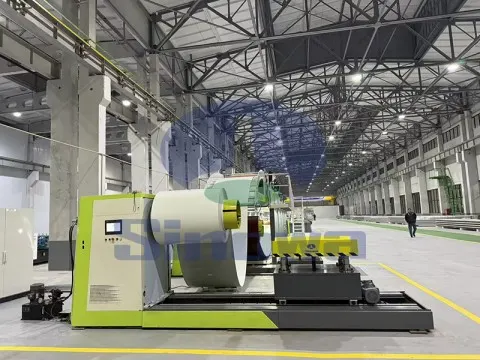
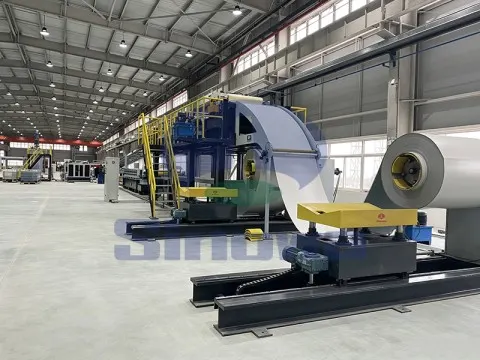
The raw material unwinding and pretreatment module is the starting link of the entire production process, undertaking the task of providing qualified surface base materials for subsequent composite processing. Metal coiled materials commonly used for panel surfaces are placed on multi-station unwinding brackets, which are equipped with automatic tension adjustment devices. During the unwinding process, the system keeps the surface material in a flat and tight state to prevent wrinkles, deviations and tensile deformation caused by uneven tension. After unwinding, the surface materials will pass through a series of pretreatment processes. The surface cleaning device removes dust, oil stains and fine attachments on the surface of the coiled materials to ensure the bonding firmness between the surface material and the core material. Then, the surface leveling mechanism conducts fine correction on the flatness of the coiled materials to eliminate subtle bending deformation generated during coiling and transportation. For surface materials that need edge sealing and bending, the edge trimming mechanism will cut the edges of the coiled materials to ensure consistent width of the surface materials, and reserve a reasonable bending allowance for subsequent edge crimping and locking connection of the panels. This pretreatment process eliminates potential quality hazards of raw materials in advance and lays a foundation for the uniformity of subsequent composite molding.
The surface profiling and shaping module is responsible for processing flat metal coiled materials into specified geometric profiles suitable for roof and wall use. According to the structural design requirements of building enclosure panels, this module is equipped with multiple groups of rolling forming units, and each group of rolling rollers is arranged in an orderly manner according to the deformation gradient. The flat surface material gradually completes bending, embossing, groove pressing and other molding actions under the gradual extrusion of the rolling rollers, forming wave-shaped, ribbed or flat composite substrate structures. The rolling speed and roller gap are precisely controlled to ensure that the surface material does not produce cracking or excessive tensile deformation during cold bending molding. For roof panels with drainage requirements, the profiling unit can mold uniform drainage grooves and overlapping clamping structures on the surface of the plates, which facilitates the seamless lap joint of on-site installed panels and optimizes the waterproof performance of the building enclosure. After profiling, the shaping and correcting device will calibrate the overall dimension of the molded surface material to ensure that the curvature, groove depth and edge flatness of each batch of surface materials maintain high consistency.
The core material raw material metering and mixing module is the key link to determine the thermal insulation and mechanical properties of sandwich panels. This module is mainly applicable to various organic and inorganic thermal insulation core materials, including polyurethane foam, rock wool, phenolic foam and other common thermal insulation substrates. For foamed core materials, the system adopts a fully enclosed automatic metering device to accurately extract different chemical raw materials according to the preset proportion. The high-speed stirring unit conducts homogeneous mixing of raw materials to ensure that each component is evenly fused, avoiding local density differences caused by uneven mixing. The mixing temperature and stirring speed are regulated in real time to adapt to the chemical reaction characteristics of different core material formulas, so that the mixed raw materials have stable fluidity and foaming activity. For inorganic fiber core materials such as rock wool, this module is equipped with fiber spreading and uniform distributing equipment to break up agglomerated fiber raw materials, form continuous and uniform fiber layers, and ensure that the thickness and density of the core material layers remain stable in the continuous conveying process. The entire metering and mixing process is carried out in a closed space, which reduces the loss of raw materials and avoids the impact of external dust and impurities on the purity of the core materials.
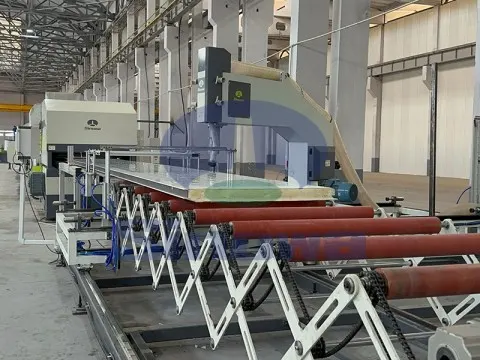
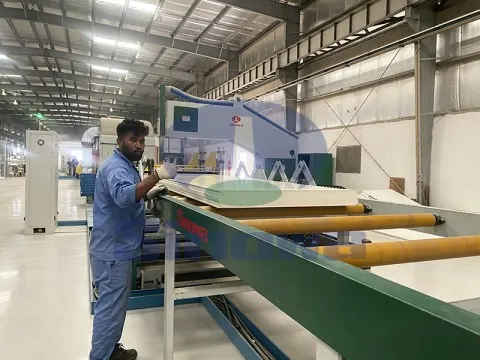
The integral composite laminating module realizes the precise bonding of the upper and lower surface materials and the thermal insulation core material, which is the core working section of the continuous sandwich panel production line. The molded lower surface material is stably transported to the composite station through the conveying roller table, and the mixed core material raw materials are evenly sprayed or laid on the surface of the lower surface material through the automatic distributing device. With the continuous advancement of the conveying system, the upper surface material is gradually buckled and covered on the unfixed core material, forming a three-layer composite structure of upper surface material, core material and lower surface material. The composite laminating unit is equipped with multi-group pressure adjusting rollers, which apply uniform and stable pressure to the composite plate blank. The pressure value is reasonably set according to the hardness and molding characteristics of different core materials to ensure that the core material is fully filled between the upper and lower surface materials without excessive compression deformation. At the same time, the lateral deviation correction device dynamically monitors the overlapping accuracy of the upper and lower surface materials to avoid lateral dislocation of the surface materials during the composite process, ensuring that the overall dimensional symmetry of the composite plate blank is within a reasonable error range.
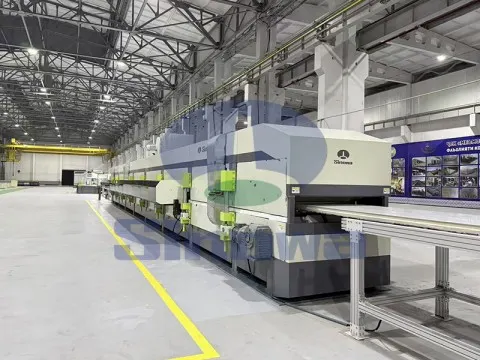
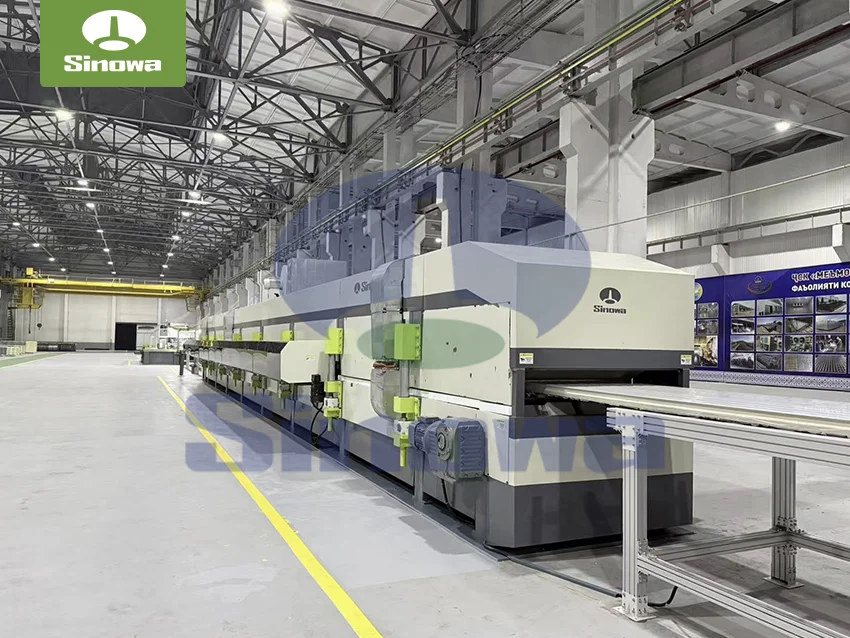
The thermal insulation curing module provides a stable temperature environment for the chemical curing and structural molding of composite plates. After the composite plate blank enters the closed curing channel, the internal temperature of the channel is maintained within the optimal reaction temperature range required by the core material through the circulating heating system. For chemically foamed core materials, the constant temperature environment accelerates the cross-linking reaction between raw materials, promotes the completion of foaming and solidification, and enhances the internal structural compactness of the core material. For fiber core materials bonded with adhesives, the thermal environment accelerates the volatilization of adhesive solvents and the curing reaction of glue layers, improving the bonding strength between the core material and the surface materials. The internal space of the curing channel is designed with layered heat preservation structures to reduce heat loss, and the circulating air system makes the internal temperature distribution uniform, avoiding local overheating or low temperature that leads to inconsistent curing degree of the plates. The curing time is matched with the production line conveying speed to ensure that each plate blank stays in the curing channel for sufficient time to complete the structural stabilization reaction.
The cooling shaping module is arranged behind the curing channel, aiming to reduce the temperature of the cured plates to room temperature and eliminate internal stress. The high-temperature composite plates coming out of the curing channel have unstable internal molecular structures and residual thermal stress, which are prone to bending deformation and dimensional shrinkage after natural cooling. This module adopts a combined cooling mode of forced air cooling and auxiliary water cooling. The low-temperature circulating air flows evenly over the surface of the plates to take away surface heat, and the bottom cooling roller table conducts indirect heat conduction to dissipate the internal heat of the plates. The cooling speed is controlled in a gradual decreasing mode to prevent rapid temperature drop from causing structural cracks inside the core material and peeling between layers. During the cooling process, the flattening pressing device keeps the plates in a horizontal stress-balanced state, further optimizing the flatness of the plates and ensuring that the plates have stable geometric dimensions and mechanical properties after entering the subsequent processing links.
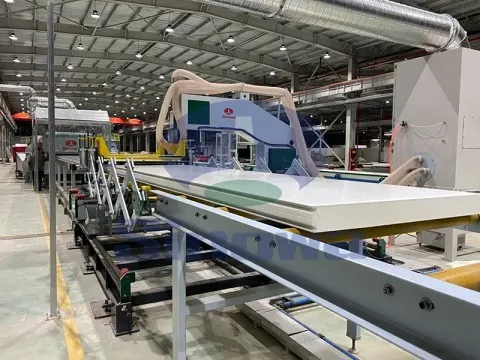
The fixed-length cutting module completes the precise cutting of continuous long plates according to customized size requirements. This module is equipped with high-precision induction positioning sensors, which record the conveying distance of the plates in real time and send cutting instructions when the plates reach the preset length. The cutting mechanism adopts a stable shear structure, which can complete the cutting action in an instant. The cutting section is smooth and flat without burrs, cracks and indentation damage. Before cutting, the positioning locking device fixes the plates to prevent position deviation caused by plate vibration during cutting. The system supports flexible switching of cutting lengths, which can meet the production requirements of plates with different specifications for roofs and walls. In addition, the trimming function is integrated on both sides of the cutting module to trim the uneven edges generated in the composite process, so that the overall outline of the finished plates is neat and uniform, reducing the processing procedures for on-site installation.
The automatic stacking and discharging module is the final link of the continuous sandwich panel line, realizing automatic collection and arrangement of finished plates. The cut finished plates are transported to the stacking station through the conveying device. The servo-driven mechanical grabbing mechanism accurately absorbs and lifts the plates, and places them on the stacking platform according to the preset arrangement sequence. The intelligent positioning correction system dynamically adjusts the placing position of each plate to ensure that the stacked plates are neatly aligned without offset. The stacking height can be automatically detected, and when the stacking quantity reaches the set standard, the system will send a material changing reminder to facilitate the staff to carry out packaging and transferring operations. The entire stacking process does not require manual contact with the plates, which avoids surface scratches and collision damage caused by manual handling, and effectively improves the appearance quality of finished products. At the same time, the automatic stacking mode simplifies the later warehousing and transportation procedures and improves the overall production turnover efficiency.
In terms of material adaptability, the continuous roof wall sandwich panel production line has strong compatibility and can realize the switching production of multiple types of sandwich panels by adjusting process parameters. In terms of surface materials, it can adapt to metal plates with different thicknesses and surface treatments, as well as non-metal decorative plates with corrosion-resistant and fire-proof characteristics. In terms of core materials, it can be compatible with organic foam materials with low thermal conductivity and inorganic fiber materials with high fire resistance. By adjusting the metering ratio of raw materials, composite pressure and curing temperature, the production line can manufacture plates with different thermal insulation coefficients, compressive strength and fire resistance grades, meeting the diversified use needs of different building scenarios. For special-purpose panels such as purification enclosure plates and cold storage thermal insulation plates, the production line can optimize the surface coating treatment and core material density configuration to enhance the anti-corrosion, antibacterial and low-temperature resistance of the products.
The intelligent control system is the brain of the automatic sandwich panel production line, realizing the integrated management of all production links. The centralized control terminal collects the operating data of each functional module in real time, including conveying speed, raw material metering proportion, curing temperature, cutting size and stacking quantity. The system adopts closed-loop logic control, which can automatically fine-tune the operating parameters of each unit according to the real-time production state. When minor parameter deviations occur in the production process, the system can complete self-correction without manual intervention. For abnormal conditions such as raw material shortage, equipment jamming and temperature abnormality, the intelligent monitoring unit will trigger an early warning prompt and perform emergency shutdown protection to avoid equipment damage and defective product accumulation. The operating data generated in the production process can be automatically stored, which is convenient for production personnel to count output, analyze product quality fluctuations and optimize production processes in the later stage.
In terms of production performance advantages, the continuous roof wall sandwich panel manufacturing line has significant improvements in production efficiency and product stability compared with traditional intermittent production equipment. The uninterrupted streamlined production mode eliminates the waiting time for feeding and mold closing in batch production, greatly improves the effective production time, and realizes large-scale continuous output. The unified parameter setting and automatic control mode reduce the quality differences between different batches of products. The thickness of the core material, the bonding uniformity of the composite layer and the dimensional accuracy of the finished plates are maintained at a high stable level. In addition, the centralized raw material supply and closed production structure reduce the waste of raw materials, and the optimized transmission structure reduces mechanical energy consumption, which has outstanding energy-saving and consumption-reducing effects in long-term production operations.
In practical industrial application, the continuous roof wall sandwich panel line has optimized many details for production stability and maintenance convenience. The transmission parts of the equipment are equipped with dust-proof and wear-resistant protective structures, which can adapt to the harsh production environment with dust and raw material residues, reducing the wear loss of mechanical parts. The quick disassembly structure is adopted for key vulnerable parts, which facilitates daily inspection, cleaning and replacement of parts by maintenance personnel. The humanized operation interface simplifies the parameter setting steps, and the production personnel can complete the switching of different product specifications through simple operation logic. At the same time, the production line is equipped with a sound insulation and shock absorption structure, which reduces the noise and vibration generated during mechanical operation, improves the on-site production environment, and reduces the impact of vibration on the precision components of the equipment.
With the continuous improvement of building energy-saving standards and the continuous expansion of the prefabricated building market, the market demand for high-quality continuous sandwich panels is showing a steady growth trend. The continuous roof wall sandwich panel production line, as an efficient and intelligent manufacturing carrier, continuously outputs standardized and high-performance building enclosure panels for the construction industry. The produced panels have the advantages of light weight, high strength, convenient installation, good thermal insulation and weather resistance, which can shorten the on-site construction cycle of buildings and reduce the comprehensive construction cost. In the future, with the further development of intelligent manufacturing technology, the continuous production line will evolve towards higher automation integration, more diversified material adaptation and lower energy consumption. The optimization of intelligent sensing, automatic debugging and green production technology will further enhance the production capacity and product quality of the equipment, and provide more reliable material support for the high-quality development of the modern construction industry.
Sinowa is a professional manufacturer of sandwich panel machine in china, we provide diversified and high-performance sandwich panel production lines, including fully automatic continuous PU sandwich panel line and customized special lines to meet mass production and personalized order demands. These sandwich panel lines support processing multiple foam core materials, such as PU, PIR, mineral wool, rock wool and glass wool, covering different insulation and fireproof standards.
Featuring stable operation, high efficiency, energy saving and easy maintenance, our PU sandwich panel line deliver sandwich panels with excellent thermal insulation, fire resistance, sound insulation and lightweight durability. The finished panels are widely applied in industrial workshops, warehouse roofing and wall cladding, cold storage insulation, serving global construction and industrial insulation markets.
https://www.cnsinowa.com/sandwich-panel-machines/continuous-roof-wall-sandwich-panel-production-line.html