 sandwich panel line
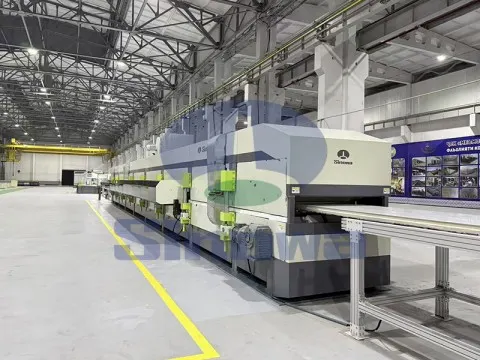
A comprehensive understanding of the basic composition and structural layout of the continuous insulated sandwich panel production line is essential for grasping its operational logic and production advantages. The entire production system adopts a linear horizontal layout, with each functional unit arranged in sequence according to the production process flow to ensure the one-way steady movement of raw materials and semi-finished products. The overall structure can be divided into multiple interconnected functional sections, including raw material unwinding and pretreatment section, chemical raw material metering and mixing section, core material foaming and composite molding section, constant temperature curing and shaping section, surface trimming and precision cutting section, as well as finished product conveying and automatic stacking section. Every section is equipped with independent power transmission devices and intelligent adjustment components, and all sections maintain a synchronous operating speed through a unified control system, avoiding production defects such as material dislocation and bonding separation caused by speed differences. The main frame of the continuous sandwich panel line is made of high-strength metal structural parts with anti-deformation treatment, which can maintain structural stability under long-term continuous operation and withstand the mechanical pressure generated in the foaming and composite molding process. In addition, the internal circulation system of the continuous sandwich panel production line is equipped with temperature regulation modules and dust removal devices to optimize the production environment inside the equipment, reduce the interference of external temperature and dust on panel molding quality, and lay a solid foundation for consistent product performance.
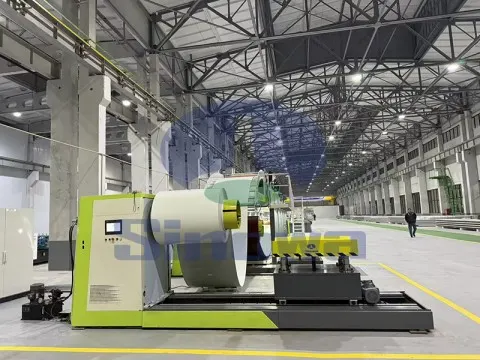
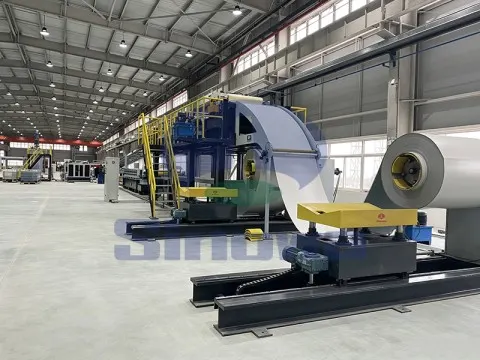
The raw material unwinding and pretreatment section serves as the starting link of the entire production process, undertaking the task of providing qualified surface layer materials for subsequent composite processing. This section is mainly composed of unwinding racks, tension control assemblies, surface cleaning devices, and preheating components. The unwinding racks are designed to carry coiled surface materials, and the quantity of racks is configured according to the production requirements of double-sided composite panels, realizing synchronous unwinding of upper and lower surface layers. Common surface layer materials include metal color-coated sheets, corrosion-resistant alloy plates, and lightweight fiber-reinforced plates, all of which are supplied in coiled form to adapt to continuous feeding requirements. The tension control assembly adopts a flexible adjustment structure to maintain constant tension during the unwinding process, preventing elastic deformation, wrinkling, or uneven stretching of thin plate materials due to excessive tension or loose accumulation caused by insufficient tension. After unwinding, the surface materials pass through the cleaning device, which removes surface dust, oil stains, and oxide impurities through physical brushing and air blowing, ensuring that the bonding interface between the surface layer and the core material is clean and improving the adhesion tightness between layers. The preheating component conducts uniform low-temperature heating on the cleaned surface materials, eliminating the temperature difference on the material surface caused by ambient temperature changes. Preheating can also activate the molecular activity of the material surface, enhance the combination effect with foaming raw materials, and effectively avoid hollowing and delamination problems between the surface layer and the core layer of finished panels.
The chemical raw material metering and mixing section is the core functional unit that determines the thermal insulation performance and internal structure stability of sandwich panels, mainly responsible for the precise proportioning and homogeneous mixing of foaming raw materials. This section is equipped with sealed storage tanks, quantitative delivery pumps, high-speed mixing devices, and pipeline circulation systems. The raw materials used for core layer foaming include isocyanate, polyether polyol, and various auxiliary additives, which are stored in independent sealed tanks to prevent chemical reactions caused by raw material mixing in advance and avoid raw material deterioration due to contact with external air and moisture. Each storage tank is matched with a high-precision quantitative delivery pump, which can accurately control the feeding amount of different raw materials according to the preset formula parameters. The proportioning ratio is adjustable within a certain range to adapt to the production requirements of core materials with different densities and thermal conductivity. After quantitative extraction, multiple raw materials are transported to the high-speed mixing device through sealed pipelines. The mixing chamber adopts a fully enclosed structure to prevent the volatile substances generated during raw material mixing from diffusing into the external environment. The built-in stirring blades carry out high-speed swirling mixing to make various chemical raw materials fully fused at the molecular level, forming a uniform liquid mixed material. The mixing speed and stirring time can be intelligently adjusted according to the production speed and panel thickness, ensuring that the mixed material has stable fluidity and reaction activity, which is conducive to uniform foaming in the subsequent process.
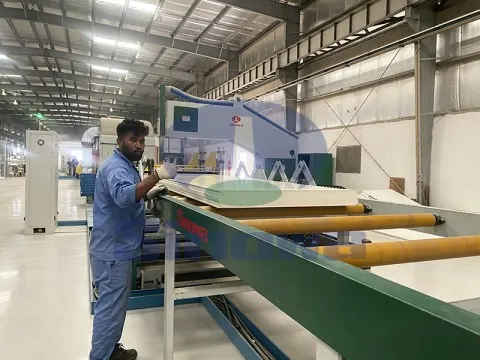
The core material foaming and composite molding section is the key link to realize the integral molding of insulated sandwich panels, completing the processes of liquid material pouring, foaming expansion, and multi-layer material composite bonding. After mixing, the liquid foaming material is evenly poured on the horizontally moving lower surface layer through a controllable pouring nozzle. The pouring nozzle adopts a strip-shaped discharge structure to ensure that the liquid material is evenly distributed in the width direction of the plate, avoiding local material accumulation or sparse distribution. With the progress of chemical reaction, the liquid mixed material begins to expand slowly and generate fine and dense porous structures inside. During the foaming process, the upper surface layer is gradually folded and covered on the surface of the expanding foaming material through a guiding roller set. The upper and lower surface layers and the intermediate foaming raw materials jointly enter the pressing molding unit. The molding unit is composed of upper and lower parallel pressing conveyor belts, and the gap between the two conveyor belts is precisely adjusted according to the designed thickness of the panel. Under the combined action of mechanical pressure and chemical expansion force, the foaming material fills the gap between the two surface layers, and the porous structure is gradually stabilized. Meanwhile, the surface of the foaming material closely fits with the inner side of the surface layer, forming a preliminary bonded composite structure. The internal pressure of the molding unit is kept within a stable range through hydraulic adjustment components. Excessively high pressure will cause the foaming pores to collapse and reduce the thermal insulation effect, while excessively low pressure will lead to loose internal structure and insufficient bonding strength. Therefore, constant pressure control is crucial to ensure the comprehensive performance of the panel.
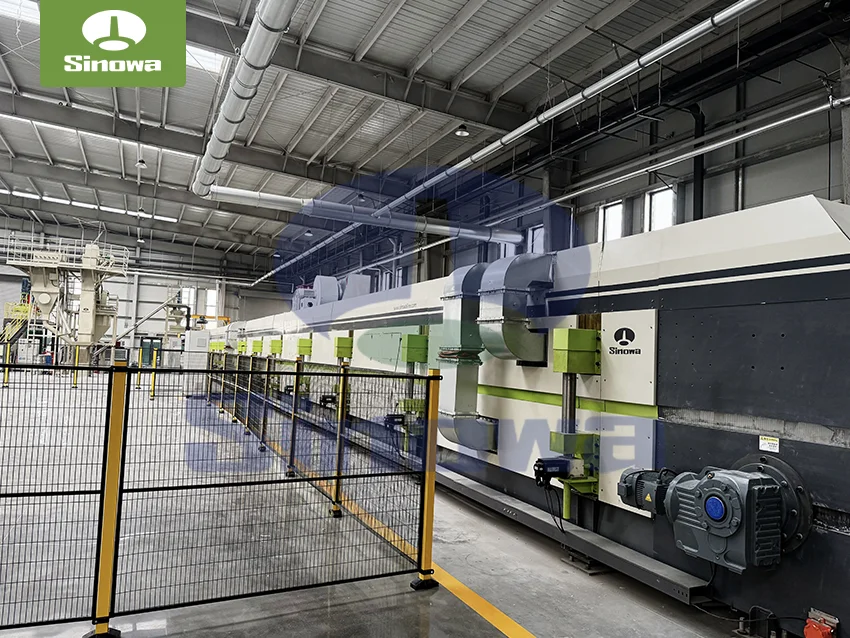
The constant temperature curing and shaping section undertakes the task of stabilizing the internal structure and bonding performance of semi-finished panels. After preliminary composite molding, the panels enter an insulated closed curing channel with a controllable internal temperature. The curing channel is equipped with circulating heating components and uniform air supply pipelines, which can form a stable and uniform temperature field inside the channel. The temperature parameters are adjusted according to the type of foaming raw materials and panel specifications, maintaining a constant temperature environment suitable for curing reactions. In this section, the chemical reaction of the intermediate foaming core material is completely completed, the internal porous structure is fully finalized, and the molecular bonding force between the core material and the surface layer is further enhanced. The continuous conveying structure inside the curing channel ensures that each part of the panel stays in the constant temperature environment for the same time, avoiding performance differences caused by uneven curing. In addition, the curing channel is equipped with heat preservation and heat insulation layers on the outer wall to reduce internal heat loss, improve energy utilization efficiency, and maintain the stability of the internal temperature field. After long-term constant temperature curing, the semi-finished panels change from flexible state to rigid fixed state, with stable overall size, no internal residual reaction stress, and greatly improved structural compression resistance and tensile resistance.
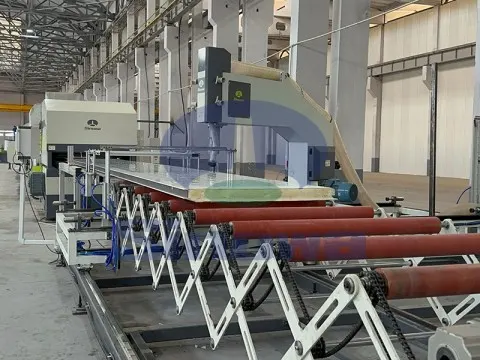
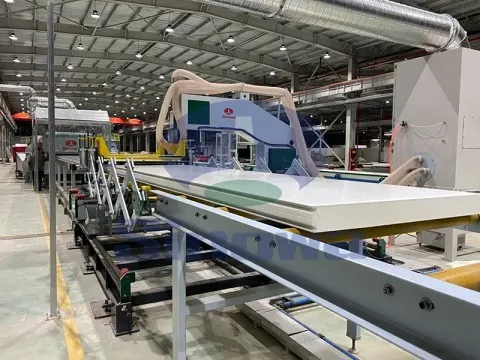
The surface trimming and precision cutting section processes the cured integral plates into finished products with standardized dimensions, realizing the unified specification of panels. After exiting the curing channel, the continuous long plates first pass through the edge trimming device. The edge trimming part is equipped with high-speed rotating cutting tools, which cut off the irregular residual materials on both sides of the plates to ensure that the width of the panels meets the preset standard. The trimmed edge is smooth and flat without burrs and cracks, which improves the aesthetic degree and assembly convenience of the panels. Subsequently, the long plates are transported to the fixed-length cutting device. The cutting system adopts intelligent positioning and sensing components, which can automatically measure the conveying distance of the plates and complete intermittent cutting according to the preset length parameters. The cutting tool is made of wear-resistant high-hardness materials, which can realize flat cutting without damaging the surface layer and internal core structure. During the cutting process, the dust removal and debris collection device synchronously operates to collect the cut residual materials, reducing material waste and keeping the production environment clean. All trimming and cutting actions are synchronized with the conveying speed of the sandwich panel production line, without stopping the production line for processing, which fully reflects the advantages of continuous production and ensures the continuity and high efficiency of the overall production rhythm.
The finished product conveying and automatic stacking section is the final link of the production line, responsible for the orderly transportation, temporary storage, and stacking of qualified finished panels. The cut standard panels are horizontally transported to the stacking station through the low-speed conveying platform. The stacking station adopts a double-station alternating operation structure. When one station completes stacking and material arrangement, the other station automatically receives subsequent panels, realizing uninterrupted docking of finished products and avoiding production line shutdown caused by slow stacking speed. The mechanical grabbing component of the stacking equipment adopts a flexible clamping structure, which can stably grab panels of different thicknesses and widths without squeezing and damaging the panel surface. During the stacking process, the equipment automatically adjusts the horizontal position of the panels to ensure neat stacking, consistent gaps between layers, and no lateral displacement. After the stacking quantity reaches the preset standard, the stacked panel groups are transported out of the stacking area through the mobile trolley, and new empty stacking positions are automatically supplemented to prepare for subsequent stacking work. This automated stacking mode replaces manual carrying and arrangement, reduces labor input, lowers the risk of panel surface damage caused by human operation, and improves the neatness and transportation convenience of finished product storage.
The intelligent control system runs through all functional sections of the continuous insulated sandwich panel production line, serving as the central brain to coordinate the synchronous operation of various mechanical components. The system adopts an integrated control mode with a human-computer interaction interface. Operators can set production parameters such as panel thickness, length, width, raw material proportioning ratio, and operating speed through the terminal. The internal data sensing modules are distributed in all sections of the sandwich panel manufacturing line, real-time collecting operating data including equipment operating speed, internal curing temperature, raw material feeding flow, and molding pressure. The collected data is transmitted to the central processing unit for real-time analysis and comparison with preset parameters. When subtle deviations of operating parameters occur, the system automatically sends adjustment instructions to the corresponding functional components to complete intelligent calibration, ensuring that all production links are always in a stable operating state. In addition, the control system is equipped with an abnormal monitoring and early warning mechanism. Once faults such as raw material interruption, equipment jamming, and temperature abnormality occur, the system will automatically trigger an alarm prompt and perform graded shutdown protection according to the fault severity, effectively avoiding equipment damage and mass production of defective products caused by abnormal conditions. The modular control design also facilitates daily maintenance and later function upgrading of the production line, improving the service life and scalable application capability of the equipment.
Compared with traditional discontinuous sandwich panel production equipment, the continuous insulated sandwich panel production line has prominent technical and production advantages in multiple dimensions. In terms of production efficiency, the continuous linear processing mode eliminates frequent startup, shutdown, and debugging links in intermittent production. All production processes are completed in one go, and the single-line daily output is far higher than that of batch production equipment, which can meet the large-scale order production demand of industrial manufacturers. In terms of product quality stability, the unified and controllable production environment realizes precise control of raw material proportioning, foaming pressure, curing temperature, and processing time. The internal pore structure of the produced panels is uniform, the bonding between layers is tight, and there is no obvious performance difference between different batches of products. In terms of material utilization rate, the sealed raw material conveying structure and precise quantitative feeding design reduce the volatilization and waste of chemical raw materials. The automatic trimming and cutting system can reasonably utilize raw materials, minimizing the generation of residual waste. From the perspective of operating cost, the highly automated production mode reduces manual operation links, lowers long-term labor investment costs, and the optimized structural design of the equipment reduces energy consumption during operation, achieving energy-saving and low-consumption production. In addition, the sandwich panel line has strong production flexibility. By adjusting process parameters and replacing individual functional components, it can produce insulated sandwich panels with different surface materials, core densities, and structural specifications, covering diversified product production needs.
The insulated sandwich panels produced by the continuous production line have excellent comprehensive performance and are widely used in multiple industrial and civil fields. In the field of industrial building construction, such panels are used for the enclosure walls, roof structures, and partition walls of factory buildings, workshops, and temporary construction facilities. They have light weight and high structural strength, which can reduce the load-bearing pressure of building structures. At the same time, their good thermal insulation performance effectively reduces the energy consumption of building temperature regulation. In the low-temperature storage industry, the panels serve as the main building materials for cold storage, refrigerated warehouses, and constant-temperature storage rooms. The dense porous core layer can effectively block heat transfer, maintain the low-temperature stability of the internal storage space, and reduce the operating energy consumption of refrigeration equipment. In the special purification engineering field, smooth and easy-to-clean surface materials cooperate with antibacterial and mildew-proof auxiliary raw materials to produce purification panels, which are applicable to the production workshops of pharmaceutical, food processing, and precision electronic manufacturing industries, meeting the high requirements of dust-free and sterile production environments. Moreover, such composite panels can also be used for the insulation and protection of transportation equipment such as refrigerated transport vehicles and special engineering containers, as well as the thermal insulation transformation of outdoor pipeline facilities, showing strong market adaptability.
In the actual production and application process, the daily maintenance and standardized operation of the continuous insulated sandwich panel production line are crucial to maintain stable equipment performance and extend service life. Daily maintenance work includes regular cleaning of residual raw materials and debris on the surface of conveying rollers, cutting tools, and mixing components to prevent material accumulation from affecting equipment operation accuracy. The transmission parts such as gears and bearings need regular lubrication treatment to reduce mechanical friction loss and avoid abnormal noise and jamming during operation. The sealing performance of chemical raw material storage tanks and conveying pipelines should be inspected regularly to prevent raw material leakage and air infiltration from causing raw material deterioration. The temperature sensing elements and pressure detection components in each section need regular calibration to ensure the accuracy of data monitoring. In terms of operation management, operators need to follow standardized operation procedures, avoid arbitrary modification of core process parameters, and complete equipment preheating and parameter debugging before formal production. After daily production is completed, the residual raw materials inside the equipment should be cleaned in time, and the power supply and air supply system should be cut off in sequence to ensure the safety of equipment shutdown. Scientific maintenance and standardized operation can effectively reduce equipment failure rate, maintain long-term stable production capacity of the production line, and reduce the comprehensive maintenance cost of the equipment.
With the continuous development of global energy-saving policies and advanced manufacturing technologies, the continuous insulated sandwich panel production line is evolving towards higher automation, lower energy consumption, and stronger intelligent optimization. At present, many upgraded production lines have introduced visual detection technology. The high-precision camera sensing components are installed behind the cutting section to automatically identify surface defects such as tiny cracks, bubbles, and uneven coatings on panels. The defective products are automatically marked and sorted, realizing intelligent screening of finished products and improving the qualification rate of delivered products. In terms of energy optimization, the heat recovery system is applied to the curing section. The waste heat generated during the heating process is recycled and reused for raw material preheating and equipment heat preservation, effectively reducing invalid energy consumption. In terms of structural upgrading, the modular combined design is adopted for the production line. Each functional section can be independently disassembled and assembled, which is convenient for equipment transportation, installation, and later functional expansion. In addition, in response to the market demand for environmentally friendly materials, the production line is gradually adapting to degradable and low-pollution foaming raw materials, optimizing the internal mixing and reaction structure to reduce harmful gas volatilization during the production process and realize green and environmentally friendly manufacturing.
In conclusion, the continuous insulated sandwich panel production line, as an efficient, stable, and highly integrated composite material manufacturing equipment, integrates multiple advanced processing technologies and realizes streamlined production of insulated sandwich panels from raw material processing to finished product output. Each functional section of the insulated panel line has a clear division of labor and close connection, jointly ensuring the high quality and stable performance of finished panels. Relying on its advantages of high production efficiency, low comprehensive consumption, and flexible product adaptation, this production line has become an indispensable key equipment in the insulated composite material manufacturing industry. Driven by technological innovation and market demand, the continuous insulated sandwich panel production line will continue to optimize its structural performance, upgrade intelligent control functions, and expand the application scope of compatible raw materials. It will provide more high-quality energy-saving composite panel products for the construction, cold chain, purification, and special engineering fields, and make important contributions to the development of energy-saving buildings and green industrial manufacturing in the global industry. In the future, with the deep integration of intelligent manufacturing and new material technology, such continuous production equipment will develop in the direction of higher intelligence, lower carbon emission, and stronger customization capability, continuously meeting the diversified and high-standard material demand of the industrial market.
Sinowa is a professional manufacturer of sandwich panel machine in china, we provide diversified and high-performance sandwich panel production lines, including fully automatic continuous PU sandwich panel line and customized special lines to meet mass production and personalized order demands. These sandwich panel lines support processing multiple foam core materials, such as PU, PIR, mineral wool, rock wool and glass wool, covering different insulation and fireproof standards.
Featuring stable operation, high efficiency, energy saving and easy maintenance, our PU sandwich panel line deliver sandwich panels with excellent thermal insulation, fire resistance, sound insulation and lightweight durability. The finished panels are widely applied in industrial workshops, warehouse roofing and wall cladding, cold storage insulation, serving global construction and industrial insulation markets.
https://www.cnsinowa.com/sandwich-panel-machines/continuous-insulated-sandwich-panel-production-line.html