How To Solve Surface Bubble Problems Of Panels From PU Foam Core Sandwich Panel Line
Sep 29, 2026
Surface bubbles are a common quality defect for panels produced from the PU foam core sandwich panel line, compromising surface flatness, adhesion performance and service durability.
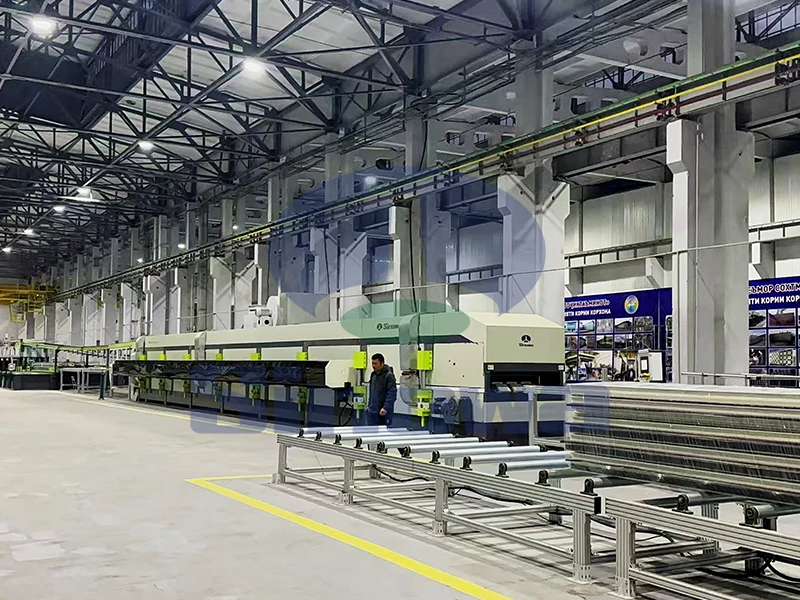
Surface bubble defects on panels manufactured by the PU foam core sandwich panel line mainly manifest as tiny pinholes, raised blisters and uneven hollow areas on panel surfaces, which not only damage the aesthetic appearance of finished panels but also weaken the bonding tightness between PU foam core and metal surface layers, easily leading to delamination and deformation during long-term use. Most bubble issues in the PU foam core sandwich panel line stem from unbalanced chemical reactions of PU foam materials and improper production parameter control. The core chemical trigger is the reaction between excess moisture in production links and isocyanate components, which generates carbon dioxide gas that cannot escape completely during foam curing and remains trapped between the surface layer and foam core to form bubbles. Meanwhile, irregular material mixing, unregulated ambient conditions and incomplete equipment exhaust also exacerbate bubble generation, making defect control a key technical focus for stable operation of the PU foam core sandwich panel line.
Raw material quality control is the primary step to eliminate surface bubbles on panels from the PU foam core sandwich panel production line. PU foam production relies on the precise proportion and purity of polyol, isocyanate, catalysts and surfactants, and any raw material abnormality will directly induce bubble defects. Excessive moisture in polyol raw materials is the most prevalent cause, as residual water continuously reacts with isocyanate during foaming to produce cumulative gas that forms surface bubbles. In addition, expired or impure surfactants fail to effectively adjust foam surface tension, resulting in uneven foam pore structure and local gas accumulation on panel surfaces. Uneven ratio of raw material components also disrupts the synchronization of foam gas generation and gel solidification, causing premature gas retention before the foam core is fully shaped. To solve this problem, production staff need to strictly inspect raw material dryness and purity before feeding, store raw materials in a dry and sealed environment to avoid moisture absorption, and calibrate raw material proportioning parameters regularly to ensure stable chemical reaction effects in the PU foam core sandwich panel line.
Ambient environmental parameter adjustment plays a vital role in reducing panel surface bubbles in the PU foam core sandwich panel manufacturing line. Production temperature, humidity and air flow directly affect the foaming speed, curing cycle and gas discharge efficiency of PU foam cores. High workshop humidity leads to condensed moisture on panel surface layers and production molds, which mixes into the foaming system and triggers secondary gas generation. Excessively high ambient temperature accelerates the foaming reaction speed, making foam cure too fast to allow internal gas to escape thoroughly, while low temperature delays curing and causes unstable foam structure with residual tiny bubbles. Poor workshop air circulation also leads to local gas accumulation around production equipment, hindering the discharge of floating gas generated during foaming. Enterprises need to maintain constant temperature and humidity in the production workshop of the PU foam core sandwich panel line, install dehumidification and ventilation equipment to keep air dry and flowing, and adjust environmental parameters dynamically according to real-time production conditions to create a stable foaming environment.
Equipment operation and maintenance optimization effectively avoids bubble defects in panels from the PU sandwich panel line. Core equipment such as mixing systems, feeding devices and molding molds directly determine the uniformity of PU foam molding. Insufficient mixing speed or uneven mixing of the PU foaming system causes local concentration differences of raw materials, leading to inconsistent reaction degrees and scattered bubble formation on panel surfaces. Blocked or unstable feeding pipelines result in discontinuous raw material supply, creating gaps in the foam core and forming surface concave bubbles. Moreover, incomplete mold venting design and residual dirt or release agent residue on mold surfaces will trap air and hinder gas discharge during foaming. Regular equipment maintenance is essential: clean mixing devices and feeding pipelines to ensure smooth material transmission, check and optimize mold venting structures to improve gas discharge efficiency, and standardize mold cleaning procedures to remove surface impurities, so as to eliminate equipment-induced bubble problems in the PU foam core sandwich panel line.
Standardized operational process management is crucial to control surface bubble quality of panels in the PU sandwich panel production line. Many subtle bubble defects come from non-standard manual operation and unreasonable production process settings. Improper feeding sequences and inaccurate feeding dosages disrupt the balanced reaction of PU foam raw materials, causing abnormal gas production. Unreasonable mold closing speed and pressure lead to uneven extrusion of foaming materials, trapping air between the surface layer and foam core. In addition, insufficient curing time before panel demolding makes the foam core incompletely solidified, and residual internal gas gradually forms surface bubbles after demolding. Production teams need to formulate standardized operation specifications for each process of the PU foam core sandwich panel line, unify feeding sequences, mixing time and mold pressure parameters, and set a reasonable curing cycle according to different panel specifications. Strengthening staff operation training to avoid arbitrary parameter adjustment and irregular operation can effectively reduce human-induced bubble defects.
Post-production inspection and remedial optimization further improves the finished product qualification rate of panels from the PU foam core sandwich panel line. Even with strict front-end control, occasional tiny surface bubbles may still appear due to subtle fluctuations in production conditions. Establishing a comprehensive post-production inspection mechanism helps detect bubble defects in a timely manner and avoid defective products entering subsequent processes. For micro surface bubbles that do not affect structural performance, targeted surface polishing and repair processes can be adopted to smooth panel surfaces and restore flatness. For panels with severe bubble and internal hollow problems, timely rework and material replacement are required to ensure product quality consistency. Meanwhile, production data of bubble defects should be recorded and analyzed regularly to summarize recurring problems, continuously optimize raw material proportioning, environmental parameters and equipment operation standards of the PU foam core sandwich panel line, and form a closed-loop quality control system to fundamentally reduce surface bubble defects.
Gallery
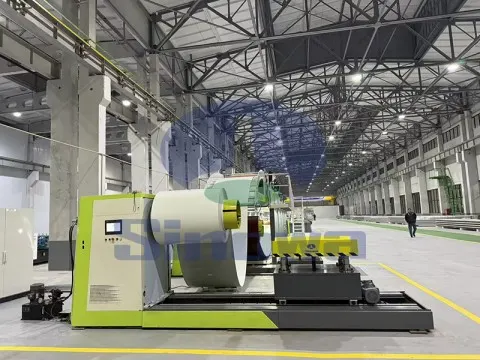
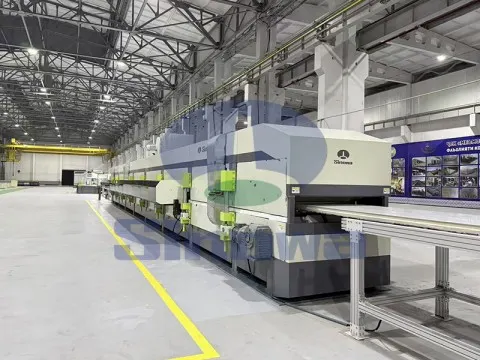
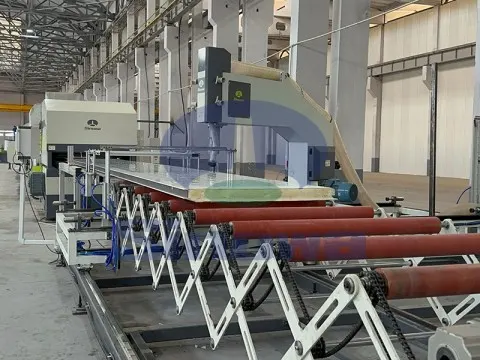
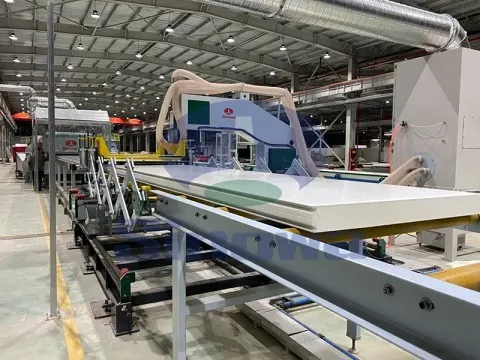
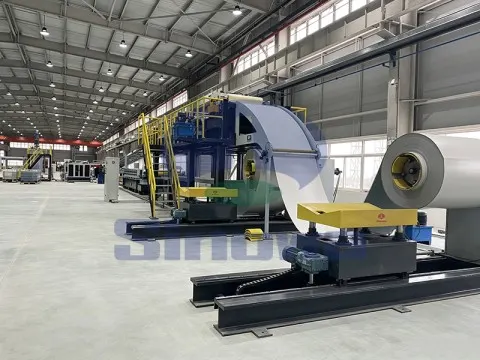
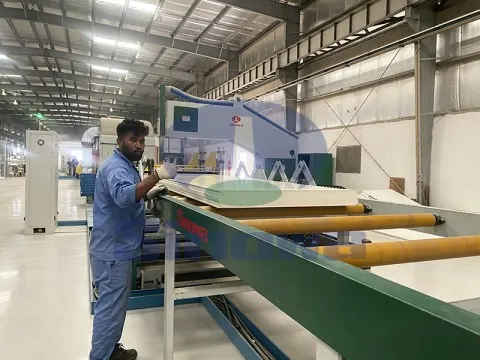
Sinowa is a professional manufacturer of sandwich panel machine in china, we provide diversified and high-performance sandwich panel production lines, including fully automatic continuous PU sandwich panel line and customized special lines to meet mass production and personalized order demands. These sandwich panel lines support processing multiple foam core materials, such as PU, PIR, mineral wool, rock wool and glass wool, covering different insulation and fireproof standards.
Featuring stable operation, high efficiency, energy saving and easy maintenance, our PU sandwich panel line deliver sandwich panels with excellent thermal insulation, fire resistance, sound insulation and lightweight durability. The finished panels are widely applied in industrial workshops, warehouse roofing and wall cladding, cold storage insulation, serving global construction and industrial insulation markets.
Main Products
-

Continuous PU Sandwich Panel Production Line
This continuous PU sandwich panel production line is an integrated automatic equipment. It covers uncoiling, forming, foaming, curing and cutting processes. With automatic raw material proportioning and precise temperature & pressure control, PIR sandwich panel production line continuously composites panels with double skins. Polyurethane sandwich panel production line stably produces steel and aluminum sandwich panels. Featuring high automation, the line makes fireproof and thermal-insulation panels for building enclosure and cold storage. -

Rock Wool Sandwich Panel Production Line
Continuous rockwool sandwich panel production line is an automatic integrated production equipment, consisting of uncoiling, forming, gluing and compounding, heating curing, fixed-length cutting, automatic stacking and other modules. The mineral wool sandwich panel production line continuously conveys color steel plates and rock wool core materials to automatically complete lamination and curing, which can produce fireproof and thermal insulation sandwich panels. Featuring high automation degree and stable operation, this production line is suitable for mass production of panels used for building walls, roofs and other scenarios. -

Phenolic Insulation Board Production Line
This integrated automatic production line continuously manufactures PU and phenolic insulation boards. The insulation board production line covers raw material proportioning, high-pressure foaming, laminating, curing and fixed-length cutting. Featuring high automation and stable molding, the insulation panel production line supports various surface materials. PU boards offer excellent thermal insulation, while phenolic boards have superior fire resistance. These products are widely used in construction, cold chain, ventilation ducts and other thermal insulation fields.
Other FAQs
- How To Maintain A Polyurethane Sandwich Panel Machine Daily
- How To Adjust Foaming Density Gradient Of PIR Sandwich Panel Production Line Core Layer
- What Causes Color Difference Of Finished Boards In Insulation Panel Production Line
- How To Reduce Material Waste Of Continuous PU Sandwich Panel Production Line
- What Is The Standard Production Speed Of A PUF Sandwich Panel Production Line
- Polyurethane Sandwich Panel Production Line Energy Saving Transformation Effect
- PU Sandwich Panel Line Installation And Commissioning Steps
- Sandwich Panel Production Line Adaptation For Different Metal Facing Materials
- Price Composition Of Complete PU Sandwich Panel Production Line
- Does The Continuous PU Sandwich Panel Manufacturing Line Support Automatic Stacking And Packing
Related Articles
- Polyurethane Sandwich Panel Manufacturing Line For Fire-Resistant Panels B1 Grade
- PIR Sandwich Panel Manufacturing Line With Film Laminating Function
- Continuous PU Sandwich Panel Line Manufacturer
- PU Sandwich Panel Manufacturing Machine For Thermal Insulation Board Production
- PUR Sandwich Panel Assembly Line
- Sandwich Panel Line System
- PU Sandwich Panel Roll Forming Machine
- PU Sandwich Panel Machine Made In China
- Customized PU Sandwich Panel Line For Different Thickness Panels
- Sandwich Panel Line Easy Maintainable