How To Improve The Flatness Of Panels Made By PIR Foam Core Sandwich Panel Line
Sep 29, 2026
Panel flatness is a core quality indicator for products from the PIR foam core sandwich panel line, directly affecting installation accuracy and service performance. Uneven surfaces mainly stem from raw material flaws, unstable process parameters and improper equipment operation.
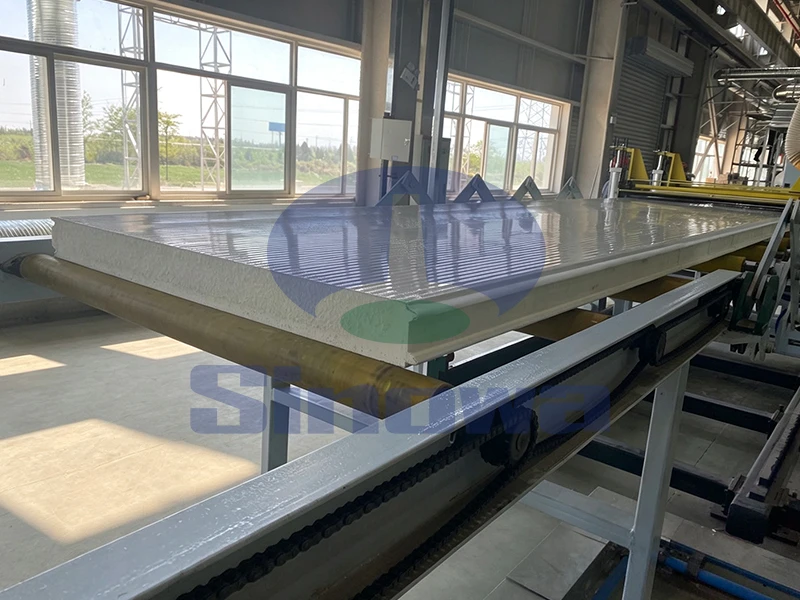
High-quality raw material pretreatment lays a fundamental foundation for improving the flatness of panels produced by the PIR foam core sandwich panel line. Many surface unevenness issues in finished panels originate from unprocessed raw material defects, rather than late-stage production errors. For the metal surface skins, subtle wrinkles, edge warping and inconsistent thickness will be amplified during foaming and pressing processes, leading to irregular panel surfaces. It is essential to conduct comprehensive inspection and leveling of surface skins before feeding them into the production line, removing tiny deformations through fine mechanical calibration. Meanwhile, the formula stability of PIR foam materials cannot be ignored. Unmatched proportions of polyol and isocyanate, or impure raw material components, will cause uneven foaming density and inconsistent expansion speed across different panel areas. This results in local bulges or depressions after curing. Controlling raw material storage conditions to avoid moisture absorption and component deterioration also ensures uniform foaming reaction, which is the primary step to maintain stable panel flatness in the PIR foam core sandwich panel line.
Precise adjustment of pressing and lamination parameters is critical to eliminate flatness defects in sandwich panels from the PIR foam core sandwich panel manufacturing line. The double-belt lamination system serves as the core molding unit of the production line, and its pressure, temperature and running speed directly determine the panel's surface uniformity. Uneven belt pressure is one of the most common causes of unflat panels; excessive local pressure leads to foam core compression depression, while insufficient pressure causes incomplete bonding and loose surface bulges. Operators need to calibrate the overall and regional pressure of the lamination belt regularly to ensure uniform pressure distribution across the entire panel width. In addition, matching pressing temperature with production speed is essential. Too high a temperature accelerates partial foam curing and causes irregular shrinkage, while too low a temperature leads to inadequate foaming and unsmooth surfaces. Maintaining a constant and balanced lamination temperature creates a stable curing environment for the PIR foam core, enabling synchronous molding of the core material and surface skins and effectively improving overall panel flatness in continuous line production.
Scientific curing and cooling processes effectively relieve internal stress and stabilize the flatness of panels manufactured by the PIR foam core sandwich panel production line. Freshly molded sandwich panels retain significant internal stress generated by foaming expansion and mechanical pressing. If stress is not released properly in time, subsequent natural shrinkage and deformation will destroy surface flatness. The production line's curing section needs to maintain a stable constant-temperature environment to ensure gradual and uniform curing of the PIR foam core. Rapid or uneven curing will produce inconsistent stress distribution inside the panel, leading to warping and surface undulation after molding. After preliminary curing, graded cooling treatment is indispensable. Adopting combined air and water circulation cooling methods can evenly take away internal heat of the panel, avoiding local rapid cooling that causes asymmetric shrinkage. Slow and balanced cooling allows internal stress to release fully and uniformly, locking the panel's flat shape and preventing post-production deformation of panels from the PIR foam core sandwich panel line.
Real-time equipment calibration and daily maintenance effectively avoid flatness fluctuations in mass production of the PIR sandwich panel line. Long-term continuous operation will cause subtle wear, deviation and loose parts in key production units, which gradually affect panel molding accuracy. The conveying and positioning system is particularly critical; deviation in roller levelness and belt operation synchronism will lead to uneven feeding of surface skins and foam materials, resulting in overall or partial panel inclination. Regular laser calibration of the entire conveying platform and timely adjustment of asynchronous operating parts ensure horizontal and stable material transmission. Moreover, residual foam residues on the lamination belt and rollers will form tiny bumps, leaving indentations on the panel surface. Daily cleaning of production equipment and regular inspection of wearing parts eliminate equipment-induced flatness defects. Stable equipment operation state maintains consistent production conditions for the PIR foam core sandwich panel line, ensuring uniform flatness of each batch of panels.
Optimization of foam reaction uniformity further refines the surface flatness of panels from the PIR sandwich panel production line. As the core functional material of sandwich panels, the molding state of PIR foam directly determines the flatness and flat stability of finished products. In continuous production, inconsistent catalyst distribution and uneven material mixing speed often lead to differences in foaming speed and gel time between the edge and middle areas of panels. Edge foam cures too fast and fails to fully expand, while middle foam overexpands slightly, causing surface undulation. Optimizing the material mixing system to improve mixing uniformity and adopting regional catalyst compensation technology can balance the foaming reaction speed of different panel areas. This ensures synchronous expansion and gelation of the entire foam core, avoiding local density differences and surface irregularities. Fine-tuning the foaming reaction parameters greatly improves the surface smoothness and flatness of panels produced by the automated PIR foam core sandwich panel line.
Strict finished product inspection and post-molding trimming serve as the final guarantee for qualified flatness of panels from the PIR foam core sandwich panel line. Even with optimized front-end processes and stable equipment operation, occasional minor flatness deviations are inevitable in mass production. Arranging full-process flatness detection for finished panels can timely identify subtle warping, bulges and depressions that affect product quality. For panels with slight flatness defects, targeted trimming and leveling treatment can be conducted through static pressure shaping and local fine polishing to correct tiny deformations. Meanwhile, summarizing defect data regularly helps trace abnormal parameters in raw materials, processes or equipment, forming a closed-loop optimization mechanism. This continuous improvement mode gradually reduces flatness defect rates, comprehensively upgrades the overall molding quality of panels manufactured by the PIR foam core sandwich panel line, and meets high-precision usage requirements.
Gallery
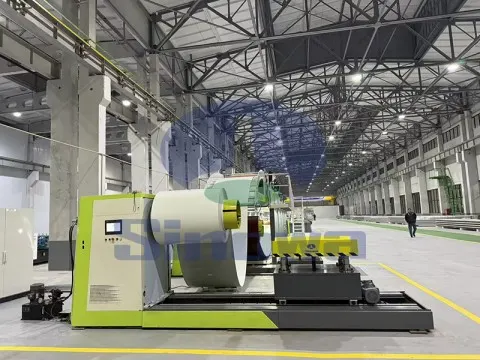
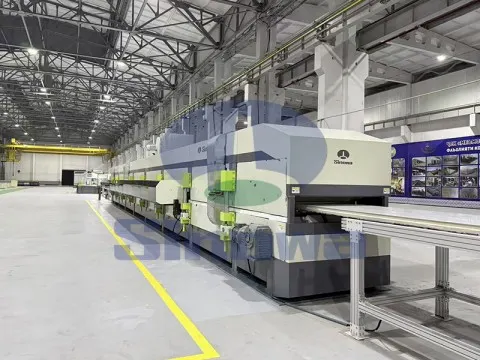
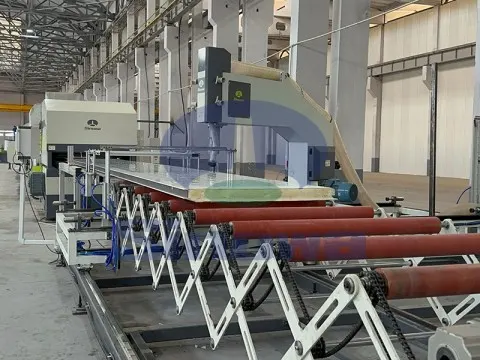
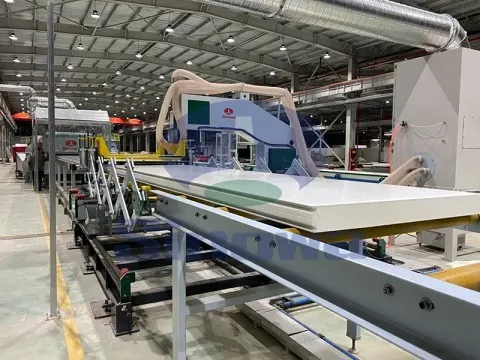
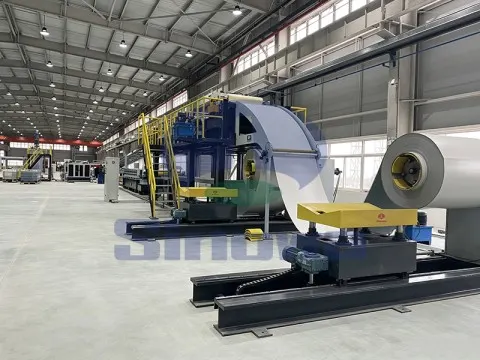
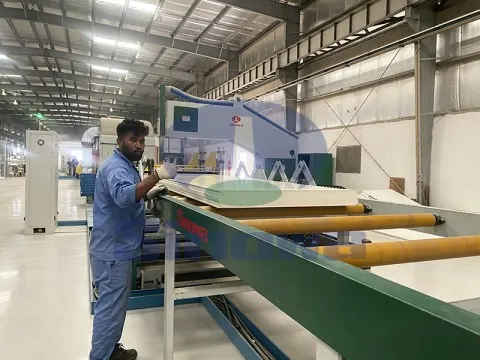
Sinowa is a professional manufacturer of sandwich panel machine in china, we provide diversified and high-performance sandwich panel production lines, including fully automatic continuous PU sandwich panel line and customized special lines to meet mass production and personalized order demands. These sandwich panel lines support processing multiple foam core materials, such as PU, PIR, mineral wool, rock wool and glass wool, covering different insulation and fireproof standards.
Featuring stable operation, high efficiency, energy saving and easy maintenance, our PU sandwich panel line deliver sandwich panels with excellent thermal insulation, fire resistance, sound insulation and lightweight durability. The finished panels are widely applied in industrial workshops, warehouse roofing and wall cladding, cold storage insulation, serving global construction and industrial insulation markets.
Main Products
-

Continuous PU Sandwich Panel Production Line
This continuous PU sandwich panel production line is an integrated automatic equipment. It covers uncoiling, forming, foaming, curing and cutting processes. With automatic raw material proportioning and precise temperature & pressure control, PIR sandwich panel production line continuously composites panels with double skins. Polyurethane sandwich panel production line stably produces steel and aluminum sandwich panels. Featuring high automation, the line makes fireproof and thermal-insulation panels for building enclosure and cold storage. -

Rock Wool Sandwich Panel Production Line
Continuous rockwool sandwich panel production line is an automatic integrated production equipment, consisting of uncoiling, forming, gluing and compounding, heating curing, fixed-length cutting, automatic stacking and other modules. The mineral wool sandwich panel production line continuously conveys color steel plates and rock wool core materials to automatically complete lamination and curing, which can produce fireproof and thermal insulation sandwich panels. Featuring high automation degree and stable operation, this production line is suitable for mass production of panels used for building walls, roofs and other scenarios. -

Phenolic Insulation Board Production Line
This integrated automatic production line continuously manufactures PU and phenolic insulation boards. The insulation board production line covers raw material proportioning, high-pressure foaming, laminating, curing and fixed-length cutting. Featuring high automation and stable molding, the insulation panel production line supports various surface materials. PU boards offer excellent thermal insulation, while phenolic boards have superior fire resistance. These products are widely used in construction, cold chain, ventilation ducts and other thermal insulation fields.
Other FAQs
- How Much Does A Full Automatic Sandwich Panel Machine Cost
- What Causes Uneven Density In Insulation Board Production Line Finished Products
- What Core Materials Can A Continuous PU Sandwich Panel Line Process
- Overload Protection Function Detection Of Polyurethane Sandwich Panel Production Equipment
- Polyurethane Sandwich Panel Production Line Cleaning Cycle And Operation Standard
- Wearing Parts Replacement Cycle Of PU Sandwich Panel Production Line Equipment
- Sandwich Panel Production Line Upgrade And Expansion Feasible Solutions
- Standard Panel Thickness Range Of PU Sandwich Panel Line
- How To Choose A Reliable PU Sandwich Panel Machine Manufacturer
- How To Solve Foaming Instability Issues In Insulation Panel Production Line
Related Articles
- Working Principle of PU Foam Production Line
- Foam Color Steel Sandwich Panel Line
- PU Continuous Sandwich Foam Board Production Line
- PU Sandwich Panel Production Line For Insulation Panels
- Full-Automatic PIR Sandwich Panel Production Line For Roof Panels
- Color Steel PU Sandwich Panel Line
- What is PU Sandwich Panel Machine
- Polyurethane Sandwich Panel Machinery
- PU Sandwich Panel Making Plant For Clean Room Panel Production
- Production Process Of PU Sandwich Panel Machine