Why Does The Continuous PU Sandwich Panel Line Have Unstable Production Speed
Oct 5, 2026
Unstable production speed is a common issue plaguing continuous PU sandwich panel production lines, undermining product consistency and manufacturing efficiency. This problem stems from intertwined mechanical, hydraulic, material, control, operational and environmental factors, each disrupting the steady cyclic operation of the automated production system.
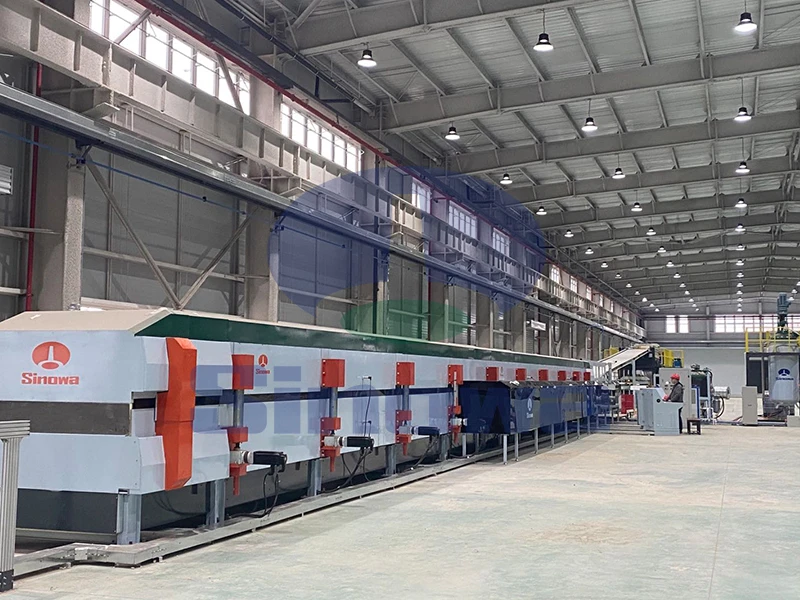
Mechanical transmission system abnormalities are the most primary cause of unstable operating speed in continuous PU sandwich panel production lines. Long-term continuous operation inevitably triggers subtle wear, deformation and misalignment of core transmission components, including drive shafts, coupling parts, conveyor rollers and laminating belts. Minor shaft misalignment will generate uneven torque transmission and local stress concentration during equipment operation, increasing internal friction loss of mechanical structures. As the production line runs continuously, these tiny mechanical defects are gradually amplified, leading to inconsistent rotation speed of different roller groups and asynchronous movement of upper and lower laminating belts. In addition, mechanical vibration generated by high-speed operation further exacerbates transmission deviation, causing intermittent jitter and speed fluctuation of material conveying. Aging and fatigue of transmission parts after long service life will also reduce structural stability, resulting in frequent speed ups and downs in the production process, which directly disrupts the continuous and rhythmic production process of PU sandwich panels.
Hydraulic and pneumatic system instability is another key factor inducing fluctuating production speed of PU sandwich panel lines. The entire production process, including material pressing, plate positioning and cutting operations, relies on stable hydraulic and pneumatic power output to maintain synchronous operation. Internal blockage, oil leakage or air mixing in hydraulic pipelines will lead to unstable system pressure output, making the telescopic speed of hydraulic cylinders and the pressing force of laminating structures inconsistent. Similarly, insufficient air pressure supply, pressure valve failure and pipeline leakage in pneumatic systems will cause delayed response and uneven power transmission of executive components. These hydraulic and pneumatic abnormalities will not only change the operating speed of single equipment units, but also break the speed matching relationship between upstream and downstream processes. When the power output cannot keep constant, the production line will frequently experience slow running, sudden speed changes and temporary stagnation, seriously affecting the stability of overall production rhythm.
Fluctuations in raw material performance and feeding uniformity greatly interfere with the stable speed operation of continuous PU sandwich panel lines. PU foam raw materials have strict requirements on viscosity, activity and fluid state during production. Changes in raw material temperature and storage time will alter material viscosity and fluidity, leading to inconsistent dosing and foaming speed in the mixing link. Unstable feeding speed of surface metal plates and core materials, such as plate deviation, material jamming and uneven coil tension, will cause intermittent pause and speed change in the feeding process. When the feeding speed cannot match the set operating speed of the subsequent foaming and laminating process, the production line will automatically adjust the operating speed adaptively, resulting in overall speed instability. Moreover, impurities in raw materials or uneven material mixing will cause local foaming abnormalities, forcing the equipment to reduce speed or pause temporarily to avoid defective products, further disrupting continuous stable production.
Intelligent control system errors and parameter mismatches are important invisible causes of unstable production speed. Modern continuous PU sandwich panel lines rely on precise program control systems to coordinate the operation of all functional units. Long-term operation will lead to signal delay, sensor drift and program data deviation in the control system, resulting in inaccurate real-time monitoring of equipment operating speed and material state. When the feedback data of speed, pressure and temperature sensors is distorted, the control system will issue wrong operation instructions, causing abnormal speed adjustment of each production unit. In addition, unreasonable parameter setting and mismatched process parameters will also trigger speed fluctuation. Unmatched dosing parameters, laminating speed and curing time will make the equipment unable to maintain a fixed operating speed, and the system will continuously fine-tune the running state to adapt to uncoordinated process links, resulting in irregular speed changes in the whole production line.
Improper daily operation and irregular equipment maintenance will gradually accumulate hidden dangers of speed instability in PU sandwich panel production lines. Many speed fluctuation problems are derived from non-standard manual operation habits, such as frequent arbitrary adjustment of operating parameters during production, improper debugging of feeding and laminating structures, and untimely handling of minor equipment abnormalities. These irregular operations will disrupt the stable operation state of the production line and damage the original speed matching relationship between various processes. In terms of maintenance, long-term omission of lubrication for transmission parts, failure to clean pipeline impurities regularly, and no timely calibration of sensors and control components will gradually aggravate equipment aging and performance degradation. Minor faults that are not eliminated in time will evolve into continuous operating abnormalities, making the production speed unable to maintain a stable state for a long time and reducing the overall operational reliability of the production line.
Operating environment changes also exert subtle but persistent impacts on the speed stability of continuous PU sandwich panel production lines. The production of PU sandwich panels is sensitive to ambient temperature, humidity and ventilation conditions. Excessively high or low ambient temperature will affect the working efficiency of mechanical transmission structures and hydraulic systems, as well as the foaming and curing speed of PU materials. High humidity environment may cause slight corrosion of metal transmission parts and circuit system damp, resulting in insensitive equipment operation and signal transmission delay. Poor on-site ventilation will lead to heat accumulation inside the equipment, causing thermal expansion of mechanical parts and further increasing transmission deviation. These environmental changes will not cause sudden equipment failure, but will continuously interfere with the coordinated operation of the entire production system, leading to slow and irregular speed fluctuations, which affect the continuity and stability of industrial mass production.
Gallery
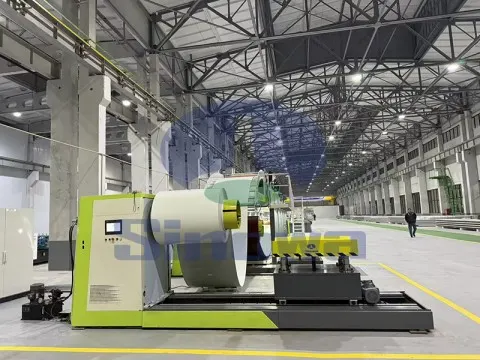
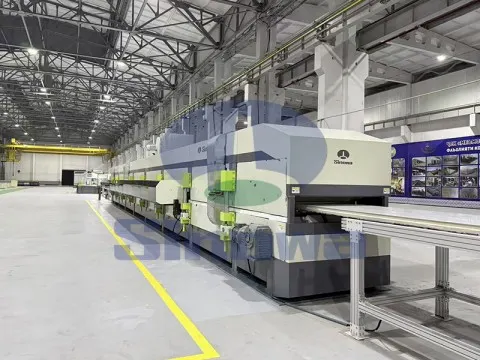
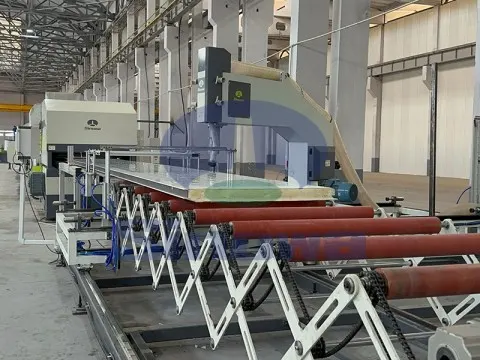
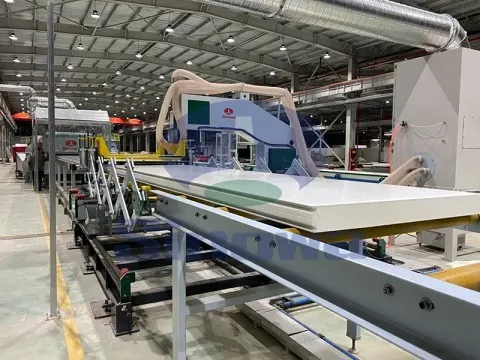
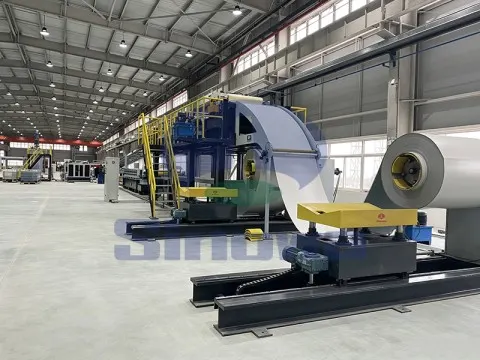
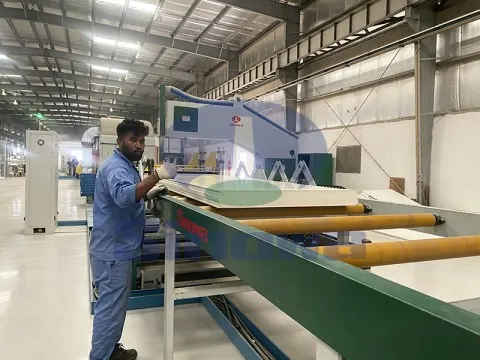
Sinowa is a professional manufacturer of sandwich panel machine in china, we provide diversified and high-performance sandwich panel production lines, including fully automatic continuous PU sandwich panel line and customized special lines to meet mass production and personalized order demands. These sandwich panel lines support processing multiple foam core materials, such as PU, PIR, mineral wool, rock wool and glass wool, covering different insulation and fireproof standards.
Featuring stable operation, high efficiency, energy saving and easy maintenance, our PU sandwich panel line deliver sandwich panels with excellent thermal insulation, fire resistance, sound insulation and lightweight durability. The finished panels are widely applied in industrial workshops, warehouse roofing and wall cladding, cold storage insulation, serving global construction and industrial insulation markets.
Main Products
-

Continuous PU Sandwich Panel Production Line
This continuous PU sandwich panel production line is an integrated automatic equipment. It covers uncoiling, forming, foaming, curing and cutting processes. With automatic raw material proportioning and precise temperature & pressure control, PIR sandwich panel production line continuously composites panels with double skins. Polyurethane sandwich panel production line stably produces steel and aluminum sandwich panels. Featuring high automation, the line makes fireproof and thermal-insulation panels for building enclosure and cold storage. -

Rock Wool Sandwich Panel Production Line
Continuous rockwool sandwich panel production line is an automatic integrated production equipment, consisting of uncoiling, forming, gluing and compounding, heating curing, fixed-length cutting, automatic stacking and other modules. The mineral wool sandwich panel production line continuously conveys color steel plates and rock wool core materials to automatically complete lamination and curing, which can produce fireproof and thermal insulation sandwich panels. Featuring high automation degree and stable operation, this production line is suitable for mass production of panels used for building walls, roofs and other scenarios. -

Phenolic Insulation Board Production Line
This integrated automatic production line continuously manufactures PU and phenolic insulation boards. The insulation board production line covers raw material proportioning, high-pressure foaming, laminating, curing and fixed-length cutting. Featuring high automation and stable molding, the insulation panel production line supports various surface materials. PU boards offer excellent thermal insulation, while phenolic boards have superior fire resistance. These products are widely used in construction, cold chain, ventilation ducts and other thermal insulation fields.
Other FAQs
- What Safety Protection Measures Are Needed For A Polyurethane Sandwich Panel Manufacturing Line
- What Regular Maintenance Does A Polyurethane Sandwich Panel Line Need
- How To Fix Uneven Foam Density On The PU Foam Production Line
- What Raw Materials Are Required For The PUR Sandwich Panel Production Line Operation
- Emergency Fault Handling Process For PU Sandwich Panel Line Shutdown
- Polyurethane Sandwich Panel Production Equipment Lubrication Maintenance Standard
- Troubleshooting For Sandwich Panel Production Line Frequent Shutdown Failure
- How To Solve Surface Bubble Problems Of Panels From PU Foam Core Sandwich Panel Line
- Why Does The Polyurethane Sandwich Panel Line Produce Uneven Foam Distribution
- How To Improve The Production Efficiency Of Insulation Board Production Line
Related Articles
- Polyurethane Sandwich Panel Production Line For Modular House
- High Quality PU Sandwich Panel Machine Design
- PU Sandwich Panel Making Machine For High Density Composite Panels
- Corrugated Sandwich Panel Production Line
- PIR Sandwich Panel Production Line With PLC Control System
- External Wall Composite Insulation Board Production Line
- PU Sandwich Panel Manufacturing Machinery For Double-sided Composite Panels
- PU Sandwich Panel Plant For Composite Board Production
- Polyurethane Sandwich Panel Making Machine For High Strength Composite Panel Production
- Sandwich Panel Forming Machine