Standard Panel Thickness Range Of PU Sandwich Panel Line
Sep 17, 2026
PU sandwich panels feature diverse standard thickness specifications tailored for versatile construction and industrial applications.
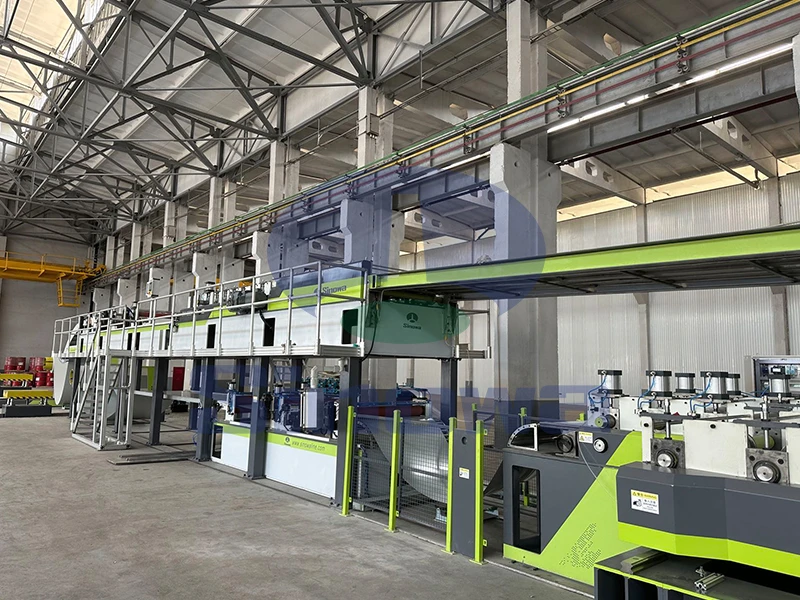
The standard thickness range of PU sandwich panels covers a complete gradient of specifications to meet differentiated usage demands in modern building enclosure and industrial insulation projects. The mainstream standard thicknesses start from 35mm for lightweight indoor partition scenarios, followed by common conventional specifications including 40mm, 50mm, 60mm, 75mm, 100mm, 125mm, 150mm, and extend to heavy-duty options of 200mm and 250mm. This graded thickness setup forms a systematic product matrix, covering lightweight interior decoration, conventional building exterior enclosure, low-temperature thermal insulation, and ultra-thick heat preservation and heat insulation scenarios. Each standard thickness is designed with matched foam core density and surface layer configuration, ensuring balanced structural stability and thermal insulation performance. The production line is precisely calibrated for these fixed thickness specifications, realizing standardized and stable batch production while reserving flexible adjustment space for special non-standard thickness demands in individual engineering projects.
Thickness specifications below 60mm belong to the lightweight series of standard PU sandwich panels, which are mainly developed for indoor non-load-bearing partition and simple ceiling insulation scenarios. The 35mm and 40mm ultra-thin specifications feature low overall weight and flexible installation, suitable for interior space division of office buildings, commercial venues and temporary construction facilities. These thin panels do not require high structural bearing capacity, and their core advantages lie in reducing building self-weight, saving installation space and controlling construction cost. The 50mm and 60mm specifications are upgraded lightweight models with slightly enhanced foam core filling thickness, effectively improving basic thermal insulation and sound insulation effects on the premise of maintaining light weight. They are widely used for indoor partition walls of clean rooms, ordinary warehouses and residential auxiliary spaces. In the production process of the assembly line, lightweight thin panels adopt high-precision constant-speed foaming and pressing processes to avoid core material hollowing and uneven thickness, ensuring the flatness and overall consistency of finished panels in batch production.
The 75mm to 125mm thickness range constitutes the most widely used conventional standard specifications of PU sandwich panels, occupying the mainstream market share in building exterior wall and roof enclosure projects. Panels in this thickness interval achieve an optimal balance between structural strength, thermal insulation performance and economic applicability. The 75mm specification is the basic standard for ordinary building exterior walls, meeting the daily heat preservation and temperature isolation needs of conventional industrial plants and public buildings. The 100mm specification is the most versatile universal model, applicable to most factory building walls, sloped roofs and outdoor enclosure structures, with significantly improved wind resistance, pressure resistance and thermal insulation compared with thinner panels. The 125mm specification is a transitional model for enhanced insulation, suitable for building envelopes in areas with obvious seasonal temperature differences. The production line is highly mature in processing these medium-thickness panels, with standardized foaming ratio, pressing pressure and curing time parameters, which can stably produce finished products with uniform core density, tight bonding between surface layer and core material, and stable dimensional accuracy.
Standard thicknesses from 150mm to 200mm are classified as heavy-duty thermal insulation PU sandwich panels, focusing on meeting high-standard thermal insulation and low-temperature anti-freezing demands of special industrial scenarios. The 150mm specification is commonly used for the wall and roof enclosure of ordinary cold storage, constant-temperature workshops and heat-insulated warehouses, which can effectively block external temperature conduction and maintain stable indoor constant-temperature environment. The 200mm thick panel is oriented to ultra-low temperature storage, high-temperature industrial workshops and special thermal insulation facilities, with excellent heat insulation, cold resistance and energy-saving effects. With the increase of panel thickness, the overall structural rigidity and impact resistance of the panel are further improved, enabling it to adapt to harsh outdoor working environments and long-term high-load use conditions. The production line needs to adjust the foaming filling volume and layered pressing process for such thick panels to ensure that the internal PU foam core is densely and uniformly filled without gaps, preventing thermal bridge phenomena that affect thermal insulation performance.
The maximum standard thickness of mass-produced PU sandwich panels can reach 250mm, which is a special thickened specification for extreme thermal insulation and super-large span building structures. This ultra-thick standard panel is mainly applied to professional low-temperature cold storage, high-temperature industrial kiln insulation layers and special energy-saving building projects that require ultra-high thermal insulation efficiency. Different from medium and thin panels, 250mm thick panels have higher requirements for production line equipment precision and process technology. The production process needs to adopt segmented slow curing and balanced pressure pressing technology to solve the problems of inconsistent internal curing speed and uneven stress distribution caused by excessive thickness. Meanwhile, the matching between the surface steel sheet and the thick core material is optimized to avoid panel deformation and core delamination in long-term use, ensuring the structural stability and durability of ultra-thick standard panels.
The rational matching between PU sandwich panel thickness specifications and production line performance directly determines product quality and application effect. Standard thickness grading design fully considers the boundary of scene demand performance, and each thickness interval has corresponding optimal production process parameters and application scenarios. In actual production and engineering selection, it is necessary to comprehensively judge the suitable standard thickness according to the building's thermal insulation demand, structural stress conditions and service environment. The standardized thickness system of the production line not only realizes efficient and low-cost batch manufacturing but also provides reliable product support for the refined development of modern building energy-saving and industrial insulation engineering, realizing the organic unity of production efficiency, product performance and application value.
https://www.cnsinowa.com/faqs/standard-panel-thickness-range-of-pu-sandwich-panel-line.html
Main Products
-

Continuous PU Sandwich Panel Production Line
This continuous PU sandwich panel production line is an integrated automatic equipment. It covers uncoiling, forming, foaming, curing and cutting processes. With automatic raw material proportioning and precise temperature & pressure control, PIR sandwich panel production line continuously composites panels with double skins. Polyurethane sandwich panel production line stably produces steel and aluminum sandwich panels. Featuring high automation, the line makes fireproof and thermal-insulation panels for building enclosure and cold storage. -

Rock Wool Sandwich Panel Production Line
Continuous rockwool sandwich panel production line is an automatic integrated production equipment, consisting of uncoiling, forming, gluing and compounding, heating curing, fixed-length cutting, automatic stacking and other modules. The mineral wool sandwich panel production line continuously conveys color steel plates and rock wool core materials to automatically complete lamination and curing, which can produce fireproof and thermal insulation sandwich panels. Featuring high automation degree and stable operation, this production line is suitable for mass production of panels used for building walls, roofs and other scenarios. -

Phenolic Insulation Board Production Line
This integrated automatic production line continuously manufactures PU and phenolic insulation boards. The insulation board production line covers raw material proportioning, high-pressure foaming, laminating, curing and fixed-length cutting. Featuring high automation and stable molding, the insulation panel production line supports various surface materials. PU boards offer excellent thermal insulation, while phenolic boards have superior fire resistance. These products are widely used in construction, cold chain, ventilation ducts and other thermal insulation fields.
Other FAQs
- Sandwich Panel Production Line Startup And Shutdown Standard Operating Procedures
- Maximum Production Capacity Of Polyurethane Sandwich Panel Production Line
- Sandwich Panel Production Line Upgrade And Expansion Feasible Solutions
- Difference Between Continuous And Discontinuous PU Sandwich Panel Production Lines
- Daily Maintenance Items Of Polyurethane Sandwich Panel Production Line