What Causes Uneven Density In Insulation Board Production Line Finished Products
Sep 29, 2026
Uneven density is a prevalent quality flaw in finished products from the insulation board production line, undermining thermal performance and structural stability. This issue stems from intertwined raw material inconsistencies, equipment operation deviations, processing parameter fluctuations, and environmental interference during continuous production, affecting overall product uniformity.
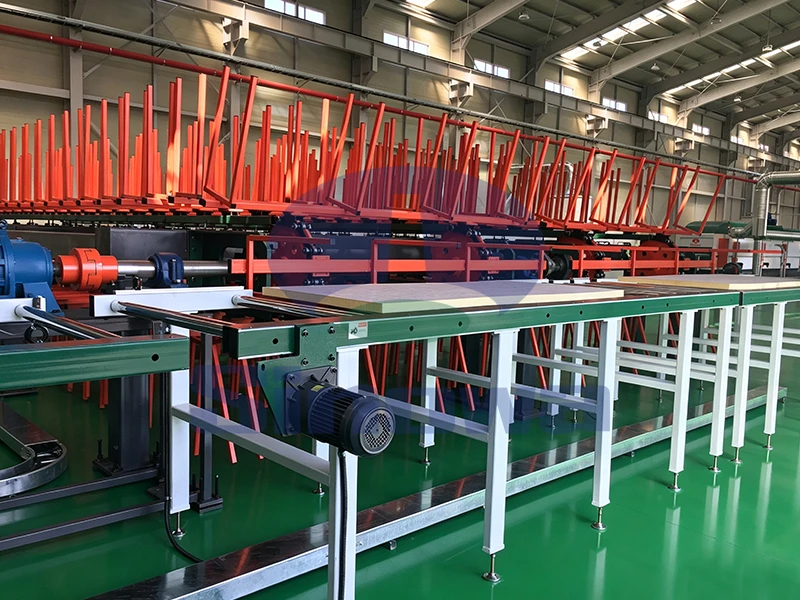
Unstable raw material properties stand as one of the most fundamental triggers for uneven density in products from the insulation board production line. Insulation board manufacturing relies on consistent raw material particle sizes, purity, and formulation uniformity to achieve uniform foaming and molding results. In actual production processes, mixed particle size grades of foam beads or base materials often occur due to unscientific material storage and irregular feeding operations. Fine and coarse particles exhibit distinct expansion and compression characteristics under the same processing conditions, leading to inconsistent compactness in different areas of finished boards. Additionally, minor impurities, residual dust, or mixed foreign materials in raw materials can disrupt regular foaming reactions, forming sparse low-density voids or dense high-density spots on board surfaces and interiors. Batch-to-batch subtle differences in raw material reactivity and composition further amplify density deviations. Without strict pre-production material screening and homogenization treatment, these raw material inconsistencies will be fully reflected in finished products, becoming the primary source of uneven density in the insulation board production line output.
Improper material mixing and mold filling operations in the insulation board production line directly cause regional density disparities in finished boards. The core of uniform insulation board production lies in the even distribution of raw material mixtures in molds or continuous molding cavities. Inadequate operation of mixing equipment, such as insufficient mixing time, uneven stirring speed, or mismatched material feeding ratios, leads to localized accumulation of foaming agents, curing agents, and base materials. Partial areas with excessive foaming agents form loose low-density structures, while areas with insufficient additives result in dense, under-foamed regions. During mold filling, unstable feeding speeds, unbalanced material flow, and unreasonable mold cavity structural designs cause inconsistent material filling rates across different board sections. Edge and corner areas are prone to over-filling and excessive compression to form high-density zones, while central areas may have insufficient filling and residual air pockets to form low-density voids. Long-term continuous operation without regular calibration of mixing and filling systems will solidify these operational flaws, leading to persistent uneven density defects in batch products from the insulation board production line.
Fluctuations in thermal processing parameters constitute a key technical factor for uneven density in insulation board production line finished products. Thermal treatment including pre-expansion, high-temperature molding, and post-curing determines the final cell structure and compactness of insulation boards. Stable and consistent temperature, steam pressure, and heating duration are essential for uniform product density. In actual production, unstable steam supply pressure and inconsistent heating zone temperatures cause asynchronous expansion of raw materials in different parts of the board. Local overheating leads to excessive foam cell expansion and reduced density, while insufficient heating results in incomplete cell expansion and increased compactness. Moreover, unreasonable temperature gradient settings in continuous production equipment cause inconsistent heat dissipation speeds across board surfaces during cooling and shaping. Rapid cooling areas form dense and stable structures, whereas slow cooling areas produce loose and uneven cell distributions. Slight deviations in thermal parameters that are not adjusted timely will accumulate in continuous processing, forming obvious density differences on the surface and inside finished insulation boards.
Equipment aging, calibration deviations and mechanical operation errors greatly undermine density uniformity in products from the insulation board production line. Long-term operation of production equipment inevitably causes wear on key components such as extruder screws, mold platens, conveyor belts, and pressure control valves. Screw wear leads to uneven material extrusion volume and inconsistent melt conveying speed, resulting in fluctuating material output per unit area of the board. Deformed or unparallel mold platens cause uneven compression force on the board during molding; partial over-compression increases density while under-compression reduces it. In addition, inaccurate calibration of pressure sensors, temperature controllers, and speed regulation systems leads to inconsistent parameter feedback and execution. The matching deviation between line operating speed and material foaming cycle makes some boards complete curing prematurely with incomplete foaming, while others stay in the molding system too long with over-expanded cells. Unregular equipment maintenance and calibration will continuously amplify mechanical errors, making uneven density a recurring quality problem in insulation board production line finished products.
Changes in production workshop environmental conditions indirectly induce uneven density defects in insulation board production line finished products. Ambient temperature, humidity, and air flow in the production workshop have subtle but critical impacts on the foaming and curing process of insulation board raw materials. In high-humidity environments, raw materials easily absorb moisture, which interferes with chemical foaming reactions, causing irregular cell growth and uneven density distribution. Excessively high ambient temperature accelerates surface curing of boards, forming a dense outer layer while the internal foaming reaction is incomplete, resulting in inconsistent internal and external density. On the contrary, low ambient temperature slows down the curing speed, leading to unstable cell structure and easy deformation of local areas. Unstable workshop air flow causes inconsistent heat dissipation on board surfaces during continuous production, further exacerbating regional density differences. Many production sites lack constant temperature and humidity control systems, and seasonal climate changes and ventilation adjustments bring continuous environmental fluctuations, which interfere with the stable operation of the insulation board production line and reduce finished product density uniformity.
Unstandardized post-processing and curing management further aggravates uneven density in insulation board production line finished products. After preliminary molding, insulation boards require a stable curing period to complete internal reaction stabilization and cell structure shaping. Improper stacking modes in the curing stage, such as excessive local extrusion, uneven gaps between boards, and inconsistent stacking heights, lead to uneven stress and air circulation on board surfaces. Extruded areas are compacted to increase density, while poorly ventilated areas retain residual heat and moisture, causing delayed reaction and loose structures. In addition, inconsistent curing time for batch products makes some boards fully stabilized with uniform density and others incompletely cured with variable internal structures. Random adjustments of post-processing transportation speed and sorting operations also cause slight extrusion and vibration deformation of semi-finished boards, destroying initial density uniformity. Scientific and standardized post-curing management is often overlooked in daily production, yet it serves as a vital final link to ensure consistent density of finished products from the insulation board production line.
Gallery
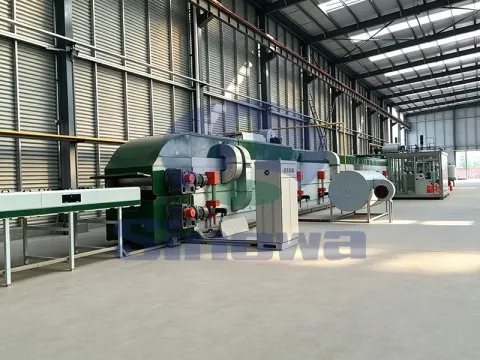
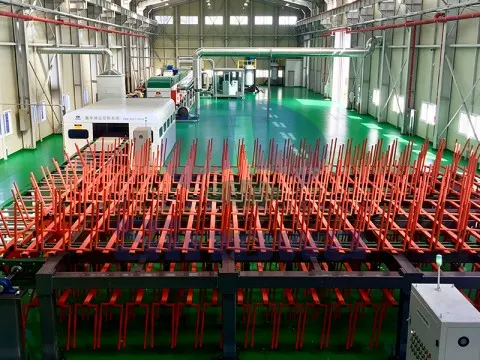
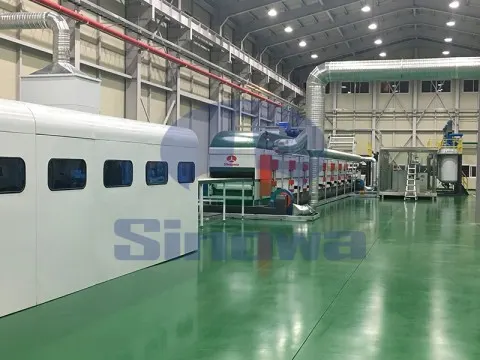
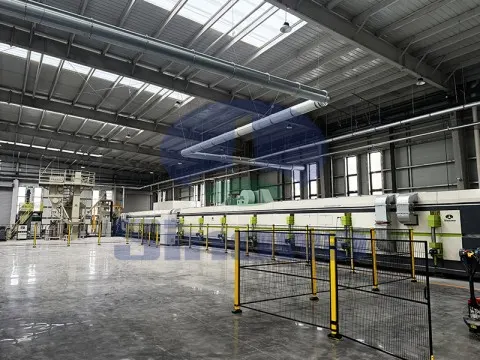
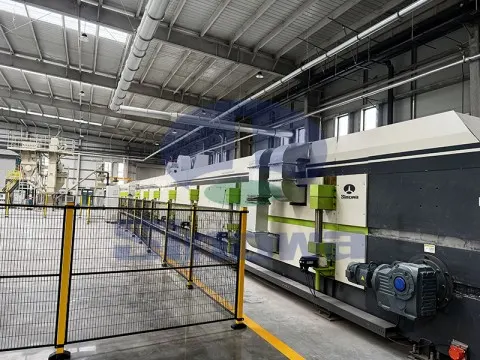
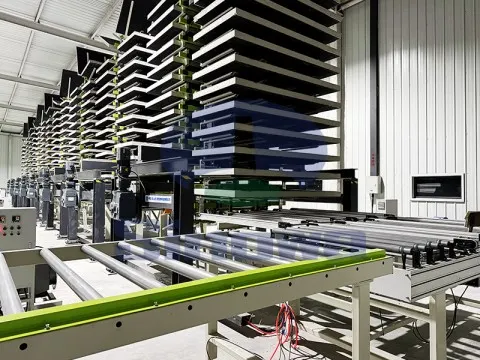
Sinowa is a professional manufacturer of sandwich panel machine in china, we provide diversified and high-performance sandwich panel production lines, including fully automatic continuous PU sandwich panel line and customized special lines to meet mass production and personalized order demands. These sandwich panel lines support processing multiple foam core materials, such as PU, PIR, mineral wool, rock wool and glass wool, covering different insulation and fireproof standards.
Featuring stable operation, high efficiency, energy saving and easy maintenance, our PU sandwich panel line deliver sandwich panels with excellent thermal insulation, fire resistance, sound insulation and lightweight durability. The finished panels are widely applied in industrial workshops, warehouse roofing and wall cladding, cold storage insulation, serving global construction and industrial insulation markets.
Main Products
-

Continuous PU Sandwich Panel Production Line
This continuous PU sandwich panel production line is an integrated automatic equipment. It covers uncoiling, forming, foaming, curing and cutting processes. With automatic raw material proportioning and precise temperature & pressure control, PIR sandwich panel production line continuously composites panels with double skins. Polyurethane sandwich panel production line stably produces steel and aluminum sandwich panels. Featuring high automation, the line makes fireproof and thermal-insulation panels for building enclosure and cold storage. -

Rock Wool Sandwich Panel Production Line
Continuous rockwool sandwich panel production line is an automatic integrated production equipment, consisting of uncoiling, forming, gluing and compounding, heating curing, fixed-length cutting, automatic stacking and other modules. The mineral wool sandwich panel production line continuously conveys color steel plates and rock wool core materials to automatically complete lamination and curing, which can produce fireproof and thermal insulation sandwich panels. Featuring high automation degree and stable operation, this production line is suitable for mass production of panels used for building walls, roofs and other scenarios. -

Phenolic Insulation Board Production Line
This integrated automatic production line continuously manufactures PU and phenolic insulation boards. The insulation board production line covers raw material proportioning, high-pressure foaming, laminating, curing and fixed-length cutting. Featuring high automation and stable molding, the insulation panel production line supports various surface materials. PU boards offer excellent thermal insulation, while phenolic boards have superior fire resistance. These products are widely used in construction, cold chain, ventilation ducts and other thermal insulation fields.
Other FAQs
- How To Solve Surface Bubble Problems Of Panels From PU Foam Core Sandwich Panel Line
- Why Does The Polyurethane Sandwich Panel Line Produce Uneven Foam Distribution
- How To Improve The Production Efficiency Of Insulation Board Production Line
- How To Solve Foam Shrinkage Issues On A Polyurethane Sandwich Panel Production Line
- Polyurethane Sandwich Panel Production Line Idle Period Maintenance Management Scheme
- Polyurethane Sandwich Panel Production Line Start-up Pre-inspection Complete Items
- Noise Reduction Measures For PU Sandwich Panel Production Equipment
- Difference Between PUR And PIR Sandwich Panel Production Lines
- How To Improve The Flatness Of Panels Made By PIR Foam Core Sandwich Panel Line
- What Is A PU Sandwich Panel Machine And How Does It Work
Related Articles
- Industrial Continuous PU Sandwich Panel Production Line
- Continuous PU Sandwich Panel Line For Roof Wall
- Cold Roll Forming Sandwich Panel Machine
- PU Insulated Panel Line
- Industrial Sandwich Panel Production Machine
- PUF Panel Manufacturing Machine
- Sandwich Panel Production Line For Prefab House
- Continuous Sandwich Panel Manufacturing Line
- Automatic Continuous Sandwich Panel Production Line
- Color Steel Tile Sandwich Panel Machine