PU Sandwich Panel Line Installation And Commissioning Steps
Sep 22, 2026
The installation and commissioning of a PU sandwich panel production line is a systematic, stepwise engineering process that determines production stability and product quality. Standardized operation covers site preparation, equipment assembly, pipeline connection, electrical debugging, trial operation, parameter optimization and final acceptance, ensuring smooth formal production of high-performance sandwich panels.
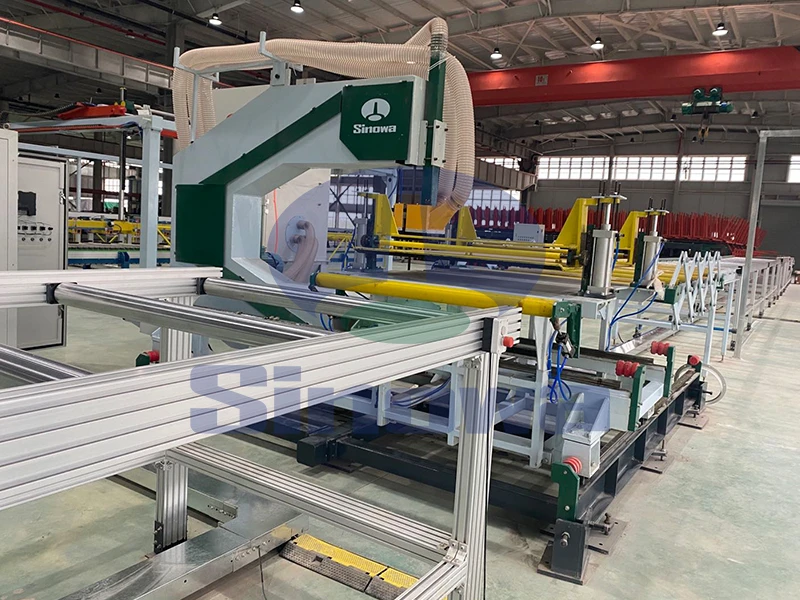
Site preparation is the foundational prerequisite for the smooth installation of the PU sandwich panel line, which lays a solid foundation for subsequent equipment assembly and long-term stable operation. Before any equipment entry, it is essential to thoroughly clean and level the entire production workshop area reserved for the production line. The ground must be flat, solid and free of obvious cracks, depressions and floating dust, to avoid equipment tilt and vibration during operation that may affect assembly accuracy and production precision. Meanwhile, operators need to reasonably plan the equipment layout space according to the overall structural dimensions of the production line, reserving sufficient channels for daily operation, later maintenance, parts replacement and equipment debugging. In addition, pre-configuration of basic supporting conditions is required, including stable power supply layout, reasonable water supply and drainage pipelines, and unobstructed ventilation and heat dissipation environment in the workshop. All sundries in the installation area shall be removed in advance to ensure a tidy and standardized construction environment, eliminating potential obstacles and safety hazards for subsequent installation work.
Precision equipment assembly serves as the core link of the entire installation project, directly affecting the matching degree and operating efficiency of each functional module of the production line. After completing the site preparation and inspection, the main equipment and auxiliary components of the PU sandwich panel line can be transported to the designated installation position in a fixed sequence. The assembly shall follow the structural logic of the production process, starting with the installation of the main frame, feeding system, PU foaming system, rolling forming system and cutting system, followed by the assembly of auxiliary equipment such as conveying devices and cooling systems. During the assembly process, all connecting parts, bolts and positioning components must be installed in place and locked tightly to prevent loose parts caused by long-term mechanical operation. Operators need to repeatedly calibrate the horizontal and vertical accuracy of each equipment module to ensure the precise docking of each production link from raw material feeding to panel forming. After the assembly of a single module is completed, a preliminary manual inspection shall be carried out to check for assembly deviations, missing parts or unsmooth mechanical movement, and adjust and correct problems in a timely manner to ensure the overall assembly quality of the production line.
Professional pipeline and circuit connection is a key step to realize the functional operation of the PU sandwich panel production line, which connects all independent equipment modules into a complete operating system. This process mainly includes the connection of hydraulic pipelines, pneumatic pipelines, PU material conveying pipelines and electrical control circuits. For all fluid conveying pipelines, tightness testing must be conducted after connection to avoid leakage of PU raw materials, hydraulic oil and compressed air, which would cause material waste, equipment failure and production safety risks. The pipeline layout should be neat and standardized, with reasonable bending and fixing to prevent pipeline distortion and damage during equipment operation. In terms of electrical connection, all wiring operations must comply with standardized construction specifications, with accurate docking of power lines, signal lines and control lines, and firm wiring terminals. Meanwhile, independent circuit protection settings should be configured for each equipment module to avoid circuit overload and short circuit faults. After all connections are completed, the overall inspection of pipelines and circuits shall be carried out to confirm no wrong connection, missing connection or leakage, laying a safe and reliable foundation for subsequent electrical debugging and equipment trial operation.
Electrical and system debugging is a critical process to verify the functional integrity of the production line and eliminate potential operating faults. Before formal power-on debugging, operators need to conduct a comprehensive secondary inspection of all electrical circuits, control components and sensor devices to ensure that all parts are in normal standby state. Then, implement segmented power-on debugging for each functional system of the production line separately. Firstly, test the normal start and stop of the conveying system, rolling system and cutting system to check whether the mechanical operation speed is uniform and the movement track is accurate. Next, debug the PU foaming control system to verify the sensitivity of material proportioning, feeding speed and foaming parameter induction. Meanwhile, calibrate all detection sensors and automatic control components to ensure accurate real-time monitoring and data feedback of production parameters such as material flow, equipment temperature and panel forming size. During the debugging process, record all abnormal phenomena such as delayed system response, unstable mechanical operation and inaccurate parameter control, and carry out targeted troubleshooting and parameter correction one by one to ensure that each independent system can operate stably and independently.
No-load and load trial operation is an indispensable link to test the overall coordination performance of the production line and simulate actual production conditions. After the completion of single-system debugging, start the no-load trial operation of the whole production line without adding any raw materials. The continuous no-load operation duration is maintained for a reasonable period, during which operators observe the overall operating coordination of each equipment module, check for abnormal vibration, noise and shutdown faults, and monitor the stable operation of the automatic control program. After confirming the normal no-load operation, carry out load trial operation with formal PU sandwich panel production raw materials. In the trial production process, strictly observe the whole process of raw material feeding, foaming, forming, cooling and cutting, and detect the forming effect, surface flatness and overall uniformity of the trial-produced sandwich panels. Adjust the operating speed of the equipment, PU material proportioning and foaming temperature parameters in real time according to the trial production effect, to eliminate product defects such as uneven foaming, inconsistent plate size and unsmooth surface. Through repeated trial production and parameter adjustment, the production line can achieve continuous and stable operating state.
Final parameter optimization and project acceptance are the last steps to complete the installation and commissioning of the PU sandwich panel production line, realizing the formal put-into-use of the equipment. On the basis of stable trial production, carry out fine optimization of all core production parameters, focusing on matching equipment operating efficiency with product forming quality, and forming a set of standardized and stable production parameter schemes suitable for conventional panel production. Meanwhile, sort out and record all installation and debugging data, parameter adjustment records and trial production quality detection results to form complete equipment operation files. Conduct comprehensive acceptance inspection on the whole production line, including equipment assembly accuracy, system operation stability, product production qualification rate and safety protection performance. After confirming that all indicators meet the production operation requirements, the installation and commissioning work is officially completed. The production line can be handed over for formal mass production, and operators can be trained on daily operation, parameter adjustment and routine maintenance skills to ensure long-term efficient and stable operation of the equipment.
https://www.cnsinowa.com/faqs/pu-sandwich-panel-line-installation-and-commissioning-steps.html
Main Products
-

Continuous PU Sandwich Panel Production Line
This continuous PU sandwich panel production line is an integrated automatic equipment. It covers uncoiling, forming, foaming, curing and cutting processes. With automatic raw material proportioning and precise temperature & pressure control, PIR sandwich panel production line continuously composites panels with double skins. Polyurethane sandwich panel production line stably produces steel and aluminum sandwich panels. Featuring high automation, the line makes fireproof and thermal-insulation panels for building enclosure and cold storage. -

Rock Wool Sandwich Panel Production Line
Continuous rockwool sandwich panel production line is an automatic integrated production equipment, consisting of uncoiling, forming, gluing and compounding, heating curing, fixed-length cutting, automatic stacking and other modules. The mineral wool sandwich panel production line continuously conveys color steel plates and rock wool core materials to automatically complete lamination and curing, which can produce fireproof and thermal insulation sandwich panels. Featuring high automation degree and stable operation, this production line is suitable for mass production of panels used for building walls, roofs and other scenarios. -

Phenolic Insulation Board Production Line
This integrated automatic production line continuously manufactures PU and phenolic insulation boards. The insulation board production line covers raw material proportioning, high-pressure foaming, laminating, curing and fixed-length cutting. Featuring high automation and stable molding, the insulation panel production line supports various surface materials. PU boards offer excellent thermal insulation, while phenolic boards have superior fire resistance. These products are widely used in construction, cold chain, ventilation ducts and other thermal insulation fields.
Other FAQs
- Working Principle of PU Sandwich Panel Production Line
- PU Sandwich Panel Production Line Vibration Reduction And Noise Control Scheme
- Production Efficiency Improvement Measures Of Sandwich Panel Production Line
- Production Line Operation Steps For Continuous PU Sandwich Panel Molding
- Polyurethane Sandwich Panel Production Line Energy Saving Transformation Effect