Equipment Foundation Construction Standard For PU Sandwich Panel Line
Sep 22, 2026
The construction of equipment foundations for PU sandwich panel production lines is a core prerequisite for stable, long-term, and high-efficiency industrial production. It focuses on structural stability, spatial rationality, vibration resistance, and process adaptability to match continuous automated production operations and ensure consistent finished product quality.
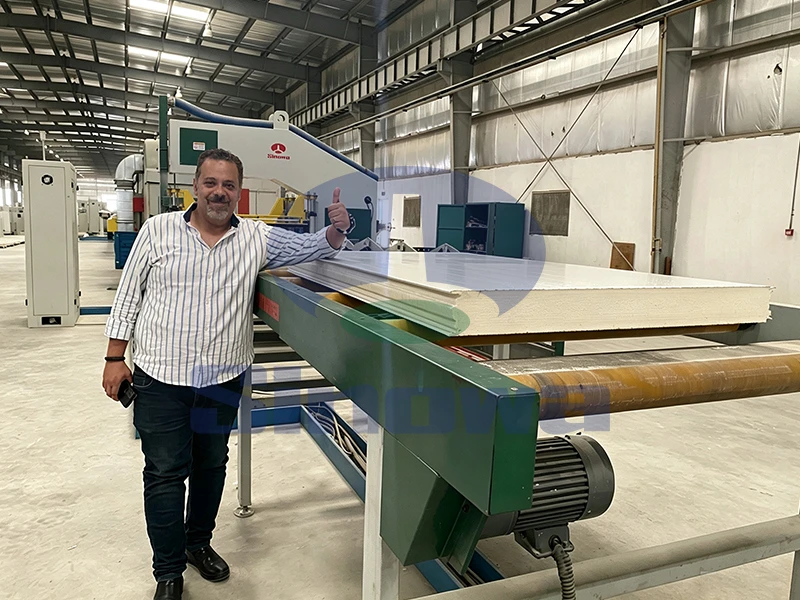
Foundation site selection and overall spatial planning constitute the primary link in the construction of PU sandwich panel line equipment foundations, laying a fundamental framework for subsequent construction and long-term equipment operation. The site needs to maintain a flat and integral terrain with uniform ground bearing capacity across the entire installation area, avoiding local foundation settlement that may cause equipment tilt and operational deviation. Reasonable functional zoning is essential for the production line’s continuous operation, which requires scientific division of raw material storage areas, sheet metal processing areas, PU foaming composite areas, curing areas, finished product sorting and stacking areas, and auxiliary equipment placement areas. This zoning design effectively isolates different production processes, prevents cross interference between material transportation and mechanical operation, and optimizes the overall production logistics route. Meanwhile, the site planning must reserve sufficient expansion space and maintenance channels to adapt to subsequent equipment function upgrading, process adjustment, and daily overhaul work. The spatial layout should follow the linear operation logic of the automated production line, ensuring smooth material transmission from feeding, molding, foaming, pressing to cutting and finished product output, and reducing unnecessary walking and transportation resistance in the production process.
Structural stability and bearing capacity design are the core technical indicators of PU sandwich panel line equipment foundation construction, directly determining the equipment’s operating accuracy and service life. The foundation structure adopts integrated reinforced concrete pouring as the main form, with thickened structural layers set in key equipment installation areas such as uncoiling machines, rolling forming units, high-pressure foaming systems, and composite pressing machines. These key areas bear long-term static load from equipment and dynamic load from cyclic mechanical operation, so the structural design needs to eliminate local stress concentration and enhance overall compression resistance and deformation resistance. Before concrete pouring, accurate positioning and embedding of anchor bolts must be completed in strict accordance with equipment installation dimensions, with standardized control of embedding depth, spacing and verticality to ensure firm connection between equipment base and foundation. Post-construction stress maintenance is also indispensable; sufficient curing time is required to ensure the concrete reaches stable structural strength, avoiding foundation cracking or deformation caused by premature equipment installation and load bearing. A stable foundation structure can effectively offset mechanical vibration generated by high-speed operation, maintain the horizontal precision of the entire production line, and guarantee consistent flatness and thickness uniformity of PU sandwich panels.
Vibration isolation and shock absorption construction is a key specialized requirement for PU sandwich panel line foundation engineering, aiming to eliminate vibration interference in continuous production. The production line involves multiple dynamic operating units, including rotating uncoiling components, reciprocating cutting devices, and high-pressure hydraulic pressing systems, which will generate continuous vibration during long-term operation. Uncontrolled vibration not only causes loosening of equipment connecting parts and accelerated wear of transmission components but also affects the bonding compactness and dimensional accuracy of PU foam and metal sheets, reducing finished product qualification rate. To solve this problem, professional vibration isolation layers and shock absorption fillers are laid at the bottom and around the foundation of core vibrating equipment. Flexible isolation structures are set between adjacent equipment foundations to block vibration transmission between different working units. In addition, the ground around the production line foundation is treated with integral reinforcement to prevent resonance caused by uneven ground vibration. Standardized vibration isolation construction can maintain the stability of the production environment, ensure the precision of foaming and composite molding processes, and reduce equipment failure rates caused by vibration fatigue.
Flatness and levelness control of the foundation surface is a crucial detail that cannot be ignored in the construction standard, which is closely related to the assembly accuracy and operating stability of automated production equipment. The entire foundation surface of the production line needs to achieve high-precision horizontal calibration after pouring and curing, with uniform flatness to avoid height deviation in local areas. Uneven foundation surface will lead to inconsistent stress on the equipment base, resulting in tilt of rolling forming mechanisms and pressing devices during operation, further causing problems such as uneven panel thickness, offset edge sealing, and unstable foaming molding. In the construction process, professional leveling tools are used for repeated calibration and polishing treatment on the foundation surface to remove protrusions, depressions and uneven mortar layers. Special attention is paid to the linear levelness control of the long-distance horizontal operation section of the production line, ensuring that the conveying track of sheet materials and finished products remains straight and stable. High-precision surface treatment provides a reliable installation benchmark for the overall assembly of the production line, ensuring the coordinated and accurate operation of each functional unit.
Auxiliary facility matching construction is an important supporting part of the PU sandwich panel line foundation system, ensuring the full-function and safe operation of the production line. The foundation construction needs to reserve standardized pipelines and wiring trenches for equipment power supply, pneumatic systems, hydraulic systems and cooling systems, with reasonable layout of pipeline paths to avoid crossing and extrusion, and facilitate subsequent circuit and pipeline maintenance. Drainage structures are reasonably arranged around the foundation to timely discharge rainwater and production wastewater, prevent long-term water soaking of the foundation from damaging concrete structure and reducing bearing capacity. Meanwhile, anti-corrosion and wear-resistant treatment is carried out on the foundation surface and side walls, adapting to the long-term erosion of industrial dust, residual foaming materials and cleaning agents in the production environment. The peripheral ground of the foundation is reinforced and smoothed to meet the walking and operation needs of production and maintenance personnel, and anti-slip treatment is carried out in key operation areas to improve production safety. Perfect auxiliary facilities can effectively extend the service life of the foundation and equipment, and maintain the long-term stable operating state of the production line.
Foundation acceptance and post-construction protection specifications form the final guarantee of construction quality, realizing closed-loop management of PU sandwich panel line foundation engineering. After the completion of foundation construction and concrete curing, comprehensive quality inspection and acceptance shall be carried out from multiple dimensions including structural strength, surface flatness, levelness, anchor bolt positioning accuracy, vibration isolation effect and auxiliary facility completeness. Unqualified parts need targeted rectification and re-inspection to ensure all indicators meet the operational requirements of automated production lines. After acceptance, standardized protection measures shall be implemented for the foundation surface to avoid mechanical collision, heavy pressure extrusion and artificial damage during equipment handling and installation. In the subsequent daily production process, regular inspection and maintenance of the foundation structure are required, focusing on checking for cracks, settlement, surface wear and pipeline blockage problems. Timely maintenance and repair can eliminate potential safety hazards in advance, maintain the long-term structural stability of the foundation, and provide continuous and reliable basic support for the efficient and stable operation of the PU sandwich panel production line.
Main Products
-

Continuous PU Sandwich Panel Production Line
This continuous PU sandwich panel production line is an integrated automatic equipment. It covers uncoiling, forming, foaming, curing and cutting processes. With automatic raw material proportioning and precise temperature & pressure control, PIR sandwich panel production line continuously composites panels with double skins. Polyurethane sandwich panel production line stably produces steel and aluminum sandwich panels. Featuring high automation, the line makes fireproof and thermal-insulation panels for building enclosure and cold storage. -

Rock Wool Sandwich Panel Production Line
Continuous rockwool sandwich panel production line is an automatic integrated production equipment, consisting of uncoiling, forming, gluing and compounding, heating curing, fixed-length cutting, automatic stacking and other modules. The mineral wool sandwich panel production line continuously conveys color steel plates and rock wool core materials to automatically complete lamination and curing, which can produce fireproof and thermal insulation sandwich panels. Featuring high automation degree and stable operation, this production line is suitable for mass production of panels used for building walls, roofs and other scenarios. -

Phenolic Insulation Board Production Line
This integrated automatic production line continuously manufactures PU and phenolic insulation boards. The insulation board production line covers raw material proportioning, high-pressure foaming, laminating, curing and fixed-length cutting. Featuring high automation and stable molding, the insulation panel production line supports various surface materials. PU boards offer excellent thermal insulation, while phenolic boards have superior fire resistance. These products are widely used in construction, cold chain, ventilation ducts and other thermal insulation fields.
Other FAQs
- Polyurethane Sandwich Panel Production Equipment Lubrication Maintenance Standard
- Troubleshooting For Sandwich Panel Production Line Frequent Shutdown Failure
- Polyurethane Sandwich Panel Production Line Start-up Pre-inspection Complete Items
- Noise Reduction Measures For PU Sandwich Panel Production Equipment
- Difference Between PUR And PIR Sandwich Panel Production Lines