How To Adjust The Foaming Ratio Of The PUR Sandwich Panel Production Line
Oct 13, 2026
The foaming ratio of a PUR sandwich panel production line directly determines panel density, insulation performance, dimensional stability, and production yield. Mastering how to adjust it — by balancing raw material reactivity, mixing precision, mold temperature, conveyor speed, and pressure conditions — is the core skill that separates stable, high-quality panels from scrap, voids, or over-foamed blocks.
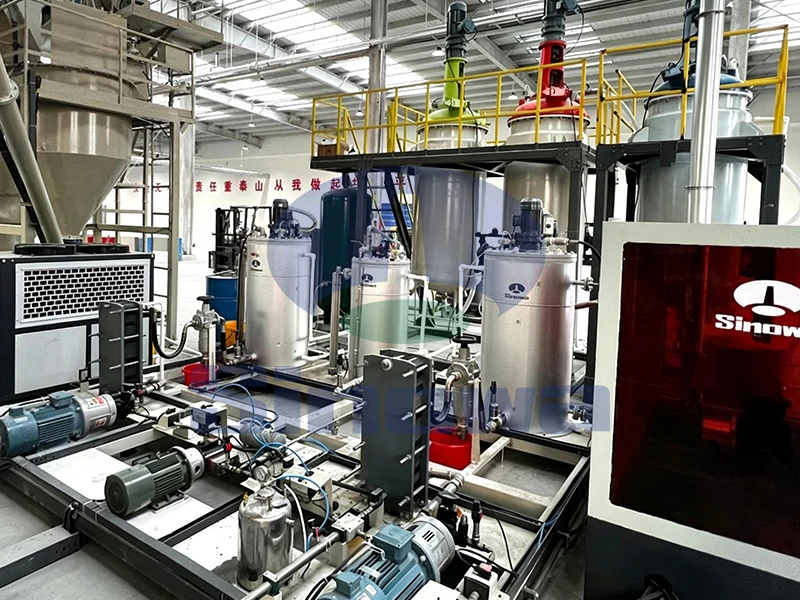
To adjust the foaming ratio effectively, one must first understand what the ratio actually represents in polyurethane chemistry. PUR (polyurethane) foam forms when polyol and isocyanate react exothermically, generating carbon dioxide — either from water blown into the system or from physical blowing agents — which expands the liquid mix into a cellular structure. The foaming ratio is essentially the relationship between the density of the raw liquid blend and the final free-rise or molded foam density. A higher ratio means lighter foam per unit volume, better thermal insulation per kilogram, but weaker compressive strength and a greater risk of cell collapse. A lower ratio means denser, more rigid foam with higher mechanical performance but higher material cost per square meter. On a continuous sandwich panel line, this ratio is not set in a single control; it emerges from the interaction of formulation, machine settings, and environmental conditions. Operators who treat the ratio as a single knob — "just add more blowing agent" — usually discover that adjusting one variable shifts three others, causing skin peeling, core voids, or warped panels downstream.
The starting point for any ratio adjustment is the polyol–isocyanate (NCO) index, because it sets the reactivity baseline that all other parameters depend on. The index is the ratio of actual isocyanate available to the stoichiometric amount needed to fully react with the polyol hydroxyl groups. On most PUR sandwich lines, operating slightly above 1.05 — typically in the 1.08 to 1.15 range — gives a robust, complete cure with good cross-link density, but pushing the index higher accelerates the cream time and shortens the rise time. When an operator wants to increase the foaming ratio (produce a lighter panel), the instinct is often to increase blowing agent, but if the NCO index is too low, the faster rise outruns the cure, and cells rupture before the gel locks them in, causing shrinkage. Conversely, lowering the index slows the reaction so much that the foam sits on the conveyor in a tacky state, allowing the top and bottom metal skins to sink into the core before gelation. Before touching any other setting, a disciplined operator confirms the index is at the line's known-good value, logs the current polyol temperature, isocyanate temperature, and mixing head pressure, and only then changes one variable at a time. This disciplined, single-variable approach is what makes the ratio adjustment reproducible rather than a trial-and-error gamble that consumes dozens of meters of panel.
The second lever is the blowing agent itself, which is the most direct way to change the foaming ratio. In modern PUR sandwich panel systems, blowing agents are typically added into the polyol component as a pre-blend or injected at the mixing head through a separate metering line. Increasing the blowing agent dosage — whether a physical hydrofluorocarbon, a low-boiling hydrocarbon, or the water that generates CO₂ in situ — increases the volume of gas available during the rise, directly lowering the free-rise density and raising the expansion ratio. But this adjustment has a narrow safe window. Increase it too much and the cell walls stretch thinner than their tensile strength can support, producing open cells, large voids, and a visible "egg-shell" surface on the cut panel edge. Increase it with water, and the extra CO₂ raises the exotherm peak inside the foam core, which can scorch the center of thick panels, yellow the skin contact layer, and even trigger internal delamination as the skin and core shrink at different rates. A practical adjustment is therefore incremental: change the blowing agent pump output by 2 to 3 percent, run a 6- to 10-meter test panel, cut the edge cross-section, measure the core density with a small sample cutter, and only then move the next increment. Over-correcting in one shift is the most common cause of a wasted roll of facing coil.
The third critical lever is material temperature, which controls both viscosity and reaction kinetics. Polyol temperature is usually held between 20 and 25°C on a continuous line, while isocyanate sits slightly warmer, around 22 to 28°C. Raising the polyol temperature by even 3°C lowers its viscosity noticeably, improves mixing quality at the head, and speeds up the initial reaction, effectively shortening cream time and making the foam rise faster on the lower skin. Operators sometimes use this effect to compensate for a line speed increase: if the conveyor is sped up and the foam no longer has time to fill the panel cavity before it reaches the curing press, a small rise in polyol temperature can accelerate the rise to match. But there is a catch — warmer polyol also reduces the time available for the foam to flow and level across the panel width, which can produce side-edge voids where the foam fails to push fully into the corner ribs of the metal skin. Isocyanate temperature has a subtler effect; raising it slightly improves flow, but pushing it above 30°C accelerates pre-reaction in the manifold and shortens the usable pot life inside the mixing chamber. A well-kept production log records both temperatures at every ratio adjustment, because a 5°C ambient shift on a summer afternoon can undo a carefully tuned formulation without the operator touching a single valve.
The fourth lever is mixing head pressure and output, which determines how uniformly the chemicals combine before the foam lands on the lower skin. On high-pressure PUR machines, the impingement pressure — typically 120 to 180 bar — slams the polyol and isocyanate streams into each other in a small chamber, producing a homogeneous, turbulent mix. If pressure drops because of worn seals, clogged filters, or a weakened hydraulic pump, the two streams no longer fully emulsify, and the dispensed bead is streaky with unreacted striations. The visible result is uneven cell structure across the panel width: one edge foams normally, the other edge stays dense and under-expanded. When an operator adjusts the foaming ratio by changing chemical output, the mixing head pressure must be rebalanced, because changing the pump stroke without adjusting the return-to-tank bypass can either raise or lower impingement pressure and change the effective mix quality. A related setting is the fan pattern or spray width of the dispensing head. The wider the head sweeps across the panel width, the more evenly the foaming ratio is distributed laterally. A narrow, concentrated bead creates a high-density center band and low-density side regions — a problem often misdiagnosed as a blowing agent error when it is actually a dispensing-pattern issue. Regularly inspecting the wear plates on the mixing chamber and replacing them at the scheduled interval is therefore part of ratio control, not just preventive maintenance.
The fifth lever is the mold — or in a continuous panel line, the double-band press and side rail configuration — which imposes physical constraints on how freely the foam can expand. Free-rise foam reaches its natural expansion ratio, but foam inside a sandwich panel is confined between two metal facing sheets and two side rails, so its rise is constrained vertically. The panel thickness set by the press opening determines the target core density: if the line is set to produce a 50 mm panel and the chemical output per linear meter is fixed, any change in blowing agent that raises the free-rise ratio will either push harder against the skins (raising internal pressure and possibly delaminating the skin) or, if the press opening is not adjusted, squeeze excess foam out through the side rails as trim scrap. The correct procedure is to adjust the press opening together with the chemical output, maintaining a slight back-pressure inside the cavity — usually a few centimeters of pre-expansion above the nominal panel thickness — so the foam presses firmly against both skins without oozing out. Side rail height, roller spacing, and the height of the closing roll above the lower skin all influence this confined expansion. When operators switch from a 40 mm panel to a 100 mm panel on the same line, they do not simply "run more chemistry"; they re-tune the entire constrained-expansion envelope, and the final foaming ratio is measured by cutting the cured panel and comparing actual core density against the target.
The sixth lever is conveyor speed and the curing oven profile, which set how long the foam has to rise, gel, and cure before the panel exits the press and is cut. If the line runs too fast, the foam exits the press before the gel point, and the panel still flexes under its own weight — causing the top skin to sag and the core density to stratify, heavier at the bottom and lighter at the top. If the line runs too slow, the foam sits in the press longer than necessary, over-curing, building internal stress, and often producing slightly higher density than intended because the long dwell time lets more gas diffuse out through the skin. Adjusting line speed is therefore almost always coupled with a reactivity adjustment: speed up the line and slightly raise material temperature or catalyst dosage so the cream–rise–gel sequence compresses to match; slow the line down and cool the polyol slightly or reduce the amine catalyst to prevent scorching in the center of thick panels. Most continuous lines use a multi-zone oven with independently heated upper and lower bands, typically between 40 and 60°C. Maintaining a stable band temperature — not too hot on the lower skin where the fresh foam lands, not too cold on the upper skin where the top sheet closes — keeps the rise rate consistent from start to finish of a production run, which is the difference between a panel whose density is uniform along its length and one that drifts from light to heavy as the day warms up.
The seventh lever is catalyst and surfactant dosage, which fine-tunes the three competing timings that define a successful rise: cream time (onset of expansion), rise time (peak volume), and gel time (when the structure locks). Tertiary amine catalysts accelerate the blowing reaction that generates CO₂, while tin-based catalysts accelerate the cross-linking reaction that builds the polymer network. To raise the foaming ratio safely — that is, to produce a lighter panel without cell collapse — the operator does not just add blowing agent; they also slightly adjust the catalyst balance so the gel time follows the rise time, not lags behind. If the gel lags, cells burst; if the gel leads, the foam stops rising too early and stays denser than the free-rise potential. Silicone surfactant, meanwhile, is what stabilizes the cell wall during expansion — too little and the cells coalesce into large voids, too much and the foam becomes overly fine-celled, which raises density slightly and increases cost. Experienced operators keep a small cabinet of pre-weighed catalyst and surfactant adjustments, and they make them in tenth-of-a-percent increments rather than wholesale changes, because the surfactant and catalyst window is narrow. When a line switches from winter to summer production, the ambient temperature drift is enough to push the gel point out of its window, and a tiny catalyst rebalance is often the cheapest, fastest fix that restores the intended foaming ratio without changing the formulation tank.
The eighth consideration is the facing skin condition, because the metal sheet the foam lands on is not just a passive substrate — it interacts chemically and thermally with the rising foam. A clean, properly primed steel or aluminum skin lets the foam wet out and adhere immediately, so the rise is unimpeded from the first centimeter. A contaminated skin — with residual oil from the uncoiling process, water vapor condensation on a cold morning, or an uneven coat of adhesive primer — creates a barrier that slows initial rise, causing the foam to pile up at the center of the panel and leave side voids. Skin temperature also matters: a cold lower skin absorbs heat from the freshly dispensed mix, lengthening the cream time and effectively reducing the expansion ratio near the bottom surface. On a cold day, operators often pre-heat the lower skin band slightly or increase polyol temperature by a couple of degrees to compensate. Adhesion primer thickness, sheet tension, and the moment the top skin closes over the rising foam all influence how much back-pressure the foam sees during its critical rise phase. A panel that looks perfectly foamed at the exit but fails a peel test in the QC lab usually points back to a skin-foam interface issue, not a bulk ratio error — which is why a disciplined adjustment process always includes a small peel-strength check after each ratio change, not just a density measurement.
Finally, the ninth and most underrated lever is measurement discipline and closed-loop control. Every ratio adjustment should end with a small, repeatable test: run 5 meters, cut three cross-sections at the head, middle, and tail of the run, weigh a known-size core sample with a precision balance, and record the density against the line settings. The operator should also inspect the cell structure under a magnifier, check for voids along the side rails, and verify skin adhesion on a peeled edge. Over time, these logged measurements build a formulation–settings–density map specific to that line, that polyol grade, that season, and that facing skin — and this map is the real operational asset. Without it, every new operator re-discovers the same tuning rules through scrap. Modern lines increasingly automate parts of this loop, using inline density sensors and closed-loop metering pumps that adjust output to a target weight per square meter, but even the most automated system depends on an operator who understands that the foaming ratio is the product of chemistry, temperature, pressure, speed, and substrate interaction — not a single dial. Treat it as a system, measure every change, and the panel line becomes predictable; treat it as a single variable, and each shift becomes a gamble with scrap, coil waste, and customer complaints.
Gallery
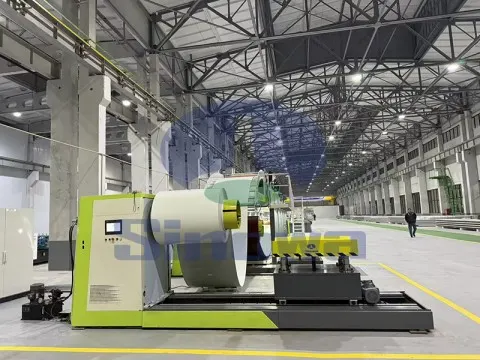
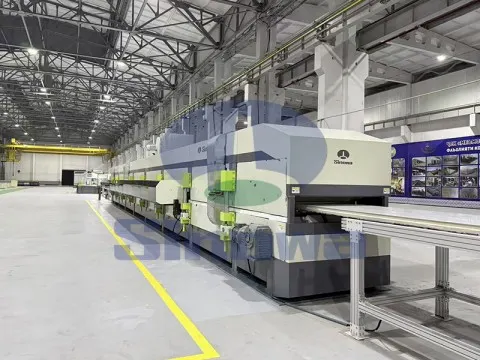
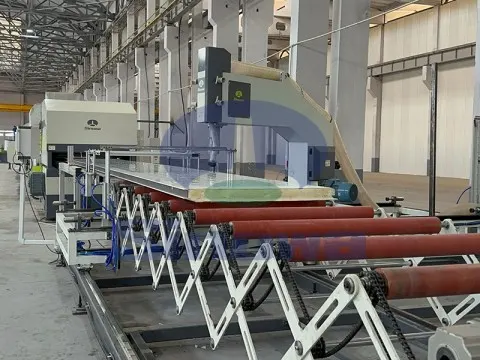
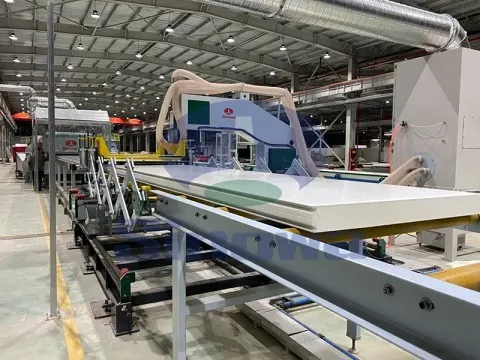
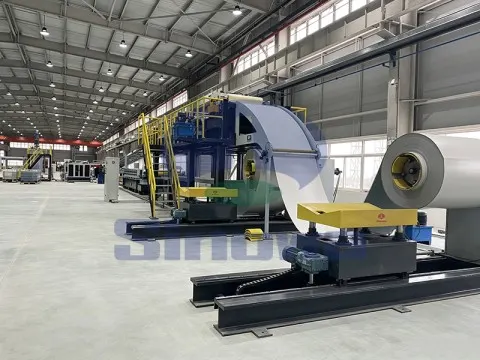
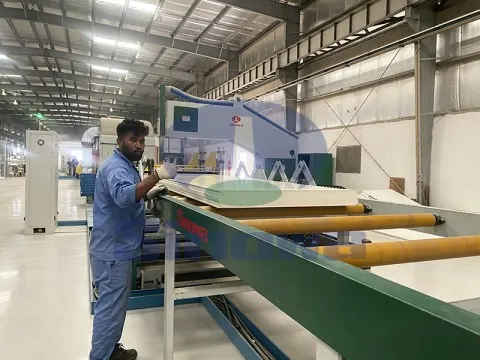
Sinowa is a professional manufacturer of sandwich panel machine in china, we provide diversified and high-performance sandwich panel production lines, including fully automatic continuous PU sandwich panel line and customized special lines to meet mass production and personalized order demands. These sandwich panel lines support processing multiple foam core materials, such as PU, PIR, mineral wool, rock wool and glass wool, covering different insulation and fireproof standards.
Featuring stable operation, high efficiency, energy saving and easy maintenance, our PU sandwich panel line deliver sandwich panels with excellent thermal insulation, fire resistance, sound insulation and lightweight durability. The finished panels are widely applied in industrial workshops, warehouse roofing and wall cladding, cold storage insulation, serving global construction and industrial insulation markets.
Main Products
-

Continuous PU Sandwich Panel Production Line
This continuous PU sandwich panel production line is an integrated automatic equipment. It covers uncoiling, forming, foaming, curing and cutting processes. With automatic raw material proportioning and precise temperature & pressure control, PIR sandwich panel production line continuously composites panels with double skins. Polyurethane sandwich panel production line stably produces steel and aluminum sandwich panels. Featuring high automation, the line makes fireproof and thermal-insulation panels for building enclosure and cold storage. -
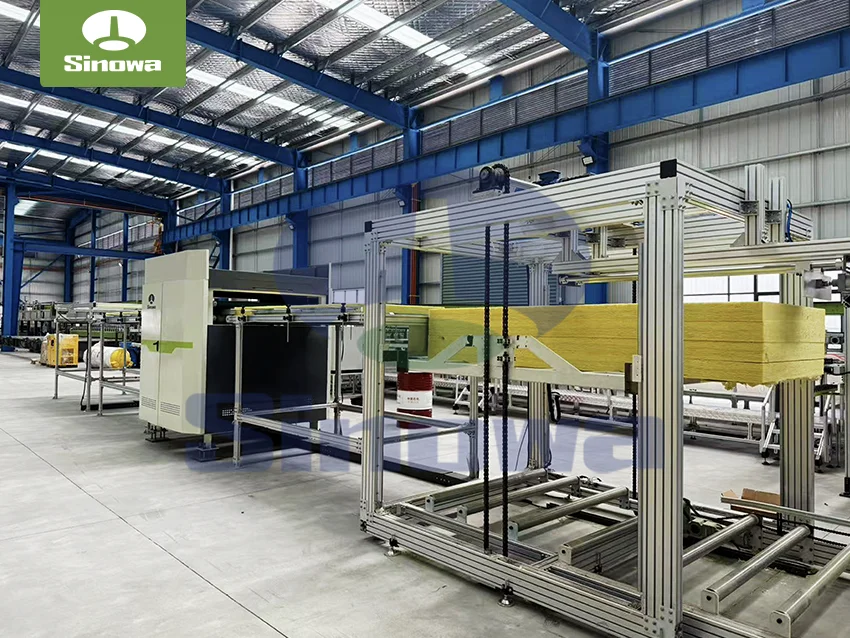
Rock Wool Sandwich Panel Production Line
Continuous rockwool sandwich panel production line is an automatic integrated production equipment, consisting of uncoiling, forming, gluing and compounding, heating curing, fixed-length cutting, automatic stacking and other modules. The mineral wool sandwich panel production line continuously conveys color steel plates and rock wool core materials to automatically complete lamination and curing, which can produce fireproof and thermal insulation sandwich panels. Featuring high automation degree and stable operation, this production line is suitable for mass production of panels used for building walls, roofs and other scenarios. -
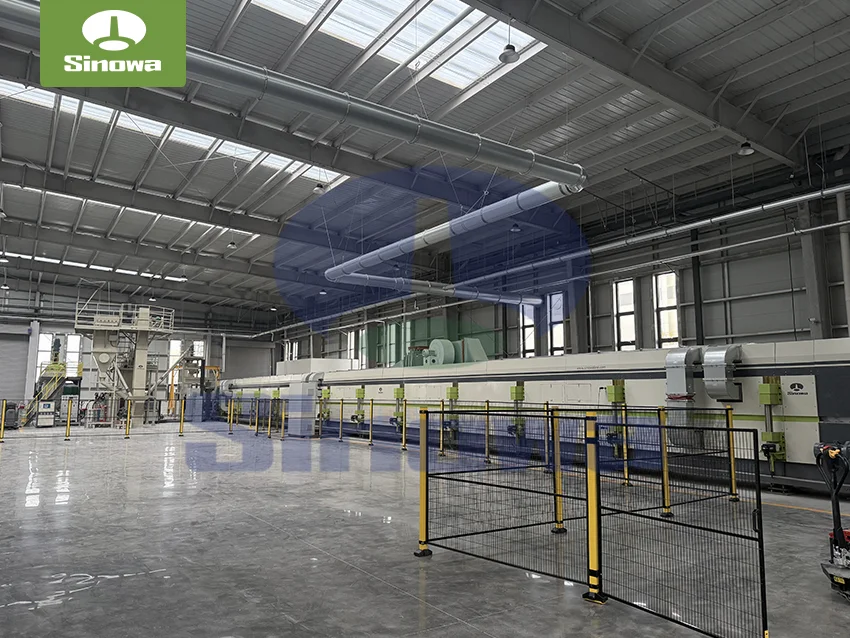
Phenolic Insulation Board Production Line
This integrated automatic production line continuously manufactures PU and phenolic insulation boards. The insulation board production line covers raw material proportioning, high-pressure foaming, laminating, curing and fixed-length cutting. Featuring high automation and stable molding, the insulation panel production line supports various surface materials. PU boards offer excellent thermal insulation, while phenolic boards have superior fire resistance. These products are widely used in construction, cold chain, ventilation ducts and other thermal insulation fields.
Other FAQs
- What Thickness Range Can A Polyurethane Sandwich Panel Production Line Manufacture
- What Power Supply Requirements Does A Continuous PU Sandwich Panel Line Have
- Why Does The Continuous PU Sandwich Panel Line Have Unstable Production Speed
- How To Choose A Reliable PU Sandwich Panel Machine Manufacturer
- How To Solve Foaming Instability Issues In Insulation Panel Production Line
- How Much Factory Space Does A Full Continuous PU Sandwich Panel Line Require
- Equipment Foundation Construction Standard For PU Sandwich Panel Line
- Anti-corrosion Treatment Standard For PU Sandwich Panel Equipment
- Difference Between Continuous And Discontinuous PU Sandwich Panel Production Lines
- Daily Maintenance Items Of Polyurethane Sandwich Panel Production Line
Related Articles
- PIR Sandwich Panel Line For High-quality Panel Manufacturing
- Automatic PU Sandwich Panel Machine
- Insulation Board Production Line
- Continuous Polyurethane Foam Sandwich Panel Production Line
- Continuous Roof Wall Sandwich Panel Production Line
- Composite Polyurethane Sandwich Panel Production Line
- PU Insulated Panel Manufacturing Line
- Polyurethane Sandwich Panel Production Line With Automatic Feeding Device
- Insulated Sandwich Panel Production Line
- Sandwich Panel Production Line Supplier