What Is The Standard Production Speed Of A Continuous PU Sandwich Panel Line
Oct 13, 2026
Continuous PU sandwich panel lines represent one of the most efficient manufacturing systems for insulated building envelopes, and their production speed sits at the center of every operational decision. Understanding what counts as a standard rate requires looking beyond a single number and examining how materials, tooling, and process controls interact.
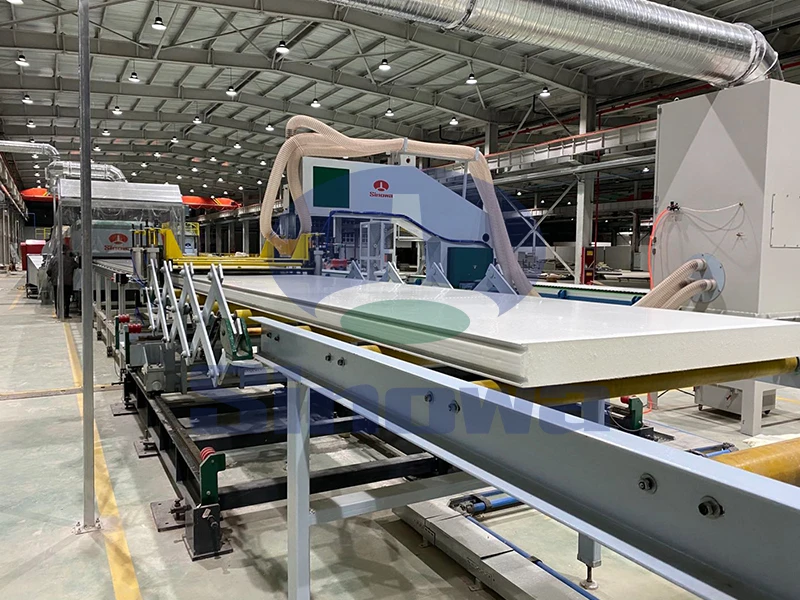
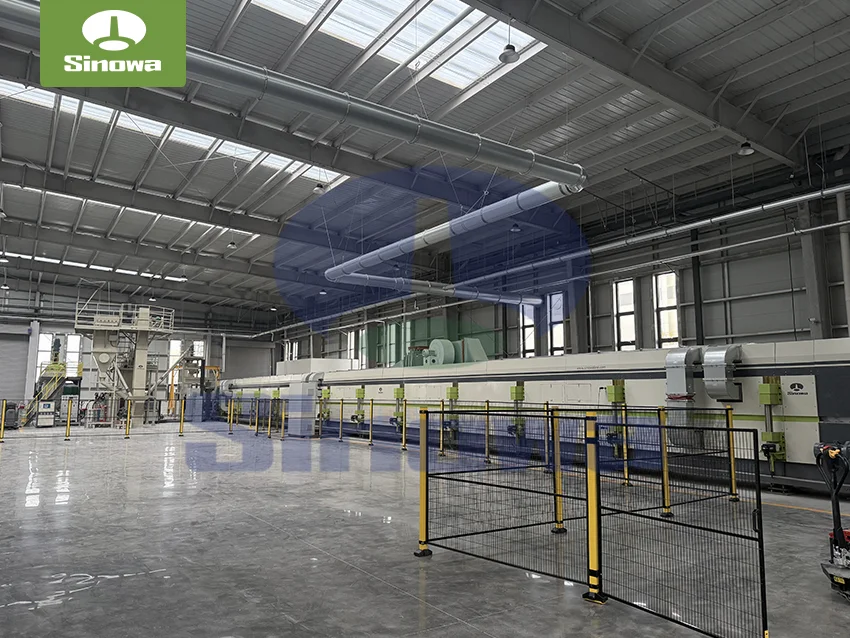
At its core, a continuous PU sandwich panel line is an integrated conveyor system that feeds two metal facing coils—typically pre-painted steel or aluminum—through a series of stations where polyurethane foam is injected, expanded, and bonded between them. The production speed of such a line is not a fixed figure stamped onto equipment; rather, it is a range determined by the panel thickness, the density target, the foam chemistry, and the oven length available for chemical reaction. Most commercial lines operate somewhere between four and twelve meters per minute under normal conditions, with thinner wall panels reaching the higher end and thicker roofing or cold-storage panels dropping toward the lower end. This wide band exists because polyurethane foam requires a minimum residence time inside the laminator to rise, gel, and achieve enough green strength to hold its shape before the panel exits and is cut. Manufacturers who try to push a thick panel line beyond its thermal window often find that the core delaminates, caves in during stacking, or develops internal voids that show up as surface waviness on the facing sheets.
The single biggest variable governing line speed is panel thickness. A 40-millimeter wall panel uses relatively little foam volume per linear meter, so the chemical reaction completes quickly and the conveyor can move briskly. A 100-millimeter refrigerated warehouse panel, by contrast, pumps several times the foam mass into the same linear meter, and that thicker core needs more time to expand uniformly from the center outward. The foam head traverses across the width of the lower facing in a controlled zigzag pattern, depositing a bead of mixed polyol and isocyanate that must spread evenly before the upper facing closes in. If the line runs too fast for the chosen thickness, the bead does not have time to self-level, and the finished panel exhibits density gradients—heavier at the edges and lighter in the center—that compromise both insulation value and structural rigidity.
Raw material preparation also imposes practical limits on how fast the line can comfortably run. The polyol blend, which includes blowing agent, catalysts, surfactants, and flame-retardant additives, must be held at a tightly controlled temperature in agitated day tanks. The isocyanate component is equally temperature-sensitive. When either material drifts outside its designed viscosity window, the mixing head cannot atomize and combine the streams properly, and the resulting foam develops uneven cell structure. Operators compensate by slowing the line slightly so that the mixer can deliver a consistent shot, because a cheap few meters lost in speed is far less costly than an entire coil of off-spec panels that must be scrapped. Similarly, the decoilers that feed the metal facings must maintain constant tension through load cells; a facing that flaps or drifts sideways at high speed will crease or misalign, forcing an immediate stop.
The laminating oven, often called the double-belt press, is where the actual speed is physically set. It is a long, modular steel belt maintained at controlled surface temperature, and its length multiplied by the conveyor speed gives the total residence time the foam experiences while it cures under pressure. A line with a twenty-four-meter oven at six meters per minute gives four minutes of press time; the same oven at ten meters per minute drops that to under two and a half minutes. Polyurethane chemistries are formulated around specific rise and gel times, and those chemistries are matched to a target residence window. Running the belt faster than the chemistry allows means the panel leaves the press before the foam has built enough compressive strength, and the downstream cut-to-length saw can crush or deform the still-soft core. This is why equipment suppliers quote a speed range rather than one number: the upper bound is dictated by oven length and reaction time, while the lower bound is an economic floor below which the line cannot pay for itself.
Cutting and sawing stations represent another speed-critical zone. After the panel exits the double belt, it passes through a traveling cut-off saw that must synchronize its motion with the moving strip, make a clean crosscut to the customer-specified length, and retract before the next panel arrives. At higher line speeds, the saw carriage must accelerate more aggressively, and the blade feed rate must increase proportionally to avoid burning the coating or leaving a burr on the steel skin. Many lines also include side trimming knives that slit the panel edges to the correct width as the strip moves. These stations are mechanically capable of high speeds, but the quality of the cut—the squareness of the end, the absence of delamination at the cut edge, and the smoothness of the skin—becomes the limiting factor. Operators often report that the saw, not the foaming process, is the first subsystem that begins to chatter or deflect when the line is pushed beyond about twelve meters per minute on standard panels.
Cooling and curing after the press introduce a less obvious but equally important speed constraint. Although the foam is handling-worthy when it leaves the belt, it continues to exotherm and crosslink for some time afterward. Panels that are stacked too early or moved onto packaging racks before residual heat dissipates can deform under their own weight, especially thick panels with higher foam mass. A well-designed line includes a cooling conveyor or an accumulation table long enough to give the stacker time to sequence panels without immediate pressure. When the line is sped up, this post-press section often becomes the bottleneck: the stacker cannot keep up, and operators either slow the front end manually or accept cosmetic damage from rushed stacking. Experienced production managers therefore treat the entire line as a linked system—any speed increase must be compatible with every station, not just the foaming section.
Quality feedback loops further shape what a sustainable standard speed looks like. Modern lines incorporate online thickness gauges, density sampling, and infrared thermography that monitor core temperature profile as the panel exits the oven. If the measured core peak temperature is lower than the formulation target, it usually means the foam reaction is incomplete, and the line is running too fast for that particular mix ratio or ambient condition. Conversely, an excessively hot core signals over-cooking or over-charging, which wastes raw material and can cause internal scorching. The best operating speed is the one at which these process sensors sit comfortably in the middle of their control bands over an eight-hour shift, rather than the fastest number demonstrated on a sales brochure. Seasonal changes in workshop temperature, the age of the mixing head, and the condition of the facing coil all nudge that sweet spot up or down by small increments from week to week.
It is also worth distinguishing between theoretical maximum speed and standard production speed. Equipment vendors typically advertise a peak figure achieved under ideal test conditions with a single panel specification, fresh raw materials, and a fully warmed-up line. Real-world standard speed, the rate at which a plant runs day after day while accepting routine coil changes, recipe switchovers, quality audits, and minor maintenance, is usually eighty to ninety percent of that peak. A line rated at twelve meters per minute might happily produce ten meters per minute across a full shift with normal interruptions. Switching between wall panels and roofing panels, changing coil widths, or adjusting the foam density for a new customer specification all bring the line to a stop or slow it to a crawl while settings are verified. Over the course of a month, the average output rarely equals the fastest single-hour reading.
In practice, determining the right continuous PU sandwich panel line speed is an exercise in balancing chemistry, mechanics, and economics rather than quoting a universal standard. The line that runs fastest on paper may not be the line that delivers the most finished, acceptable panels per shift, because scrap rate, rework, and equipment wear all accelerate when speed is pushed beyond its comfortable envelope. The most productive plants treat speed as a tuned variable—adjusted per product specification, monitored through sensors, and validated through end-of-line quality checks—rather than as a fixed parameter printed on a nameplate. That disciplined approach is what turns a capable machine into a steady, reliable producer of insulated panels that meet both performance expectations and delivery schedules.
Gallery
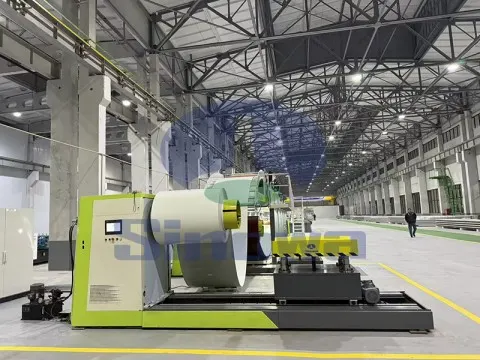
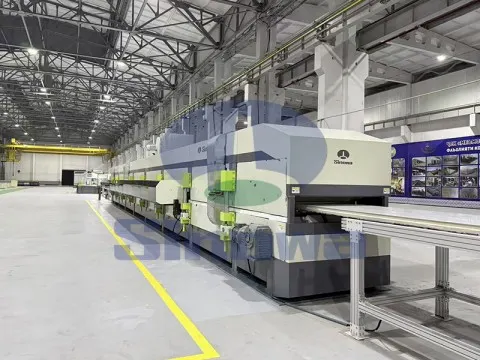
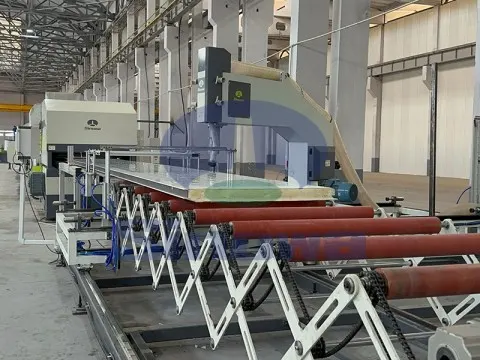
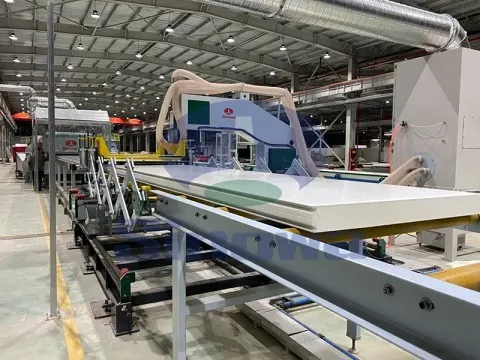
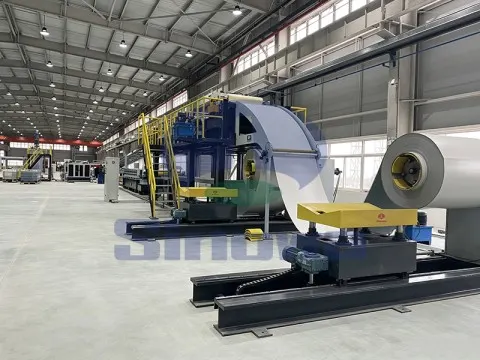
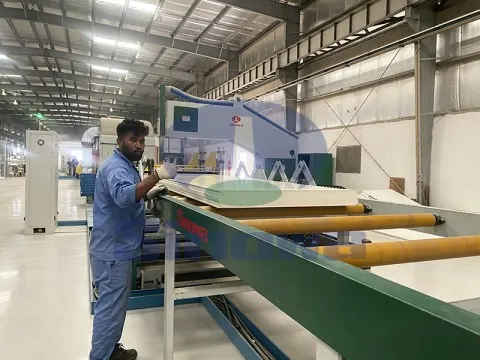
Sinowa is a professional manufacturer of sandwich panel machine in china, we provide diversified and high-performance sandwich panel production lines, including fully automatic continuous PU sandwich panel line and customized special lines to meet mass production and personalized order demands. These sandwich panel lines support processing multiple foam core materials, such as PU, PIR, mineral wool, rock wool and glass wool, covering different insulation and fireproof standards.
Featuring stable operation, high efficiency, energy saving and easy maintenance, our PU sandwich panel line deliver sandwich panels with excellent thermal insulation, fire resistance, sound insulation and lightweight durability. The finished panels are widely applied in industrial workshops, warehouse roofing and wall cladding, cold storage insulation, serving global construction and industrial insulation markets.
Main Products
-

Continuous PU Sandwich Panel Production Line
This continuous PU sandwich panel production line is an integrated automatic equipment. It covers uncoiling, forming, foaming, curing and cutting processes. With automatic raw material proportioning and precise temperature & pressure control, PIR sandwich panel production line continuously composites panels with double skins. Polyurethane sandwich panel production line stably produces steel and aluminum sandwich panels. Featuring high automation, the line makes fireproof and thermal-insulation panels for building enclosure and cold storage. -
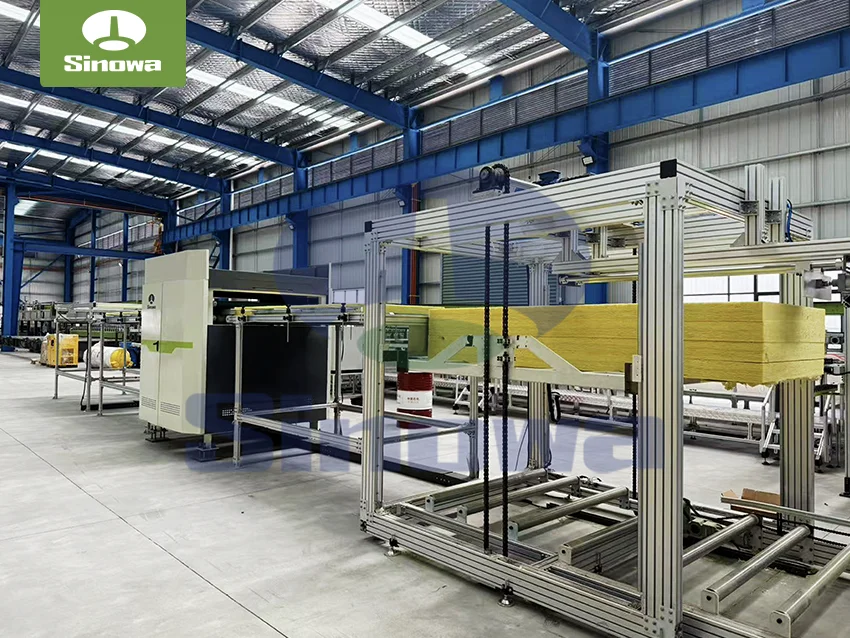
Rock Wool Sandwich Panel Production Line
Continuous rockwool sandwich panel production line is an automatic integrated production equipment, consisting of uncoiling, forming, gluing and compounding, heating curing, fixed-length cutting, automatic stacking and other modules. The mineral wool sandwich panel production line continuously conveys color steel plates and rock wool core materials to automatically complete lamination and curing, which can produce fireproof and thermal insulation sandwich panels. Featuring high automation degree and stable operation, this production line is suitable for mass production of panels used for building walls, roofs and other scenarios. -
Phenolic Insulation Board Production Line
This integrated automatic production line continuously manufactures PU and phenolic insulation boards. The insulation board production line covers raw material proportioning, high-pressure foaming, laminating, curing and fixed-length cutting. Featuring high automation and stable molding, the insulation panel production line supports various surface materials. PU boards offer excellent thermal insulation, while phenolic boards have superior fire resistance. These products are widely used in construction, cold chain, ventilation ducts and other thermal insulation fields.
Other FAQs
- What Thickness Range Can A Polyurethane Sandwich Panel Production Line Manufacture
- What Power Supply Requirements Does A Continuous PU Sandwich Panel Line Have
- Why Does The Continuous PU Sandwich Panel Line Have Unstable Production Speed
- How To Choose A Reliable PU Sandwich Panel Machine Manufacturer
- How To Solve Foaming Instability Issues In Insulation Panel Production Line
- How Much Factory Space Does A Full Continuous PU Sandwich Panel Line Require
- Equipment Foundation Construction Standard For PU Sandwich Panel Line
- Anti-corrosion Treatment Standard For PU Sandwich Panel Equipment
- Difference Between Continuous And Discontinuous PU Sandwich Panel Production Lines
- Daily Maintenance Items Of Polyurethane Sandwich Panel Production Line
Related Articles
- Working Principle of PU Foam Production Line
- Foam Color Steel Sandwich Panel Line
- PU Continuous Sandwich Foam Board Production Line
- PU Sandwich Panel Production Line For Insulation Panels
- Full-Automatic PIR Sandwich Panel Production Line For Roof Panels
- Color Steel PU Sandwich Panel Line
- What is PU Sandwich Panel Machine
- Polyurethane Sandwich Panel Machinery
- PU Sandwich Panel Making Plant For Clean Room Panel Production
- Production Process Of PU Sandwich Panel Machine