Why Does The Polyurethane Sandwich Panel Line Produce Uneven Foam Distribution
Sep 29, 2026
Uneven foam distribution is a prevalent quality defect in the polyurethane sandwich panel line, compromising panel flatness, insulation performance and structural stability. This issue stems from mechanical, material, operational and environmental factors, disrupting uniform foam forming and filling during continuous production.
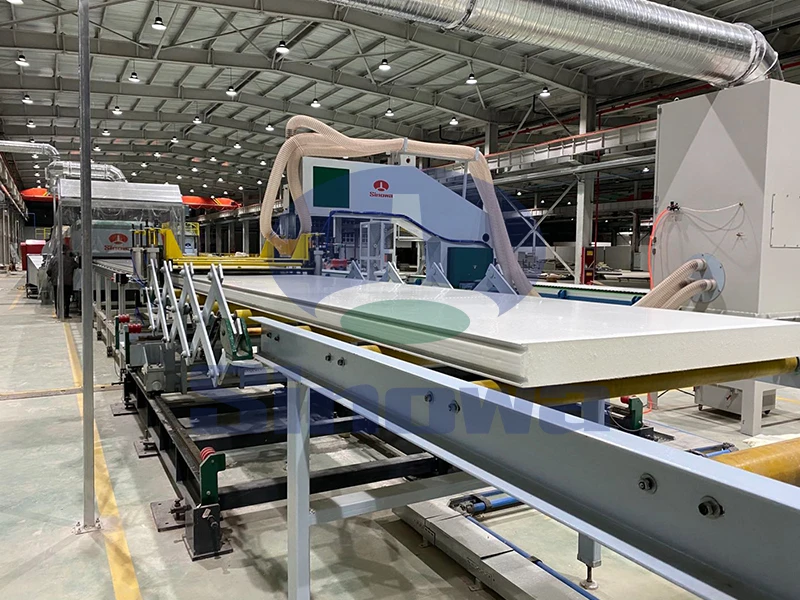
Improper material mixing and ratio deviation stand as the primary triggers of uneven foam distribution in the polyurethane sandwich panel line. Polyurethane foam formation relies on the precise chemical reaction between polyether polyol and isocyanate, and any imbalance in component proportions will directly break the uniformity of foam cell structure. In the daily operation of the polyurethane sandwich panel line, metering pump wear, filter blockage or unstable hydraulic pressure often cause inconsistent output of raw material components, leading to local excessive or insufficient reaction materials. When the two core raw materials fail to mix evenly within the specified reaction time, some areas produce dense foam with tiny cells due to over-reaction, while other areas form loose foam with large voids due to insufficient reaction. Additionally, residual impurities in raw materials or inconsistent raw material viscosity will hinder full fusion of components in the mixing chamber. Poor mixing uniformity makes the foaming reaction progress unevenly across the panel section, resulting in obvious density differences and irregular foam distribution on the finished sandwich panel surface and interior. This fundamental material mixing problem affects the overall forming quality of panels and is the most frequent cause of unqualified foam structures in continuous production.
Unstable equipment operating parameters are another key factor inducing uneven foam distribution on the polyurethane sandwich panel manufacturing line. The continuous foaming and laminating process of the polyurethane sandwich panel line requires coordinated operation of multiple modules, including feeding, spraying, laminating and curing, and any parameter mismatch will disrupt foam forming stability. Fluctuations in production line running speed are a typical problem; inconsistent linear speed leads to uneven raw material spraying volume per unit panel area, with fast-moving sections obtaining insufficient foaming materials and slow-moving sections accumulating excessive materials. Moreover, unreasonable spraying nozzle settings, such as blocked nozzles, inconsistent spraying angles or uneven nozzle spacing, will cause discontinuous material coverage on the panel base material. The pressure fluctuation of the high-pressure foaming system also cannot be ignored. Unstable spraying pressure makes the mixed polyurethane raw materials fail to spread evenly on the base material surface, forming local material accumulation or blank areas. These equipment parameter abnormalities will not only damage foam distribution uniformity but also cause hidden dangers such as panel delamination and surface wrinkling, reducing the overall yield of the production line.
Boundary layer effect and mechanical extrusion problems in the laminating process greatly affect foam uniformity in the polyurethane sandwich panel machine. In the formal laminating and forming stage of the polyurethane sandwich panel line, side sealing structures and laminating equipment will produce physical constraints on the foaming materials. Due to the boundary layer effect, the fluidity of polyurethane materials near the side seals is significantly reduced by frictional resistance, making the materials unable to diffuse freely to the edge areas of the panel. Meanwhile, the mechanical extrusion force of the side seals compresses the unformed foam structure in advance, trapping liquid polymer at the edges and forming dense, compact foam layers. In contrast, the middle area of the panel is less restricted, allowing the foam to expand fully and form loose cellular structures. This obvious difference between edge and middle foam density is a typical manifestation of uneven distribution. In addition, inconsistent gap spacing of the laminating machine will lead to uneven extrusion pressure on different parts of the panel. Too small a local gap will over-compress the foam, while an oversized gap will result in insufficient foam filling, further exacerbating the uneven foam distribution state of the finished panel.
Ambient temperature and curing condition fluctuations severely interfere with uniform foam forming in the polyurethane sandwich panel production line. Polyurethane foaming is a temperature-sensitive chemical reaction, and ambient temperature directly affects reaction rate and foam expansion efficiency in the production environment of the polyurethane sandwich panel line. When the workshop temperature is too low, the initial reaction speed of polyurethane raw materials slows down, the foam expansion time is prolonged, and local materials fail to expand fully before curing, resulting in insufficient filling and sparse foam structures. On the contrary, excessively high ambient temperature accelerates the reaction speed, making partial foam cure rapidly before uniform spreading, forming dense agglomerations and void defects. Besides ambient temperature, inconsistent temperature inside the curing oven also causes uneven foam distribution. Unbalanced heating in different areas of the curing equipment leads to asynchronous curing speed of foam in different parts of the panel. Uncured foam areas will deform and shrink under external pressure, while fully cured areas maintain stable structures, ultimately forming uneven foam density and irregular cell distribution across the panel. Humidity changes in the production environment will also affect the foaming reaction; excessive moisture reacts with isocyanate, generating extra gas and creating irregular pores that destroy foam uniformity.
Unreasonable operational processes and daily maintenance deficiencies further aggravate uneven foam distribution on the polyurethane sandwich panel making line. Many subtle operational errors in the long-term running process of the polyurethane sandwich panel line will accumulate and evolve into obvious foam quality defects. For instance, untimely cleaning of the mixing chamber and spraying nozzles leads to residual cured polyurethane materials, which hinder uniform mixing and smooth spraying of new raw materials. Irregular raw material feeding sequences and insufficient pre-stirring of raw materials also cause inconsistent material activity and viscosity, affecting the uniformity of subsequent foaming reactions. In terms of equipment maintenance, long-term operation without maintenance will cause wear of transmission parts, resulting in asynchronous operation of various functional modules of the production line. The mismatch between feeding speed and laminating speed breaks the dynamic balance of foaming material filling. In addition, lack of regular calibration of pressure and temperature monitoring devices leads to inaccurate parameter adjustment, making the production line run with deviated parameters for a long time. These human factor and maintenance problems are easy to be ignored in daily production, but they are important inducements of repeated uneven foam distribution defects.
In summary, uneven foam distribution in the polyurethane sandwich panel line is a comprehensive quality problem caused by the superposition of material, equipment, process and environmental factors. Each link from raw material mixing, equipment operation, laminating forming to curing molding affects foam uniformity. To improve panel quality, it is necessary to standardize raw material proportioning and mixing, stabilize equipment operating parameters, optimize laminating and curing processes, and strengthen daily equipment maintenance and operational management. Only by controlling every production detail can the uniform and stable foam structure of sandwich panels be guaranteed, effectively improving product performance and production yield.
Gallery
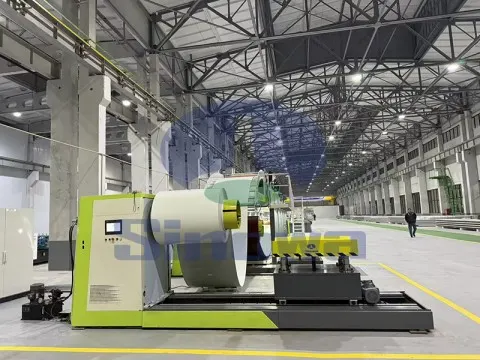
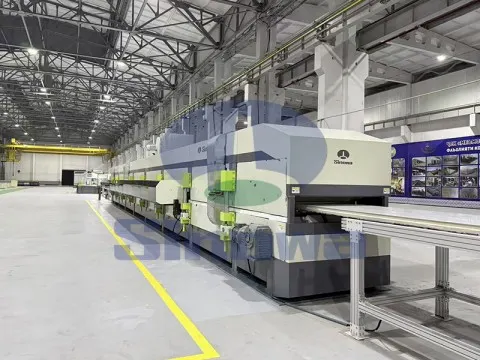
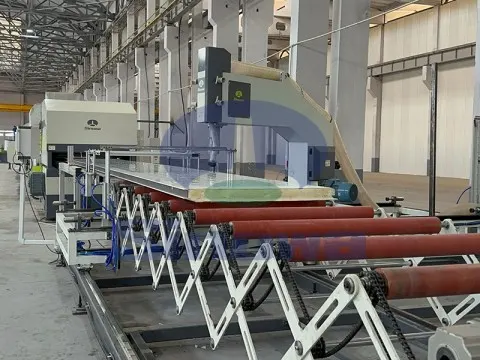
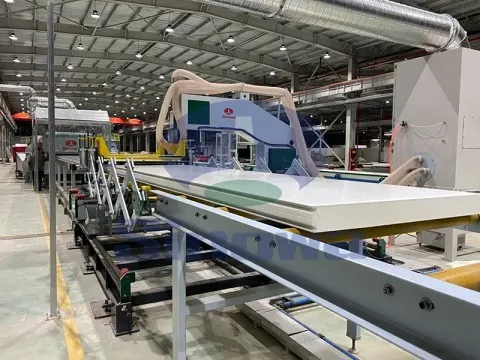
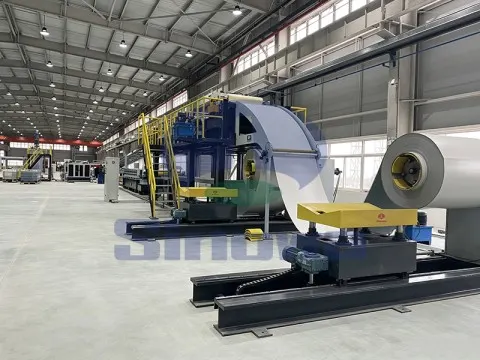
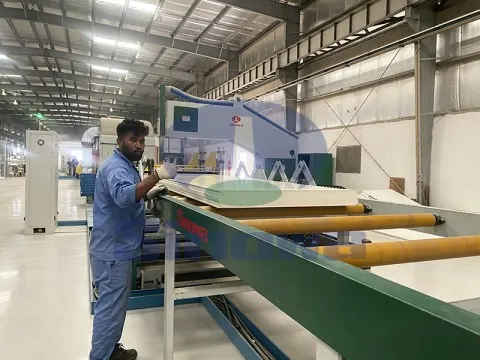
Sinowa is a professional manufacturer of sandwich panel machine in china, we provide diversified and high-performance sandwich panel production lines, including fully automatic continuous PU sandwich panel line and customized special lines to meet mass production and personalized order demands. These sandwich panel lines support processing multiple foam core materials, such as PU, PIR, mineral wool, rock wool and glass wool, covering different insulation and fireproof standards.
Featuring stable operation, high efficiency, energy saving and easy maintenance, our PU sandwich panel line deliver sandwich panels with excellent thermal insulation, fire resistance, sound insulation and lightweight durability. The finished panels are widely applied in industrial workshops, warehouse roofing and wall cladding, cold storage insulation, serving global construction and industrial insulation markets.
Main Products
-

Continuous PU Sandwich Panel Production Line
This continuous PU sandwich panel production line is an integrated automatic equipment. It covers uncoiling, forming, foaming, curing and cutting processes. With automatic raw material proportioning and precise temperature & pressure control, PIR sandwich panel production line continuously composites panels with double skins. Polyurethane sandwich panel production line stably produces steel and aluminum sandwich panels. Featuring high automation, the line makes fireproof and thermal-insulation panels for building enclosure and cold storage. -

Rock Wool Sandwich Panel Production Line
Continuous rockwool sandwich panel production line is an automatic integrated production equipment, consisting of uncoiling, forming, gluing and compounding, heating curing, fixed-length cutting, automatic stacking and other modules. The mineral wool sandwich panel production line continuously conveys color steel plates and rock wool core materials to automatically complete lamination and curing, which can produce fireproof and thermal insulation sandwich panels. Featuring high automation degree and stable operation, this production line is suitable for mass production of panels used for building walls, roofs and other scenarios. -

Phenolic Insulation Board Production Line
This integrated automatic production line continuously manufactures PU and phenolic insulation boards. The insulation board production line covers raw material proportioning, high-pressure foaming, laminating, curing and fixed-length cutting. Featuring high automation and stable molding, the insulation panel production line supports various surface materials. PU boards offer excellent thermal insulation, while phenolic boards have superior fire resistance. These products are widely used in construction, cold chain, ventilation ducts and other thermal insulation fields.
Other FAQs
- How To Choose A Reliable PU Sandwich Panel Machine Manufacturer
- How To Solve Foaming Instability Issues In Insulation Panel Production Line
- How Much Factory Space Does A Full Continuous PU Sandwich Panel Line Require
- Equipment Foundation Construction Standard For PU Sandwich Panel Line
- Anti-corrosion Treatment Standard For PU Sandwich Panel Equipment
- Difference Between Continuous And Discontinuous PU Sandwich Panel Production Lines
- Daily Maintenance Items Of Polyurethane Sandwich Panel Production Line
- What Are The Common Faults Of A Polyurethane Sandwich Panel Machine
- How To Optimize Cutting Sequence Of PIR Sandwich Panel Production Line Batch Panels
- How To Adjust The Feeding Speed Of Insulation Panel Production Line For Stable Output
Related Articles
- Customized Sandwich Panel Machine
- PIR Sandwich Panel Line For High-quality Panel Manufacturing
- Automatic PU Sandwich Panel Machine
- Insulation Board Production Line
- Continuous Polyurethane Foam Sandwich Panel Production Line
- Continuous Roof Wall Sandwich Panel Production Line
- Composite Polyurethane Sandwich Panel Production Line
- PU Insulated Panel Manufacturing Line
- Polyurethane Sandwich Panel Production Line With Automatic Feeding Device
- Insulated Sandwich Panel Production Line