Noise Reduction Measures For PU Sandwich Panel Production Equipment
Sep 17, 2026
PU sandwich panel production operations generate persistent mechanical and airflow noise that disturbs workshop environments and harms staff physical comfort. Adopting targeted noise reduction measures for core production equipment can effectively cut noise pollution, optimize working conditions, and stabilize long-term production efficiency in panel manufacturing processes.
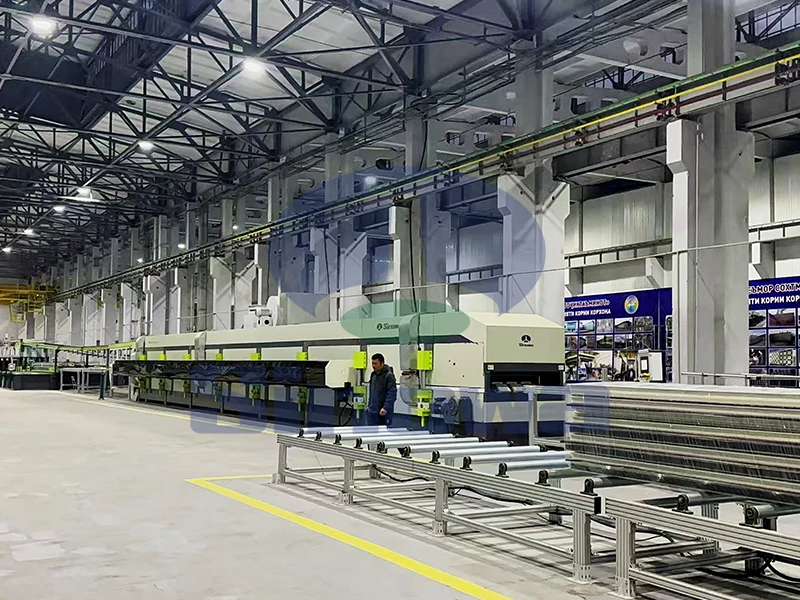
The primary source of noise in PU sandwich panel production stems from mechanical vibration and operational friction of core processing equipment, which runs continuously during mass production. Key noise-generating devices include feeding rollers, pressing units, cutting machines and foaming circulation systems, all of which produce high-frequency vibration noise during long-hour operation. In daily production, the frequent friction between metal components and the periodic vibration of operating equipment form overlapping noise waves that spread across the entire workshop space. Without targeted control, such persistent noise will not only cause auditory fatigue for on-site operators but also trigger subtle structural loosening of precision equipment parts over time, indirectly affecting the flatness and dimensional accuracy of finished sandwich panels. To address this fundamental problem, foundational vibration damping transformation should be implemented for all main production equipment. Installing high-performance rubber and metal composite damping gaskets at the base of large-scale equipment can effectively isolate the vibration transmission between equipment and the ground. Meanwhile, adding buffer sleeves to rotating and friction components such as roller shafts and transmission gears can reduce rigid friction and vibration amplitude during operation, fundamentally lowering the basic noise generated by equipment movement. Regular lubrication and maintenance of transmission parts also play a vital role in noise reduction, as insufficient lubrication will aggravate component wear and produce abnormal sharp noise during high-speed operation. Establishing a daily equipment inspection and lubrication maintenance mechanism can maintain stable operating conditions of mechanical parts and avoid incremental noise caused by component aging and wear.
Airflow and pneumatic system noise is another major noise source that cannot be ignored in PU sandwich panel production, mainly coming from PU material foaming air supply systems, pneumatic control valves and exhaust devices. In the foaming molding stage of sandwich panels, the high-speed circulating airflow and instantaneous air pressure release will produce strong airflow impact noise, which features high decibel and strong diffusivity, becoming the main interference source of workshop ambient noise. Different from mechanical vibration noise, airflow noise is more scattered and difficult to eliminate through simple damping measures, requiring professional airflow optimization and silencing transformation. The most effective improvement method is to install dedicated muffling devices at the air inlet and outlet of all pneumatic and circulating air systems. Multi-layer porous silencing materials can be used inside the mufflers to slow down airflow velocity, disperse air pressure impact and absorb high-frequency airflow noise. In addition, optimizing the pipeline layout of the air supply system is essential. Excessively curved and narrow pipelines will cause turbulent airflow and amplify noise volume, so straightening production pipelines and expanding local narrow sections can smooth airflow operation and reduce turbulent noise generation. It is also feasible to adjust the operating parameters of the pneumatic system appropriately, adopting graded air supply and slow pressure release modes to avoid instantaneous air pressure surge, which can significantly reduce the harsh noise generated by rapid airflow impact while ensuring normal foaming quality and production speed of PU materials.
Enclosed sound insulation treatment for independent production units is an efficient auxiliary measure to control equipment noise diffusion in PU sandwich panel production workshops. Most production equipment is arranged in open workshop spaces, leading to unrestricted noise diffusion and superposition, which greatly improves the overall noise level of the working environment. Building local sound insulation enclosures for high-noise single equipment can effectively block noise outward transmission and isolate noise sources from the operating area. The sound insulation enclosure structure can adopt a composite material design, with outer layer using high-density sound insulation boards to block noise penetration, inner layer laying sound-absorbing cotton and porous sound-absorbing materials to absorb residual noise inside the enclosure, forming a dual effect of sound insulation and noise absorption. It is necessary to reserve reserved openings for equipment operation, material feeding and daily maintenance on the enclosure, and install flexible sound insulation curtains at the openings to ensure no excessive noise leakage while meeting production and maintenance needs. For the integral continuous production line of PU sandwich panels, segmented semi-enclosed sound insulation baffles can be installed on both sides of the line body to block the horizontal diffusion of linear noise. This targeted enclosure treatment avoids the high cost of overall workshop sound insulation transformation, and can accurately control the noise radiation range of high-noise equipment, effectively reducing the noise exposure level of operators in the working area without affecting the normal production process and material handling efficiency.
Optimization of equipment operation and production management is a soft measure that sustains long-term noise reduction effects in PU sandwich panel production. Even with complete hardware noise reduction facilities, irregular equipment operation and unscientific production scheduling will still lead to abnormal noise and reduced noise control efficiency. First of all, standardized operating procedures should be formulated for all production equipment to require operators to start and stop equipment in a graded manner, avoid sudden start-up, sudden stop and overload operation, which can prevent instantaneous impact noise caused by unstable equipment operation. Overload operation will not only produce excessive noise but also accelerate equipment aging, forming a vicious cycle of noise increase and equipment loss. Secondly, scientific production scheduling can reduce the simultaneous operation of multiple high-noise equipment. Staggering the working time of high-noise processes such as cutting, grinding and high-pressure air supply can avoid the superposition of multiple noise sources and reduce the peak noise value of the workshop. In addition, regular professional training for on-site operators is necessary to improve their awareness of noise prevention and equipment standardized operation ability, so that operators can timely discover and eliminate abnormal noise faults such as component jitter and pipeline air leakage in daily work. Long-term standardized management can make hardware noise reduction measures play a stable effect, continuously reduce the overall noise level of the production workshop, and create a stable and low-noise production environment.
Workshop acoustic environment optimization and auxiliary noise absorption design can further polish the noise reduction effect of PU sandwich panel production sites and eliminate residual scattered noise. After completing equipment noise reduction and sound insulation transformation, there will still be partial reflected noise and residual scattered noise in the workshop space due to the hard walls, ground and top surface of the factory building. The hard and smooth building surfaces will form sound reflection, resulting in reverberant noise in the workshop and reducing the overall noise reduction effect. To solve this problem, targeted sound-absorbing transformation can be carried out on the workshop interior space. Laying durable sound-absorbing materials on the top and partial wall surfaces of the production area can effectively absorb reflected noise and residual high-frequency noise in the space, reduce indoor reverberation time, and improve the sound environment quality of the workshop. Meanwhile, reasonable spatial layout planning can assist in noise control. Isolating the high-noise production area from the staff operation and rest area through spatial partition can reduce the noise interference to staff working and resting. Green planting layout can also be arranged in the spare space of the workshop; dense foliage can play a certain role in noise absorption and buffer noise transmission, while improving the workshop ecological environment. These auxiliary optimization measures cooperate with equipment noise reduction and sound insulation measures to form a full-dimensional noise control system, realizing comprehensive improvement of the production workshop acoustic environment.
Long-term regular detection and iterative optimization of noise reduction systems ensure the continuous effectiveness and stability of PU sandwich panel production equipment noise control. Equipment aging, component wear, pipeline aging and workshop layout adjustment in the long-term production process will lead to changes in equipment noise generation conditions and attenuation of noise reduction facility performance, resulting in gradual rebound of workshop noise level. Therefore, establishing a regular noise detection and evaluation mechanism is crucial. Professional noise detection can be carried out in different production periods and different workshop areas to grasp the real-time noise distribution and change rules of the production site, accurately locate new noise sources and attenuated noise reduction links. According to the detection data, targeted iterative optimization and upgrading of noise reduction measures can be carried out, such as replacing aging damping gaskets and failed silencing materials, repairing loose sound insulation enclosure structures, and adjusting pipeline layout and equipment operating parameters. Timely maintenance and upgrading of noise reduction facilities can avoid the failure of long-term noise control work. At the same time, combining the continuous upgrading of PU sandwich panel production equipment, matching supporting noise reduction transformation can be carried out synchronously for new equipment and new processes, ensuring that noise reduction measures are always adapted to production conditions, maintaining a long-term stable low-noise production environment, and protecting the physical and mental health of on-site operators while supporting sustainable and high-quality production.
Main Products
-

Continuous PU Sandwich Panel Production Line
This continuous PU sandwich panel production line is an integrated automatic equipment. It covers uncoiling, forming, foaming, curing and cutting processes. With automatic raw material proportioning and precise temperature & pressure control, PIR sandwich panel production line continuously composites panels with double skins. Polyurethane sandwich panel production line stably produces steel and aluminum sandwich panels. Featuring high automation, the line makes fireproof and thermal-insulation panels for building enclosure and cold storage. -

Rock Wool Sandwich Panel Production Line
Continuous rockwool sandwich panel production line is an automatic integrated production equipment, consisting of uncoiling, forming, gluing and compounding, heating curing, fixed-length cutting, automatic stacking and other modules. The mineral wool sandwich panel production line continuously conveys color steel plates and rock wool core materials to automatically complete lamination and curing, which can produce fireproof and thermal insulation sandwich panels. Featuring high automation degree and stable operation, this production line is suitable for mass production of panels used for building walls, roofs and other scenarios. -

Phenolic Insulation Board Production Line
This integrated automatic production line continuously manufactures PU and phenolic insulation boards. The insulation board production line covers raw material proportioning, high-pressure foaming, laminating, curing and fixed-length cutting. Featuring high automation and stable molding, the insulation panel production line supports various surface materials. PU boards offer excellent thermal insulation, while phenolic boards have superior fire resistance. These products are widely used in construction, cold chain, ventilation ducts and other thermal insulation fields.
Other FAQs
- Difference Between PUR And PIR Sandwich Panel Production Lines
- Sandwich Panel Production Line Startup And Shutdown Standard Operating Procedures
- Maximum Production Capacity Of Polyurethane Sandwich Panel Production Line
- Sandwich Panel Production Line Upgrade And Expansion Feasible Solutions
- Standard Panel Thickness Range Of PU Sandwich Panel Line