Sandwich Panel Production Line Adaptation For Different Metal Facing Materials
Sep 21, 2026
Sandwich panel production lines require flexible structural and procedural adjustments to accommodate diverse metal facing materials. Different metal substrates vary in hardness, ductility and surface properties, demanding targeted equipment tuning and process optimization to ensure stable production and qualified panel quality in industrial manufacturing.
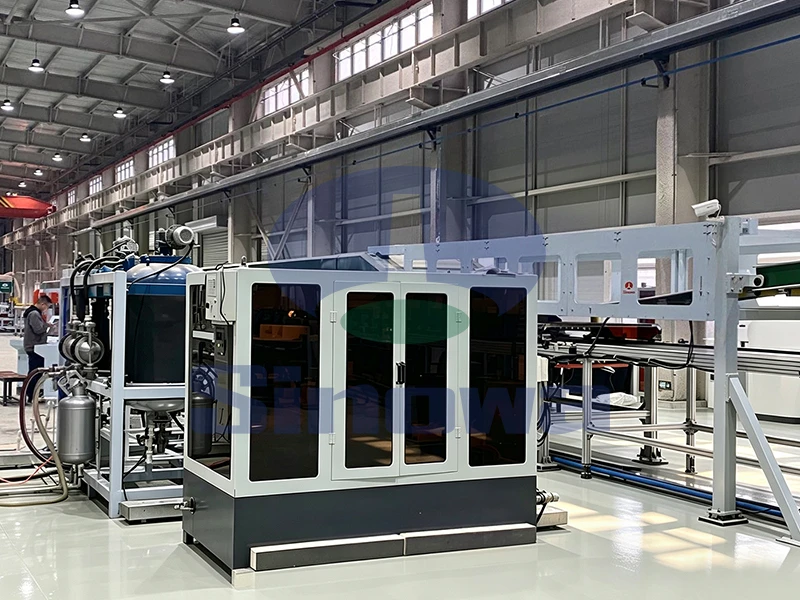
Metal facing materials serve as the outer protective and decorative layers of sandwich panels, and their physical and mechanical differences form the core reason for production line adaptation. Common metal facing options include galvanized steel, aluminum alloy, stainless steel and color-coated metal sheets, each with unique material characteristics that reshape production operation logic. Galvanized steel features moderate hardness and good rigidity, making it the most versatile facing material with stable processing adaptability. In contrast, pure aluminum and aluminum alloy sheets possess lower hardness and higher ductility, which makes them prone to deformation, stretching and surface scratching during high-speed rolling and molding processes. Stainless steel sheets, however, have high hardness and poor ductility, requiring greater processing force and precise speed control to avoid cracking and edge warping. Beyond mechanical properties, surface coating compactness, oxidation resistance and surface smoothness of different metal materials also differ greatly, which affects bonding effects with core materials and surface finishing quality of finished panels. All these material distinctions mean universal production parameters cannot apply to all metal facings, forcing production lines to achieve multi-dimensional adaptive adjustment in mechanical operation and process flow.
Roll forming system adjustment is the primary link in production line adaptation for different metal facing materials. The roll forming unit undertakes the task of flattening, bending and shaping metal sheets, and its roller gap, rolling speed and pressure parameters need precise calibration for various metals. For high-hardness stainless steel facings, the production line needs to narrow the roller gap appropriately and increase mechanical pressure evenly to ensure full sheet molding without incomplete bending or rebound deformation. Meanwhile, the rolling speed must be reduced moderately to avoid excessive instantaneous force that causes metal edge cracking and surface damage. For soft aluminum alloy facings, the adjustment logic is completely opposite. The roller gap needs to be slightly widened to prevent excessive compression from causing sheet thinning and local deformation, and the rolling speed can be properly increased to improve production efficiency while maintaining molding accuracy. In addition, the surface coating of forming rollers also needs targeted matching. Smooth and wear-resistant roller coatings are adopted for easily scratched color-coated metal sheets, while high-strength anti-pressure roller structures are used for hard metal materials to extend equipment service life and guarantee consistent molding quality of different facings.
Surface pretreatment process optimization is essential to enhance the bonding performance between metal facings and core materials across different metal types. Different metal materials have distinct surface activity, oxidation rates and impurity adhesion conditions, which require differentiated pretreatment procedures to remove surface dirt, oxide layers and oil stains. Stainless steel facings have dense surface structures and slow oxidation speeds, so they only need conventional degreasing and dust removal treatment to maintain surface cleanliness. Galvanized steel sheets are prone to surface zinc layer oxidation and white rust formation, requiring targeted passivation treatment after cleaning to stabilize surface properties and improve glue adhesion. Aluminum alloy materials are highly susceptible to oxidation, forming a dense and inert oxide film on the surface that hinders bonding, so enhanced surface activation treatment is necessary to improve surface roughness and chemical activity. Moreover, the drying temperature and time after pretreatment also need adaptive adjustment. Soft metal materials with thin oxide layers are dried at lower temperatures to avoid surface thermal deformation, while hard metal materials with thick surface attachments require higher-temperature drying to ensure thorough moisture removal, laying a solid foundation for subsequent composite bonding processes.
Glue coating and composite lamination parameter tuning determines the overall structural stability of sandwich panels with different metal facings. The viscosity, coating thickness and curing speed of adhesive materials need to match the surface characteristics and thermal conductivity of various metal facings. Metal materials with high surface smoothness, such as polished stainless steel, require low-viscosity adhesives that can spread evenly on flat surfaces to avoid glue accumulation and hollow bonding. For rough-surface galvanized steel facings with slight surface textures, medium-viscosity adhesives are selected to fill tiny surface gaps and enhance bonding firmness. In terms of lamination pressure and temperature, high-hardness metal facings can withstand higher lamination pressure and curing temperature, which accelerates adhesive curing and improves production efficiency. Soft aluminum facings cannot bear excessive pressure and high temperature, as extreme conditions will cause sheet bending, wrinkling and thermal deformation, so low-pressure and constant-temperature lamination modes are adopted. Meanwhile, the lamination speed is synchronized with glue curing speed according to metal thermal conductivity, ensuring that each type of metal facing and core material achieves seamless, uniform and firm composite bonding.
Cutting and post-processing system adaptation ensures the dimensional accuracy and surface integrity of finished panels with different metal facings. Different metal materials have varying cutting resistance and edge forming effects, requiring adjustment of cutting tool speed, blade gap and cutting feed rate. High-hardness stainless steel needs high-speed and low-feed cutting modes with high-strength alloy blades to ensure smooth cutting sections without burrs and cracks. Soft aluminum and color-coated metal sheets are cut at medium speed with optimized blade gaps to prevent sheet extrusion deformation and surface coating peeling during cutting. In addition, the edge trimming and surface finishing processes after cutting are adjusted accordingly. Hard metal facings require fine grinding of cutting edges to eliminate tiny burrs, while soft metal facings only need simple trimming to avoid secondary surface damage. The conveying and stacking links after production also need adaptive adjustment: flexible buffer conveying structures are used for soft metal panels to prevent extrusion deformation, while stable and high-load conveying modes are applied for hard metal panels to ensure orderly and intact finished product collection.
Intelligent system integration and real-time parameter switching have become the key to efficient and flexible adaptation of modern sandwich panel production lines. Traditional production lines rely on manual parameter adjustment, which is time-consuming and prone to errors when switching between different metal facing materials. Modern optimized production lines are equipped with integrated intelligent control systems that pre-store matched process parameter groups for various metal facings including steel, aluminum and stainless steel. Workers can complete one-click switching of equipment parameters according to production material requirements, realizing rapid adjustment of rolling, pretreatment, gluing, lamination and cutting processes. Meanwhile, the system is equipped with real-time monitoring modules to track material molding state, bonding quality and equipment operation data during production. It can automatically fine-tune local parameters according to subtle changes in metal material batches, effectively avoiding quality fluctuations caused by material differences. This intelligent adaptive mode not only greatly improves the production flexibility and compatibility of the production line for diverse metal facing materials, but also stabilizes product quality, reduces material waste and equipment loss, and meets the diversified production demands of the sandwich panel industry.
Main Products
-

Continuous PU Sandwich Panel Production Line
This continuous PU sandwich panel production line is an integrated automatic equipment. It covers uncoiling, forming, foaming, curing and cutting processes. With automatic raw material proportioning and precise temperature & pressure control, PIR sandwich panel production line continuously composites panels with double skins. Polyurethane sandwich panel production line stably produces steel and aluminum sandwich panels. Featuring high automation, the line makes fireproof and thermal-insulation panels for building enclosure and cold storage. -

Rock Wool Sandwich Panel Production Line
Continuous rockwool sandwich panel production line is an automatic integrated production equipment, consisting of uncoiling, forming, gluing and compounding, heating curing, fixed-length cutting, automatic stacking and other modules. The mineral wool sandwich panel production line continuously conveys color steel plates and rock wool core materials to automatically complete lamination and curing, which can produce fireproof and thermal insulation sandwich panels. Featuring high automation degree and stable operation, this production line is suitable for mass production of panels used for building walls, roofs and other scenarios. -

Phenolic Insulation Board Production Line
This integrated automatic production line continuously manufactures PU and phenolic insulation boards. The insulation board production line covers raw material proportioning, high-pressure foaming, laminating, curing and fixed-length cutting. Featuring high automation and stable molding, the insulation panel production line supports various surface materials. PU boards offer excellent thermal insulation, while phenolic boards have superior fire resistance. These products are widely used in construction, cold chain, ventilation ducts and other thermal insulation fields.
Other FAQs
- Price Composition Of Complete PU Sandwich Panel Production Line
- Operator Professional Training Content For PU Sandwich Panel Line
- Energy Consumption Standard Of Automatic PU Sandwich Panel Production Equipment
- Polyurethane Sandwich Panel Production Equipment Lubrication Maintenance Standard
- Troubleshooting For Sandwich Panel Production Line Frequent Shutdown Failure