Price Composition Of Complete PU Sandwich Panel Production Line
Sep 17, 2026
The price of a complete PU sandwich panel production line stems from multiple interconnected cost components that define overall investment value.
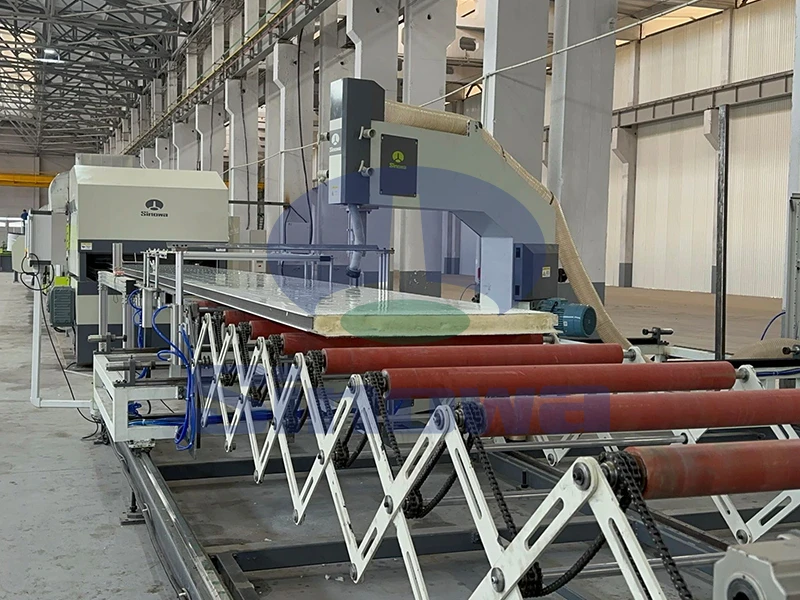
The core mechanical equipment constitutes the largest proportion of the total cost for a complete PU sandwich panel production line, serving as the fundamental framework that determines production capacity and product quality. Key core units include material unwinding and leveling systems, roll forming mechanisms, high-pressure PU foaming systems, continuous double-belt pressing equipment, and precision cutting devices. Each functional module features differentiated manufacturing costs based on structural design complexity and processing precision standards. The double-belt pressing system, as the core molding unit, requires high-precision machining and stable structural materials to ensure consistent panel flatness and foam density during continuous production, bringing relatively high manufacturing input. Similarly, the PU foaming system demands sophisticated fluid control components to realize uniform material mixing and stable foaming reactions, avoiding defective products caused by uneven foam layers. The metal sheet forming unit also involves customized roller molds to adapt to different panel shapes and thickness specifications, with mold precision and durability directly affecting production stability. All these core mechanical components adopt thickened structural materials and refined processing techniques to extend service life, which fundamentally supports the primary cost composition of the entire production line.
Automation and intelligent control configurations form another critical cost module of the production line, creating obvious price gaps between different line models. Basic production lines adopt semi-automatic control modes with manual intervention required for material switching, parameter adjustment, and finished product collection, featuring simple control systems and lower configuration costs. In contrast, high-end complete lines are equipped with full intelligent control systems, including automatic parameter calibration, real-time production data monitoring, fault self-diagnosis, and linkage operation of all units. The intelligent control core relies on programmable logic controllers, human-machine interaction terminals, and high-precision sensor groups to achieve unmanned continuous operation. These electronic control components and intelligent algorithms require intensive technical research and development, as well as strict quality screening, greatly improving configuration costs. Additionally, advanced lines support remote data transmission and production parameter optimization, which enhances production efficiency and product qualification rates while increasing initial investment costs. The degree of automation directly determines labor costs in later operation and production line operation stability, making it an indispensable variable in the overall price composition.
Production line customization and functional expansion requirements significantly affect the overall pricing structure, leading to personalized cost differences for different user demands. Standard conventional production lines are designed for universal PU sandwich panel production, with fixed equipment parameters and functional modules, featuring mature manufacturing processes and relatively stable and low comprehensive costs. However, most industrial production scenarios require targeted customization to meet diverse production needs. For instance, customized transformation for producing special-thickness panels requires adjusting the pressing stroke and mold specifications of the pressing system, while production lines for multi-type composite panels need additional material laying and composite auxiliary structures. Users pursuing diversified production capacity will also configure multi-functional switching modules to realize rapid switching between different panel specifications, which involves secondary structural optimization and program debugging. Moreover, customized anti-corrosion and wear-resistant treatments for equipment parts used in high-intensity continuous production scenarios will also increase manufacturing costs. All personalized customization items break the standardized production mode of equipment, requiring targeted design, processing, and debugging, thus forming differentiated incremental costs in the total price composition.
Auxiliary supporting systems and complete line integration costs are easily overlooked but essential components of the total investment. A complete PU sandwich panel production line cannot operate independently with core equipment alone and requires a full set of supporting systems to form a closed-loop production process. Conveying systems, finished product cooling beds, automatic stacking and discharging devices, and dust and waste material recovery devices constitute the main mechanical auxiliary units. These auxiliary devices ensure continuous and orderly production operation, reduce manual auxiliary work, and improve overall production line efficiency, with their structural design and functional integrity directly affecting the overall matching performance of the production line. In addition, pipeline layout for PU material delivery, electrical wiring integration, and safety protection system configuration also generate corresponding integration costs. Professional line integration requires reasonable matching of the operating speed and parameter logic of each equipment unit to avoid production stagnation caused by mismatched front and rear unit operation. The systematic integration process involves professional technical debugging and overall performance testing, and the complete supporting configuration enables the production line to reach the optimal operating state, making auxiliary and integration costs an important part of the total price.
Technical services, installation debugging and after-sales support systems constitute the intangible cost part of the production line pricing, which is closely related to the overall use value of the equipment. A complete production line transaction includes far more than equipment hardware supply, covering on-site installation, overall debugging, production trial operation, and staff technical training. Professional installation and debugging teams need to complete equipment positioning, line alignment, parameter optimization, and continuous trial production verification to ensure the production line meets normal production standards, consuming a large amount of technical labor costs. Meanwhile, standardized technical training services help users master equipment operation, daily maintenance, and simple fault handling skills, reducing later operation risks. Long-term after-sales support such as regular equipment maintenance guidance, spare parts supply guarantee, and remote technical troubleshooting also requires continuous technical resource investment. Different service guarantee levels correspond to different cost inputs, and complete service systems can effectively extend equipment service life and reduce later operation and maintenance losses, so service value is reasonably included in the overall pricing system of the production line.
Long-term operational cost attributes and equipment durability design further optimize the price composition logic of the production line, reflecting the total life cycle investment value. The initial purchase price is only part of the total equipment cost, and energy consumption performance, wear resistance of vulnerable parts, and later maintenance difficulty determine the long-term comprehensive input. High-quality production lines adopt energy-saving motor systems and optimized structural operation logic to reduce power consumption in continuous operation, lowering daily operational costs. The use of high-strength wear-resistant materials for vulnerable parts reduces replacement frequency and maintenance costs in the later stage. In terms of structural design, integrated and modular design simplifies equipment maintenance and parts replacement steps, saving time and labor costs for daily maintenance. Production lines with excellent durability and energy-saving performance have relatively higher initial manufacturing costs but can effectively reduce the comprehensive expenditure of the whole life cycle. Therefore, the overall pricing of high-quality complete production lines fully covers the design and manufacturing costs of long-term operational stability, forming a more scientific and cost-effective price composition system.
https://www.cnsinowa.com/faqs/price-composition-of-complete-pu-sandwich-panel-production-line.html
Main Products
-

Continuous PU Sandwich Panel Production Line
This continuous PU sandwich panel production line is an integrated automatic equipment. It covers uncoiling, forming, foaming, curing and cutting processes. With automatic raw material proportioning and precise temperature & pressure control, PIR sandwich panel production line continuously composites panels with double skins. Polyurethane sandwich panel production line stably produces steel and aluminum sandwich panels. Featuring high automation, the line makes fireproof and thermal-insulation panels for building enclosure and cold storage. -

Rock Wool Sandwich Panel Production Line
Continuous rockwool sandwich panel production line is an automatic integrated production equipment, consisting of uncoiling, forming, gluing and compounding, heating curing, fixed-length cutting, automatic stacking and other modules. The mineral wool sandwich panel production line continuously conveys color steel plates and rock wool core materials to automatically complete lamination and curing, which can produce fireproof and thermal insulation sandwich panels. Featuring high automation degree and stable operation, this production line is suitable for mass production of panels used for building walls, roofs and other scenarios. -

Phenolic Insulation Board Production Line
This integrated automatic production line continuously manufactures PU and phenolic insulation boards. The insulation board production line covers raw material proportioning, high-pressure foaming, laminating, curing and fixed-length cutting. Featuring high automation and stable molding, the insulation panel production line supports various surface materials. PU boards offer excellent thermal insulation, while phenolic boards have superior fire resistance. These products are widely used in construction, cold chain, ventilation ducts and other thermal insulation fields.
Other FAQs
- Noise Reduction Measures For PU Sandwich Panel Production Equipment
- Difference Between PUR And PIR Sandwich Panel Production Lines
- Sandwich Panel Production Line Startup And Shutdown Standard Operating Procedures
- Maximum Production Capacity Of Polyurethane Sandwich Panel Production Line
- Sandwich Panel Production Line Upgrade And Expansion Feasible Solutions