How Does A PUF Sandwich Panel Production Line Cut Panels To Fixed Lengths
Sep 29, 2026
PUF sandwich panel production lines adopt automated continuous cutting systems to trim endless molded panels into fixed-length finished products. Relying on precise sensing, synchronous operation and intelligent control, the process ensures accurate dimensions, smooth cuts and uninterrupted production, covering measurement, positioning, cutting and post-cutting processing steps.
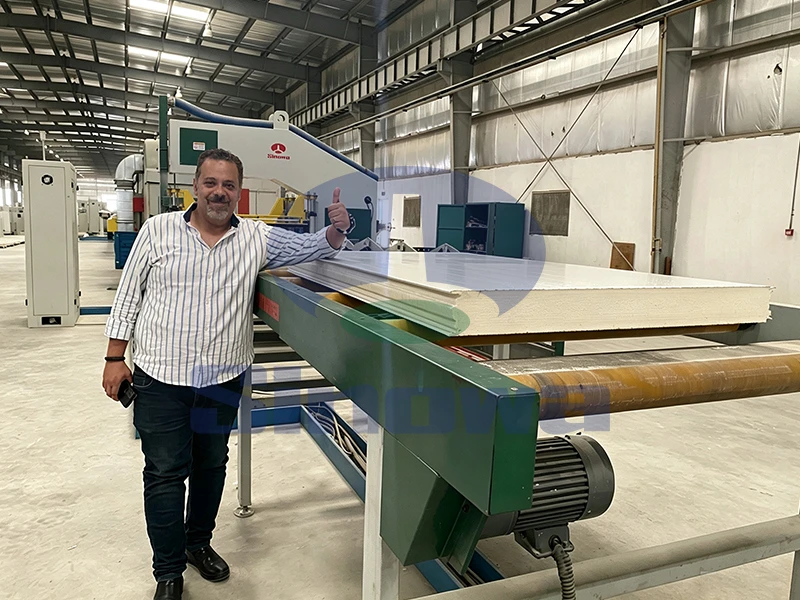
The fixed-length cutting process of PUF sandwich panels starts with stable material conveying and real-time length detection, which lays the foundation for accurate cutting. After completing foaming, laminating and curing in the continuous production line, the long strip-shaped PUF panels maintain a flat and rigid state and are steadily transported to the cutting workstation through a matched conveyor system. The entire conveying speed is precisely regulated to keep consistent panel movement, avoiding jitter or displacement that may affect cutting accuracy. Equipped with high-sensitivity length measuring components including photoelectric sensors and precision encoders, the system tracks the moving distance of panels in real time. These sensing devices continuously transmit pulse signals to the core control system, recording the real-time length of the panels passing through the detection area. Before formal cutting, workers preset target fixed-length parameters through the control terminal according to production demands. Once the real-time measured panel length matches the preset value, the system instantly triggers the cutting command, realizing automatic and precise length positioning without manual marking or measurement. This automated detection method eliminates human errors and ensures every panel can reach the standard fixed length before cutting, maintaining unified dimensional consistency of finished products.
Intelligent PLC control system serves as the core brain of fixed-length cutting, coordinating all operational links of the cutting process. The programmable logic controller integrates length data, conveying speed and cutting parameters to form a closed-loop control system for the entire cutting procedure. After receiving the length reaching signal from the detection device, the PLC system does not immediately start cutting; instead, it calculates the real-time conveying speed of the panel to adjust the cutting action rhythm dynamically. This dynamic adjustment is critical for continuous production, as PUF panels keep moving forward during operation, and static cutting will lead to dimensional deviation and production stagnation. The system synchronizes the moving speed of the cutting mechanism with the panel conveying speed to ensure the cutting tool and the panel remain relatively static during the cutting process. Meanwhile, the PLC system can store multiple sets of fixed-length parameters, supporting flexible switching of different size specifications in a single production run. It also monitors the operating status of sensors, conveyors and cutting tools in real time. Once abnormal data such as inaccurate length measurement or unstable speed is detected, the system will issue prompt reminders and fine-tune parameters automatically to stabilize cutting quality and avoid batch defective products.
Flying saw cutting mechanism is the key execution equipment for fixed-length cutting of PUF sandwich panels, adapting to the characteristics of continuous and high-efficiency production. Different from traditional fixed saw cutting equipment that requires stopping production, the flying saw device can complete cutting operations while the panel is in continuous conveying state, realizing non-stop production and greatly improving production efficiency. The mechanism is equipped with high-hardness wear-resistant cutting blades, which are professionally optimized for the composite structure of PUF panels composed of metal outer layer and polyurethane foam inner core. The sharp blade structure can penetrate the metal surface and foam core in one go, effectively avoiding common defects such as foam peeling, core layer cracking and metal edge deformation after cutting. The flying saw is installed on a movable guide rail, which can move synchronously with the forward direction of the panel. When starting cutting, the saw body accelerates rapidly to match the panel conveying speed, completes the transverse cutting action in a stable synchronous state, and then quickly resets to the initial position to wait for the next cutting instruction. The whole action cycle is efficient and compact, with no idle time in the production process, perfectly matching the high-speed continuous molding rhythm of PUF sandwich panel production lines.
Precision positioning and auxiliary clamping systems further optimize the accuracy and stability of fixed-length cutting of PUF panels. Although the synchronous cutting technology of flying saws can reduce displacement errors, auxiliary positioning structures are still essential to eliminate tiny deviations caused by mechanical vibration and material transmission. The cutting workstation is equipped with adaptive clamping components, which can gently fix the panel on both sides without squeezing and damaging the panel surface and internal foam structure. These clamping devices start synchronous clamping instantly before the cutting tool acts and release automatically immediately after cutting is completed, which will not hinder the continuous forward movement of the panel. In addition, the system is fitted with deviation correction units to monitor the horizontal offset of the panel in real time during conveying. Once slight left-right deviation is found, the unit will fine-tune the conveying track in real time to ensure the panel is always in the standard cutting position. The cooperation of clamping and deviation correction systems ensures that each cutting surface is flat and vertical, and the dimensional error of fixed-length panels is controlled within a tiny range, meeting the precise size requirements of subsequent installation and construction.
Post-cutting processing and quality inspection procedures guarantee the overall qualification of fixed-length PUF sandwich panels. Immediately after the cutting operation is completed, the supporting dust removal and cleaning device of the workstation starts to work, absorbing the foam debris and metal dust generated during cutting in real time. This not only keeps the production environment clean but also prevents residual debris from adhering to the panel surface and affecting the subsequent stacking and storage quality. Then, the cut fixed-length panels are transported to the inspection area through the conveyor. The automatic detection system conducts secondary verification on the panel length to screen out individual products with dimensional deviations. At the same time, it checks the cutting section quality to confirm no problems such as core layer hollowing, edge warping and incomplete cutting. Unqualified products will be automatically sorted out, while qualified fixed-length panels will be smoothly transported to the subsequent cooling and stacking links. This post-processing and inspection mechanism forms a complete closed-loop for fixed-length cutting production, effectively ensuring the stability and consistency of finished panel quality.
The integrated linkage of the entire fixed-length cutting system endows the PUF sandwich panel production line with efficient and flexible production capabilities. From real-time length sensing and intelligent parameter control to synchronous flying saw cutting and post-cutting quality optimization, every link is closely matched and operates collaboratively. The fully automated working mode reduces manual intervention throughout the process, effectively lowering labor costs and human-caused quality errors. Meanwhile, the adjustable parameter design enables the production line to adapt to various fixed-length production requirements, meeting the diversified size demands of different application scenarios. The stable mechanical structure and precise control logic not only improve the cutting efficiency of PUF panels but also ensure the flatness, completeness and dimensional accuracy of each cut panel, laying a solid foundation for the high-quality finished output of PUF sandwich panels in continuous industrial production.
Gallery
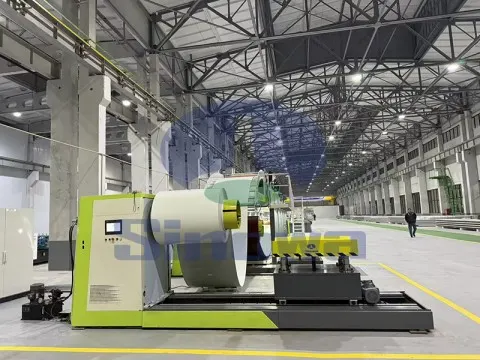
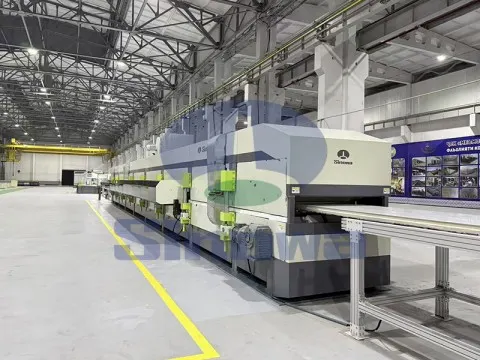
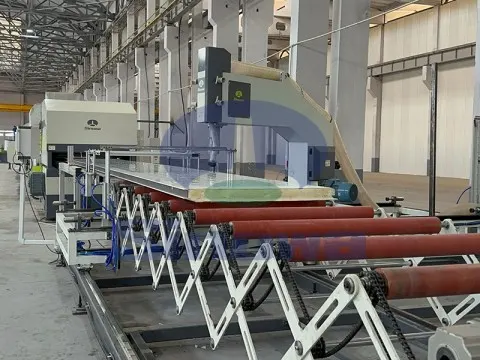
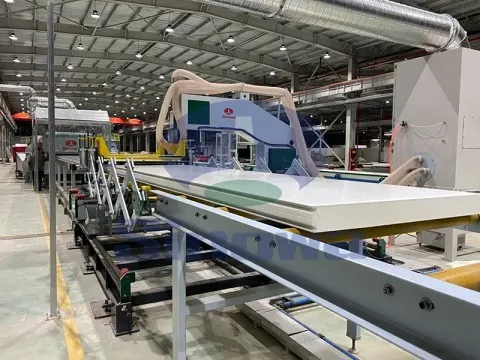
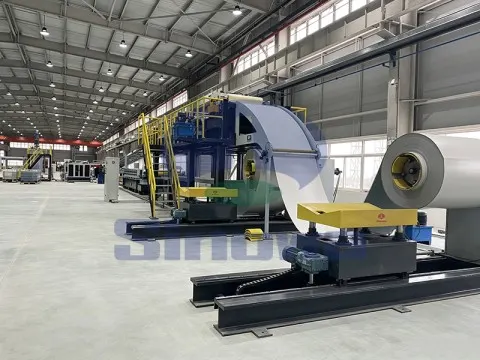
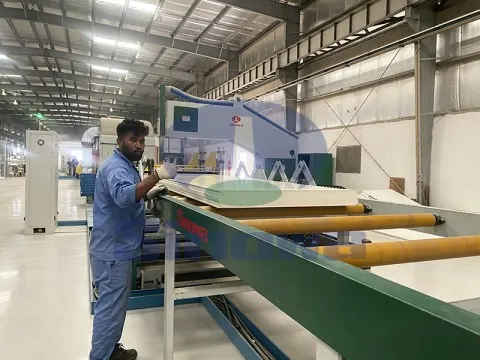
Sinowa is a professional manufacturer of sandwich panel machine in china, we provide diversified and high-performance sandwich panel production lines, including fully automatic continuous PU sandwich panel line and customized special lines to meet mass production and personalized order demands. These sandwich panel lines support processing multiple foam core materials, such as PU, PIR, mineral wool, rock wool and glass wool, covering different insulation and fireproof standards.
Featuring stable operation, high efficiency, energy saving and easy maintenance, our PU sandwich panel line deliver sandwich panels with excellent thermal insulation, fire resistance, sound insulation and lightweight durability. The finished panels are widely applied in industrial workshops, warehouse roofing and wall cladding, cold storage insulation, serving global construction and industrial insulation markets.
Main Products
-

Continuous PU Sandwich Panel Production Line
This continuous PU sandwich panel production line is an integrated automatic equipment. It covers uncoiling, forming, foaming, curing and cutting processes. With automatic raw material proportioning and precise temperature & pressure control, PIR sandwich panel production line continuously composites panels with double skins. Polyurethane sandwich panel production line stably produces steel and aluminum sandwich panels. Featuring high automation, the line makes fireproof and thermal-insulation panels for building enclosure and cold storage. -

Rock Wool Sandwich Panel Production Line
Continuous rockwool sandwich panel production line is an automatic integrated production equipment, consisting of uncoiling, forming, gluing and compounding, heating curing, fixed-length cutting, automatic stacking and other modules. The mineral wool sandwich panel production line continuously conveys color steel plates and rock wool core materials to automatically complete lamination and curing, which can produce fireproof and thermal insulation sandwich panels. Featuring high automation degree and stable operation, this production line is suitable for mass production of panels used for building walls, roofs and other scenarios. -

Phenolic Insulation Board Production Line
This integrated automatic production line continuously manufactures PU and phenolic insulation boards. The insulation board production line covers raw material proportioning, high-pressure foaming, laminating, curing and fixed-length cutting. Featuring high automation and stable molding, the insulation panel production line supports various surface materials. PU boards offer excellent thermal insulation, while phenolic boards have superior fire resistance. These products are widely used in construction, cold chain, ventilation ducts and other thermal insulation fields.
Other FAQs
- Does The Continuous PU Sandwich Panel Manufacturing Line Support Automatic Stacking And Packing
- Can PIR Sandwich Panel Production Line Produce Prefabricated Container House Roof Panels
- Why Is The Foaming Expansion Rate Unstable On The PU Foam Production Line
- Automatic Error Correction Function Of Polyurethane Sandwich Panel Production Line
- Workshop Space Layout Requirement For PU Sandwich Panel Production Line
- Operator Professional Training Content For PU Sandwich Panel Line
- Energy Consumption Standard Of Automatic PU Sandwich Panel Production Equipment
- What Safety Protection Measures Are Needed For A Polyurethane Sandwich Panel Manufacturing Line
- What Regular Maintenance Does A Polyurethane Sandwich Panel Line Need
- How To Fix Uneven Foam Density On The PU Foam Production Line
Related Articles
- Automatic PU Sandwich Panel Machine
- Insulation Board Production Line
- Continuous Polyurethane Foam Sandwich Panel Production Line
- Continuous Roof Wall Sandwich Panel Production Line
- Composite Polyurethane Sandwich Panel Production Line
- PU Insulated Panel Manufacturing Line
- Polyurethane Sandwich Panel Production Line With Automatic Feeding Device
- Insulated Sandwich Panel Production Line
- Sandwich Panel Production Line Supplier
- How To Operate The PU Sandwich Panel Machine