Difference Between PUR And PIR Sandwich Panel Production Lines
Sep 17, 2026
PUR and PIR sandwich panel production lines share similar continuous manufacturing frameworks but differ vastly in core technical configurations. Their distinctions cover raw material proportioning, foaming reaction control, temperature regulation, and post-processing settings, directly shaping panel performance, production stability, and application adaptability in industrial insulation fields.
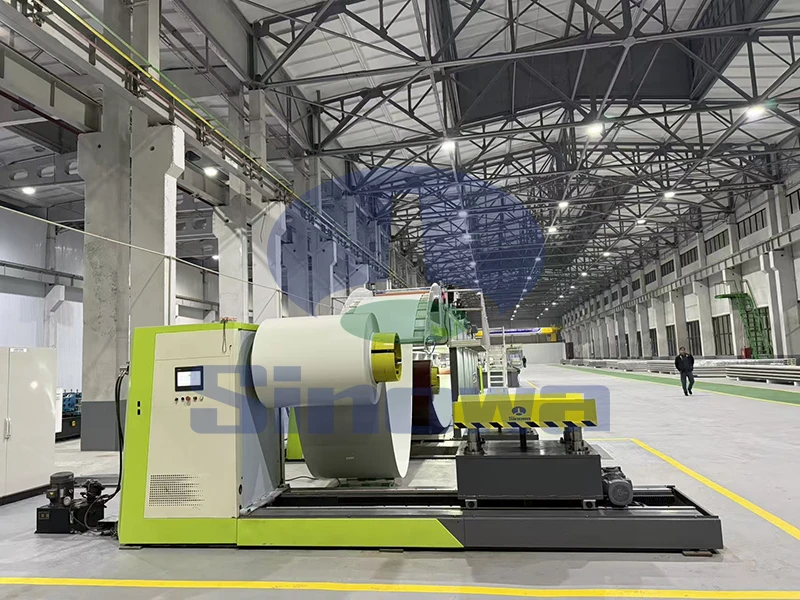
The most fundamental difference between PUR and PIR sandwich panel production lines lies in their raw material delivery and metering systems, which lay the foundation for divergent core foam properties. PUR production lines are designed for conventional polyurethane foam synthesis, adopting a standard dual-component metering structure that precisely blends polyether polyol and isocyanate at a relatively low isocyanate index. The system features moderate metering accuracy and flexible ratio adjustment, suitable for mixing basic auxiliary materials including common flame retardants and blowing agents. In contrast, PIR production lines adopt an upgraded multi-component precision metering module to accommodate the special chemical formula of polyisocyanurate foam. These lines require a significantly higher isocyanate proportion and rely on exclusive high-efficiency catalysts that promote the formation of stable isocyanurate ring structures during reactions. The metering precision of PIR lines is far stricter than that of PUR equipment, as tiny deviations in material ratios will directly affect the cross-linking density and fire resistance of the finished foam core. Additionally, PIR lines are equipped with independent raw material preheating units to ensure all chemical components reach the optimal reaction temperature before mixing, a configuration rarely required in standard PUR production setups. This specialized raw material processing system enables PIR lines to produce foam cores with higher structural stability and thermal tolerance, while PUR lines prioritize cost-effective and flexible material matching for general insulation needs.
Foaming reaction control systems represent another critical technical gap between PUR and PIR sandwich panel production lines, determining foam uniformity and bonding quality. PUR lines operate at a relatively low and stable reaction temperature range, with mild exothermic reactions that are easy to control throughout the foaming process. Their high-pressure mixing devices deliver consistent blending of chemical materials, and the foaming speed is moderate, allowing sufficient time for foam expansion and natural bonding with surface panels. The control system of PUR lines focuses on maintaining stable mixing pressure and fixed ambient temperature, with simple parameter logic and low operational difficulty, making it adaptable to various production environments. PIR lines, however, face more stringent reaction control requirements due to the intense exothermic polymerization of polyisocyanurate materials. These lines are fitted with intelligent real-time temperature monitoring and dynamic heat dissipation systems to prevent local overheating and foam carbonization during rapid cross-linking reactions. Unlike PUR foaming, PIR foaming demands precise control of reaction speed and curing time; overly fast expansion causes uneven foam pores, while excessive slowness leads to insufficient structural forming. Moreover, PIR production lines support real-time parameter adjustment according to ambient humidity and material activity, ensuring the consistency of foam density and pore structure in long-term continuous production. This sophisticated reaction control mechanism enables PIR panels to achieve tighter cell structures and better dimensional stability compared with conventional PUR panels.
Laminating and molding system configurations vary greatly between PUR and PIR sandwich panel production lines, adapting to their distinct foam curing characteristics. PUR production lines adopt standard constant-pressure laminating structures with moderate clamping force and flexible running speed. The double-belt laminating device maintains uniform pressure on the upper and lower surface panels during foam curing, which is sufficient to achieve tight bonding between polyurethane foam and metal or composite surface materials. The molding section of PUR lines features strong compatibility, supporting the production of panels with different thicknesses and surface materials through simple parameter adjustments, and the curing cycle is short to ensure efficient continuous output. PIR production lines are equipped with upgraded high-pressure constant-temperature laminating systems to match the special curing rules of polyisocyanurate foam. PIR foam requires higher molding pressure and longer constant-temperature curing time to complete stable ring closure and cross-linking reactions, so the laminating device of PIR lines has higher pressure resistance and temperature retention performance. In addition, PIR lines are designed with segmented temperature control in the molding channel, realizing gradual temperature adjustment from foaming inlet to curing outlet. This segmented temperature setting avoids internal stress concentration caused by rapid temperature changes, effectively preventing panel warping, delamination and cracking after molding. Although the molding efficiency of PIR lines is slightly lower than that of PUR lines, the optimized molding structure greatly improves the overall structural firmness and deformation resistance of finished panels.
Post-processing and quality calibration systems differ significantly between the two production lines, targeting their unique product performance attributes. PUR sandwich panel production lines are equipped with basic post-processing modules, including fixed-length cutting, edge trimming and conventional surface inspection devices. The quality calibration system mainly detects panel dimensional accuracy, bonding firmness and foam uniformity, focusing on ensuring the basic structural and appearance quality of finished products. The post-processing workflow of PUR lines is concise and efficient, matching its high-speed mass production rhythm for general building insulation projects. PIR production lines integrate more comprehensive and professional post-processing and quality monitoring functions to meet higher-performance application requirements. Beyond basic cutting and trimming processes, PIR lines are fitted with precise density detection and internal structure scanning modules to check the uniformity of isocyanurate cross-linking inside the foam core. Their intelligent calibration system can automatically identify unqualified products with inconsistent internal density or incomplete curing, realizing precise screening of defective products. Furthermore, PIR lines support fine edge sealing treatment for finished panels, which enhances the overall airtightness and structural integrity of panels. The complete post-processing quality control system of PIR lines ensures that each batch of products maintains stable high performance in terms of thermal stability and structural durability.
Production adaptability and operational maintenance characteristics further distinguish PUR and PIR sandwich panel production lines in practical industrial applications. PUR production lines feature high operational flexibility and low maintenance costs, with simple mechanical structures and universal component configurations. These lines can quickly switch between different panel specifications and adapt to diverse small-batch and customized production demands, making them suitable for versatile and cost-sensitive production scenarios. The daily maintenance of PUR lines only involves conventional cleaning, pressure calibration and component inspection, with low technical threshold and short downtime. In contrast, PIR production lines have more complex mechanical and control structures due to their precision reaction and molding systems. They require standardized professional maintenance procedures, including regular calibration of multi-component metering systems, inspection of high-temperature control modules and maintenance of precision laminating devices. Although PIR lines have higher operational and maintenance requirements, they deliver more stable product performance and stronger environmental adaptability. These lines can maintain consistent production quality in high-temperature and high-humidity working environments, and the finished panels have better long-term aging resistance, making them more suitable for high-standard industrial insulation and special building scenarios.
The final performance output and application positioning of products fundamentally differentiate the value of PUR and PIR sandwich panel production lines in the market. Products from PUR production lines excel in balanced thermal insulation performance and cost efficiency, with soft and tough foam structures that provide excellent shock resistance and bonding stability. These panels are widely applicable to conventional civil buildings, ordinary industrial workshops and general insulation engineering scenarios, meeting basic thermal insulation and structural protection needs. PIR production lines, through refined whole-process technical control, produce panels with superior thermal stability, high-temperature resistance and structural rigidity. The compact cross-linked isocyanurate structure of PIR foam endows panels with better anti-deformation ability and longer service life in extreme temperature environments. While PIR production has higher technical requirements and comprehensive production costs, its product performance advantages make it irreplaceable in high-demand fields. In essence, PUR production lines focus on universal and economical industrial production, while PIR production lines target high-performance and high-stability product manufacturing, forming a complementary production system covering different market demand levels.
https://www.cnsinowa.com/faqs/difference-between-pur-and-pir-sandwich-panel-production-lines.html
Main Products
-

Continuous PU Sandwich Panel Production Line
This continuous PU sandwich panel production line is an integrated automatic equipment. It covers uncoiling, forming, foaming, curing and cutting processes. With automatic raw material proportioning and precise temperature & pressure control, PIR sandwich panel production line continuously composites panels with double skins. Polyurethane sandwich panel production line stably produces steel and aluminum sandwich panels. Featuring high automation, the line makes fireproof and thermal-insulation panels for building enclosure and cold storage. -

Rock Wool Sandwich Panel Production Line
Continuous rockwool sandwich panel production line is an automatic integrated production equipment, consisting of uncoiling, forming, gluing and compounding, heating curing, fixed-length cutting, automatic stacking and other modules. The mineral wool sandwich panel production line continuously conveys color steel plates and rock wool core materials to automatically complete lamination and curing, which can produce fireproof and thermal insulation sandwich panels. Featuring high automation degree and stable operation, this production line is suitable for mass production of panels used for building walls, roofs and other scenarios. -

Phenolic Insulation Board Production Line
This integrated automatic production line continuously manufactures PU and phenolic insulation boards. The insulation board production line covers raw material proportioning, high-pressure foaming, laminating, curing and fixed-length cutting. Featuring high automation and stable molding, the insulation panel production line supports various surface materials. PU boards offer excellent thermal insulation, while phenolic boards have superior fire resistance. These products are widely used in construction, cold chain, ventilation ducts and other thermal insulation fields.
Other FAQs
- Sandwich Panel Production Line Startup And Shutdown Standard Operating Procedures
- Maximum Production Capacity Of Polyurethane Sandwich Panel Production Line
- Sandwich Panel Production Line Upgrade And Expansion Feasible Solutions
- Standard Panel Thickness Range Of PU Sandwich Panel Line
- Difference Between Continuous And Discontinuous PU Sandwich Panel Production Lines