sandwich panel line
The basic operational speed of the continuous PU sandwich panel line serves as the most intuitive core indicator determining overall production capacity, forming the fundamental basis for calculating hourly, daily and annual output volume. This type of production line features adjustable running speed, which can be flexibly regulated according to different panel thicknesses and structural requirements. In actual production scenarios, the line speed varies significantly with product specifications: thinner conventional insulation panels support higher operating speeds, while ultra-thick panels for special thermal insulation needs require reduced speed to ensure sufficient PU foaming, curing and composite bonding effects. A mature continuous production system can maintain stable cyclic operation within a reasonable speed range, avoiding output fluctuations caused by frequent start-stop adjustments. Steady-speed continuous operation not only improves unit time output but also eliminates the material waste and quality instability generated by repeated equipment debugging in intermittent production. The matching between speed and product specifications directly balances production capacity and finished product qualification rate, ensuring that high output does not come at the cost of reduced product quality in large-batch manufacturing.
Panel specification diversity is a key restrictive factor for the effective production capacity of continuous PU sandwich panel lines, as different thicknesses, widths and structural designs will reshape the actual output efficiency of the equipment. The line is compatible with a wide range of panel thickness specifications, covering conventional building insulation panels to special thickened panels for low-temperature cold storage and industrial anti-corrosion environments. In the same operating cycle, the production area of thin panels is significantly higher than that of thick panels, while thick panels consume more foaming materials and require longer curing and shaping time, thus lowering the effective area output per unit time. Meanwhile, the width setting of finished panels also affects capacity conversion efficiency, as standardized width specifications can maximize the utilization rate of raw material coils and avoid redundant cutting losses. Professional production lines adopt flexible specification switching mechanisms, which can complete parameter adjustment and equipment adaptation in a short time when switching between different panel types. This flexible adjustment capability enables the production line to adapt to diversified market orders without completely stopping production, greatly improving the comprehensive effective capacity of multi-specification mixed production.
Raw material metering, mixing and foaming stability directly affect the continuous operation stability and effective capacity of PU sandwich panel production lines, serving as the core process link supporting high-efficiency output. The core raw materials of PU sandwich panels include polyurethane combined materials and metal surface materials, and the precise proportional metering and uniform mixing of foaming materials are the prerequisites for continuous and stable production. Advanced continuous production systems are equipped with high-precision automatic metering and mixing units, which can maintain stable material ratio and output flow during long-term uninterrupted operation, avoiding foaming defects such as uneven density and insufficient bonding caused by material proportion deviation. Once foaming instability occurs, the production line needs to slow down or stop for debugging, which will directly reduce the overall effective production capacity. In addition, the quality and feeding continuity of metal coil raw materials also affect production efficiency; stable coil feeding and surface pretreatment can eliminate production pauses caused by raw material replacement and defect handling. Optimizing the raw material supply and foaming process coordination can effectively reduce equipment downtime and improve the continuous output efficiency of the production line.
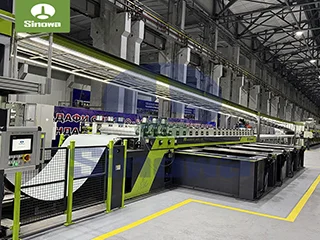
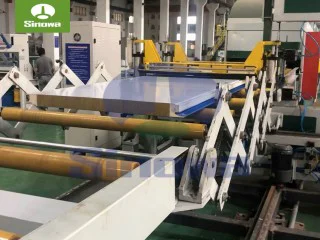
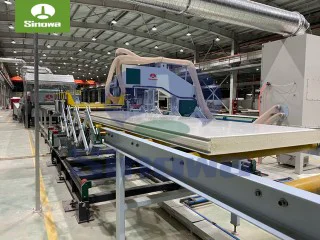
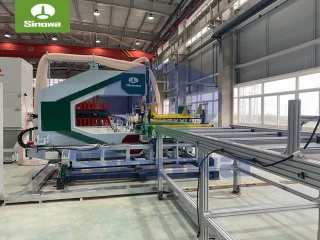
The degree of automation and integrated configuration of the production line is a crucial support for tapping the maximum production capacity of continuous PU sandwich panel equipment, realizing labor-saving and high-efficiency mass production. A complete continuous production line integrates multiple automated processing units including automatic uncoiling, roll forming, surface preheating, high-pressure foaming composite, constant-temperature curing, fixed-length cutting, automatic stacking and finished product conveying. The whole production process is controlled by an integrated industrial control system, which can realize synchronous linkage operation of each process unit without manual intervention in the middle link. Highly automated configuration greatly reduces manual operation errors and labor-dependent links, avoiding production stagnation caused by human operation fatigue and misoperation. Meanwhile, the intelligent control system can monitor the operating status, process parameters and product quality of the production line in real time, automatically adjust operating speed and process parameters according to production conditions, and pre-judge potential equipment abnormalities to realize early warning and maintenance. This intelligent operation mode maximizes the effective running time of the equipment, significantly improves the continuous production capacity of the line, and ensures the consistency and stability of batch products.
Equipment operation stability and daily maintenance mechanisms determine the long-term effective production capacity of continuous PU sandwich panel lines, distinguishing theoretical capacity from actual industrial output. The theoretical production capacity of the equipment is calculated based on full-load continuous operation, while the actual production capacity is affected by equipment failure rate, daily maintenance time and fault handling efficiency. Continuous production equipment operates under high-load cyclic conditions for a long time, and wear of transmission parts, aging of control components and blockage of foaming systems may cause minor faults if not maintained regularly, leading to production pauses. Scientific daily maintenance and regular equipment debugging can effectively reduce failure probability, maintain the long-term stable operating state of the production line, and extend the full-load operation cycle of the equipment. In addition, standardized operation procedures can avoid equipment loss caused by irregular operation and reduce frequent shutdown debugging caused by quality problems. Stable equipment operation minimizes invalid downtime, enables the production line to maintain high-efficiency output for a long time in industrial production, and ensures that the actual production capacity is close to the theoretical design level.
Production environment and operating cycle arrangement have a non-negligible impact on the practical production capacity of continuous PU sandwich panel lines, regulating the annual comprehensive output level of the equipment. This type of automated production line adapts to fixed factory production environments, and stable temperature, humidity and ventilation conditions can ensure the normal reaction of PU foaming materials and the stable operation of mechanical and electrical systems. Extreme environmental conditions will affect foaming efficiency and equipment operating accuracy, forcing the line to reduce speed or suspend operation and restrict production capacity. In terms of operating cycle, manufacturers can formulate single-shift, double-shift or uninterrupted all-day operating modes according to order demands and factory conditions. Reasonable shift arrangement can make full use of the continuous production advantages of the equipment, avoid idle equipment time, and maximize daily and annual output. Meanwhile, scientific production scheduling can coordinate equipment operation, raw material supply and finished product storage, avoid production stagnation caused by mismatched upstream and downstream links, and further optimize the overall operational efficiency and comprehensive production capacity of the production line.
Continuous optimization of process parameters and technological upgrading are effective ways to continuously improve the production capacity of PU sandwich panel continuous lines and enhance market production competitiveness. With the iterative upgrading of foaming technology and mechanical automation technology, optimizing core process parameters such as foaming pressure, curing temperature and transmission speed can further shorten the single-panel forming cycle and improve unit time output. Reasonable parameter matching can not only improve production efficiency but also ensure the structural performance and bonding quality of panels, realizing simultaneous improvement of capacity and quality. In addition, upgrading supporting units such as automatic stacking and intelligent sorting systems can improve the post-processing efficiency of finished products, avoid production line blockage caused by delayed finished product collection, and smooth the overall production rhythm. Continuous technological optimization and parameter iteration enable the production line to adapt to higher-efficiency production requirements and more complex product specifications, continuously tap the potential of equipment production capacity, and help manufacturing enterprises meet growing large-scale and high-standard market order demands.
https://www.cnsinowa.com/sandwich-panel-machines/continuous-pu-sandwich-panel-line-production-capacity.html