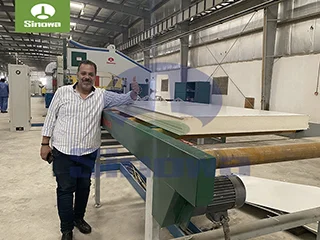
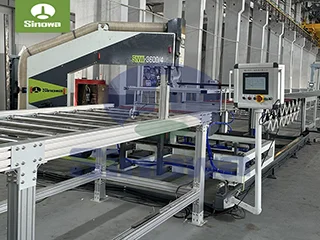
sandwich panel line
Different from the ordinary PU sandwich panels used for building wall and roof enclosure, the PU sandwich panels for pipeline insulation have special requirements in structural design, material matching, thickness control, surface protection performance and internal foam density uniformity, which are all formulated according to the actual installation environment and long-term operation needs of pipeline laying. Most pipeline insulation working environments involve long-term outdoor exposure, direct burial in soil, laying in comprehensive pipe galleries or industrial factory pipe racks, which require the supporting insulation sandwich panels to not only maintain efficient thermal insulation effect for a long time, but also have excellent water resistance, corrosion resistance, pressure resistance and aging resistance. The internal core PU foam layer of the pipeline insulation sandwich panel needs to form a dense and uniform closed-cell structure in the foaming and forming process, which can effectively block the heat conduction path and reduce the mutual heat exchange between the internal conveying medium of the pipeline and the external surrounding environment. At the same time, the high closed-cell rate structure can greatly reduce the water absorption rate of the insulation layer, avoid the problem of thermal insulation performance attenuation caused by moisture absorption and water accumulation inside the foam, and prevent the pipeline and related supporting structures from being corroded by humid gas and external corrosive media for a long time. The professional PU sandwich panel production line for pipeline insulation is precisely optimized and upgraded in view of these special performance requirements, realizing precise control in each production link from raw material mixing, high-pressure foaming, continuous composite forming to fixed-length cutting and post-processing, so that every batch of produced pipeline insulation sandwich panels can maintain consistent structural performance and stable thermal insulation effect.
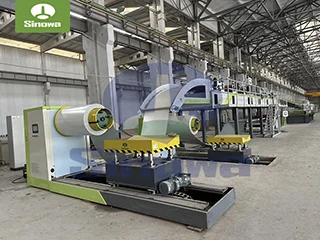
The overall operation logic of the PU sandwich panel line for pipeline insulation follows the integrated continuous production mode, which organically combines raw material pretreatment, continuous surface layer feeding, high-pressure PU raw material mixing and spraying, thermal composite laminating, constant temperature curing, fixed-length cutting and finished product conveying and stacking into a seamless production whole. The whole production process realizes continuous and uninterrupted assembly line operation, avoiding the quality difference and performance instability caused by intermittent manual operation and segmented processing in the traditional small-scale production mode. In the initial stage of production preparation, the production line carries out automatic screening and stable conveying of the base materials used for the upper and lower surface layers of the sandwich panel. The surface layer materials selected for pipeline insulation panels need to have good weather resistance and mechanical protection performance, which can resist external wind and rain erosion, soil corrosion and slight mechanical impact during pipeline installation and long-term operation. The production line is equipped with an automatic surface layer unwinding and leveling system, which can smoothly unfold the coiled surface layer materials and complete precise leveling and deviation correction, ensuring that the surface layers on both sides maintain flatness and consistent tension in the subsequent composite process, and avoiding composite deviation and local wrinkling defects in the finished sandwich panels. The accurate feeding and leveling of the surface layer is the basic premise to ensure the overall structural flatness and uniform stress of the pipeline insulation sandwich panel, and it also lays a foundation for the subsequent precise compounding with the PU foam core layer.
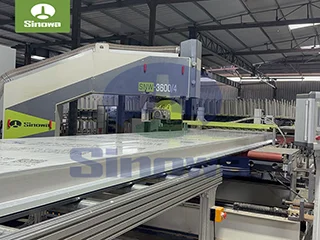
The core functional link of the entire production line lies in the automatic mixing and high-pressure foaming injection system of PU raw materials, which directly determines the cell structure density, thermal conductivity stability and overall bonding strength of the PU foam core layer of the pipeline insulation sandwich panel. The production line adopts a precise two-component raw material proportional conveying and mixing structure, which can accurately control the mixing ratio of the two core raw materials of polyurethane according to the performance requirements of different pipeline insulation working conditions. After the two raw materials are fully and evenly mixed through the high-pressure mixing device inside the equipment, they are evenly sprayed between the upper and lower surface layers that are continuously conveyed forward at a constant speed. The mixed PU raw material will undergo rapid chemical reaction in a short time, generate uniform and fine closed-cell foam inside, and gradually expand and fill the entire gap between the upper and lower surface layers. In this process, the production line is equipped with an intelligent temperature control and pressure maintaining system for the foaming area, which can stably maintain the optimal reaction temperature and composite pressure required for PU foaming and curing. Reasonable temperature control ensures that the chemical reaction of PU raw materials is sufficient and stable, the formed foam cells are uniform and dense without local hollowing or insufficient foaming, and the thermal insulation performance of the core layer is always kept in an optimal stable state. Stable pressure maintaining treatment can make the PU foam core layer closely bonded with the upper and lower surface layers as a whole, forming an integrated composite structure without delamination and peeling, effectively enhancing the overall structural strength and durability of the sandwich panel.
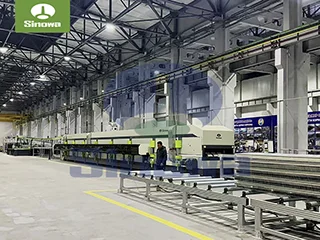
After the completion of foaming and preliminary composite bonding, the semi-finished PU sandwich panel will enter the constant temperature curing and shaping area of the production line for continuous curing treatment. The curing link is an indispensable key process for the pipeline insulation sandwich panel, which aims to fully stabilize the chemical structure of the PU foam core layer, further enhance the bonding fastness between the core layer and the surface layers, and eliminate the internal stress generated in the foaming and composite process. The curing area of the professional production line adopts a segmented constant temperature setting mode, which gradually completes the natural curing and structural shaping of the sandwich panel along the continuous conveying direction. Compared with the natural curing mode after traditional discontinuous production, the continuous constant temperature curing process can make the internal structure of each sandwich panel fully cured evenly, avoid the problems of incomplete local curing, inconsistent hardness and unstable bonding strength, and ensure that the finished pipeline insulation sandwich panel will not undergo structural deformation, performance attenuation or delamination damage during subsequent transportation, installation and long-term outdoor or buried use. After sufficient curing and shaping, the sandwich panel has stable overall size, uniform internal density and reliable comprehensive mechanical properties, and can adapt to various complex pipeline laying and installation environments.
Subsequently, the cured and shaped continuous sandwich panel will be sent to the automatic fixed-length cutting and trimming link of the production line. In view of the diversified size requirements of pipeline insulation projects for sandwich panels of different pipe diameters and different insulation thicknesses, the production line supports flexible and adjustable fixed-length cutting settings, which can automatically complete precise cutting according to the customized size parameters set in advance. The cutting equipment is equipped with a high-precision cutting and edge trimming integrated device, which can ensure that the cutting section of the sandwich panel is flat and smooth without burrs, cracks and edge collapse defects. The neat cutting edge not only facilitates the on-site assembly and docking construction of pipeline insulation panels, ensures the tightness of the overall insulation structure after installation, avoids heat loss caused by gaps at the docking positions, but also prevents the edge of the panel from being damaged and aged in advance due to rough cutting during long-term use. After cutting and trimming, the finished PU sandwich panels are automatically conveyed to the stacking area of the production line, realizing orderly automatic stacking and arrangement, which is convenient for subsequent packaging, transportation and factory outbound delivery, and greatly improving the overall production and delivery efficiency.
The structural performance advantages of PU sandwich panels produced by this professional production line are highly matched with the core needs of pipeline insulation engineering. The dense closed-cell foam structure formed by high-pressure uniform foaming inside the panel has extremely low thermal conductivity, which can effectively isolate the heat transfer between the pipeline medium and the external environment, significantly reduce the heat loss of hot water and steam transportation pipelines, and avoid the cold loss attenuation of refrigeration and low-temperature medium conveying pipelines. This excellent thermal insulation performance fundamentally improves the energy utilization efficiency of the entire pipeline transportation system, reduces the long-term energy consumption loss caused by heat and cold dissipation, and brings stable energy-saving benefits for the daily operation of industrial production and municipal supporting projects. At the same time, the high closed-cell rate structure of the PU foam core layer makes the sandwich panel have extremely low water absorption, which can effectively resist the penetration of external rainwater, soil moisture and humid air. For directly buried pipelines laid underground and outdoor pipelines exposed to long-term wind and rain, this excellent waterproof and moisture-proof performance can prevent the insulation layer from absorbing water and damp failure, avoid the problem of sharp decline in thermal insulation performance caused by moisture absorption, and also protect the main pipeline and internal metal structures from corrosion and rust caused by humid environment, effectively extending the overall service life of the pipeline system.
In terms of mechanical protection and environmental adaptation, the composite structure formed by the surface protection layer and the PU foam core layer of the pipeline insulation sandwich panel has good compressive resistance, impact resistance and weather aging resistance. During the pipeline buried construction and later long-term operation, the sandwich panel can bear the external soil pressure and slight mechanical extrusion without structural deformation and damage, maintaining the stability of the overall insulation structure for a long time. In different regional environments with large temperature differences between winter and summer, high temperature in summer and low temperature in winter, the sandwich panel will not undergo structural cracking, performance aging and thermal and cold shrinkage deformation, and can maintain stable thermal insulation and protective performance throughout the year. Whether it is used for long-distance municipal central heating pipeline networks, high-load industrial chemical fluid transportation pipelines, low-temperature refrigeration cold chain supporting pipelines or factory internal pipe rack laying pipelines, the PU sandwich panels produced by the special production line can meet the adaptive insulation and protection needs of different scenarios, with strong engineering applicability and scene compatibility.
From the perspective of engineering construction and later maintenance, the standardized and unified pipeline insulation sandwich panels produced by the continuous PU sandwich panel production line have consistent size specifications and stable performance indicators, which is convenient for rapid on-site assembly and construction, greatly shortening the construction cycle of pipeline insulation projects and reducing the complex operation links and labor costs in the construction process. The integrated composite structure of the sandwich panel does not need additional complex auxiliary protective treatment after installation, and the later daily maintenance and upkeep work is simple and convenient without frequent inspection and replacement. Compared with the traditional on-site foaming thermal insulation construction mode and other single thermal insulation material laying modes, the prefabricated sandwich panel produced by the professional production line has more stable overall quality, better construction convenience and lower long-term comprehensive maintenance cost, which has become an important optimization direction for the upgrading and iteration of modern pipeline insulation engineering supporting materials.
With the continuous advancement of industrial energy conservation and emission reduction goals and the continuous expansion of the scale of municipal pipeline infrastructure construction, the market demand for high-performance and long-life pipeline insulation supporting materials is constantly upgrading, and the requirements for the production quality and performance stability of PU sandwich panels for pipeline insulation are also becoming increasingly strict. The professional PU sandwich panel production line for pipeline insulation, relying on its optimized continuous production process, precise intelligent control system and targeted structural design, can always produce high-quality insulation sandwich panels that meet the actual working conditions and engineering needs. In the future, with the continuous innovation and upgrading of production line technology and the continuous optimization of material formula matching, such professional production equipment will further improve the production efficiency and product performance customization level, provide more high-quality and reliable thermal insulation material support for more pipeline engineering projects, and make a continuous and important contribution to improving the energy utilization efficiency of the pipeline transportation industry, reducing operation and maintenance costs, and promoting the stable and long-term operation of infrastructure projects.
https://www.cnsinowa.com/sandwich-panel-machines/pu-sandwich-panel-line-for-pipeline-insulation.html