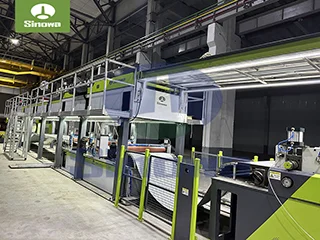
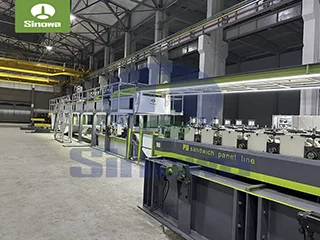
sandwich panel line
To understand the critical role of this production line, it is first essential to outline the distinct properties that make PU sandwich panels ideal for geothermal insulation. Polyurethane foam, the core material of these panels, boasts an extremely low thermal conductivity rate, far superior to traditional insulation materials such as fiberglass, mineral wool, or expanded polystyrene. This low thermal conductivity ensures that heat transferred from geothermal heat pumps or underground heat exchangers is retained within the targeted system, rather than dissipating into the surrounding ground or building foundations, directly boosting the overall energy efficiency of the geothermal setup. The sandwich structure, which consists of a rigid PU foam core bonded firmly between two outer facing layers, adds exceptional structural stability to the panels, allowing them to withstand the compressive stress of underground installation, soil movement, and minor physical impact without warping, cracking, or losing insulation performance. Unlike loose-fill or flexible insulation materials, PU sandwich panels maintain their shape and thermal properties over decades of use, making them a long-term, cost-effective solution for geothermal projects that require minimal maintenance and replacement. Additionally, the closed-cell structure of the PU foam core created by the production line resists water absorption and moisture penetration, a vital feature for geothermal applications where underground moisture can compromise insulation efficiency and lead to material degradation over time. The production line is designed to enhance these inherent material advantages, refining each manufacturing stage to eliminate weak points, ensure uniform material distribution, and create a fully bonded, seamless panel that performs consistently in demanding geothermal environments.
The continuous PU sandwich panel production line for geothermal insulation operates as a fully integrated, streamlined system, with each sequential stage optimized to uphold precision and quality without disrupting production flow. The process begins with the preparation and feeding of the outer facing materials, which are selected for their compatibility with the PU core and resistance to underground environmental stressors. Common facing materials include rigid metal sheets, fiber cement boards, and high-density polymer sheets, each chosen for their durability, bonding capabilities, and ability to protect the foam core from external damage. Before entering the core production line, these facing materials undergo a thorough pre-treatment process to remove surface contaminants, dust, and oils that could interfere with the adhesive bond between the core and the facings. This pre-treatment step is critical for geothermal panels, as a weak bond can lead to delamination over time, especially when exposed to fluctuating temperatures and moisture underground. Automated feeding mechanisms guide the pre-treated facings into the production line at a controlled, consistent speed, ensuring alignment and preventing misalignment that could result in uneven panel thickness or flawed core distribution.
Following the facing preparation stage, the line moves into the precise mixing and dispensing of the PU foam components, the most technically demanding stage of the entire process. The PU foam is formed by combining two primary reactive chemical components—polyol and isocyanate—along with carefully measured additives that enhance foam density, thermal resistance, flame resistance, and structural rigidity. These additives are adjusted specifically for geothermal applications to boost moisture resistance and long-term thermal stability, ensuring the foam retains its properties even after years of exposure to underground conditions. The production line utilizes a high-pressure, closed mixing system to blend these components with extreme accuracy, maintaining consistent ratios to avoid variations in foam density or incomplete foaming. Unlike manual or semi-automated mixing methods, this automated system eliminates human error and ensures that every batch of foam has uniform properties across the entire length of the panel. The mixed foam is then dispensed evenly onto the lower facing material in a controlled flow, spreading smoothly to fill the entire space between the upper and lower facings without gaps, air pockets, or uneven thickness. The speed of foam dispensing is synchronized perfectly with the line’s conveyor speed, a critical calibration that prevents foam overflow or insufficient coverage, both of which would compromise the panel’s insulation and structural performance for geothermal use.
Immediately after foam dispensing, the panel enters the pressing and curing phase, where the upper facing material is lowered onto the foam layer, and the entire sandwich assembly is passed through a series of precision pressure rollers. These rollers apply uniform, consistent pressure across the entire surface of the panel, compressing the foam to the exact thickness required for geothermal insulation specifications and forcing the foam to bond tightly with both facing materials. The pressure is carefully calibrated to avoid over-compression, which would reduce the foam’s thermal insulation capacity, and under-compression, which would leave air gaps and weaken structural integrity. Parallel to the pressing process, controlled heating is applied to accelerate the chemical curing reaction of the PU foam, transforming the liquid mixture into a rigid, closed-cell solid core. The production line maintains a stable temperature profile throughout the curing zone, adjusting heat levels based on the panel thickness and foam formulation to ensure complete curing without overheating, which could damage the facing materials or alter the foam’s molecular structure. This controlled curing process is essential for geothermal panels, as it locks in the foam’s low thermal conductivity, creates a fully closed-cell structure, and strengthens the bond between the core and facings to resist delamination under long-term underground stress.
Once the initial curing is complete, the semi-finished panels move through a controlled cooling zone to stabilize the material structure and reduce residual heat, preventing warping or shrinkage as the panels reach room temperature. This cooling stage is gradual and uniform, avoiding rapid temperature changes that could cause internal stress within the panel. After cooling, the panels are transported to an automated cutting and trimming station, where they are cut to precise lengths and widths based on geothermal project specifications. The cutting system uses high-precision blades to ensure clean, straight edges without fraying or damaging the facing materials, and the panels are trimmed to exact dimensions to fit seamlessly into geothermal insulation layouts, whether for underground heat exchanger enclosures, foundation insulation, or ground-source heat pump housing. Some geothermal applications require panels with interlocking edges to create a continuous, gap-free insulation barrier, and the production line can be adjusted to form these specialized edge profiles during the cutting and shaping stage, eliminating the need for secondary on-site modifications and improving installation efficiency.
Beyond the core manufacturing stages, the PU sandwich panel production line for geothermal insulation incorporates built-in quality monitoring mechanisms to ensure every panel meets the strict performance standards required for geothermal use. These monitoring systems track key parameters in real time, including foam density, panel thickness, curing temperature, line speed, and bonding strength, with automated sensors that detect any deviations from preset specifications. If a variation is detected, the system can make immediate adjustments to the production process to correct the issue, minimizing waste and ensuring consistent quality across all output. Unlike general-purpose production lines, this specialized system prioritizes consistency over high volume alone, as even minor flaws in foam density or bonding can significantly reduce the effectiveness of geothermal insulation over time. The line also operates with a high degree of automation, reducing manual intervention and lowering the risk of human error, while allowing for flexible adjustments to accommodate different panel thicknesses, facing materials, and foam formulations tailored to specific geothermal project requirements, from small-scale residential geothermal systems to large-scale commercial and industrial underground heating installations.
One of the most significant advantages of using a dedicated geothermal-focused PU sandwich panel production line is the alignment of material performance with the unique challenges of underground geothermal environments. Standard insulation panels are often designed for above-ground use, where moisture exposure and compressive stress are minimal, making them unsuitable for long-term underground installation. In contrast, panels produced on this specialized line feature a fully sealed, moisture-resistant core, strong facing-core bonding, and high compressive strength, all engineered to withstand the unique stressors of geothermal applications. The closed-cell PU foam core produced by the line has negligible water absorption rates, preventing moisture from seeping into the panel and reducing thermal conductivity, a common issue with inferior insulation materials in underground settings. Additionally, the rigid sandwich structure provides excellent load-bearing capacity, allowing the panels to support the weight of backfilled soil, concrete slabs, or light structural loads without compressing the foam core or losing insulation efficiency. This combination of thermal performance and structural durability ensures that the panels maintain their insulating properties for the entire operational life of the geothermal system, delivering consistent energy savings and reducing the need for frequent replacements or repairs.
The production line also aligns with global sustainability goals, a key consideration for geothermal energy projects that prioritize environmental responsibility. The PU foam formulation used in the line is designed to minimize environmental impact, with low-emission chemical components and foaming agents that reduce volatile organic compound (VOC) release during production and installation. The automated, closed mixing system prevents chemical waste and excess material runoff, making the production process more eco-friendly compared to open, manual manufacturing methods. Additionally, the energy efficiency of the production line itself is optimized, with controlled heating and cooling systems that minimize energy consumption during the curing and processing stages, reducing the carbon footprint of panel manufacturing. Because the panels produced are highly efficient at retaining geothermal heat, they directly contribute to lower energy consumption for heating systems, reducing reliance on fossil fuels and lowering overall greenhouse gas emissions over the life of the geothermal installation. This circular sustainability benefit—from low-waste production to long-term energy savings—makes the specialized PU sandwich panel production line a vital component of the broader geothermal energy ecosystem.
In terms of operational efficiency, the continuous production design of the line allows for consistent, large-scale output of geothermal-grade panels without sacrificing quality, meeting the demand for reliable insulation materials in the growing geothermal energy sector. The streamlined workflow reduces production time per panel compared to discontinuous or semi-automated manufacturing methods, while the automated quality control systems minimize material waste and rework, optimizing overall production yield. The line is also designed for versatility, capable of producing panels of varying thicknesses, sizes, and facing types to suit different geothermal applications, from shallow ground source heat pumps to deep underground geothermal distribution systems. This adaptability makes it a valuable asset for manufacturers serving the geothermal industry, as it allows them to respond quickly to evolving project requirements and market demands without investing in multiple specialized production setups.
Looking ahead, the role of the PU sandwich panel production line for geothermal insulation will only grow more critical as global investment in renewable heating systems continues to rise. Governments and private sectors worldwide are increasingly prioritizing geothermal energy as part of their carbon neutrality targets, driving demand for high-performance, durable insulation materials that can maximize the efficiency of these systems. The specialized production line will continue to evolve alongside advancements in PU foam technology and manufacturing automation, with ongoing refinements to foam formulations, curing processes, and quality monitoring to enhance panel performance further. Future iterations of the line may incorporate even more precise sensor technology, artificial intelligence-driven process adjustments, and more sustainable material inputs, further boosting the sustainability and performance of geothermal insulation panels.
In conclusion, the dedicated PU sandwich panel production line for geothermal insulation is a cornerstone of the modern geothermal energy industry, combining advanced manufacturing technology, material science, and engineering precision to produce insulation panels that meet the unique and rigorous demands of underground heating systems. By controlling every stage of the production process—from facing preparation and foam mixing to curing, cutting, and quality assurance—the line ensures that each panel delivers exceptional thermal resistance, structural stability, moisture resistance, and long-term durability. These panels not only maximize the energy efficiency of geothermal heating systems but also support the broader transition to renewable, low-carbon energy by reducing heat loss and minimizing environmental impact throughout the product life cycle. As the world continues to shift toward sustainable heating solutions, the importance of this specialized production line will remain undeniable, providing the essential insulation materials that make geothermal energy a viable, efficient, and reliable choice for residential, commercial, and industrial heating applications worldwide. The seamless integration of automation, precision, and material expertise in this production line highlights the critical link between advanced manufacturing and renewable energy progress, proving that high-quality industrial production is a key driver of global sustainability goals.
https://www.cnsinowa.com/sandwich-panel-machines/pu-sandwich-panel-production-line-for-geothermal-insulation.html