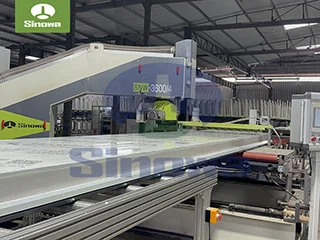
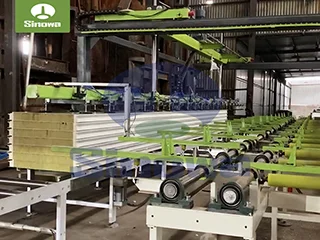
sandwich panel line
The structural composition of a full rockwool board production line is divided into several key interconnected modules, each working in seamless sequence to convert raw ore into finished boards. The first module is the raw material handling and feeding system, which is responsible for sorting, crushing, and conveying selected natural rocks such as basalt, dolomite and other silicate minerals into the melting unit. This module includes vibrating screens, jaw crushers, belt conveyors and storage silos, designed to process raw materials into uniformly sized particles that melt evenly at high temperatures, preventing uneven melting that could weaken fiber formation. Next is the high-temperature melting furnace, the heart of the production line, which heats the crushed mineral particles to temperatures exceeding 1400 degrees Celsius, turning solid rock into a smooth, viscous liquid melt. This furnace is built with heavy-duty refractory lining to withstand extreme heat and maintain stable temperature control, as consistent melting is vital for producing uniform, high-strength rockwool fibers. Following melting, the liquid mineral melt is directed to the fiber forming unit, where centrifugal spinning technology is used to pull the molten rock into fine, elongated inorganic fibers; this unit uses high-speed rotating centrifugal wheels to stretch the melt into micro-scale fibers, creating a lightweight, porous fiber mat that forms the base of all rockwool products.
After fiber formation, the production line moves to the binder application and fiber laying module, where a small amount of thermosetting organic binder is evenly sprayed onto the loose mineral fibers to hold them together, without altering the non-combustible nature of the mineral core. This module uses precision spraying nozzles and air-laying systems to distribute fibers uniformly across a moving conveyor belt, forming a thick, fluffy fiber blanket with consistent density across its entire width and length. The fiber blanket then enters the curing and pressing unit, a critical structural component that shapes the loose blanket into a rigid board; this unit features a double-belt conveyor system with adjustable pressure and temperature controls, which compresses the fiber blanket to the desired thickness and cures the binder through controlled heating, locking the fibers into a stable, rigid structure. The curing oven within this unit is designed with multi-stage temperature zones to ensure thorough curing without overheating, which preserves the porous internal structure of the board that delivers key performance traits. Following curing, the semi-finished board moves to the cutting and finishing module, equipped with precision saws, edge trimmers and surface treatment tools to cut the continuous board into standard or custom dimensions, smooth rough edges, and adjust surface texture as needed. The final module is the cooling, stacking and packaging system, which cools the finished boards to room temperature, stacks them neatly for storage and prepares them for transport, completing the fully automated production cycle from raw ore to finished product. Each module is linked by automated conveyors and controlled by a centralized operating system that synchronizes speed, temperature and pressure across the entire line, ensuring continuous production and consistent product quality without manual intervention at every stage.
The performance of rockwool boards produced by a full set production line is defined by a unique combination of physical, thermal, acoustic and mechanical properties, all derived from the inorganic mineral fiber structure and the precise manufacturing process. One of the most prominent performance features is exceptional thermal insulation capability, rooted in the porous, air-trapped internal structure of the rockwool fibers; the fine, intertwined fibers create countless tiny air pockets within the board, which significantly slow down heat transfer through conduction, convection and radiation. This low thermal conductivity makes the boards highly effective at reducing heat gain in warm climates and heat loss in cold regions, making them a top choice for energy-efficient building design and industrial thermal management. Unlike organic insulation materials that degrade or lose insulation performance over time, rockwool boards maintain stable thermal properties for decades, as the inorganic mineral fibers are resistant to aging, moisture damage and structural breakdown. Another core performance trait is non-combustibility and high-temperature resistance; as a pure mineral-based material, rockwool boards do not ignite, support flame spread or release toxic fumes when exposed to extreme heat or open flames, and they can withstand sustained high temperatures without melting, warping or losing structural integrity. This fire-resistant performance is unmatched by many organic insulation materials, making rockwool boards a critical safety component in buildings, industrial facilities and high-temperature equipment.
Additional key performance attributes include excellent sound absorption and noise reduction, stemming from the porous fiber structure that traps and dissipates sound waves across a wide range of frequencies, rather than reflecting or transmitting noise. This makes the boards ideal for reducing airborne and impact noise in both building and industrial settings. Rockwool boards also exhibit strong mechanical stability, including good compressive strength, flexural resistance and dimensional stability, meaning they can withstand minor physical stress, installation pressure and environmental changes such as temperature fluctuations and humidity shifts without cracking, shrinking or expanding. They are also highly resistant to moisture absorption, with a water-repellent surface and internal structure that prevents water penetration, avoiding mold growth, rot or corrosion that commonly affects organic or porous organic materials. Furthermore, rockwool boards are chemically inert, meaning they do not react with other building materials, metals or chemicals, making them compatible with a wide range of construction and industrial applications without causing degradation or contamination. These combined performance properties make rockwool boards a versatile, long-lasting material that outperforms many alternative insulation products in demanding environments, and the full set production line ensures these properties are consistently replicated in every board produced, with minimal variation between batches.
Rockwool boards manufactured by a complete production line are available in a range of varieties, differentiated primarily by density, thickness, surface treatment and structural design, each tailored to specific performance requirements and application scenarios, with no single standard product suitable for all uses. The most common classification is based on density, which directly impacts compressive strength, thermal insulation and sound absorption; low-density rockwool boards, typically ranging from 60 to 120 kilograms per cubic meter, are lightweight and flexible, with superior sound absorption properties and moderate thermal insulation, making them ideal for acoustic applications and non-load-bearing insulation. Medium-density boards, ranging from 120 to 180 kilograms per cubic meter, strike a balance between thermal performance, mechanical strength and sound absorption, serving as the most widely used general-purpose option for standard building insulation and industrial thermal management. High-density boards, with densities exceeding 180 kilograms per cubic meter, offer maximum compressive strength, rigid structural integrity and enhanced thermal resistance, designed for load-bearing applications, high-temperature industrial environments and heavy-duty insulation where durability and structural support are critical.
Varieties are also distinguished by thickness, which ranges from 20 millimeters for thin, lightweight insulation to over 200 millimeters for heavy-duty, high-performance thermal and acoustic barriers; thicker boards provide superior thermal insulation and noise reduction, while thinner boards are suitable for space-constrained applications where minimal thickness is required. Surface treatment further divides the product range: standard unfinished boards have a porous, fibrous surface ideal for direct installation in concealed spaces, while faced boards feature a smooth, protective surface layer that enhances durability, moisture resistance and ease of installation, suitable for exposed applications or areas with higher humidity. Some varieties are designed with special edge profiles, such as interlocking or grooved edges, to ensure tight, seamless fitting during installation, eliminating gaps that compromise thermal and acoustic performance. Additionally, specialized varieties are produced for specific industrial uses, including water-repellent enhanced boards for humid environments, high-temperature resistant boards for extreme heat conditions, and flexible semi-rigid boards for curved surfaces or irregular structures. The full set production line is engineered to adapt to these different varieties by adjusting parameters such as fiber laying density, pressing pressure, curing temperature and cutting dimensions, allowing manufacturers to switch between product types efficiently to meet diverse market demands without reconfiguring the entire production system.
The applications of rockwool boards from a full production line span the construction, industrial, marine and infrastructure sectors, driven by their unique combination of thermal insulation, fire resistance, sound absorption and mechanical durability. In the construction industry, they are the most widely used for building envelope insulation, including external wall insulation, roof insulation, floor insulation and partition wall insulation, helping residential, commercial and public buildings meet energy efficiency standards, reduce heating and cooling energy consumption, and maintain comfortable indoor temperatures year-round. In high-rise buildings, public venues such as schools, hospitals and shopping malls, and industrial buildings, the fire-resistant properties of rockwool boards provide critical passive fire protection, preventing the spread of flames and smoke and enhancing overall building safety. For acoustic control, the boards are used in theaters, concert halls, recording studios, office buildings and residential spaces to reduce noise transmission, improve sound quality and create quiet indoor environments, addressing both external environmental noise and internal sound transfer between rooms.
In industrial applications, rockwool boards serve as essential thermal insulation for high-temperature equipment, pipelines, furnaces, boilers and storage tanks, preventing heat loss, stabilizing operating temperatures and protecting workers from extreme heat exposure. They are also used in industrial noise control, insulating machinery, generators, HVAC systems and production lines to reduce workplace noise pollution and comply with occupational health and safety standards. The non-combustible and chemically inert properties make them suitable for use in industrial facilities with strict safety and hygiene requirements, such as food processing plants, pharmaceutical facilities and chemical plants, where they do not support microbial growth or contaminate production materials. In marine and offshore applications, high-density rockwool boards provide insulation and fire protection for ship compartments, offshore platforms and marine equipment, withstanding the harsh, humid and corrosive marine environment while meeting strict safety standards for maritime operations. For infrastructure projects, including tunnels, bridges, transportation hubs and utility facilities, rockwool boards offer long-lasting insulation, fire protection and sound reduction, withstanding outdoor weather conditions, temperature fluctuations and physical wear for extended service life.
Beyond these core applications, rockwool boards are also used in specialized fields such as cold storage and refrigeration facilities, where consistent thermal insulation is critical to maintaining low temperatures and reducing energy consumption for refrigeration systems, and in renewable energy infrastructure, insulating solar energy systems, wind turbine components and energy storage facilities to optimize performance and protect equipment from temperature extremes. The versatility of rockwool boards is further enhanced by their compatibility with other building materials, allowing them to be integrated into various construction systems such as curtain walls, suspended ceilings, sandwich panels and prefabricated building components. The full set production line plays a pivotal role in meeting the growing global demand for high-quality, sustainable insulation materials, as it enables large-scale, efficient production of consistent, high-performance rockwool boards that support energy conservation, fire safety and sustainable development across multiple industries. Unlike manual or semi-automated production methods, the complete line ensures that every product meets strict performance and dimensional standards, making rockwool boards a reliable choice for engineers, architects, contractors and industrial operators worldwide. As demand for energy-efficient and fire-safe building and industrial materials continues to rise, the full set rockwool board production line remains an indispensable asset, bridging raw mineral resources with practical, high-performance end products that address critical modern construction and industrial needs.
https://www.cnsinowa.com/sandwich-panel-machines/full-set-rockwool-board-production-line.html