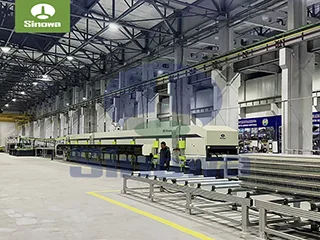
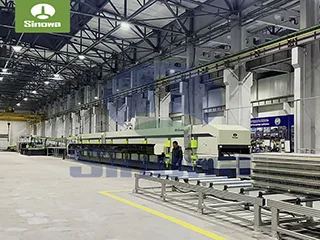
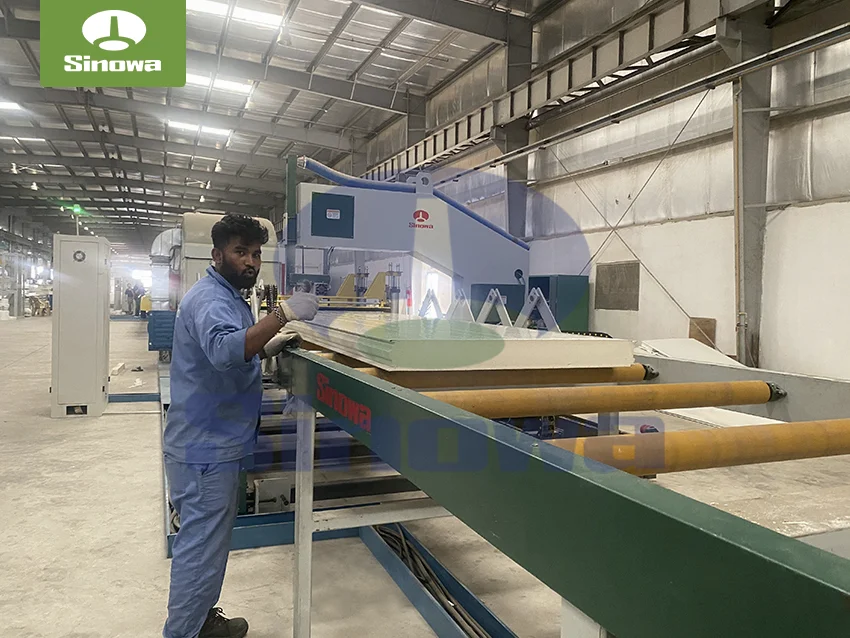
 sandwich panel line
The operational logic of the metal-faced PU sandwich panel production line centers on the perfect combination of metal surface forming and polyurethane foam core molding, two core links that determine the overall performance of finished panels. The entire production workflow starts with the feeding and preprocessing of metal raw materials, which are usually high-quality metal coils with excellent ductility and surface uniformity. The coil materials are steadily unwound through a tension-controlled unwinding system, which effectively avoids sheet deformation, wrinkling, and uneven feeding caused by excessive tension or loose conveying. During this stage, auxiliary flattening devices eliminate internal stress on the metal sheet surface, correcting subtle bending and warping generated during coil storage and transportation to lay a foundation for the flatness and dimensional accuracy of subsequent finished panels. The preprocessed metal sheets are then continuously fed into the roll forming system, where multi-group precision roller sets perform gradual cold bending and profiling according to preset structural parameters. The progressive forming process ensures uniform stress distribution on the metal surface, avoiding structural damage or local hardness reduction caused by one-time stamping, and can realize diverse profile shaping to meet the structural assembly requirements of different building scenarios.
While the metal facing materials undergo profiling and conveying, the polyurethane raw material preparation and mixing system operates synchronously to complete the pretreatment of foam core materials. Polyurethane foam is formed by the chemical reaction of two core liquid components, and the production line is equipped with independent sealed storage and temperature regulation units for these raw materials. Constant temperature control is critical in this link, as it stabilizes the chemical activity of the raw materials, ensures consistent reaction speed and foaming efficiency, and prevents quality fluctuations such as uneven foam density, insufficient expansion, or excessive bubble pores caused by temperature deviation. Precision metering pumps accurately control the proportion of the two liquid components, maintaining a fixed matching ratio throughout the production process to guarantee the physical properties of the cured foam core. After precise metering, the raw materials are transported to the high-pressure dynamic mixing chamber, where powerful mechanical stirring achieves uniform blending of the two components, triggering an initial chemical reaction and forming a homogeneous liquid foam mixture with stable fluidity.
The evenly mixed polyurethane liquid foam is continuously and evenly sprayed between the upper and lower pre-formed metal facing sheets through a reciprocating sweeping nozzle system. The intelligent spraying mechanism adjusts the spraying speed, flow rate, and sweeping range in real time according to the production line conveying speed and panel width, ensuring that the foam liquid completely fills the gap between the metal layers without excess accumulation or local vacancy. This uniform pouring method is the key to avoiding hollow layers, insufficient bonding, and inconsistent core thickness in finished panels. Immediately after foam pouring, the composite structure composed of upper metal sheet, polyurethane foam liquid, and lower metal sheet enters the laminating and curing integrated system. The closed laminating conveyor maintains stable pressure and constant temperature environment, providing optimal conditions for the foam expansion, reaction, and solidification process. In the confined space between the upper and lower conveyor plates, the polyurethane foam undergoes full expansion, fills the entire composite cavity, and forms a tight physical bond with the inner surface of the metal sheets through chemical adhesion during the curing process.
The curing stage is a decisive process for the structural stability and performance durability of metal-faced PU sandwich panels. The polyurethane sandwich panel production line adopts segmented temperature control technology in the curing area, setting gradient temperature zones according to the reaction characteristics of polyurethane materials. The front-end high-temperature zone accelerates the foaming and cross-linking reaction of the raw materials to ensure rapid shaping of the foam core, while the middle and rear-end constant temperature zones complete deep curing and stress relief, avoiding panel deformation, warping, or core layer cracking caused by excessive temperature difference and rapid cooling. The whole curing process is synchronized with the linear conveying speed of the production line, realizing uninterrupted continuous production and greatly improving production efficiency compared with traditional batch-type curing equipment. After full curing, the polyurethane foam core forms a microporous closed-cell structure, which endows the panel with excellent thermal insulation, sound insulation, and pressure resistance, while the tight bonding interface between the foam core and metal sheets ensures overall structural integrity, preventing delamination and peeling during long-term use.
Following the completion of curing and shaping, the continuous long-size composite panels enter the post-processing stage of the production line. The automatic tracking and cutting system conducts fixed-length cutting according to preset dimensional parameters, with high-precision servo control ensuring smooth and neat cutting sections without burrs, sheet deformation, or core layer fragmentation. The cutting mechanism adapts to different panel thicknesses and widths, realizing flexible switching of product specifications to meet customized production demands. After cutting, the finished panels are transported to the sorting and output platform through the conveyor system, where auxiliary trimming and surface inspection processes are completed. The integrated PU sandwich panel machine also realizes synchronous coordination of multiple processes, achieving simultaneous loading of raw materials, foaming curing of semi-finished products, and output of finished products in different working areas, which maximizes the utilization rate of production equipment and greatly improves continuous production capacity.
The core advantages of the metal-faced polyurethane sandwich panel line lie in its high integration, process stability, and product performance optimization capability. In terms of production stability, the full automated closed-loop control system realizes real-time monitoring and adjustment of key parameters such as feeding speed, raw material ratio, spraying volume, curing temperature, and laminating pressure. Once minor parameter deviations occur during operation, the system can complete automatic calibration in a short time, effectively avoiding batch quality defects. The mechanical structure of the production line is designed with high rigidity and stability, with precision-processed roller sets, conveying chains, and pressure-bearing components that maintain long-term operational accuracy and reduce equipment wear and failure rates during high-frequency continuous operation. This stable mechanical performance ensures the consistency of panel thickness, flatness, bonding strength, and foam density for a long production cycle.
In terms of product performance improvement, the process design of the polyurethane sandwich panel machine fully optimizes the composite structure of metal and polyurethane foam. The precise pressure control in the laminating process makes the bonding interface between metal and foam core more compact, significantly improving the overall mechanical strength of the panel, including bending resistance, compression resistance, and shear resistance. The closed-cell foam structure formed by precise foaming control effectively isolates heat conduction and sound transmission, enabling the finished panels to obtain excellent thermal insulation and noise reduction performance. Meanwhile, the metal surface after precise rolling and shaping has good weather resistance and surface texture, which can adapt to complex outdoor and indoor use environments, while the lightweight characteristics of the composite panel reduce the overall load of building structures and transportation costs.
The production line also has outstanding flexible production characteristics, which can adapt to the production of metal-faced sandwich panels with different thicknesses, widths, and surface profiles. By simply adjusting the equipment parameters and replacing a small number of forming accessories, the line can switch between multiple product specifications, covering the production needs of thin-wall lightweight panels for interior decoration and thick-wall high-strength panels for exterior wall insulation and industrial plant enclosure. This flexible adaptability enables production enterprises to quickly respond to market demand changes and enrich product categories without investing in multiple sets of production equipment, effectively reducing production and operation costs.
In terms of production efficiency and resource utilization, the continuous working mode of the PU sandwich panel line eliminates the standby and material waste problems of intermittent production equipment. The precise metering and spraying system controls the usage of polyurethane raw materials accurately, avoiding raw material waste caused by excessive spraying or repeated processing. The closed production environment also reduces the volatilization of chemical raw materials, improving production safety and environmental friendliness. The highly automated operation mode reduces manual participation links, lowers the labor intensity of operators, and avoids product quality fluctuations caused by human operation errors, realizing standardized and standardized large-scale production.
With the continuous upgrading of construction industry standards and the increasing demand for high-efficiency and energy-saving building materials, the technical advantages of automated metal-faced PU sandwich panel production machinery has become increasingly prominent. The panels produced by this line integrate lightweight, high strength, thermal insulation, sound insulation, fire resistance, and convenient installation, and are widely used in modern industrial workshops, logistics warehouses, cold storage insulation engineering, medical clean rooms, temporary modular buildings, and high-end civil building enclosure systems. The stable production process and excellent product quality of the production line provide reliable equipment support for the popularization and application of metal-faced polyurethane sandwich panels in the construction field.
In the future, with the continuous innovation of automation control technology and new material processing technology, the metal-faced PU sandwich panel production line will further develop towards higher intelligence, higher efficiency, and lower energy consumption. The optimized process flow and intelligent monitoring system will further improve the precision of product production and the stability of equipment operation, while the flexible production capacity will be further enhanced to meet the personalized and diversified customization needs of the market. As a key core equipment in the field of new building material production, the continuous PU sandwich panel line will continue to promote the upgrading of the lightweight building material industry and provide more high-quality and efficient material solutions for modern architectural construction.
https://www.cnsinowa.com/sandwich-panel-machines/pu-sandwich-panel-line-for-metal-faced-panels.html